
Monsoon's "Wright Back to the Obama Drama" News Analysis
In the last few days, yet another minor uproar has arisen stemming from comments made by an associate of Senator Barack Obama—this time a series of videos depicting Obama’s pastor, Rev. Jeremiah Wright of Chicago’s Trinity United Church of Christ, making incendiary statements about US foreign and domestic policies.
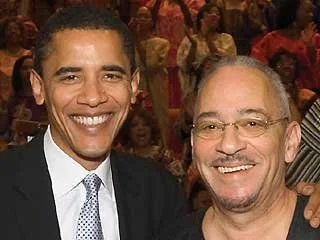
On the Huffington Post website, Obama posted a statement in which he categorically denounces and rejects the words of his long-time spiritual adviser, and the man who officiated at his wedding.
To his credit, though, Obama refused to “repudiate” Rev. Wright as a man in an interview with Keith Olbermann on MSNBC, insisting that it is possible to deeply respect a person and disagree with some of the things that person says or does. And though Obama’s opponent in the general election—or rather, 527 groups handling the dirty work for John McCain—will surely seize on the Reverend’s comments as evidence that Obama is insufficiently patriotic, at least maybe those rumors that he’s really a Muslim will be put to rest!
Obama clearly had to distance himself from Reverend Wright’s most inflammatory remarks, given that many of those whose votes he is courting will have knee-jerk responses to the remarks as deeply offensive and borderline treasonous. But I thought I’d take a closer look at Reverend Wright’s remarks in the three principal video clips that are currently circulating and try to consider just how unreasonable or off-base they are.
In the first clip, delivered several days after the September 11, 2001 attacks, Reverend Wright says: “We bombed Hiroshima, we bombed Nagasaki and we nuked far more than the thousands in New York and the Pentagon, and we never batted an eye. We have supported state terrorism against the Palestinians and black South Africans, and now we are indignant because the stuff we have done overseas is now brought right back to our own front yards. America’s chickens are coming home to roost.”
The concluding statement here echoes one made by Malcolm X at the end of his association with the Nation of Islam (in fact, this statement was one of the factors that brought about this break). After the assassination of President John F. Kennedy in November 1963, Malcolm X was asked by a reporter for his reaction to the event. It’s a case of “the chickens coming home to roost,” he replied, adding that “Being an old farm boy myself, chickens coming to roost never did make me sad, they’ve always made me glad.” Later that day, he clarified his statement by explaining that there has long been a climate of hate and brutality in the United States, particularly against Black people. The death of President Kennedy is a natural “result of that way of life and thinking.” The New York Times ran a screaming headline the next day citing his chickens comment, and Malcolm X was further marginalized and vilified by American society.
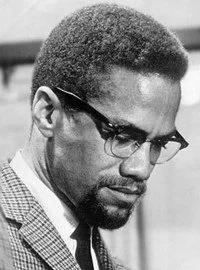
Two things were wrong with Malcolm’s comments, as far as most Americans were concerned: they suggested that the beloved President somehow deserved to be killed, and their timing right after his death bespoke an alleged insensitivity on Malcolm’s part. What folks missed here is that Malcolm did not seem to have been stating that President Kennedy deserved to die; he was arguing that a sense of karmic retribution had come to pass—that the oppression and abuse of minorities in this country had finally boomeranged to victimize one of the elites. Its timing was problematic, perhaps, but what more opportune time would there have been for Malcolm X to reach large numbers of people with his message—in this hope that they might begin questioning their own responses to President Kennedy’s assassination?
I think similar arguments hold up what scrutinizing Reverend Wright’s comments from September 16th, 2001. He cites the actions of this government in inflicting or supporting the infliction of pain and death upon untold millions around the world in the last 60 years or so, citing the Japanese atomic bombs and state support for the terrorism of foreign governments. (He might also have mentioned the My Lai massacre, the invasion of Grenada—or the US-backed military coup of Chile’s democratically elected president on September 11, 1973, which installed General Augusto Pinochet, who soon became known for his flagrant human rights abuse and widespread corruption.)
Surely it was not proper for the leaders of this country to think that they could perpetrate such wantonly violent, extreme, and usually unprovoked attacks on other peoples and not deliver the consequences to their own shores, to their own people? “Why do they hate us?” was the familiar refrain after the attacks. “They hate our freedoms,” was the pat answer. But more honestly, they hate our actions—not those of its individual citizens, necessarily, but the actions of the country in which we live and to whose allegiance we pledge each morning. I cannot imagine that he was suggesting the repugnant notion that those who died on September 11, 2001 deserved to die; but the question of whether America, by its actions, its dirty politics, its aggressive foreign policy, may have rightfully earned the animus of folks throughout the world—that’s another, more complicated, question, and one whose answer is too uncomfortable for many Americans to deal with.
As for the “timing” problem, I’ll return to my argument from above: What better time to challenge one’s flock than when they are still grappling with their own grief and indulging the a great national orgy of victimhood and outrage? Surely some minds were changed, some thinking was challenged, by this sermon—though I suspect that now, it is just dismissed out of hand as the anti-American rantings of a leftist preacher caught up in his own argument and the power of his pulpit. That’s unfortunate.
The second clip from a 2003 sermon deals with the reasons African Americans should be critical of their government: “The government gives them the drugs, builds bigger prisons, passes a three-strike law and then wants us to sing ‘God Bless America.’ No, no, no. God damn America, that’s in the Bible for killing innocent people. God damn America for treating our citizens as less than human. God damn America for as long as she acts like she is God and she is supreme.”
Whoa. First he’s referring to some of the more frequently cited reasons for the continued socioeconomic disadvantage of African Americans in relation to whites: the prison-industrial complex and the disparate incarceration of African Americans. Angela Davis has written eloquently on this subject, particularly in her book Are Prisons Obsolete?. In a controversial series in 1996 that appeared in the San Jose Mercury News, Gary Webb wrote extensively about an alleged link among the CIA, Nicaraguan Contras, and crack cocaine; the article implied, but did not establish, that the CIA was at least indirectly responsible for introducing crack cocaine into the inner cities in the early 1980s, devastating those neighborhoods.
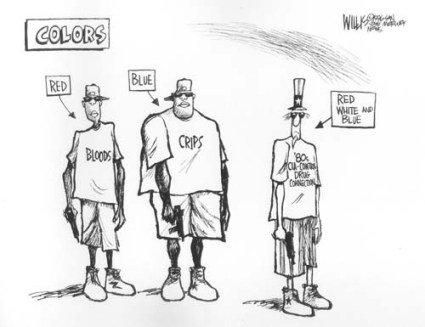
You all know I love a good conspiracy theory, and this is as plausible as any, as far as I’m concerned. (In fact, there’s a conspiracy theory within a conspiracy theory here: Gary Webb was found dead of an apparent suicide in his apartment in 2004, but the circumstances surrounding the “suicide” are very suspicious. Is’t possible that the US government not only orchestrated the sale of crack cocaine to the inner cities, but sought to cover it up years later by killing the journalist who exposed them? Yes.)
Though African Americans and Latinos make up only 25 percent of the US population, they constitute 63 percent of the prison population in this country. Much of this disparity is caused by the “three strikes” and other laws, as well as the “drug war.” Blacks are prosecuted much more aggressively for crack or rock cocaine than their white counterparts for power cocaine. So his complaints at the beginning of this statement are legitimate. (Find a nice summation of grievances about racial bias in the US corrections system here on the website of Human Rights Watch.
But Reverend Wright got himself into some rhetorical trouble when he began vitiating the sacred phrase “God bless America.” Politicians frequently end their speeches with “God bless you, and God bless America!” And of course after the September 11th attacks, the phrase became as ubiquitous on bumper stickers and t-shirts as “My child is an honor student at…” With all apologies to Irving Berlin, who wrote the song, and Lee Greenwood, who altered it slightly for his star-spangled jingo-fest “God Bless the USA,” I’ve always loathed this phrase. It sums up what people outside this country dislike so much about it—so we think God is on our side, apparently? God wants us to go bomb the living shit out of other people? As if God concerns herself with protecting the citizens of one country at the exclusion of citizens of all other countries.
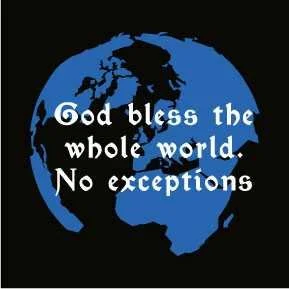
I’ve noted a couple of instances in recent popular culture that tried to tweak this saying: In the otherwise vapid and dreadful movie Head of State, Chris Rock’s ultra-conservative Republican opponent ends speeches by saying, “God bless America—and no one else!” Nothing could have better captured the xenophobic “we Merkins are special, and all you foreigners suck” attitude of the most knee-jerk and cravenly nationalistic among us. I’ve seen bumper stickers recently as well that read, “God bless the whole world, no exceptions.” It’s an inclusive message—one that emphasizes the fact that the bonds we all share as humans are (or should be) far stronger than the bonds we share because we live within the same geographical entity.
So while I agree with the content of his comments there, even I realize that you can’t go around saying “God damn America” and not expect to have your ass handed to you on a red-white-and-blue platter.
The third clip is more recent and specifically discusses the relative merits of a Hillary Clinton vs. a Barack Obama candidacy: “Barack knows what it means to be black man living in a country and a culture that is controlled by rich white people. Hillary can never know that. Hillary ain’t never been called a nigger.”
Now, aside from the fact that Reverend Wright was surely “preaching to the choir” in making these comments to his mostly-black congregation, I see no problem with the first sentence. The notion that this country is controlled by “rich white people”—is there anyone who doesn’t realize the essential truth of this statement? The second and third sentences give me pause, though. Surely it’s valuable to have someone with Obama’s experiences in the White House—someone who knows what it’s like to be discriminated against, someone who has a diverse background and experiences. But it seems as though Reverend Wright is suggesting that Barack Obama’s experiences of discrimination and bias have been more valuable than what Hillary Clinton has experienced because of her gender.
You all know that I do not like Hillary Clinton—and in fact, I doubt that I’d be able to bring myself to vote for her if she was the Democratic nominee—but she does not deserve the mean-spirited attacks she endured through much of the 90s from the right. (Remember the “vast, right-wing conspiracy” she talked about at the time? It’s real.) She doesn’t deserve to be referred to as disrespectfully as she was back in November by a (female!) McCain supporter who assumed Hillary would be the Democratic nominee and asked McCain at a campaign event, “How do we beat the bitch?” (McCain’s response, without missing a beat or expressing disappointment at her choice of words—he even seemed kind of amused—was, “That’s an excellent question. You might know that there was a poll yesterday, a Rasmussen poll, identified, that shows me three points ahead of Senator Clinton in a head-to-head matchup.” Classy guy.)
So…the verdict on Barack Obama’s pastor, Reverend Jeremiah Wright? Obviously Obama needs to distance himself from Wright’s statements for political reasons, and it would seem that Reverend Wright might begin to choose his own words more carefully. But I hope that when he wins the White House in November, Obama does not forget some of the most though-provoking questions his pastor raised in those controversial clips. By considering issues like America’s role in the world and bias in the US correctional system, Obama can evolve into the true leader this country—and world—so sorely needs.
Monsoon