
Monsoon's NYT letter; Boehringer's rave; weather update
My good blog-readers...
I am pleased to announce that your old pal Monsoon has written a letter to the editor of the New York Times, and it has been accepted for publication in the 13 March edition of the Sunday Magazine. You can check this link and scroll toward the bottom; my entry is headlined "Dislike Button."
My letter was edited for space due to the new format of the Letters page, so here (for you Monsoon completists out there) is the unexpurgated version:
Editor:
I have long enjoyed the Sunday Magazine as the must-read component your increasingly expensive publication. However, the February 27th issue was, for me, a barrage of bad news. I understand that Mr. Lindgren, the Magazine's new editor, felt he had to take steps to remake the glossy in his image, eliminating those columns or features he deemed outdated or redundant. When I read of Deborah Solomon's firing from the Magazine's interview segment, I felt it made sense to rid the magazine of her combative, repetitive, and sometimes misleading pieces.
But the tale that unfolded in the February 27th issue was one of wholesale attrition. First, I read that this column would be Randy Cohen's last as the Ethicist, later learning in an online article that he had already been replaced. Mr. Cohen's elegant, understated responses to ethical quandaries were the first words I read in each edition of the Magazine, and I am already wondering how Sundays will be the same without his work.
Next, I read that this would be the final column for Virginia Heffernan and "The Medium." As the internet becomes an ever more integral part of our lives--my wife and I often ask one another as we look up a recipe or bit of trivia, "What did we do before the internet?"--it would seem that such a column would be indispensible.
Finally, and perhaps most troubling for a high school English teacher and lover of language, was Ben Zimmer's announcement that this would be the final "On Language" column. Mr. Zimmer performed admirably in the unenviable task of replacing the late William Safire in writing this feature. In this time of rapid changes in the development of language--the redefinition of what is acceptable, the spectrum of global influences, and so on--makes a column like this essential.
Mr. Lindgren's apparent policy of taking a scythe to the Magazine in an effort to improve it and make it more relevant seems to me shortsighted and impetuous. It's a classic case of throwing out the baby with the bathwater, and neglects to consider the deeply held loyalties and preferences of your readership.
As you can see, the editors chopped my references to Hugo Lindgren, the Magazine's new editor, while tightening up some of my more longwinded tangents.
It's almost spring, and the March 11th opening of Boehringer's, Route 272 in Adamstown, is a most welcome sign of that season's approach.
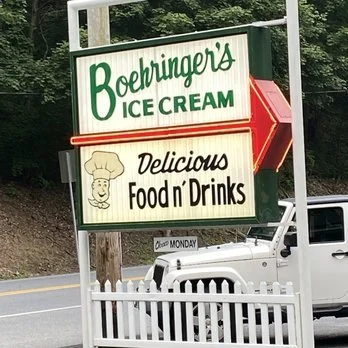
A note about the pronuncation of this throwback drive-in's name: we have been calling it "BOAR-in-jerz" (rhymes with "Four in Purrs") since have been frequenting the joint; most locals say "BERR-ing-ers" (rhymes with "Herr Ringers"); I have even heard it pronounced "BOW-ringers" (rhymes with "Foe Flingers") and "BAY-rin-jerz" (rhymes with "Day Fin Curs").
The German pharmaceutical company Boehringer Ingelheim provides some guidance here: the "oe" construction is an Anglification of the "ö" (o umlaut) in German. The "ö" is difficult for the typical English-speaking mouth to pronounce, but the proper pronunciation is something close to "BAY-rin-gers" (rhymes with Jay Fingers) or "BOH-ring-ers" (rhymes with "Foe Thing Burrs"). Given the tendency of most Pennsylvanians in this region (of German or Penna. Dutch descent) to swallow the "g" in their pronunciations, I'd say either the locals' version ("BERR-ingers") or the second German version ("BOH-ring-ers") is closest. Can anyone shed some light here? Is anyone still reading this?
Well whatever you call the joint, it's fantastic. Boehringer's is celebrating its 75th anniversary this year, and has just created a Facebook presence so you can "Like" them, keep up with goings-on, and generally rave about the place.
Mrs. Monsoon and I went there today for the first time this season. Saw some of my students there (two former, one current) and exchanged pleasantries while waiting for our order. Had my first cheesesteak there (plain, of course). I wasn't expecting Pudge's (the best cheesesteaks in the history of the world; they're in Blue Bell). But I had heard they were good, so I gave it a shot.
My good people, it was damn good. Far better than a cheesesteak from a roadside drive-in has any business being. The roll was good, the cheese was intermingled nicely with the chopped beef, and the overall feeling I departed with was one of pure gustatory pleasure. (Of course, the perfect fries and ice cream cone chaser didn't hurt, either.)
Etiquette is key at Boehringer's: order up at the counter, then step back to wait for your food. The holding open of doors is particularly helpful. Pay with cash only--credit cards and checks are not accepted. Some jackwagon trying to pay for his hot dog, fries, and vanilla milkshake with a platinum card can really gum up the works. Boehringer's is a well-oiled machine, Tucker. Get with the program.
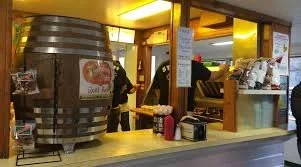
You can't really go wrong at Boehringer's--hot dogs, burgers, steaks, fries, and homemade ice cream. And milkshakes! Oh, the milkshakes. You have to find just the right green-shirted employee, but I have had a few chocolate-peanut butter milkshakes there that made me forget my name.
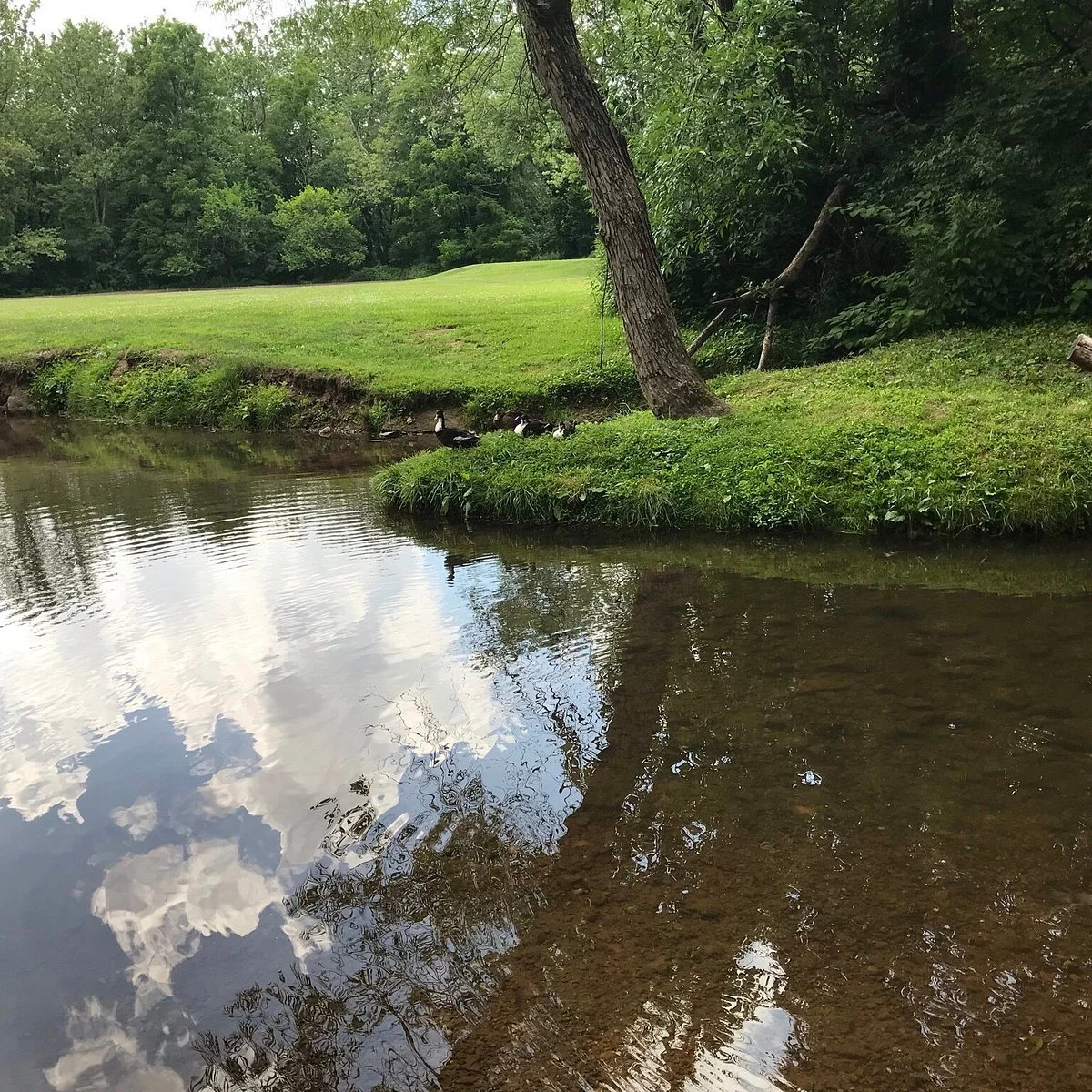
The ambiance is nice, too. Not inside the place--though there is a sort of controlled chaos that I find strangely calming. I'm talking about the creekside picnic tables where you can enjoy your food and watch the ducks pad about. It's like a little park: dogs, fowl, trees, rocks. It's usually quite comfortable and breezy there, even on a really hot and humid day. Sometimes the ants can be a little vexing and the bees a little threatening and the ducks a little aggressive, but what do you want? You're outside and it's lovely. Eat your butter brickle and stop your frickin' complaining.
It's open Tuesday through Sunday, 11am to about 9pm.
I'd love to hear your favorite Boehringer's memories, stories, foods, etc. Email me!
Now on to the weather...
Today was nice - a bit brisk, but plenty sunny. Sitting outside at Boehringer's got a little chilly as highs only reached into the mid 50s.
Sunday will be nice, but a little cooler: mostly sunny and rather windy with highs in the lower 50s (but this high will feel like the lower 40s due to the whipping winds). Low just below freezing Sunday night.
Monday will feature more clouds than sun and highs in the upper 40s. Just light breezes on this day. Overnight lows in the upper 20s.
Tuesday will begin with plenty of sunshine, but clouds will build in late. Expect milder southeasterly breezes to make the mid-50s high feel even a bit warmer.
Wednesday looks rainy and mild with temperatures in the mid 50s for much of the day. We'll see showers and drizzle rather than the soaking downpours of last week.
Thursday and Friday will be sunny and milder still--Thursday's high will be in the upper 50s, Friday's in the low 60s. Maybe an overnight shower Friday into Saturday, but nothing too bad.
Saturday and Sunday look nice: highs in the upper 50s to low 60s, lows in the mid to upper 30s.
Next week looks rainy and cooler. But it will officially be spring! So there's that...
Monsoon's "A Tall, Cool (Expensive) Drink of Water" Blind Taste-Test
In the past 10 to 15 years, bottled water has become as ubiquitous in our culture as cell phones, play dates, and Britney Spears. As George Carlin observed in an early-90s routine, “What happened in this country that now, suddenly, everyone is walking around with their own personal bottle of water? When did we get so thirsty in America? Is everybody so dehydrated they have to have their own portable supply of fluids with them at all times? Get a drink before you leave the house!” And yet, in more recent appearances, Carlin typically totes along a water bottle of his very own.
Much has been made of the fact that the human body (like our planet) is about two-thirds water, and we replenish up to 90% of our water each day. Undeniably, it is far more healthful to reach for water than for a cola or fruit drink to quench our thirsts. Given these factors, and the fact that convenience has been elevated to the status of a universal human right in our society, bottled water isn’t likely going anywhere anytime soon.
And though I try to be environmentally conscientious, I have taken a liking to a bottled water or two in my day. In the English planning room, we have a water cooler that uses Crystal Spring water in reusable jugs that are delivered biweekly. Encouragingly, the water in these jugs is bottled locally, cutting down on travel time and pollution.
It occurred to me, though, that this multibillion-dollar bottled water industry had sprung out of nothing in the past 20 years at most. It’s one of the rarest triumphs in free-market capitalism: creating a perceived need among consumers where none at all existed before. The question for most consumers is not “Will I purchase bottled water?” but “Which bottled water will I purchase?” Since one of my fondest pursuits in life is sticking it to The Man—or to thwart The Man in his efforts to stick it to me—I thought I’d conduct a blind taste test of various available waters and see if these bottled waters were all they claim to be. I have no illusions that I will be forever able to kick the bottled water habit, but maybe the results of my wildly unscientific study will give me (and, just possibly, you, dear reader) pause before grabbing for that next bottle of water.
I lined up six different water sources—some popular, some more obscure—and poured them in glasses so that I could not tell which water I was drinking. Then I forgot which water was in which glass, so I had to start over and label the glasses with a code, and I was on my way. The six contestants: Deer Park, Voss, Dasani, Iceland Spring, Fiji, and of course, good old municipal Adamstown tap water.
(I eschew flavored waters like Dasani with raspberry and kiwi and the like because if I want a freaking fruit juice I’m just going to get a freaking fruit juice, not some watery confection; vitaminwater, which is seen everywhere in my school—perhaps because there’s a machine selling it in the cafeteria—but has as much caloric and sugar content as a typical glass of fruit juice; and other permutations. I was only interested in water that claimed to be “pure” or unadulterated in some way. I am also aware that there are about 5,000 other brands of water out there, including Evian, Dannon, Aquafina, Pure Choice, and many more. Finally, I know there are products like the Brita filter that create purified water from tap water, but we used to have one of these and it was a pain in the arse. So I chose these as what I feel is a representative sample.)
Below are my findings…
VOSS artesian water from Norway, which sells at local Turkey Hill markets: $1.59 for a half-liter. (“Artesian” means simply that its source is an underground aquifier whose groundwater rises to the surface rather than having to be pumped out.) The label says it’s “naturally pure water, free of sodium, low in minerals, and incomparable in taste.” The sodium bit is an obvious swipe at the likes of Dasani, which adds sodium to its product (more on that later). It comes in an ingeniously designed bottle that looks like a hairspray canister with a red stripe and a gray top. One of the most outstanding design features is the bottle’s wide mouth, which seems to be about 50% bigger than standard bottles, allowing for bigger gulps and more comprehensive palate coverage.
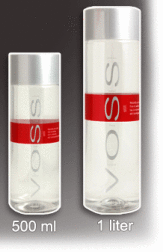
I found Voss, in the blind taste test, to be clean, crisp and totally refreshing. There is a very slightly bitter aftertaste—the purity of the water is too much, no doubt, for my coarse palate—that I find eminently pleasing. When I take a swig of Voss, I feel as though I am gliding contentedly down the glacial fjords of Norway’s northern coast.
There is an internet rumor that Voss (as has been suggested about other “pure” bottled waters) is actually just Norwegian tap water. This is an ugly and unfounded allegation, and I reject it. Ranking: 2nd of 6
ICELAND SPRING natural Icelandic spring water, which also sells at Turkey Hill, among other places: $1.09 per half liter. It’s filtered through lava, says the label, in the mountains of Iceland, and bottled in Reykjavik. The label also trumpets its low mineral content and notes that Icelanders, who have the highest life expectancy of any nationality in the world, credit this water for their longevity. The bottle is of the typical contoured plastic design, but also includes opaque and craggy sections that call to mind mountainous terrain or an iceberg.
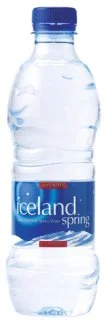
I found Iceland Spring to be fine, but not as smooth as Voss. On the second and third gulps I became aware of a harsh aftertaste, and actually a pretty unpleasant during-taste as well. The absence of flavor is jarring. When I drink Iceland Spring, I feel as though I am sailing down a glacial river in Iceland much like the idyllic fjord of Voss—but this time I am seized, my head is dunked violently underwater, and then I am returned to the safety of the boat. Ranking: 6th of 6
FIJI natural Artesian water can be purchased at many grocery and convenience stores, usually for roughly 99 cents for a half-liter (less per liter for larger sizes or cases). Fiji, which is bottled on the Fiji islands, takes great pains on its label to associate the water with an earlier, cleaner time. Fiji water flowed through the mountains before the Industrial Revolution, it insists, and is therefore untouched by pollution. (Despite my love for the product, I find this claim logistically dubious.) Fiji also trumpets its silica content, which is said to promote smoothness. Its bottle has flora and fauna to suggest a sense of place, evoking a tranquil, tropical paradise.
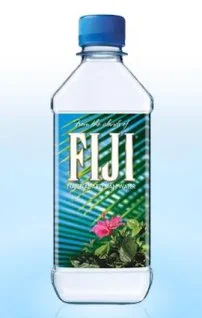
Fiji was my first dalliance into “exotic” bottled waters, and far and way my favorite. It’s got a nice, markedly softer taste than either Icelandic or Voss. It has some of the flavor of tap water without being gritty or unpleasant. Drinking Fiji makes me feel as though I am lounging blissfully on a tropical beach, utterly refreshed—OK, wait. No, that’s not a nice milieu. I’d be too hot on a tropical beach, and the sand (fine and milky though it might be) would throw me into a pissy-pants tizzy and a frantic search for a Wet-Nap, and set off my OCD in the most obnoxious way. So instead: it makes me feel as though I am in an air-conditioned room, looking out the window at a lush, tropical paradise. Ranking: 1st of 6
DEER PARK (“…that’s good water”) can be purchased at any number of places, and is also available for home or business delivery, much like Crystal Springs mentioned above. Its cost is considerably lower than the “exotics” above: $1.19 per gallon typically. It is bottled at a variety of locations, but primarily originates from springs deep in the Appalachian Mountains of western Maryland. Deer Park’s containers have changed of late to more “environmentally friendly” designs, and the largest available jug has recesses built into one side, making it much easier to pick up.
Deer Park somehow manages to be both more filling and more bland than the other contestants thus far. It has a silty aftertaste not present with the others. There are clearly more minerals here—and perhaps, more contaminants—but they don’t add to the taste appreciably. Ranking: 5th of 6
DASANI is Coca-Cola’s water, and easily the most popular of the “plain” bottled waters; it is for sale everywhere, and a one-liter bottle costs 99 cents. Dasani is tap water that has been purified using a process called reverse osmosis. The label also indicates that it’s been “enhanced with minerals for a pure, fresh taste” and contains magnesium sulfate, potassium chloride, and salt (for taste).
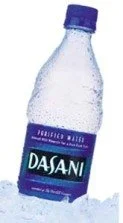
The sodium and mineral content in Dasani is evident from the first sip, though the label insists the salt is “negligible.” I can’t help but wonder if this is part of Dasani’s marketing strategy: consumers will drink Dasani to be refreshed, but that modicum of salt will leave them with a bit of unexplained lingering thirst, leading them to reach for another bottle of Dasani. The taste of this water is full-bodied, but also artificial in an indefinable way. Ranking: 4th of 6
ADAMSTOWN MUNICIPAL TAP WATER is available exclusively in Adamstown, Pennsylvania. The cost of this water for Adamstown residents is $21.85 for up to 3000 gallons, or less than a penny per gallon. It is gotten from wells in the Hammer Creek formation and is tightly controlled by the EPA (unlike most bottled waters), having been certified fit to consume. Tap water typically contains small amounts of chlorine, fluoride, aluminum sulfate, hydrogen sulfide, and nitrates.
This tap water is most definitely less “pure” than the likes of Icelandic or Fiji; it looks positively chunky by comparison. But there is a pleasing and unmistakable flavor here that’s missing from those waters that boast low mineral content. I can feel it on my tongue, and it is quite nice. Ranking: 3rd of 6
Over all, I am impressed with how well tap water stacked up against the spring and purified waters—and when the cost disparity is calculated, it’s staggering. Some bottled waters are more than twice as expensive per gallon as gasoline, and yet few us of turn on the tap (for a lousy penny per gallon) when we’re thirsty.
To be sure, there are those who would point out problems with tap water. Present in tap water are bacteria, radioactive isotopes, pesticides, and even antibiotic traces that have invaded our streams, rivers, lakes, and groundwater. And libertarians get so indignant about the fact that fluoride is infused into municipal water supplies (ostensibly as a dentifrice) that anti-fluoridation movements have sprung up, calling the addition of fluoride “compulsory mass medication” and a governmental intrusion into our lives. Now, I love a good conspiracy theory as much as the next schmo—probably a whole lot more—but god damn. I’m willing to believe that our government is tapping our phones, manipulating what we read—it may have even staged the moon landing, or faked a catastrophe or two. But messing with us by putting fluoride in our water? I just don’t see it.
The key to keep in mind regarding the argument about tap water containing bacteria and other contaminants is that independent studies have routinely found that some bottled waters contain more of these contaminants than municipal tap water! This is because the content of tap water is much more tightly controlled than that of bottled water, which has been tested and sometimes discovered to have higher (and actually rather dangerous) bacteria levels than tap water.
No matter if we choose tap or bottled water, then, it’s not easy to ensure that we’re getting a substance that’s “pure” or healthful at all. In this case, we have to look at other factors to break the tie. It all comes down to the environment.
A case in point is Fiji (where my favorite water in the world comes from). On these islands, clean drinking water is unavailable for a portion of the population, yet thousands of gallons of Fiji spring water are shipped away each day. And the Fiji water that’s made it from the islands to my grocery store has traveled roughly 6,000 miles by ship, plane, and truck—all of which use fossil fuels, and all of which have devastating effects on the environment. Using water like Crystal Spring or Deer Park at least can be defended on the grounds that it has a relatively short trip from source to your refrigerator. But keep in mind as well that only 20% of plastic beverage bottles are ever recycled, adding immeasurably to already-overcrowded landfills and releasing dangerous chemicals into the ground.
Many cities, notably the San Francisco bay area, have initiated programs like “Think Outside the Bottle” to educate people about the environmental impact of bottled water and encourage them to turn on the tap when they’re thirsty.
“Ever wonder about those people who spend $2 apiece on those little bottles of Evian water?” George Carlin once asked. “Try spelling ‘Evian’ backward.”

For my part, I’m going to start making an effort to kick the habit, but I’m not promising anything (sorry, Earth).
Below are some provocative articles on the bottled water controversy—well worth a read:
“Don’t Be Duped By Bottled Water” - http://www.commondreams.org/views05/1012-30.htm
“The Real Cost of Bottled Water” - http://www.commondreams.org/views07/0218-05.htm
$10 a gallon versus 49 cents a year” - http://www.argusobserver.com/articles/2008/02/24/news/us/doc47c13a11a550a689404593.txt
“Bad to the Last Drop” - http://www.nytimes.com/2005/08/01/opinion/01standage.html
Monsoon