
Monsoon's "The Wire" episode 59 notes and analysis
“The Wire” notes and analysis for Episode 59 – “Late Editions”
Please note that this episode is available only at HBO On Demand and has not yet aired; it will premiere on HBO on Sunday, March 2nd. Also be forewarned that as “The Wire” contains adult language and themes, my post will reflect these elements; reader discretion is advised.
Finally, this post contains spoilers about episode 59; please do not read further if you have not yet seen it and do not want details about this episode.
S
P
O
I
L
E
R
S
P
A
C
E
The penultimate episode of “The Wire” is one of its best ever. It opens with Lester carefully examining a large bulletin board with the city maps, overlaid and surrounded with images of clock faces taken from the cell phone intercepts. Soon he receives a transmission indicating map 44, grid G-10—and then another, and then another. Since this is an out-of-the way industrial area, it seems to signal a big meet. Lester calls Sydnor and sends him down there, then McNulty, and before long he’s out the door himself. The illegal wiretap, it seems, is about to pay off in a big way.
The episode’s tagline is “Deserve ain’t got nothin’ to do with it.” – Snoop. Now at the warehouse, several teams have gathered there and are assessing what’s going on. Marlo was there, but left. Chris just went inside a warehouse door opened by “some white boys.” Lester jumps in his car suddenly, realizing he’s going to need more police to take down the warehouse if it contains what he thinks it does. “Where you going?” asks Sydnor. “Time to ‘fess up,” answers Lester.
In the next scene we join a meeting in progress at Levy’s office, with Herc, Snoop, and a “Mr. Hill,” the young dealer who took a bullet in the leg and is now going to take the gun charges for the Stanfield organization. When the dealer complains about how much water he’s having to carry for Marlo—especially after having been shot—Snoop has a great line: “Go down Wal-Mart or some shit and see if they take care of you while you laid up for a while.” It’s a brilliant swipe at the retail behemoth’s abysmal record on benefits and living wages, and Herc offers an appreciative smirk (unintentional rhyme there).
At the warehouse, oblivious to the phalanx of surveillance teams (and soon, SWAT teams) that surround the building, it’s business as usual: three men who seem to be Russians open the back of a small delivery truck containing several iceboxes, each of which is filled with at least 40-50 bricks of heroin. The transaction is made with Chris, and the product is loaded into Monk’s trunk (rhyme unintentional, again), among other places.
Meanwhile, setting the stage for the show’s inevitable climactic denouement—the unmasking of McNulty’s bullshit, Scott Templeton’s reckoning, Marlo’s collapse—Gus is meeting in a pub with a former colleague named Robert Ruby (The Sun’s former Foreign Editor, who seems to be playing himself). They’re bemoaning the corporate culture at The Sun and so many other papers—“These newspaper chain guys just don’t give a fuck, do they?” Ruby asks—and Gus asks him to discreetly check out Scott Templeton’s body of work. Ruby knows instantly why Gus is asking him. “Man, I hope you’re wrong,” he says. “Of course you do,” Gus replies. Gus and Ruby adhere to the “old school” of the newsroom, for lack of a better phrase: loyalty to one’s fellow reporters to the bitter end. As we know, Scott’s lies are bound to—and in fact, are actually beginning to—come out. Soon Ruby is at The Sun greeting old friends and making a cautious inquiry into Scott’s articles.
Duquan , now working with the junk vendor, climbs over a barbed wire fence into the lot of a construction company, or a demolition site. Perhaps life as an apprentice junk man isn’t the glamorous existence it had initially seemed?
In Rawls’ office, Carcetti’s chief of staff Michael Steintorf (Neal Huff) is meeting with Rawls and Deputy Ops Cedric Daniels (Lance Reddick) to carp about the record increase in violent crime during Carcetti’s tenure. He wants results—more police, more visible presence, etc.—and Daniels is deflated by his insistence that he preside over the same old political game. After all, Daniels says, “I was told by our mayor at the outset that there would be no more Band-Aids, no more stat games.” Not so, Steintorf informs him: the mayor wants to see a 10% drop in violent crime in the next quarter. Reform can be addressed, he adds, if Carcetti is in Annapolis (as governor), and he can’t get there unless he’s got more workable crime stats. It’s an endless cycle of manipulation, compromise and futility that, in “The Wire” universe (and, it would seem at times, in our own) will never end. Being privy to the “war room” discussions between Carcetti and his staff, we know he’s selling all but his soul to ensure a shot at the governor’s mansion—and there’s little reason, despite his fiery rhetoric and the high-minded ideals he espoused in the third season, for us to think he’ll suddenly make things right if he gets there.

Lester , for his part, is coming clean to Daniels—sort of. He doesn’t spill the grand duplicity, but lets Cedric in on enough of the detail—the surreptitious wiretap, the surveillance, the warehouse, Bunk’s delayed warrant on Partlow—to ensure that Daniels will provide him with the firepower he needs. As he’s talking to Daniels, Lester gets a call from Sydnor, who has just pulled over Monk with “eight keys of the raw” in his trunk—and his phone, with all its evidence. Daniels is taken back by Lester’s revelations, but seems more bemused than angry. He calls Rhonda Pearlman: “Ronnie dear, are you sitting down?”
Soon a SWAT team vehicle smashes through the gate and its members storm in to the warehouse, arresting everyone in sight. Lester arrives and sees the refrigerators loaded with heroin, then he’s off to the playground, where Marlo is among those arrested. (I have to admit, seeing Marlo and his crew manacled and kneeling on the concrete makes me feel in some small way that Omar may not have died in vain.) Lester picks up Marlo’s cell phone, looks the drug lord in the eyes knowingly, and strolls away. He finds the clock that had been used in the picture messages, holds it thoughtfully in his hands, and looks down the line of arrestees to Marlo, whose expression is memorable: “But just how in the fuck did he…?” he seems to be thinking. A great, gratifying scene.
It’s press conference time, and Carcetti is at his self-congratulatory best after a seizure of $16 million in heroin, all told. (A cute little throwaway line from the young Mr. Hill as he, Michael, Snoop, and the few other Stanfield associates not arrested watch the coverage on TV: “Does this mean I still gotta take that charge for y’all?”) Carcetti crows, “We did not give up on that investigation, just as we do not give up on trying every day to address ourselves to the task of making this city safe and vibrant again,” after which the camera shows Bill Zorzi rolling his eyes. He knows—though not in the detail available to us—what a falsehood that is. Carcetti has a stern warning for those drug dealers who still operate in Baltimore’s neighborhoods: “A day like this is coming for you.” Zorzi mutters sarcastically, “Oh, you are so butch.” The world-weary court reporter sees through is empty posturing—as do we.
After the news conference, Daniels will only give a perfunctory quote to Alma—“A good day for the good guys”—and when pressed, says he doesn’t like being misrepresented in the paper. “Something about stabbing someone in the back,” he says, referring to Scott’s fabricated quote attributed to Nerese in episode 53. Scott’s shenanigans not only will end up harming his own career—we can only hope and assume—but it harms the credibility of everyone else in the profession. Perhaps that’s a lesson with which both McNulty and Templeton will be forced to come to terms by the series’ end.
Marlo and his crew have been arrested and locked up for processing, and many of them sit in a large holding cell, trying to decipher what went wrong. (I wondered during this scene if it’s entirely plausible that these known associates—who did not seem to have been questioned yet—would have been placed together in a communal holding cell, given the possibility that they’d have the time and opportunity to get their “stories” straight.)
Monk angrily deconstructs recent events and mentions that Omar had been calling Marlo out on the street. Marlo’s reaction is pure rage: “He used my name? In the street?” The look on Chris Partlow’s face reminds us that Chris and Snoop had deliberately decided to keep this from him—“The man’s got too much on his plate,” Chris said at the beginning of episode 58—and so Marlo never heard of Omar’s repeated challenges. “My name was on the street? When we bounce from this shit here, y’all gonna go down to those corners and let those people know: word did not get back to me. Let ‘em know Marlo’ll step to any motherfucker—Omar, Barksdale, whoever. My name is my name.” The tightly controlled, bloodless Marlo believes intimidation is the only real power he has to wield, and if he was “called out” and failed to answer that call, his reputation is worthless. One has to wonder not if, but how Chris will be brought to account by Marlo for his sloppiness.
In the Homicide unit, McNulty sits working placidly at his desk when he is approached by Jay Landsman (Delaney Williams), who conspicuously praises Bunk for his solid, deliberate police work. Then he turns on Jimmy: “From everything we’ve given you, fire should be shootin’ outta your ass. But no. There you sit like a genital wart.” He wants results.
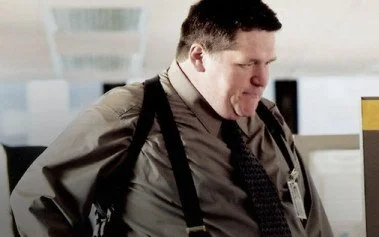
(A note here about Landsman’s locutions and manner of speech: it is possibly the most colorful and lyrical of any character on this show, or any show. His scatalogical and crude metaphors are magnificent. And his sentence constructions—“there you sit” instead of “you just sit there”—recall Shakespeare’s language. It’s a delight hear him speak, minor character though he is; it would be interesting and not a little bit amusing to compile some of his most memorable lines over the years.)
After Landsman stalks away, Kima asks a clearly tortured McNulty where this is all going to end. There will be no more calls and no more killings, he tells her, and the effort will all fade away. He tries to accentuate the positive by reminding her, “Marlo is in cuffs.” “Fuck Marlo,” she replies, and bores through him with a look of pure disgust. “Fuck you.”
(I guess I understand Bunk’s anger at Jimmy’s actions, as much as I understand why Bunk never told anyone what was going on. But I’m not sure Kima’s fiery reactions here necessarily ring true. She has undeniably given her life to police work—to the detriment of what seemed like a promising relationship with Cheryl—and most certainly her body, when she was shot in season one. But Greggs has been as stymied and frustrated at times by the bureaucracy and its ineffectual nature as much as McNulty himself. Surely she’s been shuttled around from one special unit to another enough to understand some of what McNulty’s motivations are. Would she reasonably have the extremely negative and lingeringly furious reaction she’s had—and would she reasonably take the drastic actions she’ll take later in the episode?)
The newsroom is humming along busily while Scott is in a meeting with Klebanow, Whiting, and Metro editor Steve Luxenberg (Robert Poletick) about potential Pulitzer submissions. Whiting, who reveals that he’s been on a few Pulitzer committees in his day, says the graphics have to be “clear and professional” for an article or series to be considered for the prestigious prize. Klebanow says it’s vital to cover the reaction (among city agencies, government, police, etc.) to the homeless coverage. But Luxenberg asks, “What do we want to say exactly with our coverage? What do we want to say about the homeless?” He adds that no one would argue that homelessness is terrible, “but isn’t it actually symptomatic of a much greater dynamic?” It seems here that Luxenberg wants the paper’s coverage to get into the societal and economic ills that lead to homelessness—like inadequate wages, disappearance of the manufacturing base, and flaws in the school system, to name a few.
But Klebanow, predictably, isn’t having any of it: they need to “examine the tragedy underlying these murders.” Scott, their willing lapdog, fawningly interjects, “the Dickensian aspect.” A broad, shit-eating grin spreads across Whiting’s face; it’s the self-satisfied smile of a man who’s been paid homage by having his own words parroted back to him. Besides being the title of episode 56, the phrase was used in a budget meeting in episode 52 to underscore the desired tone for the paper’s planned Pulitzer-baiting series on the school system. One wonders if Klebanow and Whiting will be drooling quite so heavily over Templeton when his fakeries are exposed—or whether their blind devotion will in fact prevent them from seeing the truth of his actions. One thing seems sure: either Scott Templeton or Gus Haynes will no longer be working for The Sun by season’s end.
McNulty and Lester are shown out by the railroad tracks—near where Jimmy and The Bunk had wound up many a late night earlier in the series—celebrating the arrests of Marlo and his crew. Well, at least Lester is celebrating, having had more than a few drinks. But McNulty stands aloof, empty and somber, refusing a drink. He’s unable to take any satisfaction from what his duplicity has accomplished in the long run, perhaps because he sees how many people he’s hurt in the interim; though he says little, his expressions convey it all. Lester insists that if McNulty will not join him for a drink, he needs to at least chauffeur him home. As Freamon dances drunkenly away, he practically sings, “Shardene better be awake, too, ‘cause I do believe Lester Freamon’s in the mood for love.”
After the holding cell conversation, Marlo is convinced that he has a snitch inside his organization who told the police about the cell phones. (After all, since the wiretap was illegal, the official police reports refer to a nonexistent “source” who told them about the picture messages.) In a later scene during which Marlo meets with Levy, Marlo insists that only he, Chris, Monk, and Cheese knew about the code. It’s ironic that because of the illicit manner in which the evidence was gathered, a CI (confidential informant) had to be invented, which will lead to chaos and more violence within the Stanfield organization. The newest member of his inner circle, the one always asking questions, seems to be the easiest scapegoat. It quickly becomes clear that Michael has a target on his back, and when Snoop visits him to ask that he kill Walter—telling him not to bring a gun because she’ll give him one later with the serial numbers filed off—Michael is instantly suspicious.
In a complete change of venue, we see a smartly-dressed, ponytailed young man at a podium speaking passionately about the AIDS epidemic in Africa. Behind him is a large banner indicating that this is a competition sponsored by the Baltimore Urban Debate League (BUDL), which is an actual organization that has been in existence since 1999. The voice is familiar, but its tone—erudite and persuasive rather than smart-alecky and coarse—is unmistakably different. It’s Namond Brice (Julito McCullum), and as he speaks, Bunny Colvin (Robert Wisdom) and his wife look on proudly. Bunny’s expression sours, though, when he notices Carcetti and his entourage enter the auditorium from the rear. Colvin has no love for Carcetti, who last season (as councilman and mayoral hopeful) made a scapegoat of Bunny and his Hamsterdam experiment in an attempt to expose the corruption of Mayor Royce and grease his path to City Hall. This is evident when Carcetti later breaks away from a news conference to talk with Bunny, who is standoffish and closed-off to Carcetti’s awkward attempts to reconnect with the disgraced former Lieutenant. (I’m not really sure what Carcetti’s motivation would be here, anyway. It could be that he’s genuinely sorry for the smear campaign he conducted to attain his position, but since so few of his actions or impulses seem authentic anymore, that’s hard to believe.)

Back to Gus’s quest to unmask Templeton’s lies, we see Gus having lunch with Nerese. He brings up Daniels (in a circuitous manner, so as not to arouse her suspicions that she’s being pumped for information) and asks Nerese if she thinks he’s ready to be commissioner given all the backstabbing he’d engaged in. Nerese answers, “Daniels wasn’t even on my radar,” and her responses make it abundantly clear to Haynes that Templeton likely piped, or fabricated, that quote.
The body of a beaten-to-death homeless man has been found, and McNulty must examine it for signs that would link it to his fake serial killer. The detective, to whom McNulty refers as “Rook,” says there are no bite marks or ribbons to be found. The ensuing exchange is classic David Simon:
Rook: “This fuckin’ guy stinks.”
McNulty: “He probably evacuated.”
Rook: “What, he left and he came back?”
McNulty: “No, he shit himself.”
This is not only funny on its face, but also because it recalls the scene in episode 51 in which Gus changes Alma’s “the people were evacuated” thanks to Jay Spry’s (Donald Neal) correction.
Gus is off to Walter Reed Medical Center to meet with the Marine whose hands were blown off in the Terry Hanning story. When Luxenberg asks what he’s doing, Gus replies, “scratching an itch.” When he arrives, he begins talking to the man who was in Terry’s unit, and he shows Gus his prosthetic hands, which have rotating thumbs and multiple grips. “Brave new world,” says Gus, marveling at the technology. (The phrase derives most recently from the 1930s Aldous Huxley novel Brave New World, which envisions a World State controlled by reproductive and conditioning technologies; it originates, though, from the play The Tempest by William Shakespeare, which contains the line, “O brave new world that has such people in it!” It’s almost certainly a stretch, but in some sense with this comment Gus might be mourning the loss of authenticity in the modern world.) Gus asks the man if Terry could have exaggerated his story to Scott, and the man says it’s not possible. “He ain’t lie, y’all did. Sorry to say,” he says, echoing Terry Hanning’s insistent statements from last episode, though in less strident terms.
Carver and Herc share a cigarette and some suds once again (with Tom Petty’s “Refugee” playing in the background), and Herc says he became “fully erect” when he heard of Marlo’s arrest. But it soon becomes obvious that he’s working Carver for information about the details of their investigation. This is confirmed when Herc later meets with Levy, his boss, and says Carver all but admitted there was an illegal wiretap used to gather evidence on Marlo’s crew. Herc, who has had moments of redemption this season, seems to have settled back down to the level of craven weaselhood here.
A nice update on Bubbles’ situation (aka, Reginald Cousins)—and, I suspect, maybe the end of his storyline altogether—appears later in this episode. In the first scene, Bubs and Fletcher are chatting in his basement when Bubs’ sister comes home with some items for him. He tells her his anniversary (of sobriety) is coming up and he wants her to attend the ceremony, but she declines. “My sister, she good people,” he explains to Fletcher. “She been through a lot, though, you know.” It seems harsh at first blush that she will allow him to inhabit only her basement and never come upstairs, but on plenty of previous occasions she allowed him to stay with her, he made promises, and then he stole and pawned her belongings for drugs.
Later on, Bubs arrives looking rather spiffy for his anniversary ceremony, Fletcher in tow. Walon (Steve Earle), Bubs’ sponsor, warmly greets Fletcher but reminds the reporter not to take notes or record the proceedings: “What happens in that room stays in that room.” Walon’s reaction when Fletcher says he’s doing an article on Reginald is priceless: “I’m his sponsor and I don’t believe I’ve ever gotten a Christian name out of him!” Inside, as Bubs walks to the front of the room and begins, we can sense something is different about him; he appears poised to break free of his shame and his guilt once and for all. “My name is Reginald,” he emphasizes, and we sense that he’s almost having a rebirth. “’Round the way they call be Bubbles.” He talks about a recent afternoon when he was walking down the street and a strong craving hit him; he tried to call his sponsor, Walon, but he wasn’t around, and no one else called him back either. (One woman says she would have definitely called him back, hinting at a possible romantic interest for Bubbles, which would be wonderful.) But he did not get high that day, he says, and the implication is clear: he’s learning to depend on, and control, himself. He also, finally, brings up Sherrod, and though he doesn’t go in to specifics about what happens, it’s cathartic for him to even utter his name again. “Ain’t no shame in holdin’ on to grief,” he winds up, “as long as you make room for other things too.” This is one of the most moving scenes I can remember in “The Wire,” which doesn’t often make room for redemption or hope among its crushing stories of hypocrisy, apathy, and betrayal.
The fruits of Lester’s threatening encounter with Clay Davis are clearly paying off, as we see the two having drinks and Clay spilling prodigious amounts of information about where the money leads. Clay insists that in “following the money,” Lester must focus on the lawyers—particularly Levy, who not only provides legal advice but also elaborate money laundering for his drug clients, routing the money through developers, community foundations, and politicians like Clay himself. Lester pushes Clay to reveal more, and he finally relents: Levy has a contact at the courthouse, who has been buying papers (sealed affidavits and other confidential legal documents) and “selling them to whoever needs an early look.” He advises Lester to focus on people “hanging around the Grand Jury” in his search. Hopefully this information will find its way to the State’s Attorney’s office, solving the mystery of the court documents found in Prop Joe’s desk.
As noted earlier, Kima is incensed by McNulty’s revelation that he conjured the homeless serial killer out of thin air. At first, it seems she’s going to tell Carver, but she just wants some advice. She asks him how he felt when he spoke up on Colicchio, who dragged a teacher out of his car and beat him in episode 54, then remained unrepentant. Carver admits he felt “like shit,” but in the long run, he’s “OK with” his decision. Kima feels it’s in her best interest, that of the department—and that of the city itself—that she tells someone what she knows. As the episode winds down, she appears nervously at the door of Deputy Ops Cedric Daniels, and their exchange takes place offscreen. Daniels then tells Pearlman, who cannot believe what he is telling her.
They go off to the evidence room—where Daniels bumps into someone from his past named “Augie,” or Augustus Polk (Nat Benchley), who I believe was involved in the season one wiretap detail—to examine the cell phone from the pier. As Pearlman dials the number in the wiretap and the cell phone rings, I’m left wondering why Sydnor would have entered that phone into evidence rather than destroying or hiding it. Whatever the reason, Daniels and Pearlman now realize they have a full-scale catastrophe on their hands, and it’ll be intriguing to see how they play it (bury it, realizing what could happen if they don’t, or allow it all to unravel) in the final episode.
Snoop picks up Michael as scheduled for the hit on Walter, and Michael is soon asking questions about why Walter needs to be killed. “Does he deserve it?” Michael asks. “Deserve ain’t got nothin’ to do with it,” says Snoop, providing the episode’s tagline. (I wonder if this has some larger meaning in terms of what will become of those most responsible for the messes this season: namely, McNulty and Templeton. Is there real justice, or even “karma,” that informs the outcomes of these situations?) Michael asks Snoop to pull into an alley, pulls a gun, and Snoop asks how Michael knew. “You always told me—get there early.” In a heartbreaking scene, Michael asks Snoop what he did wrong; why was he being targeted? “It’s how you carry yourself. Always apart. Always askin’ why when you should be doin’ what you told. You was never one of us. You never could be.” Snoop then calmly takes one last look in the car’s side mirror. “How my hair look, Mike?” she asks. “You look good, girl.” Such an odd, tender, and almost pedestrian exchange given what’s about to so unavoidably happen. The camera pans back from the truck and Michael fires the gun. Snoop is dead.
Michael then must deal with the aftermath of his actions, and his future is uncertain to say the least here. When he comes into the house, Duquan is watching Showtime’s “Dexter” and he enthuses to Michael that it’s a show about “a serial killer that only kills other serial killers!” Michael tells them to pack—they’re all leaving. He takes his brother, Bug, to his aunt’s house, along with a bag of money for her to use to raise him.
The goodbyes here are heart-rending, as is the (presumably) final scene between Duquan and Michael. Duquan tries to bring up a bit of mischief from last season—maybe to remind his friend that they were children, once, and can be again. The exchange made the “Wire” soundtrack CD (…and all the pieces matter: Five Years of Music from The Wire, track 34), and its poignancy is undeniable. Duquan says, “You remember that one day summer past, when we threw them piss balloons at them terrace boys? You remember—just before school started up again. You know, I took a beat-down from them boys. I don’t even throw a shadow on that. (chuckles) That was a day. Y’all bought me ice cream off the truck. … Remember, Mike?” After three or four full beats, Michael replies, barely audibly, “I don’t.” It’s a whisper suffused with so much meaning—Michael is stunned by his lost innocence, and how rapidly and inexorably everything has changed for him.
And we share his pain; despite ourselves, we hoped for positive outcomes for all four of the young men we met in season four—Namond, Michael, Randy, and Duquan. Now it seems that the most incorrigible of the four, Namond, is the only one whose future holds any degree of optimism: Randy is a cold, hardened teen at the group home, betrayed by a system that promised to help him; Michael has just killed someone and has nowhere to turn; and though it wasn’t clear at the end (at least to me), Duquan appears headed either to stay with the junk man or the drug-addicted family members who “raised” him.
The 90-minute finale—for which I will have to wait two full weeks, and watch it on Sunday, March 9th with everyone else!!—looks to be phenomenal. In the previews, it looks like heavy damage control is in order, a bearded Prez makes an appearance, McNulty and Scott seem to be arguing about who is more stunningly full of shit, and all hell generally breaks loose. Can’t wait for Episode 60, yet I’m really very sad about the end of this series that draws an array of superlatives from critics and fans alike, and rises above them all.
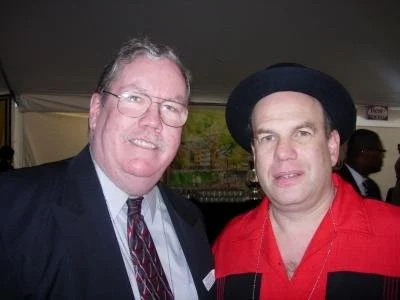
I guess I’ll spend the next couple of weeks thinking of questions to ask David Simon for the Q & A set up in March! I know it’s been said before, but thanks again to Jim King for moderating the Yahoo group, maintaining a kick-ass Wire site at http://members.aol.com/TheWireHBO/ and setting up Q & A exclusives with Dominic West, Wendell Pierce, Clark Johnson, and of course, Simon. (That’s Jim King on the left and Simon on the right in the picture below.)
END OF EPISODE 59 NOTES
Monsoon Martin's "The Wire" Episode 56 notes and analysis
“The Wire” notes and analysis – Episode 56, “The Dickensian Aspect”
Please note that this episode is available only at HBO On Demand and has not yet aired; it will premiere on HBO on Sunday, February 9th. Also be forewarned that as “The Wire” contains adult language and themes, my post will reflect these elements; reader discretion is advised.
Finally, this post contains spoilers about episode 56; please do not read further if you have not yet seen it and do not want details about this episode.
S
P
O
I
L
E
R
S
P
A
C
E
The episode (tagline: “If you have a problem with this, I completely understand.” – Freamon) opens with someone from the Medical Examiner’s office carrying a body away from the apartment building where the shootout in the last episode took place. For a fraction of a second my heart sank because I thought it may have been Omar, but then I realized it was more likely Butchie’s friend Donnie, who had been killed in the shootout. This becomes even clearer as both Chris and Snoop hunt all over the city for Omar—Snoop visits every ER in the city, figuring Omar must have injured himself and sought care at a hospital, but comes up with nothing. Nothing is found in the Dumpsters or sewers in the area, either. There’s even a besuited young man whom I don’t recognize posing as a detective and asking questions, who also comes up empty. Omar seems to have quite literally vanished.

Chris reluctantly goes back to Monk’s apartment building to meet Marlo, who is incredulous not only that they let Omar get away, but the manner in which he did so: “Don’t seem possible … some Spiderman shit there.” On closer inspection it seems Omar jumped from the 5th or 6th floor balcony (I had guessed 3rd floor in last week’s post). Marlo also has a sense of the enormity of their failure, and shows real exasperation and perhaps even worry for the first time I can remember in the series: “We missed our shot. Now he gon’ be at us.”

In the first scene after the credits we see Omar in a janitor’s closet, sobbing in pain as he tries to tend to his right ankle or leg, which seems to have been badly broken in the leap from the window. As he uses a long-handled mop as a crutch and makes his way out of the janitor’s closet and outside the building, we realize he was in Monk’s apartment building the whole time. It’s difficult to imagine how Chris and Snoop could have been so hyperopic that they would have searched all over the city for Omar and missed the fact that he had dragged himself back inside the building.
Bunk, who is reexamining the 22 bodies case (now 25, given that the triple-murder from earlier this season has now been linked to Marlo’s crew), utters a line to McNulty a line that he’s said at least three times before, in a variety of situations (it even appears as a dialogue clip on the Wire soundtrack CD): “You happy now, bitch?” McNulty replies, “I am content, yes.” Bunk guesses that Jimmy has called the reporter, but Jimmy corrects him: “No, actually – that asshole’s making up his own shit.” This is the first time we get confirmation that McNulty realizes Templeton is cooking his stories.

Cut to The Sun, where Executive Editor Whiting and Managing Editor Klebanow are thrilled with the ongoing homeless murder pieces by Scott Templeton. Scott is busy admiring his all-caps, banner headline appearing above the fold, “SERIAL KILLER PREYS ON CITY HOMELESS,” when his bosses come up to give him an “atta boy” and ask about where he’ll be taking the story. Scott’s idea is to spend the night with the homeless and “see what they see.” Klebanow also notes that the national news and cable outlets have been calling to try and secure comments and appearances from the star reporter; Klebanow advises Scott to avoid local media but that he should feel free to make national media appearances “in a responsible manner.” Scott, who cannot possibly mean what he says, says, “I’m just not all that comfortable having myself in the center of the story like this.”
This bit of unmitigated bullshit, given his fabrications, is all the more incredible since we know Scott has a “hot nut” to get out of Baltimore and secure a more prestigious job. I have an updated prediction for the end of the season: Scott’s fabrications will become obvious to only a few at the paper (Gus, for sure, and Alma and Fletch, perhaps) but he’ll receive such accolades from his series on the homeless murders that his bosses will remain oblivious—or in denial. Templeton will land a job at The Washington Post will Gus and the rest of the staff are left to pick up the pieces.
Soon thereafter, Whiting pulls Gus aside and lets it be known that the coverage of the homeless murders should “reflect the Dickensian aspect of the homeless, the human element.” The look on Gus’s face says it all—he is tired of the buzzwords, tired of the paper being run by people who wouldn’t know real news if it was sitting on their faces.
The story moves to Lester and Sydnor (Corey Parker Robinson), who were on the Stanfield case. Lester is preparing to tell Sydnor about the deceptions that are being orchestrated in the name of securing wiretaps. The cynical opening of Lester’s speech prompts Sydnor to ask if Lester’s going to retire, but he assures Sydnor that he’s not retiring (“yet,” possibly a bit of foreshadowing). Lester says, “When they took us off Marlo this last time, said they couldn’t pay for further investigation, I regarded that decision as illegitimate.” As a result he’s going to press the case “without regard to the usual rules.” Lester has enough gravitas and experience to make such radical statements and still sound reasonable, and Clarke Peters has been doing an outstanding job in a role that has seen more focus this season than perhaps any other.
Lester comes clean on the illegal wiretap and uses the show’s tagline, “If you have a problem with this, I completely understand,” as a way to offer Sydnor a clean exit, but Sydnor is in.

In explaining the wiretap to Sydnor and later McNulty, Lester begins to unravel the import of the “silent” or seemingly scrambled phone calls: “When they talk is bullshit, but there are calls when no one says a thing,” which he later determines, with the help of surveillance, to be picture messages.
Bunk, who has found Randy Wagstaff’s (Maestro Harrell) name and photo in a file about one of last year’s murders, decides to pay a visit to Randy at a Baltimore group home and see if he can extract any new information or cooperation. He finds there a young boy who has ensconced himself within walls of sullenness, posturing, and anger. Randy, whose foster mother was killed in a fire set by those who suspected him of snitching, was lost the moment he walked into his group home and saw “snitch bitch” written on his bed, then desperately tried to fight off the beat-down that ensued. Randy refuses to be manipulated, coaxed, or coerced by Bunk, as he’s been failed by police before: “That’s what y’all do, ain’t it? Lie to dumb-ass niggas?” He’s been hardened utterly, and one wonders if it’s too late for him to be “saved.”

Carcetti, whose news conference opening a new, upscale harborside condo complex is attended by scant few—save for a disorderly Nick Sobotka (Pablo Schreiber), who shouts “Fuck you!” at the mayor and is quickly arrested—must now hold a press conference about the homeless murders. It’s not lost on Carcetti that this press conference if far more well attended than his earlier one, even drawing national media: “It would appear that media attention is always focusing on the negatives when it comes to Baltimore but you guys aren’t around when we’re making real progress.” The harbor story—which assuredly is good news for a few, but certainly not for the dock workers and many others—will now be buried in the Metro section because of the front-page homeless coverage.
Carcetti then delivers an impassioned and apparently impromptu speech that surprises even Norman. He notes that his administrative tenure will be judged most correctly by how the weakest and most vulnerable citizens are treated, and states that the killer will be found. Carcetti hands it over to Rawls, who quickly hands it over to Daniels, the commissioner-in-waiting. Daniels is smooth, composed, and confident: “a natural,” according to Rawls.
McNulty and Pearlman (who used to be an item, way back in season one, I believe) go to see Judge Phelan (Peter Gerety of “Homicide” fame) and get a wiretap on Scott Templeton’s phone. After noting that the reporter’s First Amendment rights might be violated by such an act, Phelan explains the reason for his hesitation in challenging The Sun: “Never pick a fight with anyone who buys ink by the barrelful,” a long-held maxim that perhaps reflects a bygone era in newspapers in terms of primacy and might.
Back to The Bunk, who is being chastised by Kima for his tentativeness in handling the Medical Examiner’s office, who have still not provided lab analysis of the evidence in many of the vacant murders. “Well, what would the Bunk do? Take no for a fuckin’ answer?” Soon Bunk is down talking to Ron, who is spewing a litany of excuses and woes that led to the ongoing delays, including staff shortages, malfunctioning equipment, and much more. Bunk responds, “My heart pumps purple piss for you,” a marvelously alliterative rejoinder and an example of the colorful and delightful language that makes “The Wire” the gem it is. In truth, the Medical Examiner’s office is a shambles. A temporary worker (or “temp,” which I have been more than a few times in my life) has been hired to catalogue evidence and do paperwork. In a fantastic twist of fate and an example of the bureaucratic absurdities that often prevent even the most pedestrian of progress from being made, the temp didn’t understand the abbreviation “et al” (short for the Latin “et alia” plural meaning “and others”) and the evidence on the murders can no longer be differentiated. The budget crisis, along with mismanagement and good, old-fashioned human error have collaborated to create a five-alarm clusterfuck—and in encountering it, Bunk and Kima are exasperated, but sadly, not surprised.
At the co-op meeting, Joe’s chair stands empty, so Marlo takes it upon himself to address the group. He admits he is responsible for killing Prop Joe, thereby establishing himself as the de facto leader of the co-op—and as a target for anyone who is loyal to Joe and would dare come at him. Marlo also doubles the bounty on Omar: “100 large for a whiff of that dick-suck; 250 for his head.” And in this briefest of meetings, Marlo decides to suspend the meetings indefinitely—no big surprise since his intense dislike of them, and of the co-op in general, has been all too evident from the start. (As a man who would generally rather set my own head on fire than attend a meeting of any kind, I am right there with him.) “Anybody got a problem from here on out, bring it to me or sit on that shit.” He doesn’t want to manage anything but his own organization, and doesn’t want to hear about petty squabbles or turf battles. And finally—the price of the product is going up. So far, Marlo’s tenure in leading the co-op does not seem destined to be a popular one. With his attention distracted further by Omar, it seems likely that he’ll be brought down by the end of the season.
Back at the newsroom, the guys are watching Scott Templeton’s appearance on the CNN Headline News show “Nancy Grace.” The odious Grace guest-starring on “The Wire” is ironic and rather brilliant given the conversation among Lester, Bunk and Jimmy earlier in the season that yielded the tagline, “This ain’t Aruba, bitch.”

Her obsessive coverage of the Natalee Holloway case and sensationalistic style of “journalism” are a symptom of the problem of being dead “in the wrong zip code,” as Fletch put it earlier in the season. On the show, Grace calls Templeton the “Jimmy Breslin of Baltimore,” alluding to the Newsday columnist’s correspondences with the “Son of Sam” killer in the 1970s. Breslin once famously observed, “Rage is the only quality which has kept me, or anybody I have ever studied, writing columns for newspapers.”

Templeton plays the ostensibly spotlight-shunning professional perfectly, insisting that “as a reporter you expect to be in harm’s way at some points. It’s what we do.” Gus, it should be noted, walks away from the television screen dejectedly, rejecting the attention that is being lathered on his reporter. Gus is fed up with the dropping of the Pulitzer-baiting schools piece, the undeserved celebrity of Templeton, and the erosion of journalistic standards. At some point, will he explode?
Meanwhile, McNulty and Lester are reaching an impasse in their fabricated serial killer case. “They need another body, don’t they?” McNulty asks, which is going to be more difficult than it seems. When Rhonda visits Lester in the former Stanfield investigation headquarters, Lester needs to usher her out quickly to protect his illegal wiretap. His comment that “you’d be surprised what you can get done when no one’s looking over your shoulder” is brilliantly offhand and captures one of the essential themes of “The Wire”: the near-futility of trying to escape the suffocation of bureaucracy to do important, vital work.
Omar spends much of the show’s last half sending strong messages to Marlo that he is not to be trifled with. He points a gun at Rick’s head and delivers the message that he doesn’t believe Marlo has it in him to go after Omar. Later, the still-limping Omar robs one of Marlo’s corners and demands the bag full of money—today’s haul. But instead of taking it—“it ain’t about the paper”—he dumps it in one of Marlo’s SUVs and torches the vehicle. Omar sends a similar message to the corner boy he has shot in the leg: tell Marlo “he ain’t man enough to come down to the street with Omar.” I am left wondering if it’s wise that Omar continues to bait Marlo in this manner. I almost can’t bear to think it, but it seems as though Omar has placed himself a path that can only lead to his destruction. (In the “Next on The Wire” montage: is that Omar sticking a gun into the back of Michael’s head to send another message to Marlo? Is that Michael in the “box”? Stay tuned!)
Bunk, having struck out with inscrutable Randy Wagstaff, is going to work the murder of Michael Lee’s stepfather, whom we know was brutally bludgeoned to death by Chris. He meets with Michael’s mother, who puts Bunk onto Michael, and reveals that Michael is running with Chris and Snoop now.
Carcetti, meanwhile, has found his core issue in homelessness; his impassioned speech at the press conference kicked it off, and it resonates in a potential gubernatorial campaign because of the current Republican governor’s failure to address homelessness. The irony here, of course, is that the entire issue is based upon a series of lies: McNulty’s fabricated homeless murders case, picked up by the serial fabricator Templeton, is now informing the mayor’s campaign strategy. “The bigger the lie, the more they’ll believe,” said Bunk in the opening scene of the first episode this season, and the theme is carrying through.
Back to the ongoing homeless murders story, which clearly has “legs,” or ongoing appeal, we find Scott wandering awkwardly under a bridge looking for the true “homeless experience,” running away from a charging German shepherd, and generally looking out of place. My feeling initially was that he’d simply go home and make the story up, but later we see him doing actual reporting, talking to a homeless Marine vet. The man describes the shell shock he still endures from his time served in Fallujah, Iraq; when his vehicle was hit by an IED (improvised explosive device) and the driver’s hands were blown off, the driver laughed and said, “look, ma, no hands!” He is clearly haunted by the experience and clearly knows the lingo and terminology of the armed forces, but because it’s Scott, I just expect it to be made up (by the interviewee, in this case) or otherwise hinky.
Once the story is filed (or submitted to by copyedited), some of the editors—including Gus, notably—are gushing over the piece. Gus calls Scott over and says, pointedly, that it “feels like the real deal” because he didn’t “overwrite” it. To overwrite is to write with too much elaboration, to use superfluous details, to employ too many adjectives; it’s a problem faced especially with younger journalists who are used to writing flowery English papers with meandering and sophisticated explications. Good journalistic writing is simple and direct but impactful—and hard as hell to do. Gus praises Scott’s use of “no extra color, no puffy adjectives” and his reliance instead on “tight, declarative sentences” to tell his story. “No extra color, no puffy adjectives” means that Scott doesn’t spend an inordinate amount of time padding his story with unnecessary descriptions of setting and context. “Tight, declarative sentences” are sentences with very few clauses or commas that are designed to convey information or make direct statements. While most of my sentences here are declarative—as it is by far the most common type of sentence—most of them would not be described as “tight,” since they contain myriad clauses, em dashes (the double dashes that crop up frequently in my writing), commas, and ornate, copious adjectives.
Speaking of Scott, he is questioned by Gus about a piece he wrote a few weeks earlier about a woman who died due to a seafood allergy; Fletch had been told something by a community member that called the facts of his article into question. A bit later, when pressed on the matter by Gus, Scott insists he made some calls and confirmed that his article was sound—but Gus seems to remain unconvinced.
By the end of the episode, McNulty and Lester seem to have reached another level of depravity in their fabricated serial killer case: they’ve kidnapped a disabled homeless man, whom they’re calling “Donald,” but whose name may or may not be Donald, and stowing him in a D.C. shelter. It’s very confusing and very troubling, and seems certain to land one or both of them in serious trouble. The plan, it would seem, is to take cell-phone pictures of the homeless man, bound and with a ribbon on his wrist, and send them to Templeton, who will think they are from the killer. Once a warrant is approved to surveil and/or decode cell-phone picture messages, Lester will use this illicitly to crack or access Marlo’s picture messages. Judging from the scene shown in “Next week on The Wire,” in which McNulty says to Lester, “Get me out of this, Lester, as fast as you can,” it’s all going to go horribly wrong.
There’s an interesting scene near the end that was almost brief enough to overlook, but which seems destined to have serious repercussions in the final four episodes. Assistant state’s attorney Rhonda Pearlman visits the state’s attorney (Rupert Bond) and presents him with sealed affidavits taken from the desk of Prop Joe; Rhonda had gotten them from her boyfriend Daniels, who had gotten them, I believe, from Bunk. “We have a leak,” she said.

Over all it was an exciting episode, and one that makes me feel both a sense of anticipation and one of impending loss for the final four episodes of the series.
END OF EPISODE 56 NOTES
Monsoon Martin's "The Wire" episode 55 notes, observations and analysis
“The Wire” episode 55: REACT QUOTES
This post contains some notes, observations, and analysis of episode 55, which is appearing on HBO On Demand and will not air until February 3rd. As such, if you haven’t yet seen the episode, please be advised that spoilers appear below. Please be advised that as “The Wire” airs on HBO and features strong language, my examination of the episode—quoting and referring to the show itself—will utilize adult language as well. Reader discretion is advised.
S
P
O
I
L
E
R
S
P
A
C
E
It’s hard to believe that the final season is halfway over as of the end of this episode!
The episode’s tagline: “Just ‘cause they’re in the street doesn’t mean they lack opinions.” – Gus Haynes
Speaking on the phone to Alma, McNulty insists that the motive now seems sexual; “the killer is acting from sexual compulsions.” Alma says she’ll run it by the metro desk, but seems to suspect that they’ll need more to run the piece.
At The Sun’s 4 o’clock meeting: according to Klebanow, the front page stories will be Clay Davis’ indictment (“obviously”), Congressional hearings on Iraq, Price’s piece on the money raised for Carcetti’s gubernatorial campaign, and John Waters is filming in Baltimore again (but only if it has “good art”). Gus brings up the budget line for the story Alma gave him about the homeless men being murdered—McNulty’s manufactured story. He’s told to “run it inside” and “report it some more” because it’s “too vague for [page] A1.”
Bonds, the state’s attorney, speaks on the indictment of Clay Davis, who is said to have abused the “public trust of public servants” and treated the taxpayers’ money like his “personal ATM machine.” We in the Philadelphia region have heard similar statements relating to the tenure of Mayor John Street, who has just left office.
Vondas gives Marlo a cell phone and says the Greek and company will deal with Marlo only. Why did he give Marlo the phone? He gives Marlo very specific instructions on what he can use it for, and shows Marlo something on the phone, which the audience cannot see. Is he setting Marlo up? I may have missed something. When Marlo meets with Levy and gives his lawyer his cell number, Levy muses to Herc after Marlo leaves, “I have a feeling this firm is going to have quite a payday from Mr. Stanfield and his people.”

As Zorzi is writing a story on the Clay Davis scandal—presumably for A1—Gus Haynes and a copyeditor loom over his shoulder, reading as Zorzi is writing. This clearly irritates him. The copyeditor notes that in the 5th graph (paragraph), Zorzi needs to attribute a dependent clause. The phrase “a pattern of widespread influence peddling over a period of years” needs to be clearly attributed; either the indictment shows this, or it does not. Gus also observes that Zorzi began three paragraphs in a row with a gerund. [A gerund is a verb that has been made into a noun through the addition of the suffix –ing. The use of a gerund phrase is a common way to vary sentence structure while cramming more information into a sentence, and sometimes writers—particularly those on a tight deadline—can overuse them. Examples of the way gerunds or gerund phrases might be used to begin a sentence include: Preparing to testify; Denying the state’s attorney’s allegations; Maintaining his innocence.] Zorzi, fed up, asks, “How can I write with your fingers in my eyes?” and petulantly cries, “at least let me turn the copy in before you stomp on it!” As an English teacher and someone who has experience with the journalistic profession, I love these scenes on “The Wire”; not only do they highlight the (sometimes contentious) give-and-take in a newsroom, but also represent perhaps the only mention of grammar in major television productions (save for the “whomever/whoever” debate on an episode of “The Office” earlier this season, which I’ve excerpted below for your amusement).
Ryan: You know what I really want? What I really want is for you to know (the computer system) so you can communicate it to your people here, to your clients, to whomever ...
Michael: (Snort) OK.
Ryan: What?
Michael: It's whoever not whomever.
Ryan: It's whomever.
Michael: No. Whomever is actually never right.
Jim: Well, sometimes it's right.
Creed: Michael is right. It's a made-up word used to trick students.
Andy: No. Actually, whomever is the formal version of the word.
Oscar: Obviously, it's a real word, but I don't know when to use it correctly.
Michael (to camera): Not a native speaker.
Kevin: I know what's right. But I'm not going say, because you're all jerks who didn't come to see my band last night.
Ryan: Do you really know which one is correct?
Kevin: I don't know.
Pam: It's whom when it's the object of a sentence and who when it's the subject.
Phyllis: That sounds right.
Michael: Sounds right, but is it right?
Stanley: How did Ryan use it, as an object or a subject?
Ryan: As an object.
Kelly: Ryan used me as an object.
Stanley: Is he right about that ... ?
Toby: It was: Ryan wanted Michael, as the subject, to explain the computer system, the object, to whomever, meaning us, the indirect object, which is the correct usage of the word.

Back to the newsroom, Alma is taking about the need to do “more reporting” on the homeless serial killer piece; Scott, who should be working on preliminaries for the schools series, perks up. “What—he wants publicity?” he asks. The combination of McNulty, who shamelessly fabricates an entire case to force the department’s hand in another investigation, and Templeton, who shamelessly fabricates quotes and circumstances to suit his own preconceived ideas and further his career, are a match made in hell—together they’re bound to do enough creative cooking to give Wolfgang Puck a run for his money.
Alma and Scott meet with McNulty in a bar. Scott says the story needs more “juice” (or, more completely, “juicy details”) than just vague statements about sexual intent. “We need to tell people what his is about, why he’s doing it. We need to make this thing live on the page, or they’ll bury it like the last one.” What Templeton really means here is that the paper needs to tell its readers what to think and how to perceive the story, but also that there has to be an “angle” or an “in” that will appeal to readers—an approach to a story, an emphasis on certain aspects that will be the most titillating or engaging. In Scott’s case, as we have seen, he will provide that “juice” if need be.
Alma asks, “Can we say he’s molesting them?” and McNulty shrugs. “Give us something with a twist,” says Scott. Finally McNulty nibbles (pun intended): “He started biting them. Inside thigh, right ass cheek, left nipple. Is that twisted enough for you?” McNulty adds that the killer is “maturing.”
Herc gets Marlo’s number (he’s still mad about the camera), then gives it to Carver (as penance for all the things he’s done wrong), who gives it to Lester, who is going to build a case around it. Later, we find McNulty and Lester plotting about how to “squeeze a wiretap out of the serial killer” and use the phone number to their advantage. An incendiary scene between Lester and Daniels contains outstanding acting and leaves us—and the two men—with a deeper understanding of the frustrations each faces. As the episode ends, we see McNulty and Lester setting up some kind of bogus wiretap that will allow them to be surreptitiously “up” on Marlo’s phone. With Lester observing, the phone is dialed, and only electronic signals seem to be coming through. Is this a fax machine? Is the signal scrambled somehow? It’s not clear what’s happening here—I suppose it will become clearer as the season continues.
Cutty is back! It was great to see him, and he seems to have settled nicely into his position running the gym (and he seems to have healed from that beat-down he took at the end of last season, too). He tries to train Duquan, who has just taken a beat-down of his own, and who was brought to the gym by Michael—though Michael quickly leaves. Duquan is hopeless in the ring—though I’m surprised he didn’t try a bit more to train him. A good trainer would have seen it as his mission to help Duquan be less intimidated in the ring. Cutty and Duquan sit and talk a while, and Duquan almost sweetly observes how big Michael has gotten (when in reality, of the two Duquan is the one who’s had the growth spurt). Cutty tries to encourage his new charge to seek his “place” outside of West Baltimore: “The world is bigger than here.” (Michael later echoes this sentiment when he tries unsuccessfully to teach Duquan to fire a gun, pointing out that Duquan’s talent lies in his intelligence.) Duquan, in a heartbreaking moment, asks, “How do you get from here to the rest of the world?” Cutty replies, “I wish I knew.” I have to say the writers are giving Duquan (Jermaine Crawford, from last season) some great lines this year, and he’s rising to the occasion with stellar acting.

McNulty again grabs a paper from an honor box on someone else’s coin (this time running to the box to do so), and gets only a dirty look from the paying customer. Alma and Scott share the byline on her article, headlined “Sexual motive seen in killings of homeless” with a subhead of “Bite marks tied to serial slayer.” [Subheads are more and more common in today’s newspapers, elaborating on the headline; they’re predicated on the notion that the average reader spends minimal time scanning the newspaper.] The article appears on the front page of the Metro section, above the fold, a nice bump for Alma and Scott.
Scott, anxious to get deeper into the story (and neglect the Pulitzer-baiting schools series he’s supposed to be working on with another reporter), asks Gus Haynes what he can do next—maybe some background on the homeless men who were killed? Fletch has already been sent out to do this work, so Gus sends Scott out to procure react quotes from the homeless. Gus is perplexed as to what kind of material he’s going to get from the homeless, to which Gus replies, “Just ‘cause they’re in the street doesn’t mean they lack opinions,” this week’s tagline. Scott further shows his provinciality by asking, “Where’m I gonna find homeless people?” to which Gus rejoins, “Not at home, I’d imagine.” Gus is clearly frustrated by Scott’s poor reporting and grousing, and is likely beginning to doubt the veracity of some of his sources and quotes, but as Templeton has been anointed by the managing and executive editors, there’s little Haynes can do.
McNulty triumphantly presents the news article to Landsman, who yawns loudly and insists, “Just because you got some fuckin’ reporter to buy your weak shit does not mean everyone else buys it.” But they’re beginning to do just that; it’s gone up the chain of command to the mayor, and the net result of McNulty’s efforts will be unlimited overtime for two detectives to start.
Clay continues making his rounds of arm-twisting and kicking and screaming when he visits Nerese’s office and says, “I do not fall alone.” He then follows this with “Sheeeeeeeeeeeeeiiiiiit,” one of his best ever, even if it does seem a little forced. Nerese uses the vile phrase “It is what it is,” which means nothing, to indicate that Clay is going to be taken care of in the end if he “stands tall” now. (Incidentally, I’ve heard that among some young “urban” fans of “The Wire” the phrase “Clay Davis” sometimes playfully replaces the word “shit” in conversation.)
Bubs is still working cleaning dishes at the soup kitchen, and the director wants him to start serving food. Worlds collide when Scott comes through seeking homeless react quotes, only to learn (after conducting a few interviews, it seems), that most of those who use the shelter are the working poor. The soup kitchen director says to Bubs, “The reporter the Sun paper sent over – not exactly Bob Woodward,” referring of course to one-half of the young, dynamic pair of reporters (the other being Carl Bernstein) who broke the Watergate scandal for The Washington Post in the early 1970s. Later, Bubs approaches Walon about getting tested for “the bug” (AIDS). Bubs’ AIDS test is negative, but Bubs feels guilty about this. Walon (Steve Earle) urges Bubs to let the past, along with his guilt and shame about it, go.
Bunk pulls McNulty into the box as Kima is assigned as the other detective on the homeless killer—as Bunk notes, being pulled off legitimate murders to work a fake case. Though Bunk has become a bit one-dimensional this season, with his one speed being incredulity and outrage over McNulty’s unethical and illegal tactics, he gives a whopper of a speech here: “You’ve lost your fuckin’ mind, Jimmy. Half-lit every third night, dead drunk every second. Nut deep in random pussy. What little time you do spend sober and limp-dicked, you’re working murders that don’t even exist.” This seems to have some impact on Jimmy, who insists that Kima keep working her triple murder investigation, but it’s too late to reconsider; Jimmy has set himself on a path now from which he can no longer escape.
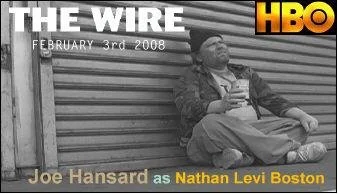
Scott Templeton, when mingling with the homeless to try and find usable react quotes, encounters some of the same characters McNulty did earlier—they’re mentally ill, merely quirky, downright reticent, or just plain hostile. A good example of this is a man (played by Joe Hansard) who gives his name as Nathan Levi Boston and seems on the verge of telling Scott who did the homeless murders, but then says, “Do you believe Satan walks the earth in a fleshly form?” Scott is utterly stymied and defeated. The scene in the shelter and among the homeless suggests that Scott has no ability to connect with ordinary people—nor does he seem to have the ability to empathize with his subjects or think outside his own experience, perhaps explaining why he finds it necessary to fabricate (more on that later).
Clay Davis appears on an African American AM talk radio station (it may have been WOLB 1010 AM—and was that Larry Young, who has a morning show on the station, interviewing him? If that’s so, it was a brilliant bit of casting; Young is a former state legislator from Baltimore who was expelled in 1998 for allegedly taking kickbacks and improper dealings). A rally is to be held at 2pm outside the courthouse to support Clay, who is presenting himself as just another example of a Black leader who is only trying to do good, but is persecuted for it by the white power establishment. Clay says, “It’s time to lift ev’ry voice,” a reference to the “Negro National Anthem” by James Weldon Johnson. Later, Royce speaks on Clay’s behalf at the aforementioned rally because Royce is dirty too, and Clay is going to carry the water for all of them. While smiling and holding up Clay’s hand for the photo op, Royce mutters to Clay that he’d better stand tall on this, meaning he needs an assurance that Clay will absorb all the punishment in return for Royce’s ongoing support.

Back in the newsroom, Alma informs Gus that more manpower has been assigned, according to the PIO (which stands for Public Information Office, I believe). Fletch turns in great background work, including the fact that the first victim was an ex-Marine. Scott breezes in, having magically found react quotes from a whole family of four living under the Hanover Street bridge. The name of the father was Nathan Levi Boston—a name actually given to him by crazed individual who kept invoking the devil. He even describes how the mother kept stroking her son’s blond hair. Templeton has quite obviously fabricated this entire family and all the quotes and information gathered. His invention of a blond-haired boy represents pandering of the worst sort—he believes the paper’s (particularly white, middle class) readership will respond more strongly and empathetically to a white homeless family than an African American or family of color. Shortly thereafter, Scott insists the homeless serial killer story has legs and he continues neglecting the schools series—and as we’ll soon learn, Scott knows exactly why the story has legs.
McNulty ignores his ex-wife’s phone calls, then finally shows up at her house, having missed his son’s play. His sons, who seem to be in their mid-teens, are practically indifferent to their absentee father’s short visit and nervous jokes. It’s a sad commentary on how skewed his priorities have become, as he’s now a hackneyed stereotype: a philandering divorced man, an alcoholic who buries himself in his work and the bottle to bury his pain. His ex-wife, Elena (Callie Thorne) then talks to Jimmy outside the house, noting that she talked to Beadie, who is at the end of her rope with him. The ex-wife says she was actually happy for him and Beadie when he’d seemed to turn things around—but now he’s throwing it all away. McNulty, who is expert at avoiding his problems, just walks away. In a later scene, Beadie meets briefly with Bunk in desperation to try and make sense of what’s happening with McNulty—for she’s about to “put him out.” Bunk, also bewildered by his friend’s behavior, is torn between his allegiance to McNulty and Jimmy’s obviously hurting companion; he makes vague excuses for McNulty’s behavior, downplaying his transgressions, and Beadie leaves disappointed.

In the first scene in which we observe the actual machinations of Templeton’s dishonesty, Scott uses a payphone to call his cell, then writes notes in a reporter’s notebook while listening to neither. His fabrications are bound to emerge somehow, but it’s still unclear how. A subsequent scene occurs in The Sun’s boardroom and features Klebanow, Gus Haynes, Scott, McNulty, and perhaps the publisher. Scott claims to have spoken to the serial killer, who called his cell from a payphone; he’s in deep now. According to the “killer,” he will produce twelve bodies before he’s finished, after which he’ll go somewhere else. The “killer” goes on to insist that they wanted him to bite them, that they asked for it. He complains that the article made him sound like a pervert. After Scott asked the “killer” if he was angry at the men, the caller hung up.
McNulty’s reactions in this scene are priceless: he knows it’s all fabricated, but he doesn’t know how to play this. This development—a reporter now fabricating developments—could ruin or make his case. Scott goes on to make up details: it was a white guy in his 40s who spoke in a calm monotone. McNulty says that the Homicide unit received a similar phone call (he’s lying, clearly, to play along and capitalize on his sudden good fortune). As Gus leaves the meeting, he remarks, “Ten minutes ago I’d have said this whole thing was complete bullshit. Shows what I know, I guess.” He’s on to Scott, but can he prove it? Surely he’ll get the evidence he will need—I can’t wait to see how this will play out.
Omar, with Butchie’s friend Donnie (Larry Andrews), stakes out Marlo’s lieutenant, Monk—not to be confused with America’s favorite obsessive-compulsive detective, played by Tony Shalhoub on USA. Omar’s patient, waiting night after night, but he seems oblivious to the fact that he’s also being watched and, as it turns out, set up. This seems to me like a blunder quite out of character for Omar. When he and Donnie decide to ambush Monk’s family, they encounter Snoop, Chris and Michael, who have been lying in wait for them. There is a heart-stopping shootout, during which Omar dives behind a couch and seems to show real fear for the first time since he was sent to prison. After Donnie is killed, Omar takes a Batman-like flying leap (his trenchcoat even billows like a cape) out the third-floor window, seemingly disappearing into thin air. Michael, Chris and Snoop peer off the balcony, baffled as to where he’s gone. (Where the hell did he go?)

Next on “The Wire”: we see Randy—he’s grown too! The mayor gives a speech about the homeless murders; Marlo is doubling the bounty (on Omar?) and seems to be making a play for control of the coop.
END OF EPISODE 55 NOTES
Monsoon's "The Wire" Notes - Episode 54
“The Wire” Episode 54 – TRANSITIONS
Notes and observations
Please be advised that this episode of “The Wire” is available only HBO On Demand and will not air on HBO until Sunday, January 27th at 9pm. The material below includes spoilers, so please do not read further if you do not want to know what happens in episode 54.
S
P
O
I
L
E
R
S
P
A
C
E
Episode 54 (tagline: “Buyer’s market out there” – Templeton) is one of those Wire episodes that is more about setting up explosive scenarios than actually depicting explosive action. (Though the ending is certainly haunting and startling.)
It begins with Tony Colicchio (Benjamin Busch) and another narcotics detective staking out a corner observing a young boy openly placing a lunch bag under a stoop, which they assume is filled with drugs for sale. They roll up and make everyone present get up against the wall. Soon Tony (the hot-headed police with the faux-military jackbooted flat-top) retrieves the paper back and sticks his hand inside, only to find that there is actually feces inside, and he has been the butt of a childish prank. In his anger and embarrassment, Tony begins slamming the boys against the police van and wantonly arresting them for little apparent reason. Soon Carver arrives and questions why it is necessary to block traffic in all directions with this police action. Just then an African American motorist asks insistently—but politely—that one of the police cruisers be moved so he can get where he’s going. Tony attacks the motorist, pulling him halfway out of his driver’s side window, before being restrained by several other officers. Most troublingly, I was not surprised by such openly unethical and racist conduct.
Later in the show, Carver tries to coach Tony on how to write up the report and informs Tony that he had been beating on a teacher who was trying to get to an after-school program. When Tony asks why the teacher hadn’t said that, Carver snaps back, “He didn’t have a chance.” Tony’s anger again boils to the surface when he says of the teacher, and the idea of writing a report explaining his actions, “Fuck his ignorant ass.” It’s difficult to think of a more poignantly ironic statement in the history of the show—an African American teacher trying to get to an after-school program is beaten by an unhinged cop, but the teacher is the ignorant one.
As a result of his actions and lack of contrition, Carver informs Tony he’s going to write him up for “excessive force” and “conduct unbecoming.” Toward the end of the show, Herc comes by to have a beer with Carver in the squad lot and tries to intervene on Tony’s behalf. Herc—who is predictably friends with Tony—tells Carver that Tony is facing suspension and all but asks Carver to reconsider. Carver then tells Herc about the situation involving Randy from last season, when Herc was supposed to deliver him the boy as a witness, with tragic consequences. Carver sums up how dramatically different his and Herc’s paths have diverged by saying, “It all matters. I know we thought it didn’t, but … it does.”
On to the newsroom, where Scott Templeton is discussing with Alma whether he should take the “Preakness piece” or the one about a firefighter’s death to his interview with the Washington Post. While Templeton is focused on his interview, Alma is excited by rumors she has heard that Mayor Carcetti will be firing Burrell today. Again a contrast is evident here: Scott is dedicated to furthering his own career, while Alma is focusing on doing good journalism.
Since the show is constantly being compared to a novel, I’ll apply a literary term here: foil. Foils are characters that are opposite in nature, and whose contrasting characteristics highlight these traits in one another. An example from the literature I teach is in Shakespeare’s Hamlet: while Hamlet is pensive and unwilling to take action—he thinks but does not act—Laertes is hot-headed and rash—he acts before he thinks. Laertes’ impetuousness serves to underscore Hamlet’s lack of action, and vice versa. Foils in “The Wire” off the top of my head include Carver and Herc (one dedicated and responsible, one not); Scott and Alma (one a career-focused fabricator, the other an eager and passionate journalist); Gus and Whiting (one of whom yearns for the days when journalists were allowed to do their jobs, the other a corporate automaton with his head up his arse); the examples are many. The idea with foils is not that one character is all good and the other all bad, but simply that there is some aspect of their behaviors and natures that provide a striking contrast. This topic might be an interesting one to parse further on the message board.
Templeton’s interview at the Washington Post is a disaster. In it, we learn that he started out at the Wichita Eagle, then went to the Kansas City Star for three years, and has been at The Sun for two years. The interviewer (I’m unsure of his position at the paper) says of his feature article, “Your feature work is a little raw, language-wise,” meaning that Scott’s writing is too colorful, peppered with colloquialisms and flowery adjectives. Scott says that his editors encouraged him to write that way, but that “I prefer to write it dry,” meaning just the facts, with plain prose. We know this to be utterly false, of course; not only does Scott like to write florid prose (referring to Oriole Park at Camden Yards as a “Colosseum”) but that he also likes to invent quotations and perhaps even people altogether. Scott also shoots himself in the foot when the interviewer notes that “The Sun’s a fine paper” and Scott replies, “Before the cutbacks, maybe,” after which the interviewer notes that The Post is still scooped by The Sun on occasion. Bashing one’s current employer is unattractive in interviews—and seriously diminishes his own value: if he works at what he thinks is a shitty rag, what kind of experience will he bring to us? Scott is told his résumé will be kept on file and sent briskly on his way. (When Alma later asks him how the interview went, he delivers the episode’s tagline: “Buyer’s market out there” and adds, somewhat unconvincingly, that “The Sun’s not so bad.”)
In the ensuing newsroom scene, one of the reporter’s chairs has an “I’m union and proud!” sticker on the back, which was a nice touch. It’s the attention to detail, as always, that makes this show what it is. (The “Fill-It-In” puzzle books on Prop Joe’s table later in the episode are another one of these seemingly throwaway touches that enhance the show’s naturalism.) Alma and another reporter are struggling to get comments or confirmation (even off the record) from police and government sources about the commissioner’s imminent firing, again underscoring the value of veteran reporters and their well-cultivated sources. Twigg, who is packing up his desk on his last day, gives the younger reporters a “gift” by placing a call to one of his sources (was it Stan Valchek?) as the e-dot deadline approaches.
At Carcetti’s “grip and grin” press conference, with Burrell and Daniels standing behind him, the mayor pays bureaucratic, politically prudent tribute to Burrell on his “retirement” while Gus, watching in the newsroom on television with a group of other reporters, “translates,” giving up the true meaning behind Carcetti’s pedestrian statements: “He feared and hated me, and I merely wanted him dead,” which sounds like Gus is quoting someone, but I can’t figure out who. When Carcetti talks about Burrell’s having played a role in “making Baltimore a safer city,” Gus quips, “don’t stray from the Inner Harbor,” and finishes off Carcetti’s speech with “It took a while, but I finally put his ass out to pasture.” When the mayor presents a plaque to Burrell at the end of the news conference, Gus says, “Plaques for hacks – prerogative of any big city mayor.” Gus Haynes is every bit the world-weary cynic, and Clark Johnson plays him with aplomb.
Soon, Managing Editor Thomas Klebanow, who has observed the tail end of Gus’s remarks, asks where the paper is with the story. Gus tells him that Twigg was the one who could “work department sources” and that a “veteran in the cop shop is what gets us over on a story like this” but, he adds sarcastically, “fuck if we didn’t buy ours out.” Klebanow’s response, which manages to be condescending while seeking to defuse the employee’s anger, will be familiar to anyone who has dealt with a hard-headed, perpetually-missing-the-point member of middle management: “I understand you’re disappointed with the cutbacks, but civility is important. I’ve been meaning to talk to you about your profanity. … A collegial atmosphere is essential.”
Immediately thereafter, the local news shows Clay Davis’ “perp walk,” orchestrated by the state’s attorney, leaving his Grand Jury testimony. (His comments to the assembled television reporters are vintage, oily Clay Davis, who composes himself quickly after being badly shaken when Rhonda reveals some of the evidence they hold against him.) Gus is dismayed to see a story on TV that his own paper has missed completely. When he calls over Bill Zorzi, who covers the Federal courts for The Sun, Zorzi reminds Gus that the paper no longer has daily city court coverage. Zorzi tells Gus facetiously that he’d be happy to take on the city courthouse coverage as well. “In fact,” he generously offers, “why don’t you just stick a broom up my ass and I’ll sweep the floor while I’m at it?” Great line, oft-repeated, can’t find its origin for the life of me.
Scott’s going to help Zorzi run down the Clay Davis story and play “catch up.” Gus closes the scene by lamenting the fact that when the state’s attorney leaked the fact that Clay Davis would be leaving his Grand Jury testimony (“setting up a perp walk”), the newspaper did not get a phone call. “All they care about is the video,” he grumbles.
The next newsroom scene is in the tradition of the “evacuate” scene in episode 51, and is one of the reasons I’m loving this season, as someone familiar with the journalistic profession, as an English teacher, and as a lover of language. A copy editor asks Gus to take a look at the “fifth graph” (paragraph) of Alma’s article about Burrell. It reads, “The mayor, incensed by the commissioner’s performance,…” Jay reads the copy and says “to incense is to inflame with wrath; it speaks to obsession. Is that the mayor’s state of mind?” Jay suggests they use “galled, vexed, annoyed—safer still, displeased.” This sort of back-and-forth banter and debate was more common in newsrooms of old, but is increasingly rare at today’s understaffed, overworked newspapers with high turnover. Gus admiringly says to Jay, “You’d take the crab out of crab soup,” by which I think he means that he’d cut anything unnecessary or errantly cited.
Gus also gives Scott a rare “atta boy” for his work on the Clay Davis piece, which is not likely to be his choice of words when it comes out that Scott has been cooking his articles.
(A possible error I noticed, which doesn’t happen often on “The Wire”: I thought Alma had the byline on the Burrell article, but when Landsman is reading the paper, it’s difficult to read but I think it’s Roger Twigg on the byline.)
Near the end of the episode, Prop Joe brings Marlo to meet with Levy to discuss his finances (namely, laundering and hiding them more effectively, it would seem). Sitting in Levy’s office reading the paper is Herc, now an investigator. Marlo looks at Herc and asks, “you ever find that camera?” and Herc replies, “it cost me the job.” Herc is such a clueless dolt that I actually enjoyed the fact that Marlo needled him here. As Levy meets privately with Marlo, Herc then makes small talk with Prop Joe about the fact that Burrell is out as commissioner. Prop Joe says, “Ervin was a year before me at Dunbar. He was in the glee club.” Pressed further, Joe says Burrell was “stone stupid.” “Dunbar” refers to Paul Laurence Dunbar High School in Baltimore, named after the African American poet (the school’s sports teams are even called the Poets).
Continuing with Prop Joe, who had a strong presence in this episode… He begins the episode in a flower shop, purchasing a funeral arrangement—foreshadowing if I’ve ever seen it—for Butchie. The card, according to Joe, should read, “Woe to them that call evil good, and good evil. Your true and loyal friend, Proposition Joe.” It’s an approximation of Isaiah 5:20: “Woe to those who call evil good, and good evil; who substitute darkness for light and light for darkness; who substitute bitter for sweet, and sweet for bitter! Who to those who are wise in their own eyes, and clever in their own sight!” Aside from its obvious implications to “The Wire” universe, sending that card to Butchie’s funeral not only sent a message to Omar that Joe was not involved in Butchie’s murder, but also sealed his fate with Marlo.
At the end of the episode, Prop Joe thinks he’s going to go away for a while to get out of Omar’s path, but Chris and Marlo emerge and it becomes clear to Joe that he is to be killed. In true fashion, his final words are, “A proposition, then…I’ll just go away, and you’ll never see me again.” Marlo assures Joe that he could no more change what he is that Marlo could. Then, in one of the most chilling scenes on the show, Marlo speaks in almost soothing tones to Joe, who sits before him at the table: “Close your eyes, relax. There now, breathe easy,” at which time Chris points a gun at the back of Joe’s neck and pulls the trigger. Marlo’s eyes—cold, remorseless, soulless—gaze dispassionately at Proposition Joe’s body, and the episode ends.
Judging from the previews—was that Snoop and Omar having a shootout, with Omar ducking behind a couch?—the next episode will be breathtaking.
END OF EPISODE 54 NOTES"The Wire" episode 53 notes & observations - contains spoilers
“The Wire” – episode 53
Notes and observations; episode 53 is on HBO On Demand only and will air on Sunday, January 20th at 9pm. Please be aware there are spoilers present below.
S
P
O
I
L
E
R
S
P
A
C
E
Episode 53—tagline, “They’re dead where it doesn’t count” from Fletcher—was one of the best of the series so far, in any season—the writing, the plot twists, the character development were all stellar.
The episode focuses on a wide range of topics, from Marlo’s money laundering to Michael’s tension between childhood and his responsibilities to his corner; from the Clay Davis Grand Jury to upheaval in the commissioner’s office; from cuts at The Sun to McNulty’s concocted serial killer.
The episode begins by concentrating on the aftermath of the murders by Snoop and Chris in episode 53, namely the ink it receives. Alma Gutierrez’ article, headlined “Three killed in west side home invasion,” was originally 35 column-inches and appeared destined for the front page. Instead it receives 12 inches below the fold in the Metro section. Alma runs from store to store at around 5 in the morning looking for the paper, then finally ends up at one of the printing plants to get a look at her first “front,” or front-page story for which she has the sole byline (so-called because it contains “By” and the reporter’s name). Gus apologetically says, “your piece took a bad bite,” acknowledging that Alma’s article was cut considerably; though it wasn’t his fault, he says “we messed up” in not giving the story a more prominent place.
The problem, according to Fletcher, is that “they’re dead where it doesn’t count,” and speculates that it’s the “wrong zip code.” If three had been killed in Timonium, an affluent, 90% white suburb of Baltimore, it would have received front-page status and at least 35 inches.
Soon the troops are gathered in The Sun’s newsroom (they’re even fetched from across the hall in Features and Sports) for announcements by the managing editor and the executive editor, James C. Whiting. Gus and some veterans of the newsroom speculate that “maybe we got sold again,” a reference to the fact that first the LA Times then the Chicago Tribune have bought The Sun in recent years. Gus observes sardonically that “we’re the minnow” because they keep getting swallowed up by media conglomerates. There’s also speculation that Whiting might be poised to announce Pulitzer Prize wins for the paper, but these are not due out for a week—and besides, Gus notes, if he were about to deliver such news, he would be sporting an unmistakable erection.
Whiting begins by using vague, euphemistic language to hint at what’s to come: buyouts and layoffs. “The news hole is shrinking,” he says, and advertising dollars are down. The news hole refers to the news content to be produced, increasingly dictated by the amount of space that needs to be allocated in each day’s paper. The bigger the ad space and other peripherals, the smaller the news hole. Because circulations are generally down, advertisers are being more and more stingy with their advertising dollars at newspapers. Whiting goes on to say that “technology is driving distribution” and that the internet has become a free source of news content. As I’ve discussed before, and others have picked up on, the newspaper industry has, by and large, allowed technology to control the gathering and dissemination of news, rather than harnessing technology into a profitable and affirming tool. In other words, the newspapers have gotten played by the internet rather than playing it, to borrow one of the show’s many taglines.
As a result of all this, Whiting says that “hard choices” had to be made in order to meet “budgetary targets” set by the Tribune company. Five foreign bureaus—London, Beijing, Moscow, Johannesburg, and Jerusalem—are to be shuttered immediately. (See my post on episode 51 for a more in-depth exploration of this trend.) There will also be a fresh round of buyouts involving veteran workers, along with layoffs. For the first of two utterances in the episode (and his third over all this season), Whiting says they need to “find ways to do more with less.”
Then managing editor Thomas Klebanow (David Kostabile) is thrown to the wolves by Whiting as he reads a prepared statement and fields their questions. He talks about a “voluntary separation plan”—a euphemistic way of saying “buyouts” that is laughably antiseptic in tone. Under a VSS (voluntary separation scheme), the corporate entity eliminates the positions of those who “volunteer” to take buyouts, saving the company lots of money in the long run. Essentially, veteran workers are “voluntarily” separated from their jobs, the jobs themselves are separated from the newsroom, and the newspaper is separated more and more from the quality on which it once prided itself. Some employees will be “moving on to other opportunities beyond The Sun.” Aside from the celestial implications of such a move, this is another euphemistic way of saying that there will be firings.
Gus Haynes (Clark Johnson), the conscience of the newsroom and the voice of true journalism in the show, asks of Klebanow, “How come there’s cuts in the newsroom when the paper’s still profitable?” It’s a valid question, since the profits of most newspapers, though down, are still the envy of many ordinary corporations. But the managing editor only offers corporate doublespeak and bottom-line apologetics in response. Gus is later pulled in to a meeting with Whiting and Klebanow during which he’s told that “we’re counting on you to transition the new team” and Gus shares his frustrations and concerns that he is being left with a gutted staff.
The word “cooked” is used a couple of times in this episode. It occurs to me that one of the themes of this episode and season in general is becoming the idea of “cooking,” a term with origins in accounting; to “cook the books” means to falsify financial records to cover up wrongdoing, inflate profits, or hide deficits. In the school plot, the jump in numbers (test scores are up 15%, apparently) is likely the result of “cooking”—though this isn’t stated; Burrell has “cooked” his crime statistics, for which his job is in jeopardy; McNulty is “cooking” the cases to produce a phony narrative about a serial killer targeting the homeless; Scott Templeton is “cooking” his pieces, it’s becoming clear (more on that later); and Prop Joe is “cooking” (really, laundering) money for Marlo, which also tangentially involves Clay Davis.
Speaking of “cooked” crime statistics, the mayor’s office is planning to “leak” the real statistics to The Sun. This term means to give out information surreptitiously, usually for personal or professional reasons involving strategy or retribution. (The Valerie Plame CIA “leak” case comes to mind here as a particularly nefarious example of this phenomenon, but ordinary leaks happen all the time, usually involve little harm, and are quite indispensable to both the political and journalistic systems.) Cut to a scene with Carcetti’s chief of staff and political voice of reason Norman Wilson (Reg E. Cathey) sitting at a bar with city editor Gus Haynes, who had been summoned via text message by Norman. It’s revealed that Norman used to work at The Sun before getting into politics; Norman goes on to “leak” the information that Mayor Carcetti is planning to “shitcan” Commissioner Burrell and that Chief of Detectives Cedric Daniels is the “frontrunner” for the position after a likely interim period with Rawls in charge.
Roger Twigg (Bruce Kirkpatrick) is featured prominently in this episode, primarily because he’s offered one of the buyouts. Twigg is a veteran reporter who has worked police cases for years. According to Twigg, “they can hire one and a half twentysomethings for what it costs to keep me in print.” This sort of crystallizes the problem with modern journalism and the rampant buyouts—an inexperienced staff with high turnover is replacing entrenched, established, veteran journalists who have become masters of their craft.
Gus goes to Scott with Norman’s leak, offers the young reporter the story, and asks Scott what he knows about Daniels, but Scott’s never heard of Daniels. Gus poses the same question to Twigg and receives a litany of information—all off the top of his head—based on years of working sources, knowing the players, and doing good journalism. Twigg gets the story. Again, this scene sums up many of the points the show is trying to make about modern journalism: Twigg, who is an undeniably valuable resource and stellar reporter, is being bought out, while the floundering the comparatively clueless Scott is taking his place, in a sense. In fact, when Scott is told by Gus to find “react quotes” (reactions about the story’s subject from local lawmakers, political movers and shakers, police sources, and the like) to accompany Twigg’s piece, he simply fabricates or pipes a quote. When pressed by Gus Haynes, Scott says that the “high-ranking city hall source” is actually Nerese Campbell (Marlyne Afflack). As I stated in my episode 52 posting, I fear Scott’s fabrications will only get more outrageous and brazen, with disastrous consequences for The Sun and for the subjects of the paper’s legitimate stories.
The good news here, if there is any to be had, is that Twigg’s police department reporting is being picked up by the dedicated, hard-working, and intuitive Alma Gutierrez. When concocting the serial killer story, McNulty decides to “leak” word of these linked homicides to The Sun and calls Alma. When the two meet at a coffee shop, he tries to charm and flatter her (saying that he’s read her stuff, and that it’s very good; flirting with her) but she’s having none of it (“bullshit,” she answers when he compliments her writing; “I’ve got a boyfriend, detective,” she fires back when he openly flirts).
In a scene at a bar, Gus and Roger Twigg chat about their lives and careers, clearly yearning for a simpler and purer time in journalism. Gus recalls watching his father read the paper raptly each morning before departing for work, and wanting to be a part of something so important that it held his father’s undivided attention. Roger remembers seeing a man on a train folding his “broadsheet” meticulously and examining it rapturously, looking every bit the smartest man on the train; that was the moment he knew he wanted to be in the newspaper business.
(A broadsheet is the most popular newspaper style, consisting of long, vertical pages folded in half; a full broadsheet contains four pages—front and back—while a half broadsheet contains two pages—a single sheet printed front and back. Tabloids are newspapers that are folded only once in the center. Examples of broadsheets include The Sun, The Philadelphia Inquirer, and The New York Times; tabloids include The New York Post and the Philadelphia Daily News; “tabloid” has also come to mean sensationalized or gossipy rags, but not all papers that appear in this format fall into the derogatory “tabloid” category.)
The scene with Roger and Gus is a touching scene, one that says a lot about both characters and about the newspaper business as a whole. Roger bids farewell by repeating H.L. Mencken’s epitaph: “If, after I depart this vale, you ever remember me and have thought to please my ghost, forgive some sinner and wink your eye at some homely girl.” Henry Louis (H.L.) Mencken was known as the “Sage of Baltimore” and was a journalist, essayist, and satirist active during the first half of the twentieth century. He is noted for his coverage of the Scopes trial (he coined “Scopes Monkey trial”), his incendiary editorials, and his pithy one-liners. A few of my favorites, some of which I’ve shared with my students…
“A cynic is a man who, when he smells flowers, looks around for a coffin.”
“Love is the triumph of imagination over intelligence.”
“Nobody ever went broke underestimating the intelligence of the American public.”
“Democracy is the theory that the common people know what they want, and deserve to get it good and hard.”
A great scene in this outstanding episode—and my notes here have covered mainly the journalistic aspects, leaving out provocative material with the likes of Omar and Prop Joe and Michael and DuQuan, for example—is when McNulty is anxious to see the splashy article he expects based upon his leaked information about the spurious serial killer. He runs to an honor box (the coin-operated newspaper boxes, so-called because it is only on one’s “honor” that one takes only one newspaper, rather than several) as the paying customer is getting his newspaper. As McNulty says “hold it!” and reaches in to retrieve a newspaper he hasn’t paid for, the man mutters, “you cheap motherfucker” as he walks away. McNulty is crestfallen to discover that the story about the fact that the murders of homeless men may be linked was positively buried on a deep interior page of the Metro section and received the briefest of treatments. Landsman later describes its position as “back in the girdle ads.”
Most riotous of all is the scene in which Bunk has brought Lester into “the box” to talk some sense into McNulty regarding his scheme. Much to Bunk’s amazement and indignation, Lester actually begins to counsel McNulty on how to improve his scheme. A classic scene.
END OF EPISODE 53 NOTESMonsoon Martin's The Wire - Episode 52 Commentary
“The Wire” – episode 52 (focusing primarily, but not exclusively, on the show’s journalism-related content)
Please note that this episode has not yet aired on HBO (it is available only on HBO On Demand) and therefore contains spoilers for most viewers. Please observe the spoiler space below to avoid gaining unwanted information about a show you haven’t yet seen.
S
P
O
I
L
E
R
S
P
A
C
E
The tagline on episode 52 is again from Bunk, who says “this ain’t Aruba, bitch.” The statement occurs during a barstool conversation among Bunk, Lester and McNulty about why the 22 murders of African American Baltimoreans now are not being investigated, and why the media have not made more noise about that fact. The conclusion is that the bodies were “the wrong color” and that if 300 white folks were killed each year in Baltimore (or wherever), the National Guard would be brought in. Finally, McNulty makes a reference to the Natalee Holloway case in which a southern teen on vacation in Aruba disappeared, earning the media’s (led by the likes of Nancy Grace) fixation, prompting Bunk’s apropos comment. I couldn’t agree more.
My first observation from this episode deals with the scenes involving Steve Earle and Bubbles (whose first name, apparently, is Reginald). Now, Andre Royo is a breathtaking actor who can convey volumes of feeling, of experience, regret, guilt, weariness, etc., all with a shrug of the shoulder or the dizzying, herky-jerky delivery of his lines. Steve Earle, who plays Bubs’ sponsor and the leader of a twelve-step group of recovering addicts, is not an actor. He’s a singer, and he’s not even very good at that. Earle’s lines are delivered with a distracting woodenness that strikes a discordant note in otherwise moving and successful scenes. He’s one of the very few Wire actors I have ever felt were miscast (the others being Anwan Glover as Slim Charles and Aidan Gillen as Councilman—now mayor—Tommy Carcetti). Given the sprawling nature of the story and the hundreds of faces that have appeared and spoken onscreen, that’s not a bad ratio, I suppose…
There is a sense of foreboding with McNulty in the opening scenes of the show, in which he makes angry, misdirected comments at Rhonda Pearlman and Kima observes after his departure, “he’s a pissy little bitch today.” (A comment that could be—and has been—said of me on more than one occasion.) It doesn’t help matters when his car has a flat so he nearly breaks his foot kicking the car, then has to take an MTA bus to the crime scene of his homicide investigation. I have to say I’m glad McNulty (played by Dominic West) is being featured more prominently this season. He’s the perfect example of the working class in a postmodern city—stuck in the system, yet smart enough to know what parts of the system are screwed. McNulty’s impotent anger—hitting out at the wrong targets because the problems are bigger than can really be addressed—is the driving force of this show. It’s telling that even Bunk, who has abetted many of McNulty’s misadventures both on and off the job, is horrified by his partner’s actions at the end of the episode.
In another memorable scene out by the loading docks of The Sun, where Gus and some other veterans go for smoke breaks, Gus tells the oft-repeated story of a young reporter in a news conference with 1950s Bawlmer mayor Tom D’Alesandro who meekly (and rather spinelessly) says several times that “the city desk wants to know” this and “the city desk asked me to clarify” that. Without a word, the mayor finally puts his ear to his own desk, looks up and says, “My desk tells your desk to go fuck itself.” The old-timers agree that the story is too good even to verify, but it has been repeated and printed in several sources.
The Sun’s Executive Editor James C. Whiting (played with oily corporate aplomb by Sam Freed) begins a meeting in the conference room by stating that he wants The Sun to go for its Pulitzer. The Pulitzer Prizes for Journalism have been awarded for more than 90 years from an endowment left by famed newspaper publisher, editor, and pioneer Joseph Pulitzer. The most prestigious awards in the field of journalism, Pulitzers are awarded annually by Columbia University in 22 categories including reporting, editing, criticism, feature writing, and editorial cartooning. When Whiting says he wants the paper to go for its Pulitzer, it’s the equivalent of a studio head insisting that a Holocaust drama be made starring Meryl Streep in the hope of snagging Oscar nominations. It’s a craven and short-sighted statement that subverts the art it purports to celebrate, and Gus Haynes quite understandably rolls his eyes.
Whiting’s big idea is to produce a “Dickensian” series about the lives of city children—which will show “clearly and concisely where the school system has failed them.” The wording and construction here are priceless for both fans of “The Wire” and those who have spent some time around the field of journalism. First of all, “The Wire” has itself been called Dickensian by critics, who praise its resemblance to a nineteenth-century novel by Dickens like Bleak House in which the socioeconomic realities of the day are explored in a sprawling narrative, sweeping in disparate segments of population and experience. (A recent NY Times article on the last season of “The Wire” was even headlined, “No Happy Ending in Dickensian Baltimore.”)
Whiting’s statement is absurd because he is simultaneously calling for the Pulitzer-baiting series to be both “Dickensian” (passionate, thorough, expansive, detailed, naturalistic) and “concise” in focusing only on how the school system has failed children. To be truly Dickensian, the series would have to focus on children, parents, institutions, and everything in between—which “The Wire” does but newspapers almost never have the courage or dedication to do. Because Scott Templeton, the young hotshot reporter who wants to work at a “real” paper like the Post or Times someday, agrees with Whiting that context isn’t that vital to telling such a story—and thus earns himself the lead on the series. Whiting says they need to “limit the scope, not get bogged down in details” and an unnamed reporter pipes up and says, “There’s more impediments to learning that a lack of materials or a dysfunctional bureaucracy.” Whiting’s response: “But who wants to read about that?” Again, The Sun is pandering to the lowest common denominator, which has been the case for the field of journalism in general. Reporters are instructed on most pieces to assume their readership is at a sixth grade reading level, a short attention span, and little initiative or natural curiosity. And the product reflects that.
The meeting ends when Whiting asks what the “budget line” (the “pitch” line in the budget, or roster of articles, that summarizes what the article will be about) will be and Gus responds, “Johnny can’t write ‘cause Johnny doesn’t have a fuckin’ pencil.” Whiting angrily insists the paper does not want “an amorphous series detailing society’s ills” (god forbid) because “if you leave everything in, soon you’ve got nothing.” This kind of double-talk is reminiscent of the managing editor’s statement in episode 51 that “you’ll just have to do more with less.”
The storyline here is intriguing on several levels. First, it’s another example of an institution that is set up to do good (journalism is designed to keep a public well-informed about its world) getting dragged down by short-sightedness, lack of funds, arrogance and incompetence. Second, it provides another point of entry into the schools, which were the focus of last season (will we see Prez this year?). And finally, it ties the whole thing up nicely; as Simon himself said in one of the introductory shows about this season of “The Wire”: if we’ve gotten any of this right, why are we the only ones paying any attention to it? In other words, where and why have the media failed?
That night, Gus has a “deadline nightmare” which occurs when one has put a piece “to bed” but later questions whether he or she might have made an error. Once the ink hits the page, it’s difficult to take the words back; the “Corrections and Clarifications” portion of a newspaper is usually buried on page A2 and seldom read. Gus is worried about the fact that he may have transposed (inadvertently switched) some numbers on a port article and wants to copy editor to check his “nut graph” (sometimes spelled “nut graf”). A nut graph is a usually the second paragraph in an article, and it details what the piece is about. Some reporters “bury” their nut graphs (put them too deep within the article, obscured by quotes, background, or set-up) and have to be reminded to let them breathe.
The managing editor soon singles Scott out for his loyalty by awarding him a leading “color” piece in a story about the opening day of the Baltimore Orioles’ baseball season. A color piece (from “local color”) is a human interest story that provides a personal angle on an otherwise straight-ahead story. Scott says, “I’d really like to find some chaw-chewin’ old timer who’d rather die than miss an O’s opener.” What he finds, however, are only cynics and casual fans: one older man laments the steroid scandal and says the sport is in disarray, another disinterestedly says that his son kinda likes baseball, and another punctuates his failure to get usable material by saying “Fuck baseball!”
The problem arises for Scott when he goes into his assignment with an idea of what he would find when he started asking questions. Journalists should go into any story well-informed, but otherwise wide open to the possibilities of the story’s path. When one starts an interview with an idea of what’s going to come out of the subject’s mouth, one begins to ask “leading questions” or those designed to elicit a specific answer. Then you’re “putting words in someone’s mouth,” as the dreadful Lesley Stahl does week after week on “60 Minutes.” (An example of a leading question that stands out in my mind from a Stahl interview: “And that made you feel really resentful, didn’t it?”) Because Scott knew he wanted a chaw-chewin’ old timer, he couldn’t use the material he did get from the cynics and casual fans, and therein lies the problem.
Scott magically arrives back at the newsroom and tells Gus about the story he did get—about a 13-year-old kid in a wheelchair (put there, evidently, by a gunshot would, though details are sparse) who did not have a ticket to the game. The boy would only give his name as “E.J.” (ostensibly because he was truant from school) and there is no art (no photograph to accompany the article) because a photographer was unavailable. Gus’s journalistic instincts cause him to question the piece, and rightly so. The background is shady, they don’t have a last name so there’s nothing to verify or fact-check, and Scott’s claim that there was no photographer is questionable (wouldn’t there have been at least one at the ballpark for opening day?). Moreover, Scott couldn’t locate the boy when he went back to try to get “art.”
None of this matters much to Whiting, though. He sees it as a solid piece that captures the disparity of the city—the upper crust, enjoying a ballgame, while a 13-year-old gunshot victim is stranded outside, pitifully listening to the roars of the crowd. He awards Scott the “lead” (it will appear front page, despite the lack of “art”) and Gus must capitulate.
I have a feeling I know where this storyline is going: Scott made the whole damned thing up. He wandered around outside the ballpark, failing to get the story he wanted, and finally got desperate and concocted this young boy out of thin air. In future episodes I think it’s going to come out gradually: there never was a boy named “E.J.” shot in Baltimore; the schools have no record of this child; the photograph never received a call requesting “art” for Scott’s article. The end result is a scandal—and I don’t think Scott will stop there. In his Pulitzer-baiting series on the failure of schools, he’ll fabricate information, pipe quotes (invent or embellish direct quotes from sources), and the like.
It may be surprising to many outside the field that reporters could or would make shit up; we assume that every word we read in the paper is precisely as it went down. But it happens far more than one might think. Milder examples include quote piping (cleaning up, rearranging, or even creating out of thin air, supposedly direct quotes from a subject so it fits more cleanly in the piece). More extreme examples are the cases of Janet Cooke, Jayson Blair, and Stephen Glass. Briefly, Janet Cooke was a reporter for the Washington Post in 1981 who had to return a Pulitzer she won for a piece on an eight-year-old heroin addict who did not exist. Jayson Blair invented interviews, quotes, and places for the New York Times in the late 90s; he submitted expense reports for trips that never happened, and described places he’d never been. He also plagiarized (took pieces of other people’s articles without crediting them). His actions were a serious “black eye” for the newspaper and several editors resigned in the wake of the scandal. Finally, Stephen Glass was an associate editor and writer for the New Republic magazine who was perhaps the most audacious fabulist of them all—he invented people, corporations, commissions, and conventions, and created a sloppy paper trail to back it all up.
How could this have happened? Aren’t reporters’ articles fact checked? Yes, they are, but there’s at least one huge hole in the process. In cases like those cited above, the fact-checkers are relying mainly on the reporter’s notes for confirmation, because they involve privileged or fleeting conversations, confidential sources, or the like. And this is, I’m afraid, what’s going on with Scott.
END OF EPISODE 52 NOTES
Monsoon Martin's The Wire - Journalism Terms Glossary (episode 51)
My Weather-Friends,
As many of you know, I consider “The Wire” the finest television show in the history of the medium. It has just begun its fifth and final season on HBO, and the focus this go-round is the media and its struggles and failures. The season will be centered around a newsroom (a fictional Baltimore Sun) while still following some of the other plot threads (schools, drug trade, police activity, city hall) that have developed over the previous four seasons. Since there was a lot of jargon being thrown around in Episode 51, and because I have some background in the field of Journalism, I thought I'd put together a sort of running glossary/guide for the terminology used. I am, of course, open to corrections or clarifications on any of these points. (I would also like to thank the members of the Yahoo! Wire group in advance for the fine-tuning this list has already undergone.) The show airs Sunday nights at 9 on HBO with episodes appearing On Demand the Monday previous to airing.
Enjoy!
Monsoon
“The Wire” Journalism terms
Episode 51
The Baltimore Sun is the newspaper of record for the state of Maryland, having been founded in 1837. It is now owned by the Tribune Company in Chicago, which also owns the LA Times, the Orlando Sentinel, and other papers in addition to its broadcast media holdings.
The open floor plan layout of the Sun’s newsroom on “The Wire” is very true to life. It was designed as such to maximize interaction among a newspaper’s various departments and desks, unlike a traditional office, which is usually fragmented by a series of high cubicle walls. As the Sun’s City Editor Gus Haynes (played by Clark Johnson) says, “I’ll tell you what a healthy newsroom is. It’s a place where people argue about everything, all the time.” More competition, overworked and younger employees, and lack of job security have dampened this free and spirited exchange of ideas in modern newsrooms. Though the (real) Sun’s TV critic pans the portrayal of his newspaper on “The Wire” as simplistic and mired in jargon, I think it’s nuanced and brilliant.

The Managing Editor referred to in the first conversation is the second-highest in rank after the executive editor, and is directly responsible for most of the day-to-day operation of the newspaper.
A Foreign Bureau is physically located in a foreign country and usually includes reporters and an administrative staff (whereas a Foreign Affairs Desk is dedicated to foreign reporting but is physically located on the premises of the publication). In the first news scene, the three gentlemen are discussing the rumored closings of all foreign bureaus, including Johannesburg and Beijing. Foreign bureaus are typically expensive to maintain, so cost-cutting measures target them aggressively, opting to rely instead on foreign reporting by the
Associated Press (AP) or other foreign bureaus.
The three gentlemen by the newspaper loading dock are also discussing impending layoffs and buyouts, “as bad as in Philly.” This refers to the recent downsizing of staff throughout layoffs, early retirements, and buyouts at the Philadelphia Inquirer and Daily News. This is endemic to mid-size to large newspapers throughout the country, which are still profitable—but less so, due to declining circulation, loss of readership and ad revenues, etc. The publishers and managing partners of the news outlets panic because profitability is down—though still fairly robust compared with other industries—and begin laying off workers. It has been argued that profitability is down as well because content is made freely available online, which is not the case in other countries. Buyouts began in earnest in the 1990s and in most cases, when a worker is “bought out,” the job itself is eliminated as well. David Simon himself took one of the initial buyouts at the Sun. Many departments are now expected to churn out the same quality product with half its former staff size.
An illustration of this phenomenon is when another, smaller paper “scoops” the Sun on a transportation story the Sun should have gotten. While Haynes reminds the managing editor that the Sun has not had a transport reporter since the last round of buyouts, the managing editor reminds his staff that “just because Chicago does a little belt-tightening is no reason for us to fall down,” referring to the Tribune Company’s ownership of—and immediate and incessant cost-cutting measures at—the Sun. He then utters the famous phrases (which resonates through the police subplot as well), “You’ll just have to do more with less.” In one of the HBO documentaries about the fifth season, David Simon adds, “Of course you don’t do more with less; you do less with less.”
Haynes complains to a reporter that he’s always having to rework his lead. The lead (sometimes spelled lede) refers to the first sentence or two of a news piece, which conveys as much of the 5W and 1H (who, what, where, when, why and how) as possible. Particularly in today’s world of short attention spans, the headline and lead are often the only things a reader will actually read as he or she peruses the newspaper. Here is a very good example of a lead from the January 2nd edition of the Washington Post: “Candidates for the Democratic and Republican presidential nominations rallied supporters in Iowa today on the eve of the state's caucuses, as new polls showed tightening races among the leading contenders in both parties.”
Later in this exchange, Haynes asks the reporter to get him material by the “e-dot deadline” and later mentions a “double-dot deadline.” According to a Yahoo! Wire group member: “Dots are also called bugs. They're tiny marks you see at the top of the page if the page has been reworked for a later edition. Pages for the first edition (also called Four-Star) have an 11:30pm deadline (approx) and have no extra mark on the page. Five-star, or E-dot, is marked with one dot and would be the the five-star (next edition, the deadline is around 12:30am). Five-star chase, or double dot, is the final, marked with a letter F or C or a dot and a letter F or C and that close is anywhere from 1:15am to 2:30am depending on what kind of news day is happening.”
A deadline, of course, is the time set by which a step of the reporting process must be completed—copy deadline refers to when a story’s finished draft must be submitted to a copy editor; print deadline refers to the moment an edition must be finished and laid out to be sent to the printer. An article is often referred to as a “piece.”
From another Yahoo! Wire group member: “The path is story creation, then source editing (do the facts make sense? too much or too little of something in the story), copyediting (correct typographical errors), slot editing (does it fit on the page space allotted to it? plus putting in the headline, pull quotes and so on), then the page is checked and approved. You can't have all the stories done at the same time, because then your various editors would have too much to do all at once.
“Similarly, they can't send all the pages at once, because there is a limited number of plates that can be made at once. If they want to change ten pages on deadline, it's a really big deal, and they may let the pages go if they're not actually erroneous and do a ‘chase.’ This is where they replace the plates on the press after printing the first few, or if it's multiple presses they hold back on one press and put on the new ones, then stop the first and replace the old ones, all so they won't miss the press deadline for first good paper out of the pressroom.
“Color pages require multiple copies (cyan magenta yellow black) and every page has to have two plates because they put two copies on the drum, so plate A impresses and then plate B. Unless it's a "collect" run, but that doesn't happen very often.”
A columnist is a newspaper employee who is paid to write periodic (usually weekly or biweekly) columns for the paper, which can be humorous, lifestyle, related to politics or civic life, business, sports, or any number of niches.
It’s one of the few places in the newspaper (the other being the op-ed page, or opinion-editorial page) where a newspaper employee may offer his or her opinion. Haynes derisively remarks that columnists are “paid to sit on [their] asses.”
The Associated Press (AP) is a news organization that employs a vast (though shrinking) network of reporters to produce stories that will be syndicated throughout the country—and sometimes the world. Sometimes the AP will “pick up” a story that is of wider interest from a local or regional newspaper and syndicate it to other news outlets. On these occasions, the local reporter receives additional pay and his or her newspaper is highlighted as one that is producing quality journalism. Newspapers must pay to use AP articles, of course.
Haynes shouts on a couple of occasions that he needs “budget lines.” He’s looking for shorter pieces of background relating to the developing city budget. Another theory from a Yahoo! Wire group member: “The budget is the list of stories scheduled to be printed that night. Without more context I'm not sure what Haynes is asking for, but he's probably asking to be allowed to put more stories in.”
A reporter asks, “What about art for the Hopkins press conference?” Art here refers to photographic illustration of a story, which is essential for prominent pieces. Because downsizing occurs among the photography staff of a newspaper too, though, it’s difficult to get a photographer to every newsworthy event.
A couple of things related to newspaper “art”: first, a “grip-and-grin” is a derisive term for a photograph of a civic event that features participants shaking hands and posing—as the announcement of a new initiative, the donation of funds, etc. Also, Haynes is incensed when he receives the “art” for an East Baltimore row house fire because it features a charred doll in the foreground. This composition is a common—and lazy—way for a photographer to convey the sense of loss and the ways in which a fire may have affected a home’s children.
Haynes speculates that since all of the photographer’s fire photos have a burnt doll or singed toy in the foreground, he must have a trunk full of them and some lighter fluid so he can stage the photograph just right.
Various desks are mentioned—state desk, metro desk, city desk. These are dedicated “departments” whose reporters cultivate knowledge of, and write pieces about, civic affairs in the city, metropolitan area, and state. The reporting in these areas has suffered mightily as a result of cutbacks, particularly at a place like the Sun, because older reporters with lots of contacts and expertise are being “bought out” and inexperienced recruits fresh out of “j-school” (journalism school), who will work cheaply, are hired.
Another cost-cutting measure that has been used for years by newspapers is the use of floaters and stringers. A floater is a part-time or full-time reporter who is not bound to any particular desk or specialty. The problem here is that one becomes mediocre at lots of different things, but not excellent at any of them. A stringer is a freelance writer hired by the newspaper on an as-needed basis and paid per article. Stringers sometimes have specialized knowledge (like the “College Park stringer” mentioned in the episode) and are often used to attend municipal meetings, cover local sporting events, and the like.
The editors discuss “20 inches” and “15 inches” at different times here. This refers to the length of an article, and is technically measured in “column-inches.” A column-inch is a one inch deep (long) and one newspaper
column wide. Reporters—particularly ambitious ones, or those for whom brevity is difficult—are forever trying to get more inches.
Some stories “go national” (are picked up by the national press because their appeal or newsworthiness transcends regional considerations, as with the 22 bodies story). Another reporter, however, contends that this story did not “have legs”—meaning that it did not become the source of ongoing follow-up pieces or deeper investigation. The ultimate story with “legs” was Watergate.
The ambitious reporter Scott Templeton (played by Tom McCarthy) is chagrined at being sent to “pull clips” and “check the morgue files” so he can write the “A-matter” on Ricardo’s history. He is being asked to check through the Sun’s archives (electronic files, physical clippings, and possibly even microfiche or film) to find previous articles about the principals in this story so he can provide the background material (which will be presented “up front”) against which the story can be told. It’s essential but unglamorous work that young reporters often draw.
The editors, late at night, determine that the Ricardo story “deserves a front” and will appear on the “front page, below the fold.” This means that the story is newsworthy enough to merit inclusion on the “jump page” or front page, but will not appear “above the fold” where screaming headlines and attention-grabbing images are shown. The “jump page” is so called because this is typically the only page in the first section from which articles “jump” (are continued on a subsequent page, indicated by a “jump line”—please see Ricardo on A12). In this configuration, six or seven articles can be included on the front page, with probably only one or two above the fold, and they all jump to the inside pages. Note that there has been some discussion about whether the jump page actually might refer to the page to which many of the jumps go.
Alma Gutierrez (Michelle Paress) is complimented on her ability to secure a quote from the article’s subject when Haynes says to her, “Good pull.” For her efforts, she receives a contributing line (or contrib line), which doesn’t
impress Templeton, but means she’ll receive something like “with additional reporting by Alma Gutierrez” under the main reporter’s byline (name) or (usually) at the conclusion of the piece. A “pull quote” is also the name for a quote that is featured in larger font surrounded by rules (lines, or a box) in an article to draw the reader in; Alma may have contributed a quote from the subject that was used in a pull.
Templeton states that he wishes to get out of Baltimore because it has “shit news,” but Alma is clearly invigorated by her work and feels that “the Sun is still a pretty good paper.” Templeton wants to move up and out—when asked
where, he answers, “The Times or Post, where else?” He’s referring to the New York Times and the Washington Post, the two most respected newspapers in the United States, widely considered the pinnacle of the profession.
“When did this break?” is asked of the Ricardo story. Bill Zorzi’s character (is he playing himself?) is asking when the story “became” news—not only when it occurred, but when someone realized it was newsworthy.
Finally, Templeton asks Haynes who is “doing the react piece” on the Ricardo story, because he sees that it could be a story that “has legs.” A react(ion) piece seeks to broaden the story by talking with associates of the principals, political figures, and others to assess the impact of the original story.
END OF EPISODE 51 NOTES.