
Monsoon Martin's Open Letter to White People re: Barack Obama
National polls conducted since the end of the Republican National Convention have shown John McCain with a lead over Barack Obama as high as four percentage points, but that’s not even the aspect of the poll I found most alarming. Recent polling indicates that “whites” support McCain over Obama at a rate of 55-60% to 35-40% consistently—nearly 20 percentage points in most polls.
Now, I don’t trust polls, particularly in this election that features millions of newly registered voters, comprised of Democrats over Republicans at a rate of 2 to 1; and in which (mostly) young voters who have only cell phones are not being reached by traditional polling methods. But the resurgence of the McCain campaign since adding the Barracuda to the ticket is undeniable—there are (overwhelmingly white) people across this land who have been taken in by Sarah Palin’s “jus’ folks” persona and plainspoken convictions. (I have spent more than a little time over the past two weeks dissecting and directing vitriol toward Alaska Governor and Vice-Presidential candidate Sarah Palin—some have commented that my visceral reaction to her ascendancy has been “obsessive” and even “worrisome”—so I won’t belabor that point. At least not right now. Just prior to the election, I will present my list of reasons why not to vote for John McCain, for the undecided or McCain-leaning voters in my audience.)
And finally, I’m getting a little hinked out about the potential for the so-called Wilder Effect. This refers to the 1989 gubernatorial election in Virginia in which Democrat Douglas Wilder (African American) ran against Republican Marshall Coleman (white): polling in the days before the election indicated that Wilder would win the office comfortably, by at least a 9% margin; he actually won by a half-percent, a result so close it had to be verified by recount. It seems—as the theory runs, supported by post-election polling and studies—some white folks had told pollsters they would vote for Wilder, had walked into the polling place intending to vote for Wilder, but once the curtain closed, they just could not bring themselves to pull the lever for a Black man.
The fact that racism still exists in this country in many forms is as undeniable as the fact that many white people supported and continue to support the candidacy of Barack Obama—not despite or because of his racial heritage, but with indifference to it. But consider this: while current national polling reveals 5% of whites admit they would not vote for Obama because he is Black, exit polling after the Democratic Pennsylvania primary indicated that more than one in six white voters who chose a candidate other than Obama did so because of his race.
All of these factors have me and some other progressives contemplating the unthinkable fewer than 50 days before the election: that John McCain could actually end up winning the goddamned thing. And so, I need to have a chat with the white people who will decide this election—Hispanics are supporting Obama at a rate of 66% or higher, while African-Americans are going for the Democratic ticket at greater than 90% in most polls. Yes, white folks, it wasn’t enough to colonize this land and control its inhabitants, its corporate holdings, its commerce, and its government, its judiciary, for 400 years; now you’re going to be the key factor in deciding whether this nation, whose past is so stained with the wretched heritage of bigotry, will elect its first Black president. Whites, Caucasians, ofays, crackers, honkys: I’m talking to you.
----------------------------------------------------------------------------------------------
Dear White People,
It has come to my attention that despite Barack Obama’s historic campaign, despite the millions of people from all walks of life who support him, and despite the fact that Republicans have sent this great country shimmying down the shitpipe over the past seven-plus years, a nearly two-to-one majority of you say you will not be voting for the Democratic ticket in November.
I know some of you are scared. You’ve been worked up into a lather by right-wing talk show hosts, pundits, email chains, and your screwy Uncle Jed, who have all told you of the horrors that will be visited upon the American populace if Barack Obama should be allowed to take the Oath of Office.
My melanin-challenged friends, I need you to take a long, brutally honest look inside yourselves—down “in places you don’t talk about at parties” (Col. Nathan Jessup, USMC, in A Few Good Men)—and figure out just what’s stopping you from supporting Senator Obama. I have strong doubts that it’s because you feel passionate about the candidacy of John McCain, one of the least-compelling candidates I can recall.
It’s OK. Your old pal Monsoon is here to help you deal with the fallout from this potentially unpleasant journey of soul-searching. The reason I’ve contacted you, White America, is to reassure you about some key points that may have found their way into your subconscious “Why I don’t want to vote for that Obama guy” litany—either through your email inbox, impromptu discussions at the grocery store, or even through years of internalized messages about race and racism in America.
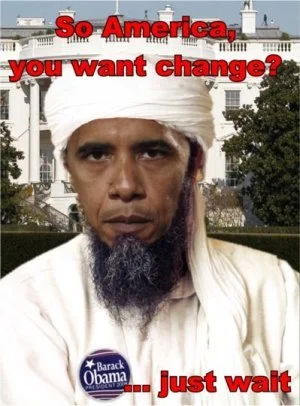
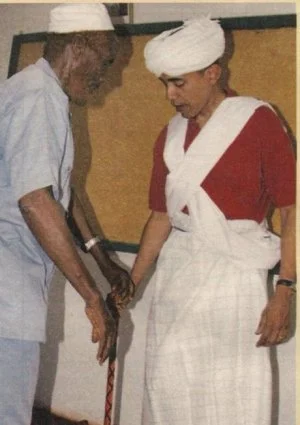
One of the most persistent and pervasive rumors—10% of respondents in most polls report that they believe this is true—is that Barack Hussein Obama is a radical Muslim who took his oath of office as Senator from Illinois on a Koran instead of a Bible. As President, his “geographical allegiance” would be to Mecca—where adherents of Islam direct their prayers—rather than to the country he has been elected to lead. In fact, the rumors suggest, he is only seeking the presidency in the hope of waging global jihad from inside the White House. (Pundits on Fox News and CNN have even referred to him as “Osama” in an unforgivably Freudian slip.) Not that it should really matter in a country that prides itself on being a “melting pot” of diversity, tolerance, and freedom of worship, but Barack Obama has repeatedly stated he’s a Christian, and there is no credible evidence that he attended an Indonesian madrassa (radical Muslim school) as a youth. Do any of you recall the shitstorm that rained down on him for the incendiary comments of his pastor and longtime spiritual mentor, Jeremiah Wright? I think that pretty much seals it.
Another tack in the “smearing” of Obama’s spiritual values goes something like this: Actually, he’s not a Muslim or a Christian; he’s an atheist who will infest the world with his godlessness and trample on the rights of Christians. Well, now this is damning, quite literally. In a country where 85%-90% of its citizens believe in God—and 60%-70% believe in angels—it is understandable that folks would want a President who shares their religious values. But it’s a crying shame, too, that Americans can’t look beyond this sort of thing and realize that a lack of religious conviction does not necessarily preclude an individual from exhibiting values like charity, empathy, and fairness. In fact, look at the example of born-again Christian George W. Bush, who has said repeatedly that God “speaks through” him and directs his decisions, particularly those that shore up U.S. foreign policy in the Middle East. Anyhoo, Barack Obama is an avowed Christian. End of story.
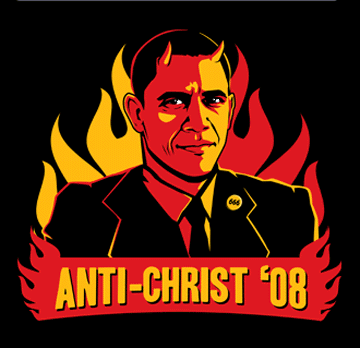
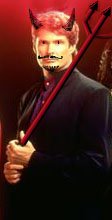
Barack Obama, according to some widely distributed email chains, is the antichrist. He is the “King of South” (referencing Daniel)—since he is “from” Kenya, which is south of Jerusalem—who shall “shall do as he pleases, exalting himself and making himself greater than any god; he shall utter dreadful blasphemies against the God of gods.” The antichrist is described in John as a man who will have incredible charisma, who will gain the backing of millions of followers through his promises of bringing peace and instilling hope, and who will ultimately establish dominion over the entire world, turning God’s creation into a reeking hell, according to the emails. The Book of Revelation describes the fact that the antichrist will be a Muslim man in his 40s who will rule for 42 months (almost a full Presidential term). He will come mounted on a white female horse (and Obama’s mother had six African husbands—nice misogynistic conflation of a female horse with Obama’s mama, Ann Dunham, who seems to have actually been married just twice, and only once to an African man). Obama “hails from” Chicago, whose zip code is 60606 (see those three sixes?). In point of fact, the book of Revelation does mention a beast, “[a]nd there was given unto him a mouth speaking great things and blasphemies; and power was given unto him to continue forty and two months.” But there’s nothing about the “beast” (no mention of antichrist in the New Testament) being and in his 40s of Muslim descent, and nothing about a horse. In addition—oh, screw it. If you truly believe that Barack Obama is the antichrist, then you need more help than I can give you, or indeed than the finest psychiatric facilities can provide. Besides, everyone knows that the real antichrist is the incomparable überstar of stage, screen, and song, David Hasselhoff.
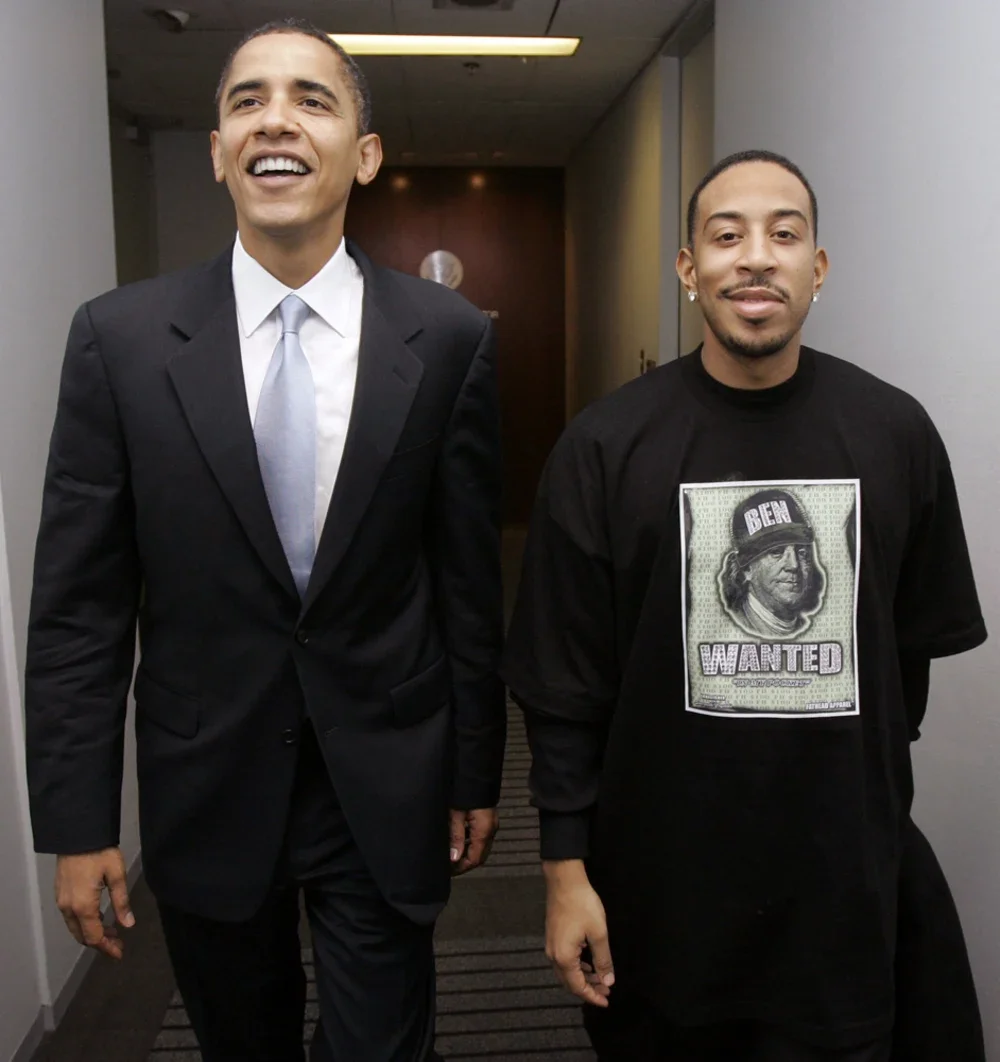
Another popular argument insists that Barack Obama will favor Blacks over whites in his policy-making. (He’s even been “endorsed” by Louis Farrakhan, for god’s sakes.) If this were true, couldn’t it also be said that a white President, simply by virtue of his skin color, would ignore Black issues? (Kanye West’s observation that “George Bush doesn’t care about Black people” after the criminally negligent Katrina response notwithstanding, you see the point I’m trying to make.) In point of fact, Barack Obama has been assailed by many in his own community for failing to address issues like civil rights and poverty aggressively enough. The Rev. Jesse Jackson even commented into a “hot mike” that he’d like to “cut [Obama’s] nuts off” for making speeches insisting that Black fathers take responsibility for their children, a fairly conservative viewpoint. To be sure, Barack Obama’s diverse racial heritage makes him uniquely attuned to issues of race—his platform includes promises to strengthen civil rights laws and end racial profiling—but he’s not going to establish a D.C. (“Dark Country,” as Richard Pryor memorably fantasized about the District of Columbia) once elected. Barack Obama has been described as the first “postracial” candidate: he has garnered support for his policies and his abilities, not typically because of, or in spite of, his race. (Even his “race speech” in Philadelphia, perhaps his most famous address, focused on transcending rather than celebrating racial differences.) So: he’s not going to institute mandatory break-dancing lessons on the South Lawn or commission Ludacris to write a new hip-hop National Song "Starz and Stripez (Fo' Yo' Ass)" to replace “The Star-Spangled Banner.” Play dates, scrapbooking bees, and Mary Kay cosmetics demonstrations will continue unabated. Banana Republic will remain open for business and fully stocked with khaki. John Tesh concerts will, unfathomably, go on as scheduled. Your Netflix queue will not be disrupted. Take a deeeeeep breath. There.
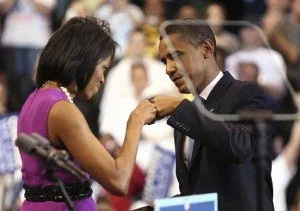
In a related line of thinking, sky-is-falling types suggest that Michelle Obama hates her country, will wield too much power in influencing her husband, flaunts her support of terrorism by fist-bumping her husband, and will invite militant Black Power groups like the Panthers to stay in the Lincoln Bedroom. It has been alleged (in footnoted diatribes, increasing their apparent legitimacy) that in her Princeton thesis she wrote that America was founded on “crime and hatred” and that white people are “ineradicably racist.” But thorough checks of her thesis have revealed that neither of these phrases appear anywhere in the thesis. Some think that, like her husband, she will “elevate black over white,” but no evidence exists to suggest this would come to pass. Surely, as I said above, she will advocate for some of the issues—welfare reform, poverty, affordable housing, crime—that disproportionately affect the Black community. But as she would be the first African American First Lady, it would be a squandered opportunity not to address these problems. Finally, regarding Michelle Obama, there’s the matter of her comment in February that “For the first time in my adult life, I am proud of my country, because it feels like hope is making a comeback.” Okay, bad choice of words there, admittedly. But she was celebrating the fact that people of all races had come together behind her husband, a step many would have deemed highly unlikely prior to this historic election season.
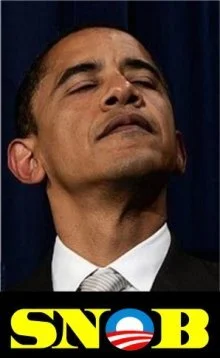
Some pundits and even ordinary folks like to paint Obama as an ivory-tower elitist because of his Harvard Education and the fact that his manner seems erudite and even aloof at times. He thinks he’s smarter than everyone else, the argument goes, and he has trouble relating to ordinary folks. (Some of you call him “arrogant” or “uppity,” an observation that has its roots in a time of more overt and limiting racism when Blacks had to stay “in their place.” Surely his affect is not more arrogant than that of Bill Clinton, yet few people have dwelt on his “uppity” manner.) First, to address the elitism: one does not work successfully as a community organizer in the most impoverished sections of Chicago, as Obama did, by being an out-of-touch elitist. Second, Barack Obama will not make you feel stupid—unless you are. Has it occurred to you that our President should be smarter than we are? He’s faced with entrenched, complex problems in every area of his governance—foreign policy, the domestic economy, healthcare, environmental stewardship, and more—so I’d just as soon see a guy with an egghead in the White House. (Not to beat a lame duck, but we’ve just suffered through seven and a half years of being led by a guy who graduated Yale with a C average, with seemingly no natural curiosity, who has led more with his “gut” than with his brain. And look how well that’s turned out.) Finally: the very notion that John McCain, who owns nine houses (so many that he’s lost count) and whose wife, Cindy, is worth at least $100 million, would call Barack Obama an elitist is absurd on its face.
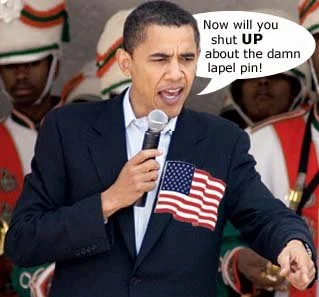
It has also been circulated that Obama refuses to say the Pledge of Allegiance and won’t wear a flag pin, and is therefore unpatriotic. He’s in the “blame America first” crowd and will not exhibit the love of country needed to govern correctly. Oh, here we go again with the slippery definitions. Specifically, what is patriotism? If wrapping yourself in the flag and a horrific national tragedy as you send thousands of inadequately equipped young people to die in (and mercilessly bomb) a sovereign nation, then cut veterans’ benefits, is patriotic, then President Bush surely is. If patriotism is standing by idly as more than 2,000 citizens on the Gulf Coast perish due to the ineptness of a grossly underfunded agency headed by one of your cronies, then let’s have a big “God Bless America” for W. again. If it’s patriotic to offer your buddies in big business tax breaks for outsourcing American jobs, moving plants abroad, and polluting the environment, then by all means, let’s hear it for G-Dub. I, on the other hand, prefer to define patriotism in the following way: a true patriot will be eternally vigilant in evaluating and criticizing his government; a true patriot loves his country too much to see it hijacked by the religious right and neo-conservative war-hawks. And finally: the pictures that purport to show Obama refusing to put his hand on his heart during the Pledge were actually snapped during the Anthem, and he’s singing. As for the flag pin, I can’t fathom a more trivial matter with which to concern ourselves during this dire time in America.
I have heard that his tax plan will raise taxes on all of us to pay for his social programs, driving us into a recession; his economic plan will harm American businesses, hamstring the free market, and cost American jobs. Hello? The economic climate now—under a Republican administration—is not looking too rosy. For a supposed “conservative,” G.W. Bush has played fast and loose with the national treasury in funding a war of aggression against a nation that posed no threat to the United States, subsidized companies doing business in Iraq, bailed out two mortgage giants and now the world’s largest insurer (AIG), etc. Obama’s tax plan would actually provide tax relief for 150 million working families and shift the burden onto the super-rich. He would also seek to hold companies accountable for unethical practices, tax windfall profits, protect workers’ rights to organize, raise the minimum wage, crack down on predatory lending (including credit cards), reform bankruptcy laws to favor consumers, and seek to maintain and create jobs in the U.S. by eliminating tax breaks for companies that shift their operations overseas or outsource. And he’d introduce much-needed regulatory controls to curb speculation in the market.
According to critics, Barack Obama is a peacenik who wants to talk to our enemies without preconditions and will be hesitant to use military force. First of all, listen to the man’s speeches: to my personal dismay, he has said that he actually wants to increase troop levels in Afghanistan while leaving Iraq; would attack Iran if necessary; and would consider any unilateral act of aggression against Israel an act against the United States, potentially answering that violence with military might. So while he’s certainly not in the category of a Richard Perle in terms of his hawkishness, he’s not nearly the effete, slow-to-act caricature that’s been painted in some quarters. And finally, just what in happy hell is wrong with talking to our “enemies”—I mean, really giving diplomacy a shot, unlike the charade that ensued in the first months of 2003 before the U.S. invasion of Iraq—before things get really out of hand? It’s not as if sitting and talking is going to make the U.S. look weak; it’s going to make us look prudent and deliberate, two qualities that have been sorely lacking in this country’s foreign policy.
On a related note, some folks are bothered by the fact that Barack Obama’s candidacy has been embraced by people of all backgrounds living around the world. If people in the Middle East and throughout Europe love him, the “thinking” goes, that means he is going to collude with them in taking down the American system and way of life. Oh, here’s a doozy. His popularity is now a liability? In a recent television ad, John McCain’s campaign even tried to link Obama’s popularity in the U.S. and abroad to “famous just for being famous” figures like Britney Spears and Paris Hilton. (How would McCain now explain the crowds who have been flocking to see—and have been forming a cult of personality around—his running mate, Sarah Palin?) You see, I thought it was good to be popular, as long as it’s for the right reasons. Barack Obama’s popularity stems, it seems to me, from a few key characteristics: his elocution, his relative youth, his promise of change, and the fact that his candidacy represents promise and possibility to those, here and abroad, who viewed America as hopelessly racist in its domestic policies and determinedly exceptionalist in its foreign policies.
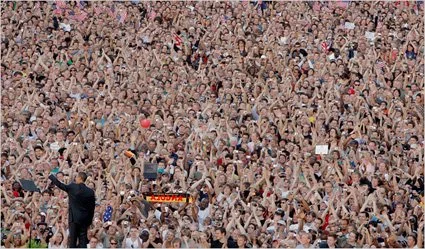
Speaking of his youth, many worry that he lacks adequate experience to be Commander-in-Chief; he’s only worked as a community organizer, taught Constitutional Law at the University of Chicago law school, was elected state senator, and now U.S. Senator. Well—and forgive me from dwelling on the current administration, but I’ve got some emotional brush to clear in purging myself of accumulated anger—we had an experienced guy and he didn’t work out too well. George W. Bush skirted Vietnam, ran some oil companies and then a baseball team into the ground, helped his daddy get elected, spent about five years as Governor of Texas, and then was appointed President of the United States by the Supreme Court in 2000. And what “experience” can really prepare one to be President? It’s the qualities of judgment and wisdom and a sensible, far-sighted approach to governance we can use to ascertain if a person will make a good leader. Barack Obama, in my view, has these qualities.
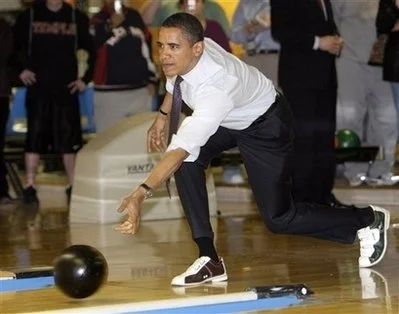
While we’re on the subject: some denigrate his speeches as too “smooth” and polished. My friends, I think we could stand a President who is thoughtful and articulate after seven and a half years of cringing at the non-sequiturs of a nannering ninny. We’ve had a President for two terms now who reminded us of a guy we’d like to go bowling with. Now we need somebody who can actually process thoughts into intelligible words and sentences—never mind that he can’t bowl to save his life (rolling a 37 in Altoona back in a March campaign stop). Heck, maybe he’ll even tear out the White House’s bowling alley and install a basketball court when he wins. (Oh—sorry, white folks. Didn’t mean to scare you there.)
To some, his lack of bowling prowess—his style was derided in some quarters as “dainty”—proves that he’s out of touch with the common man. Seriously? To me it just proves that he’s fallible. And do you really want a guy to be hitting the lanes for two, three hours each night to hone his skills? Shouldn’t he be reading, studying policy memos, deciding the fate of the free world—shit like that?
He’s not going to take your guns, as NRA alarmists posit—you’ll still be able to shoot animals and intruders to your heart’s content. But he may take steps that will eventually remove some handguns and assault weapons off the streets of our most dangerous cities and towns—and that’s incontestably a good thing.
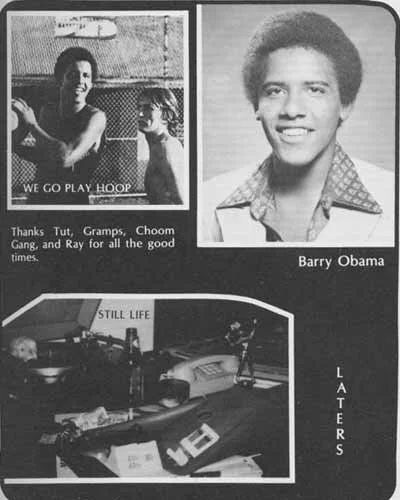
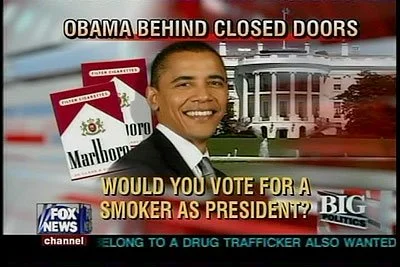
He admitted to using cocaine, marijuana, and drinking alcohol to excess while in high school. Well, la-de-freakin-da. You just described more than half of teenagers nationwide, according to polls, at least with the weed and booze. And at least he admitted it. Jeez. And another thing: Barack Obama is a longtime smoker who has reportedly kicked the habit while on the campaign trail. Now that’s impressive self-discipline.
It is often alleged that Obama is the “most liberal congressman in the entire U.S. Senate” – according to a study done by the National Review – but (again, to my dismay) this is patently false. His support for the Bush wiretapping bill and his unequivocal support for Israel are just two of many examples that bear this out. And since his days as a community organizer and perhaps even before, Barack Obama has displayed an almost obsessive commitment to building consensus. Indeed, his campaign has drawn record numbers of independents and even Republicans to support him, and there is little reason to speculate that he’ll morph into the spineless, godless liberal bogeyman of Ann Coulter’s worst nightmares.
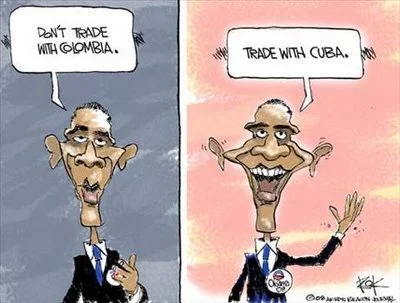
And finally, rest easy: Barack Obama will not use his gigantic lips to transport half of the citizens of Cuba to the United States to be granted political asylum. What—what??! Yes, my friends, according to an article in the Reading Eagle that was picked up by some national outlets, this was the brilliant statement made by Adam LaDuca, a senior at Kutztown University—ah, I fairly swell with pride that it’s in Berks County—on his weblog: he has “a pair of lips so large he could float half of Cuba to the shores of Miami (and probably would).” In his defense, LaDuca insulated himself from charges of bigotry with the following caveat: “And man, if sayin’ someone has large lips is a racial slur, then we’re ALL in trouble.” (As we all know, prefacing an utterance with a clarification of its intent is always the most effective way to deflect the truth, a la: “I don’t mean to be racist, but why do Black people talk so damned funny?” or “I’m not a sexist or anything, but why doesn’t Hillary Clinton just go home, put on an apron, and bake me some cookies?”) Anyhoo, LaDuca—who, by the way, in a delicious bit of synergy, was the executive director of the Pennsylvania Federation of College Republicans—was forced to resign his post. LaDuca, you may remember, held an “Affirmative Action Bake Sale” when he was president of the College Republicans at Kutztown—at which whites were charged more for cookies than Blacks. What. A. Guy.
Well, white people, I hope you’ve found this a worthwhile enterprise, and that I’ve succeeded in helping you purge some of the ugly misconceptions surrounding the candidacy of the next President of the United States, Barack Obama. (If you felt calm or even inspired when you read that last bit, or even peed a little with joy, then our exercise here has worked. If you felt panic or loathing, or even threw up a little in your mouth, then we’ve still got work to do.) Feel free to send this to your fellow Caucasians across the political spectrum if you think my message will help in their decision-making processes.
Please contact me if I can be of further assistance.
Sincerely,
Update
on 2008-09-22 03:18 by Monsoon Martin
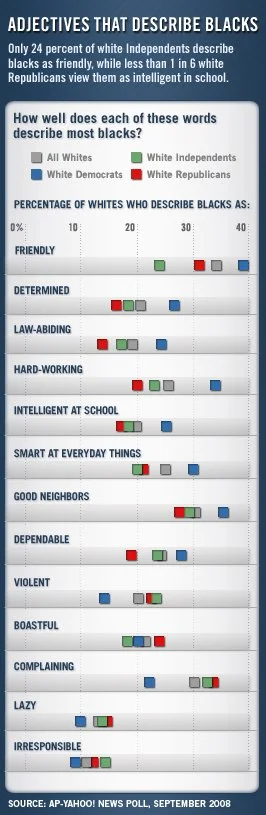
An AP/Yahoo! poll suggests that Obama's ofay problem may be even more significant than I posited above. Though I disagree with the methodology of the study and therefore question both the reliability and validity of its findings, there are some potentially alarming indications here. One such finding was, "Statistical models derived from the poll suggest that Obama's support would be as much as 6 percentage points higher if there were no white racial prejudice," which could be a game-changer if the election is anywhere near as close as polls suggest.

Monsoon Martin's Analysis of Barack Obama's Philadelphia Speech, 18 March 2008
Analysis of Barack Obama’s “More Perfect Union” speech at the National Constitution Center in Philadelphia, 18 March 2008
Senator Barack Obama’s speech on Tuesday was billed as “historic” before a word of it was even uttered, and has received near-unanimous praise since its delivery. I thought it was a very, very good speech with a lot to admire, but there were a few things that trouble me.
[A couple of notes here: first, I invite you to comment on and argue with my ideas here. Second, I’ve added a couple of new features to the weblog, which I’m still figuring out how to use to its fullest potential. You’ll notice that at the very end of each posting are links that read “Email” and “Print”—these will enable you to (you guessed it) easily email to your friends and print out each posting!]
Being an English teacher, I’ll first approach the speech as a work of literature, evaluating its structure, its pacing, its symbolism and recurring themes. Then I’ll try briefly to foresee how the speech might impact the primary election, and how Americans will respond to it.
First, the speech began with a quote. If one of my students had begun a writing piece with a quote—even one that set up the thematic milieu of his speech, as Obama’s did—he or she would have been docked points. But here, it was effective to begin with “We the people, in order to form a more perfect union,” because his speech then went on to discuss how “the American experiment” continues to work, sometimes falteringly, towards perfection.
Obama stood in front of six gigantic American flags in the National Constitution Center and romanticized the Constitutional Convention of 1787, whose resultant document was “a Constitution that promised its people liberty, and justice, and a union that could be and should be perfected over time.” Though the setting was so ham-handedly patriotic that it could have come out of a Jerry Bruckheimer film, Obama’s words softened the effect, talking as he did about America as a work in progress—citing protest, struggle, civil war and civil disobedience as part of the great history of perfecting this union. He also pointedly mentioned slavery as one of the Constitution’s—and our nation’s—great failings, and its eventual eradication as one of its great triumphs.

“This was one of the tasks we set forth at the beginning of this campaign,” he went on, deftly connecting America’s past struggles—grassroots and governmental—with his own candidacy. “To continue the long march of those who came before us, a march for a more just, more equal, more free, more caring and more prosperous America.” Obama went on to say that he has such faith in the ability of the American people to make change because of his own story, and went on to cite his oft-mentioned upbringing. “It’s a story that hasn’t made me the most conventional candidate. But it is a story that has seared into my genetic makeup the idea that this nation is more than the sum of its parts—that out of many, we are truly one,” he went on, citing the American motto “E pluribus unum.”
He moved then to an appraisal of his own campaign’s success at crossing racial lines and indeed transcending race: “Despite the temptation to view my candidacy through a purely racial lens, we won commanding victories in states with some of the whitest populations in the country.” Obama lamented several times that commentators, pundits, and media figures seemed to be playing too great a role in determining what the American public is regarding as important in the race. “At various stages in the campaign, some commentators have deemed me either ‘too black’ or ‘not black enough.’” In the last few weeks, he said, the primary elections have taken a decidedly “divisive” turn in their obsession with race:
On one end of the spectrum, we've heard the implication that my candidacy is somehow an exercise in affirmative action; that it's based solely on the desire of wide-eyed liberals to purchase racial reconciliation on the cheap. On the other end, we've heard my former pastor, Reverend Jeremiah Wright, use incendiary language to express views that have the potential not only to widen the racial divide, but views that denigrate both the greatness and the goodness of our nation; that rightly offend white and black alike.
Now he’s obviously referring to the racially charged comments made by Geraldine Ferraro about a week ago and referenced in one of my recent postings. And “purchase reconciliation on the cheap” is one of many examples in this speech of brilliant turns of phrase. (Remember that Obama writes most of his speeches, and reportedly wrote almost every single word of this one; he’s an accomplished wordsmith in addition to being a spellbinding orator.) He also brought up his former pastor, Rev. Jeremiah Wright, as expected.
The words he chose and forcefulness with which he condemned and dismissed Wright’s statements is where I part company with the candidate a bit. He referred to Wright’s comments as expressing a “profoundly distorted view of this country … a view that sees the conflicts in the Middle East as rooted primarily in the actions of stalwart allies like Israel, instead of emanating from the perverse and hateful ideologies of radical Islam.”
Oh, Barack. Wright’s views about the culpability of American foreign policy being causally responsible for the September 11th attacks; his suggestion that the CIA played a role, however distant, in fomenting the devastating crack epidemic in the inner cities; his criticisms of prisons and the justice system—these are views that are shared by plenty of intelligent, rational, clear-thinking individuals in this country and around the world. Granted, these are not mainstream views, but denigrating Wright’s views as “profoundly distorted” leave a very bad taste in my mouth as an Obama supporter.
And his simplistic appraisal of the Israeli-Palestinian conflict—essentially, that Israel can do no wrong, and Palestinians’ struggles are motivated solely by radical Islamic jihad or intifada—is alarming to me. (I had mentioned such concerns in my endorsement of Obama back at the beginning of February, and he’s shown me nothing to allay those concerns.) He may have scored a few points in distancing himself from rumors of being a Muslim, and attracted the fawning attention of Zionists, but his flip, absolutist summation of this morally and historically complex situation is unacceptable.
Obama got back on track, though, when he expressed a desire to move past a preoccupation with race and build unity in addressing a set of “monumental” problems: “two wars, a terrorist threat, a failing economy, a chronic health care crisis and potentially devastating climate change; problems that are neither black or white or Latino or Asian, but rather problems that confront us all.” It’s his inclusion of healthcare and economic concerns that gives me hope that Obama will live up to campaign promises to retool NAFTA, punish companies who outsource workers overseas, pursue serial polluters and predatory lenders, and force the reevaluation of a system that elevates profits above people. (Well, he hasn’t said all that explicitly, but I’m hoping he’ll tackle some of these issues.)
After denouncing (or rejecting, or whatever) Wright’s “distorted” views, Obama then stops short of casting aside his former pastor and mentor altogether. After all, he said, “that isn’t all that I know of the man.” Wright is a reflection of the Black community, Barack insisted, and very much a product of the turbulent era in which he grew up. The Black church, he explains, is misunderstood by many outsiders because of its complex admixture of the contemplative and the exuberant, the holy and the secular: “The church contains in full the kindness and cruelty, the fierce intelligence and the shocking ignorance, the struggles and successes, the love and yes, the bitterness and bias that make up the black experience in America.”
It was this passage that made me fall for Barack Obama all over again. Having studied African American culture for many years, I have often lamented that a lot of folks outside the community fail to grasp the complex forms of expression and variegated interactions inside the Black community. Black churches are houses of worship, yes, but many of them are also places of emotional release, of the struggle for social justice, of crass comparisons and exaggerations, of gossip and aid and tough love and mercy. Those who would dismiss Black churches—and by extension, the Black experience—as simple-minded, repetitive, overenthusiastic or inane are missing the richness and depth that has earned my profoundest respect and sustained my sincerest interest for more than 20 years.
“I can no more disown him,” Obama concluded here about Rev. Wright, “than I can disown the black community. He went on to very skillfully connect Rev. Wright’s ideas to the casual racial slurs of a relative:
I can no more disown him than I can my white grandmother – a woman who helped raise me, a woman who sacrificed again and again for me, a woman who loves me as much as she loves anything in this world, but a woman who once confessed her fear of black men who passed by her on the street, and who on more than one occasion has uttered racial or ethnic stereotypes that made me cringe.
Who among us does not have at least one stunningly ignorant distant relative who spouts racial slurs or anti-Semitic rants from time to time? Many of us even have a closer relative—a mother, a father, a sister, a brother-in-law—who is otherwise tolerant and sharp, but who once in a while lets a jaw-dropping homophobic phrase or embarrassing anti-Muslim stereotype slip? (I would not have been—nor am I generally—so forgiving or generous in dealing with racist white folks, but hey, he’s trying to run for President, here…) Speechmaking is all about getting the audience to identify with what the speaker is saying and feeling—where he or she is coming from. It’s an act of empathy, which is one of the most difficult things for a human being to do. I think he accomplished it here.
“These people are a part of me,” Obama stated pointedly—the patriots and the scalawags, the tolerant and the racist, the seekingly intelligent and the willfully ignorant. “And they are a part of America, this country that I love.”
Rev. Wright and others in his generation have experienced a great depth and breadth of the frustration and anger of the Black experience in this country—“the complexities of race in this country that we’ve never really worked through.” He cited school segregation, employment and real estate discrimination, and a “lack of economic opportunity” which all helped to “create a cycle of violence, blight and neglect that continue to haunt us.” (Another beautifully turned phrase.) He made several references to the “anger” and “bitterness” of those years and wrapped up his discussion of Wright’s generation by saying of this anger: “[It] is real; it is powerful; and to simply wish it away, to condemn it without understanding its roots, only serves to widen the chasm of misunderstanding that exists between the races.”
(Small criticism: “among the races” would have been better there, given that we’re not just talking about Black and white, but people of multiple ethnicities and backgrounds who have to work out their differences.)
Next, he moved on to white people, and I think this section has the potential to be the most soundbited and most pounced-upon by conservatives and 527 groups. But I thought it was strong and strikingly honest—like nearly all of the rest of his speech—and will work well for him. “Most working- and middle-class white Americans don’t feel that they have been particularly privileged by their race,” he said, and I think it’s quite possible that with that one sentence, he may have turned off the switch of racial animus in working whites all around this country. (Alright, maybe it’s not “off”; maybe if we could imagine the simmering and lingering racism of some whites as mood lighting, he may have dimmed it quite a bit right there.)
And he didn’t dismiss this resentment out of hand as merely inarticulate racism that needs to be discarded and buried; he acknowledged that there are legitimate experiences and sources of these feelings: “Politicians routinely expressed fears of crime for their own electoral ends. Talk show hosts and conservative commentators built entire careers unmasking bogus claims of racism while dismissing legitimate discussions of racial injustice and inequality as mere political correctness or reverse racism.” In one passage, he laid the smackdown on George H.W. Bush and his Willie Horton ad; while exposing the sniveling likes of Bill O’Reilly, Rush Limbaugh, and Glenn Beck for the fearmongering half-wits they really are. Bravo, Barack!
“Contrary to the claims of some of my critics, black and white,” he went on, “I have never been so naïve as to believe that we can get beyond our racial divisions in a single election cycle, or with a single candidacy—particularly a candidacy as imperfect as my own.” But the path before us provides a clear choice—remain stuck in the past or move together into the future. In this sense, it echoes Martin Luther King’s statement that “we must live together as brothers or perish together as fools.”
Obama illustrated the choice in this way:
The profound mistake of Reverend Wright’s sermons is not that he spoke about racism in our society. It’s that he spoke as if our society was static; as if no progress has been made; as if this country – a country that has made it possible for one of his own members to run for the highest office in the land and build a coalition of white and black; Latino and Asian, rich and poor, young and old -- is still irrevocably bound to a tragic past.
“In the end, then, what is called for is nothing more, and nothing less, than what all the world’s great religions demand—that we do unto others as we would have them do unto us. … For we have a choice in this country. We can accept a politics that breeds division, and conflict, and cynicism.”
Here I think he’s quite pointedly rejecting the dirty campaign tactics of Hillary Clinton and refusing to join her in the seamy muck of politics as usual in America.
“We can do that. But if we do, I can tell you that in the next election, we’ll be talking about some other distraction. And then another one. And then another one. And nothing will change.”
What a brilliantly succinct review of American politics over the past 20 years, at the very least.
That is one option. Or, at this moment, in this election, we can come together and say, “Not this time.” This time we want to talk about the crumbling schools that are stealing the future of black children and white children and Asian children and Hispanic children and Native American children. This time we want to reject the cynicism that tells us that these kids can’t learn; that those kids who don’t look like us are somebody else’s problem. The children of America are not those kids, they are our kids, and we will not let them fall behind in a 21st century economy. Not this time.
Obama went on to talk about the importance of addressing three other key issues in addition to education: healthcare, the economy, and ending the war.
The final couple of minutes of his speech, he told a story about a white woman organizing in a predominantly Black South Carolina district for the Obama campaign—a story that nicely illustrated the manner in which people of diverse backgrounds are coming together for real change in this election year, but which ultimately felt shoehorned in and somewhat forced.
But at this point, really, it didn’t matter. He’d already been dazzling, and he regained his stride in his final sentences: “But it is where we start. It is where our union grows stronger. And as so many generations have come to realize over the course of the two hundred and twenty-one years since a band of patriots signed that document in Philadelphia, that is where the perfection begins.”
Over all, I think Obama’s speech is one of the most important—and searingly honest—speeches about race made in my lifetime. And I think it’s going to be received extremely well by most Democrats and supporters of Obama.
But there are elements that are going to be picked apart and harped on. At one point, Obama seems to admit that he was present in the pews when Reverend Wright made some incendiary statements (though not for the ones being circulated in the videos). Some will jump on this as a contradiction of his earlier statements that he hadn’t been present for Wright’s remarks, and if he had been, he would have confronted him about them afterward. In addition, some of his comments about race—a subject that is rarely talked about openly in this country—may rankle some, particularly those he referenced in the speech as thinking that serious discussions about race are simply an instance of political correctness run amok.
The speech in history it reminds me most of is Lincoln’s 1858 “House Divided” speech, in which he urges unity for the sake of saving the union: “A house divided against itself cannot stand.” It’s a paraphrase of Matthew 12:25, and it’s a powerful and evocative phrase that influence many citizens’ views on the matter and led eventually to the Civil War.
Obama’s speech revived his campaign, solidified his frontrunner status, and likely comforted many “superdelegates” whose votes are ultimately going to decide the nomination. He may still not win Pennsylvania, but I think he’ll win the nomination handily.