
Monsoon's Newseum Review and Television Debut
If, as Jean-Paul Sartre wrote, hell is other people, then people in their hordes and crowds and maundering packs of listlessness must constitute a new circle in Dante’s Inferno. Trying to have a meaningful museum-going experience amidst the sweaty multitudes is a nearly fruitless pursuit. Dodging visor-and-fanny-pack-bedecked tourists, restless adolescent Boy Scouts and their harried scoutmasters, giggling imps, and fusty society ladies can take all the magic out of taking a look at some nice-assed art.
Seeing a large wooden track for homemade model cars bisecting a portrait gallery in the Smithsonian (it was some sort of Scouting and crafts weekend) was as disheartening as it was shocking.
Surely a museum of that magnitude can be appreciated by patrons of all ages simply on the basis of its cultural and artistic merits without being turned into a Night at the Museum come to life. Judging from the Scouting chaos, the little girl who almost knocked over a statue (prevented from doing so by my alarmed yawp, after which her parents ushered the stunned toddler from the gallery), the disinterested tweens texting obsessively, and the brazenly loud cellphone conversations carried on unapologetically in front of artistic treasures, the answer to that question is a resounding no.

But truly and sincerely, the Newseum was well worth the effort of enduring the inappropriateness, insensitivity, lack of museum etiquette and just plain presence of other people—teeming, snorting, prating, obstructing, farting, shuffling people.
As a person who teaches a journalism elective course, has worked briefly in journalism, and harbors a long-standing interest in the field, I have been excited about the Newseum since it was reported in its planning stages.
The Newseum is on Pennsylvania Avenue between 5th and 6th Streets, and is open 9 to 5 daily (closed only on Thanksgiving, Christmas, and New Year’s Day). Unlike the Smithsonian museums, which are free, it costs $19.95 for adult admission. Let me hit some of the highlights of this museum; my recollections are by no means intended to be exhaustive, though by the end of this post you may feel much as I do when my mother says “to make a long story short” well into a longwinded saga.
Into the façade of the Newseum is etched the so-called Establishment Clause from the First Amendment, and the length of the building is lined with the current front pages of newspapers around the country and (on the sixth floor) world.
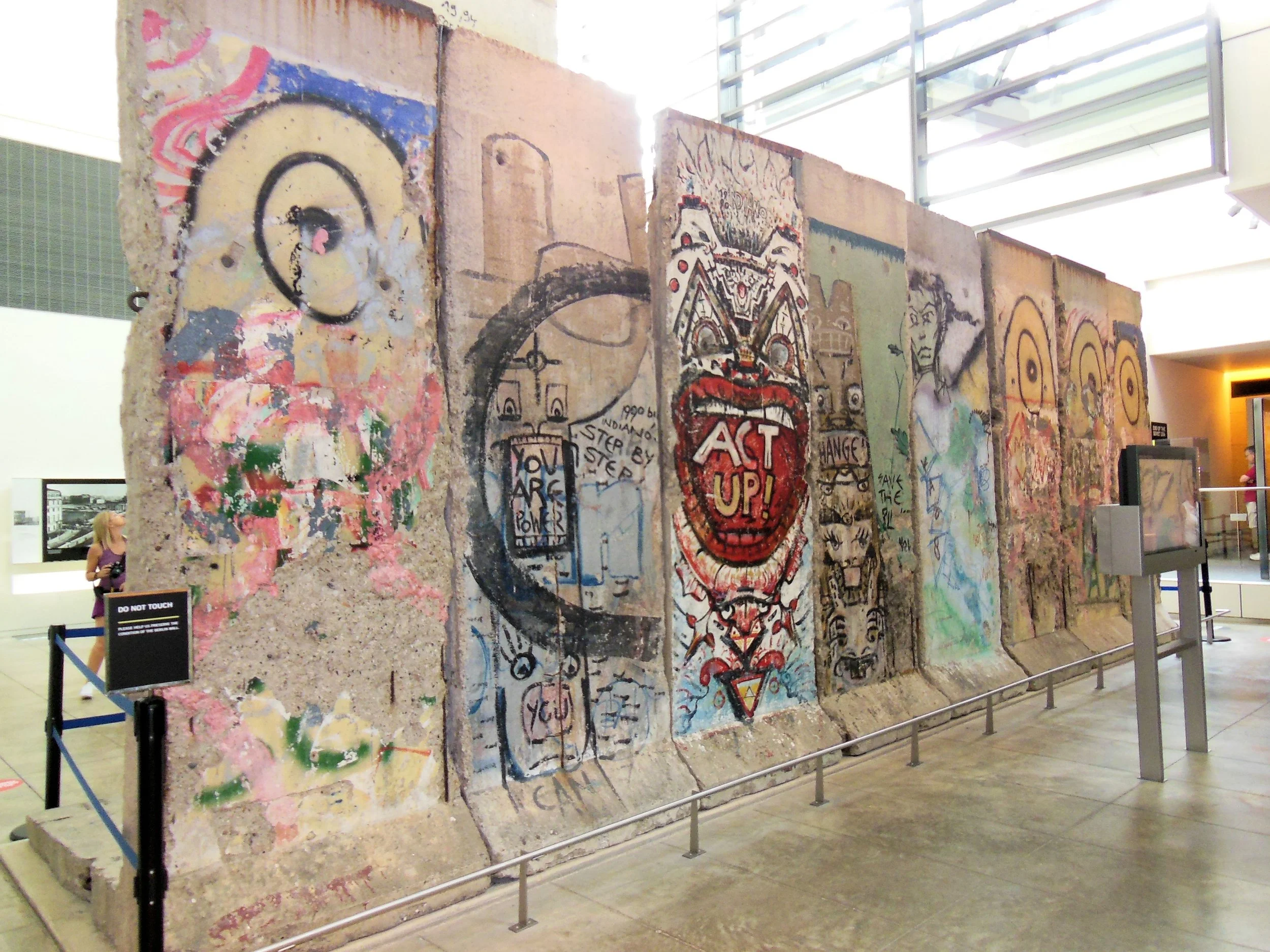
We began on the concourse level, one of the highlights of which was the largest hunk of the Berlin Wall outside Germany (including guard tower), which was supplemented with many informative placards and interactive touchscreens. (The Newseum, like most museums, integrates new technologies and media into its exhibits; however, unlike in many other places, the incorporation of these tools is seamless and overwhelmingly effective.) Another concourse highlight was the changing exhibit “G-Men and Journalists: Top News Stories from the FBI’s First Century,” which included powerful artifacts relating to the Oklahoma City bombing, the DC sniper case, the Branch Davidian compound siege, the fight against hate groups, and the Unabomber case (including Ted Kaczynski’s actual cabin).

From there we were whisked up a hydraulic glass elevator, past the gigantic LCD monitor and up to the 6th floor, which wasn’t great. (This is the recommended path for exploring the Newseum—concourse, then 6th floor and work your way down—and we followed it.) From the 6th floor we could see down to the 4th floor, which is dominated by a 9/11 exhibit that focused too much on the outrage of the American people and not enough on journalism’s role in covering the attacks.
The 5th floor, though—once we got there (it was a little difficult to figure out how to access it)—was staggering. Visitors are just overwhelmed by the sheer magnitude of information: News History traces the history of news-gathering in the US from its earliest examples through its transformations and milestones and vicissitudes. The room is dominated by rows of drawers containing glass-encased newspapers and magazines, chronicling not only the story of us as a people, but journalism as a field. Ringing the room are interactive pieces focusing on various major topics—satire, plagiarism, Watergate, tabloids, the publishing barons, etc. All contain a masterfully conceived admixture of actual artifacts, news items, video clips, and more. There are also several small theaters on the outer edge of the room—and, in fact, throughout the entire museum—showcasing issues in journalism, exploring ethics and news values, discussing photojournalism, etc.
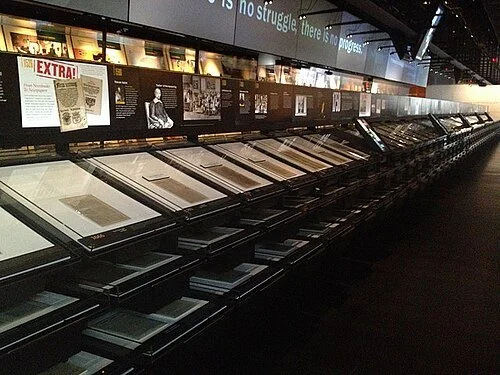
My only complaint for the 5th floor was that the lighting was too dim to read beyond the headlines, and the arrangement of the drawers at knee-level and in vertical columns meant that closer examination—to say nothing of sharing material with another museumgoer—was impractical. But really, these are comparatively minor quibbles.
The 3rd floor was a’ight: stuff about Edward R. Murrow, internet news, and a memorial to journalists killed while covering the news. It should be noted that throughout the Newseum are actual pieces of journalistic history that go beyond the newspapers and typewriters: news vans and helicopters, studio cameras, satellite dishes, and the like.
Friends, on the 2nd floor, I became a child again. The 2nd floor is home to the Interactive Newsroom, where one can queue up and become part of an actual “newscast”! To be honest, the opportunity was seized mainly by children, but I could not resist even the fleeting fulfillment of a longtime dream: to be a weatherman.
The results:
Mrs. Monsoon can be heard near the end of the video laughing loudly at my inexplicable antics: the saucy delivery, the tentative, pointless gestures, and just the obvious glee I took in being in front of the camera. Your comments are, always, welcome.
Finally on the first floor are the 4D theater (skipped it), the gift shop, and one of the most moving exhibits I’ve ever seen. The gift shop has lots of what you would expect—key chains, magnets, pencils, shot glasses, and more emblazoned with the Newseum name. It also has some great DVDs, mugs that read “Not tonight dear … I’m on deadline” and—the pièce de résistance —a book called Correct Me if I’m Wrong. This slim volume collects the best selections from the Columbia Journalism Review’s popular feature “The Lower Case,” which reproduces unintentionally funny headlines and press blunders. Some examples—which are also printed on tiles in the Newseum’s bathrooms—include:
Nuns forgive break-in, assault suspect
Crack in toilet bowl leads to 3 arrests
Literarcy week observed
Parking lot floods when man bursts
Drunk gets nine months in violin case
Farmer Bill Dies In House
…and my personal favorite…
Johnson Teacher Talks Very Slow
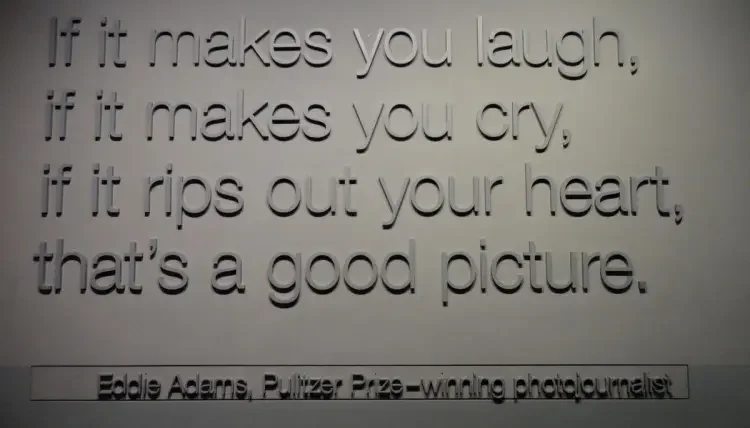
The first floor is also home to the permanent exhibition of Pulitzer Prize winning photographs. All of the winners are reproduced in small prints, but there are 30-40 enlarged photographs, each with a bit about the context of the piece and a reflective comment from the photojournalist responsible for the image. I had not seen some of these photographs, but even with the ones with which I was familiar—the execution of a Viet Cong prisoner in Saigon, the iconic image of a firefighter carrying an injured infant after the Oklahoma City bombing, the famous photo in the aftermath of the Kent State massacre—seeing them in a gallery setting, presented not just as photojournalism but really as art, was profoundly affecting. Many museum visitors were moved to tears by some of the photographs. I marveled at how impactful, how intense a photograph can be—far more moving and eloquent, in many cases, than a video of the same event, or an eyewitness account.
Not to be missed, and never to be forgotten.
"The Wire" episode 53 notes & observations - contains spoilers
“The Wire” – episode 53
Notes and observations; episode 53 is on HBO On Demand only and will air on Sunday, January 20th at 9pm. Please be aware there are spoilers present below.
S
P
O
I
L
E
R
S
P
A
C
E
Episode 53—tagline, “They’re dead where it doesn’t count” from Fletcher—was one of the best of the series so far, in any season—the writing, the plot twists, the character development were all stellar.
The episode focuses on a wide range of topics, from Marlo’s money laundering to Michael’s tension between childhood and his responsibilities to his corner; from the Clay Davis Grand Jury to upheaval in the commissioner’s office; from cuts at The Sun to McNulty’s concocted serial killer.
The episode begins by concentrating on the aftermath of the murders by Snoop and Chris in episode 53, namely the ink it receives. Alma Gutierrez’ article, headlined “Three killed in west side home invasion,” was originally 35 column-inches and appeared destined for the front page. Instead it receives 12 inches below the fold in the Metro section. Alma runs from store to store at around 5 in the morning looking for the paper, then finally ends up at one of the printing plants to get a look at her first “front,” or front-page story for which she has the sole byline (so-called because it contains “By” and the reporter’s name). Gus apologetically says, “your piece took a bad bite,” acknowledging that Alma’s article was cut considerably; though it wasn’t his fault, he says “we messed up” in not giving the story a more prominent place.
The problem, according to Fletcher, is that “they’re dead where it doesn’t count,” and speculates that it’s the “wrong zip code.” If three had been killed in Timonium, an affluent, 90% white suburb of Baltimore, it would have received front-page status and at least 35 inches.
Soon the troops are gathered in The Sun’s newsroom (they’re even fetched from across the hall in Features and Sports) for announcements by the managing editor and the executive editor, James C. Whiting. Gus and some veterans of the newsroom speculate that “maybe we got sold again,” a reference to the fact that first the LA Times then the Chicago Tribune have bought The Sun in recent years. Gus observes sardonically that “we’re the minnow” because they keep getting swallowed up by media conglomerates. There’s also speculation that Whiting might be poised to announce Pulitzer Prize wins for the paper, but these are not due out for a week—and besides, Gus notes, if he were about to deliver such news, he would be sporting an unmistakable erection.
Whiting begins by using vague, euphemistic language to hint at what’s to come: buyouts and layoffs. “The news hole is shrinking,” he says, and advertising dollars are down. The news hole refers to the news content to be produced, increasingly dictated by the amount of space that needs to be allocated in each day’s paper. The bigger the ad space and other peripherals, the smaller the news hole. Because circulations are generally down, advertisers are being more and more stingy with their advertising dollars at newspapers. Whiting goes on to say that “technology is driving distribution” and that the internet has become a free source of news content. As I’ve discussed before, and others have picked up on, the newspaper industry has, by and large, allowed technology to control the gathering and dissemination of news, rather than harnessing technology into a profitable and affirming tool. In other words, the newspapers have gotten played by the internet rather than playing it, to borrow one of the show’s many taglines.
As a result of all this, Whiting says that “hard choices” had to be made in order to meet “budgetary targets” set by the Tribune company. Five foreign bureaus—London, Beijing, Moscow, Johannesburg, and Jerusalem—are to be shuttered immediately. (See my post on episode 51 for a more in-depth exploration of this trend.) There will also be a fresh round of buyouts involving veteran workers, along with layoffs. For the first of two utterances in the episode (and his third over all this season), Whiting says they need to “find ways to do more with less.”
Then managing editor Thomas Klebanow (David Kostabile) is thrown to the wolves by Whiting as he reads a prepared statement and fields their questions. He talks about a “voluntary separation plan”—a euphemistic way of saying “buyouts” that is laughably antiseptic in tone. Under a VSS (voluntary separation scheme), the corporate entity eliminates the positions of those who “volunteer” to take buyouts, saving the company lots of money in the long run. Essentially, veteran workers are “voluntarily” separated from their jobs, the jobs themselves are separated from the newsroom, and the newspaper is separated more and more from the quality on which it once prided itself. Some employees will be “moving on to other opportunities beyond The Sun.” Aside from the celestial implications of such a move, this is another euphemistic way of saying that there will be firings.
Gus Haynes (Clark Johnson), the conscience of the newsroom and the voice of true journalism in the show, asks of Klebanow, “How come there’s cuts in the newsroom when the paper’s still profitable?” It’s a valid question, since the profits of most newspapers, though down, are still the envy of many ordinary corporations. But the managing editor only offers corporate doublespeak and bottom-line apologetics in response. Gus is later pulled in to a meeting with Whiting and Klebanow during which he’s told that “we’re counting on you to transition the new team” and Gus shares his frustrations and concerns that he is being left with a gutted staff.
The word “cooked” is used a couple of times in this episode. It occurs to me that one of the themes of this episode and season in general is becoming the idea of “cooking,” a term with origins in accounting; to “cook the books” means to falsify financial records to cover up wrongdoing, inflate profits, or hide deficits. In the school plot, the jump in numbers (test scores are up 15%, apparently) is likely the result of “cooking”—though this isn’t stated; Burrell has “cooked” his crime statistics, for which his job is in jeopardy; McNulty is “cooking” the cases to produce a phony narrative about a serial killer targeting the homeless; Scott Templeton is “cooking” his pieces, it’s becoming clear (more on that later); and Prop Joe is “cooking” (really, laundering) money for Marlo, which also tangentially involves Clay Davis.
Speaking of “cooked” crime statistics, the mayor’s office is planning to “leak” the real statistics to The Sun. This term means to give out information surreptitiously, usually for personal or professional reasons involving strategy or retribution. (The Valerie Plame CIA “leak” case comes to mind here as a particularly nefarious example of this phenomenon, but ordinary leaks happen all the time, usually involve little harm, and are quite indispensable to both the political and journalistic systems.) Cut to a scene with Carcetti’s chief of staff and political voice of reason Norman Wilson (Reg E. Cathey) sitting at a bar with city editor Gus Haynes, who had been summoned via text message by Norman. It’s revealed that Norman used to work at The Sun before getting into politics; Norman goes on to “leak” the information that Mayor Carcetti is planning to “shitcan” Commissioner Burrell and that Chief of Detectives Cedric Daniels is the “frontrunner” for the position after a likely interim period with Rawls in charge.
Roger Twigg (Bruce Kirkpatrick) is featured prominently in this episode, primarily because he’s offered one of the buyouts. Twigg is a veteran reporter who has worked police cases for years. According to Twigg, “they can hire one and a half twentysomethings for what it costs to keep me in print.” This sort of crystallizes the problem with modern journalism and the rampant buyouts—an inexperienced staff with high turnover is replacing entrenched, established, veteran journalists who have become masters of their craft.
Gus goes to Scott with Norman’s leak, offers the young reporter the story, and asks Scott what he knows about Daniels, but Scott’s never heard of Daniels. Gus poses the same question to Twigg and receives a litany of information—all off the top of his head—based on years of working sources, knowing the players, and doing good journalism. Twigg gets the story. Again, this scene sums up many of the points the show is trying to make about modern journalism: Twigg, who is an undeniably valuable resource and stellar reporter, is being bought out, while the floundering the comparatively clueless Scott is taking his place, in a sense. In fact, when Scott is told by Gus to find “react quotes” (reactions about the story’s subject from local lawmakers, political movers and shakers, police sources, and the like) to accompany Twigg’s piece, he simply fabricates or pipes a quote. When pressed by Gus Haynes, Scott says that the “high-ranking city hall source” is actually Nerese Campbell (Marlyne Afflack). As I stated in my episode 52 posting, I fear Scott’s fabrications will only get more outrageous and brazen, with disastrous consequences for The Sun and for the subjects of the paper’s legitimate stories.
The good news here, if there is any to be had, is that Twigg’s police department reporting is being picked up by the dedicated, hard-working, and intuitive Alma Gutierrez. When concocting the serial killer story, McNulty decides to “leak” word of these linked homicides to The Sun and calls Alma. When the two meet at a coffee shop, he tries to charm and flatter her (saying that he’s read her stuff, and that it’s very good; flirting with her) but she’s having none of it (“bullshit,” she answers when he compliments her writing; “I’ve got a boyfriend, detective,” she fires back when he openly flirts).
In a scene at a bar, Gus and Roger Twigg chat about their lives and careers, clearly yearning for a simpler and purer time in journalism. Gus recalls watching his father read the paper raptly each morning before departing for work, and wanting to be a part of something so important that it held his father’s undivided attention. Roger remembers seeing a man on a train folding his “broadsheet” meticulously and examining it rapturously, looking every bit the smartest man on the train; that was the moment he knew he wanted to be in the newspaper business.
(A broadsheet is the most popular newspaper style, consisting of long, vertical pages folded in half; a full broadsheet contains four pages—front and back—while a half broadsheet contains two pages—a single sheet printed front and back. Tabloids are newspapers that are folded only once in the center. Examples of broadsheets include The Sun, The Philadelphia Inquirer, and The New York Times; tabloids include The New York Post and the Philadelphia Daily News; “tabloid” has also come to mean sensationalized or gossipy rags, but not all papers that appear in this format fall into the derogatory “tabloid” category.)
The scene with Roger and Gus is a touching scene, one that says a lot about both characters and about the newspaper business as a whole. Roger bids farewell by repeating H.L. Mencken’s epitaph: “If, after I depart this vale, you ever remember me and have thought to please my ghost, forgive some sinner and wink your eye at some homely girl.” Henry Louis (H.L.) Mencken was known as the “Sage of Baltimore” and was a journalist, essayist, and satirist active during the first half of the twentieth century. He is noted for his coverage of the Scopes trial (he coined “Scopes Monkey trial”), his incendiary editorials, and his pithy one-liners. A few of my favorites, some of which I’ve shared with my students…
“A cynic is a man who, when he smells flowers, looks around for a coffin.”
“Love is the triumph of imagination over intelligence.”
“Nobody ever went broke underestimating the intelligence of the American public.”
“Democracy is the theory that the common people know what they want, and deserve to get it good and hard.”
A great scene in this outstanding episode—and my notes here have covered mainly the journalistic aspects, leaving out provocative material with the likes of Omar and Prop Joe and Michael and DuQuan, for example—is when McNulty is anxious to see the splashy article he expects based upon his leaked information about the spurious serial killer. He runs to an honor box (the coin-operated newspaper boxes, so-called because it is only on one’s “honor” that one takes only one newspaper, rather than several) as the paying customer is getting his newspaper. As McNulty says “hold it!” and reaches in to retrieve a newspaper he hasn’t paid for, the man mutters, “you cheap motherfucker” as he walks away. McNulty is crestfallen to discover that the story about the fact that the murders of homeless men may be linked was positively buried on a deep interior page of the Metro section and received the briefest of treatments. Landsman later describes its position as “back in the girdle ads.”
Most riotous of all is the scene in which Bunk has brought Lester into “the box” to talk some sense into McNulty regarding his scheme. Much to Bunk’s amazement and indignation, Lester actually begins to counsel McNulty on how to improve his scheme. A classic scene.
END OF EPISODE 53 NOTESMonsoon Martin's The Wire - Episode 52 Commentary
“The Wire” – episode 52 (focusing primarily, but not exclusively, on the show’s journalism-related content)
Please note that this episode has not yet aired on HBO (it is available only on HBO On Demand) and therefore contains spoilers for most viewers. Please observe the spoiler space below to avoid gaining unwanted information about a show you haven’t yet seen.
S
P
O
I
L
E
R
S
P
A
C
E
The tagline on episode 52 is again from Bunk, who says “this ain’t Aruba, bitch.” The statement occurs during a barstool conversation among Bunk, Lester and McNulty about why the 22 murders of African American Baltimoreans now are not being investigated, and why the media have not made more noise about that fact. The conclusion is that the bodies were “the wrong color” and that if 300 white folks were killed each year in Baltimore (or wherever), the National Guard would be brought in. Finally, McNulty makes a reference to the Natalee Holloway case in which a southern teen on vacation in Aruba disappeared, earning the media’s (led by the likes of Nancy Grace) fixation, prompting Bunk’s apropos comment. I couldn’t agree more.
My first observation from this episode deals with the scenes involving Steve Earle and Bubbles (whose first name, apparently, is Reginald). Now, Andre Royo is a breathtaking actor who can convey volumes of feeling, of experience, regret, guilt, weariness, etc., all with a shrug of the shoulder or the dizzying, herky-jerky delivery of his lines. Steve Earle, who plays Bubs’ sponsor and the leader of a twelve-step group of recovering addicts, is not an actor. He’s a singer, and he’s not even very good at that. Earle’s lines are delivered with a distracting woodenness that strikes a discordant note in otherwise moving and successful scenes. He’s one of the very few Wire actors I have ever felt were miscast (the others being Anwan Glover as Slim Charles and Aidan Gillen as Councilman—now mayor—Tommy Carcetti). Given the sprawling nature of the story and the hundreds of faces that have appeared and spoken onscreen, that’s not a bad ratio, I suppose…
There is a sense of foreboding with McNulty in the opening scenes of the show, in which he makes angry, misdirected comments at Rhonda Pearlman and Kima observes after his departure, “he’s a pissy little bitch today.” (A comment that could be—and has been—said of me on more than one occasion.) It doesn’t help matters when his car has a flat so he nearly breaks his foot kicking the car, then has to take an MTA bus to the crime scene of his homicide investigation. I have to say I’m glad McNulty (played by Dominic West) is being featured more prominently this season. He’s the perfect example of the working class in a postmodern city—stuck in the system, yet smart enough to know what parts of the system are screwed. McNulty’s impotent anger—hitting out at the wrong targets because the problems are bigger than can really be addressed—is the driving force of this show. It’s telling that even Bunk, who has abetted many of McNulty’s misadventures both on and off the job, is horrified by his partner’s actions at the end of the episode.
In another memorable scene out by the loading docks of The Sun, where Gus and some other veterans go for smoke breaks, Gus tells the oft-repeated story of a young reporter in a news conference with 1950s Bawlmer mayor Tom D’Alesandro who meekly (and rather spinelessly) says several times that “the city desk wants to know” this and “the city desk asked me to clarify” that. Without a word, the mayor finally puts his ear to his own desk, looks up and says, “My desk tells your desk to go fuck itself.” The old-timers agree that the story is too good even to verify, but it has been repeated and printed in several sources.
The Sun’s Executive Editor James C. Whiting (played with oily corporate aplomb by Sam Freed) begins a meeting in the conference room by stating that he wants The Sun to go for its Pulitzer. The Pulitzer Prizes for Journalism have been awarded for more than 90 years from an endowment left by famed newspaper publisher, editor, and pioneer Joseph Pulitzer. The most prestigious awards in the field of journalism, Pulitzers are awarded annually by Columbia University in 22 categories including reporting, editing, criticism, feature writing, and editorial cartooning. When Whiting says he wants the paper to go for its Pulitzer, it’s the equivalent of a studio head insisting that a Holocaust drama be made starring Meryl Streep in the hope of snagging Oscar nominations. It’s a craven and short-sighted statement that subverts the art it purports to celebrate, and Gus Haynes quite understandably rolls his eyes.
Whiting’s big idea is to produce a “Dickensian” series about the lives of city children—which will show “clearly and concisely where the school system has failed them.” The wording and construction here are priceless for both fans of “The Wire” and those who have spent some time around the field of journalism. First of all, “The Wire” has itself been called Dickensian by critics, who praise its resemblance to a nineteenth-century novel by Dickens like Bleak House in which the socioeconomic realities of the day are explored in a sprawling narrative, sweeping in disparate segments of population and experience. (A recent NY Times article on the last season of “The Wire” was even headlined, “No Happy Ending in Dickensian Baltimore.”)
Whiting’s statement is absurd because he is simultaneously calling for the Pulitzer-baiting series to be both “Dickensian” (passionate, thorough, expansive, detailed, naturalistic) and “concise” in focusing only on how the school system has failed children. To be truly Dickensian, the series would have to focus on children, parents, institutions, and everything in between—which “The Wire” does but newspapers almost never have the courage or dedication to do. Because Scott Templeton, the young hotshot reporter who wants to work at a “real” paper like the Post or Times someday, agrees with Whiting that context isn’t that vital to telling such a story—and thus earns himself the lead on the series. Whiting says they need to “limit the scope, not get bogged down in details” and an unnamed reporter pipes up and says, “There’s more impediments to learning that a lack of materials or a dysfunctional bureaucracy.” Whiting’s response: “But who wants to read about that?” Again, The Sun is pandering to the lowest common denominator, which has been the case for the field of journalism in general. Reporters are instructed on most pieces to assume their readership is at a sixth grade reading level, a short attention span, and little initiative or natural curiosity. And the product reflects that.
The meeting ends when Whiting asks what the “budget line” (the “pitch” line in the budget, or roster of articles, that summarizes what the article will be about) will be and Gus responds, “Johnny can’t write ‘cause Johnny doesn’t have a fuckin’ pencil.” Whiting angrily insists the paper does not want “an amorphous series detailing society’s ills” (god forbid) because “if you leave everything in, soon you’ve got nothing.” This kind of double-talk is reminiscent of the managing editor’s statement in episode 51 that “you’ll just have to do more with less.”
The storyline here is intriguing on several levels. First, it’s another example of an institution that is set up to do good (journalism is designed to keep a public well-informed about its world) getting dragged down by short-sightedness, lack of funds, arrogance and incompetence. Second, it provides another point of entry into the schools, which were the focus of last season (will we see Prez this year?). And finally, it ties the whole thing up nicely; as Simon himself said in one of the introductory shows about this season of “The Wire”: if we’ve gotten any of this right, why are we the only ones paying any attention to it? In other words, where and why have the media failed?
That night, Gus has a “deadline nightmare” which occurs when one has put a piece “to bed” but later questions whether he or she might have made an error. Once the ink hits the page, it’s difficult to take the words back; the “Corrections and Clarifications” portion of a newspaper is usually buried on page A2 and seldom read. Gus is worried about the fact that he may have transposed (inadvertently switched) some numbers on a port article and wants to copy editor to check his “nut graph” (sometimes spelled “nut graf”). A nut graph is a usually the second paragraph in an article, and it details what the piece is about. Some reporters “bury” their nut graphs (put them too deep within the article, obscured by quotes, background, or set-up) and have to be reminded to let them breathe.
The managing editor soon singles Scott out for his loyalty by awarding him a leading “color” piece in a story about the opening day of the Baltimore Orioles’ baseball season. A color piece (from “local color”) is a human interest story that provides a personal angle on an otherwise straight-ahead story. Scott says, “I’d really like to find some chaw-chewin’ old timer who’d rather die than miss an O’s opener.” What he finds, however, are only cynics and casual fans: one older man laments the steroid scandal and says the sport is in disarray, another disinterestedly says that his son kinda likes baseball, and another punctuates his failure to get usable material by saying “Fuck baseball!”
The problem arises for Scott when he goes into his assignment with an idea of what he would find when he started asking questions. Journalists should go into any story well-informed, but otherwise wide open to the possibilities of the story’s path. When one starts an interview with an idea of what’s going to come out of the subject’s mouth, one begins to ask “leading questions” or those designed to elicit a specific answer. Then you’re “putting words in someone’s mouth,” as the dreadful Lesley Stahl does week after week on “60 Minutes.” (An example of a leading question that stands out in my mind from a Stahl interview: “And that made you feel really resentful, didn’t it?”) Because Scott knew he wanted a chaw-chewin’ old timer, he couldn’t use the material he did get from the cynics and casual fans, and therein lies the problem.
Scott magically arrives back at the newsroom and tells Gus about the story he did get—about a 13-year-old kid in a wheelchair (put there, evidently, by a gunshot would, though details are sparse) who did not have a ticket to the game. The boy would only give his name as “E.J.” (ostensibly because he was truant from school) and there is no art (no photograph to accompany the article) because a photographer was unavailable. Gus’s journalistic instincts cause him to question the piece, and rightly so. The background is shady, they don’t have a last name so there’s nothing to verify or fact-check, and Scott’s claim that there was no photographer is questionable (wouldn’t there have been at least one at the ballpark for opening day?). Moreover, Scott couldn’t locate the boy when he went back to try to get “art.”
None of this matters much to Whiting, though. He sees it as a solid piece that captures the disparity of the city—the upper crust, enjoying a ballgame, while a 13-year-old gunshot victim is stranded outside, pitifully listening to the roars of the crowd. He awards Scott the “lead” (it will appear front page, despite the lack of “art”) and Gus must capitulate.
I have a feeling I know where this storyline is going: Scott made the whole damned thing up. He wandered around outside the ballpark, failing to get the story he wanted, and finally got desperate and concocted this young boy out of thin air. In future episodes I think it’s going to come out gradually: there never was a boy named “E.J.” shot in Baltimore; the schools have no record of this child; the photograph never received a call requesting “art” for Scott’s article. The end result is a scandal—and I don’t think Scott will stop there. In his Pulitzer-baiting series on the failure of schools, he’ll fabricate information, pipe quotes (invent or embellish direct quotes from sources), and the like.
It may be surprising to many outside the field that reporters could or would make shit up; we assume that every word we read in the paper is precisely as it went down. But it happens far more than one might think. Milder examples include quote piping (cleaning up, rearranging, or even creating out of thin air, supposedly direct quotes from a subject so it fits more cleanly in the piece). More extreme examples are the cases of Janet Cooke, Jayson Blair, and Stephen Glass. Briefly, Janet Cooke was a reporter for the Washington Post in 1981 who had to return a Pulitzer she won for a piece on an eight-year-old heroin addict who did not exist. Jayson Blair invented interviews, quotes, and places for the New York Times in the late 90s; he submitted expense reports for trips that never happened, and described places he’d never been. He also plagiarized (took pieces of other people’s articles without crediting them). His actions were a serious “black eye” for the newspaper and several editors resigned in the wake of the scandal. Finally, Stephen Glass was an associate editor and writer for the New Republic magazine who was perhaps the most audacious fabulist of them all—he invented people, corporations, commissions, and conventions, and created a sloppy paper trail to back it all up.
How could this have happened? Aren’t reporters’ articles fact checked? Yes, they are, but there’s at least one huge hole in the process. In cases like those cited above, the fact-checkers are relying mainly on the reporter’s notes for confirmation, because they involve privileged or fleeting conversations, confidential sources, or the like. And this is, I’m afraid, what’s going on with Scott.
END OF EPISODE 52 NOTES