
Monsoon Goes To Prison - Part Three
“So what kinds of reactions did your students have to the film?”
This was the first question from Curt L. Tofteland, director of Kentucky Shakespeare Festival and Shakespeare Behind Bars, after he picked me up from my hotel to head to the Monday, April 14th rehearsal.
They had reacted in myriad ways, and with broadly divergent thoughts, but what stood foremost in my mind was their initial reaction, which is said to be the most honest.
About 40 minutes into the film, Leonard, one of the troupe members, is suddenly sent to the “hole” (solitary confinement), allegedly for a violation of the computer policy. In a brief interview segment, the filmmaker is heard asking Leonard, “So why are you here?” There is a pause of some 20 seconds, during which landscapes of emotion cross Leonard’s face. He finally answers, “I sexually molested seven girls.” Choking with emotion, he continues, “It’s the worst thing I’ve ever done,” and says that he hopes to be able to conduct a meaningful life, somehow balancing the scales, “so that I’m not remembered for the very worst thing I’ve ever done.”
Immediately following this confession, the bell ending the class period was about to ring and I asked my students what they thought of the film so far. Some of them stared forward, some of them looked at me, some shifted uncomfortably in their seats—but none answered. And this wasn’t adolescent indifference; what they had seen had impacted them, maybe even changed them, and they were still processing it. It was a powerful moment for me to witness, and I told Curt about it.
Curt then gave me some background about this scene, which led to a lengthy dialogue about both the documentary film and the program. The filmmakers had been instructed not to ask the troupe members about their crimes. “Nobody talks about their crimes in prison,” Curt explained, and yet the confessions of Hal, Sammie, and Big G had come tumbling out spontaneously on camera.
When Leonard was sent to the hole, disrupting the play’s rehearsals and necessitating that his role be recast, the film crew received special permission to talk with Leonard despite the fact that prisoners in solitary confinement are typically allowed no visitors. (Curt also explained that sex offenders occupy the lowest rung in the inmate hierarchy; cop killers, the highest: indeed, one can hear the other prisoners in “the hole” heckling Leonard in strong terms about pedophilia.)
When the filmmaker asks Leonard in the course of their interview, “So why are you here,” he is actually asking what Leonard has done to be placed in solitary confinement. “Leonard had never talked about his crime, never taken responsibility for what he had done,” Curt told me, “but he was just ready.” He answered the question in its larger sense—why is he in prison—and the results are spellbinding.
Having completed the sex offender program, Leonard had high hopes that his parole would be granted and his 50-year sentence reduced at his recent hearing. Instead, according to Curt, he got a 10-year “flop” (deferment, or extended sentence), which means that he will not be released until he is at least in his late 50s. As a result, Leonard withdrew from prison life, leaving the Shakespeare Behind Bars program (Curt insists on referring to it as a “vacation” when an inmate leaves the program, always leaving the door open for his eventual return). Since then he’s become involved with Luckett’s TV studio and has shown signs of reengaging with constructive programs, so there’s hope he’ll come back to Shakespeare.
Curt then talked a bit about how Shakespeare Behind Bars (SBB) is funded: it has been a condition of his involvement since he founded the program in 1995 that it should never be dependent on tax dollars. He said he periodically receives phone calls from citizens who are angry that their tax money is going to such a program for prisoners. His first response is that the program is free; his second is that he doesn’t really approve of the fact that his tax dollars are being used to fight a war, but he has little say in the matter. This usually ends the conversation rather quickly.
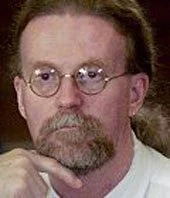
Recently, though, he couldn’t pass up an opportunity to expand upon some of the program’s goals through the facilitation of a $25,000 National Endowment for the Arts (NEA) grant. With the funds, he’s continues to be part of the SBB program and restaging the play Julius Caesar at the Luther Luckett Correctional Complex (LLCC); the festival’s education director, Pamela DiPasquale is directing an abridged version of Caesar with professional actors that will tour schools in the area. In addition, an actor/director who works often with Kentucky Shakespeare Festival, Matt Wallace, is conducting a Shakespeare’s Studio Artist Residency with troubled youths ages 15-17 at the Audubon Youth Development Center; they’re also studying and staging sections of Caesar. The teens visited LLCC in March to witness the inmates running scenes and ask questions of them; this week, the students in the Audubon program will return to LLCC to perform a few scenes and share what the program has meant to them.
As we reached the end of our 20-minute drive northeast from Louisville to La Grange and turned in to the prison’s long driveway, Curt told me about some of the rhythms and procedures of entering the prison and what to expect when entering the site of the rehearsal. (When speaking of SBB’s participants, Curt consistently refers to them as “my guys,” which serves to underscore his devotion to these men and his unwavering belief in the value of the program.)
Luther Luckett was built fairly recently (about 25 years ago), so it’s set up more like an office park than a prison: no clanging gates, no towering walls, no imposing architecture. Still, I was reminded I was entering a prison when Curt told me to bring only a photo identification and my notebook, leaving my phone, wallet, keys, and all other personal effects in the car. When we entered, we had to remove our jackets and place them on a conveyor which led them through an x-ray machine, then each sidle through a free-standing metal detector. There’s something eerie and rather sobering about watching your jacket and notebook and they are dragged through the unit—and seeing only the zipper and buttons along with the metal parts of my fancy pen. I surrendered my driver’s license and was handed a badge I was to wear at all times inside the prison, showing it to guards at various stations along our way. As Curt pointed out, my official identity was now “Visitor 3” for the duration of my visit. Matt Wallace, the artist-in-residence mentioned above and presumably the man who will take over SBB (at least on an interim basis) when Curt retires next year, joined us as well to observe the rehearsal.

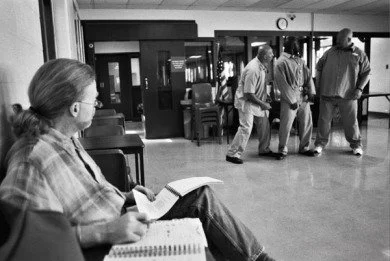
Curt introduced me to the guards and staff members he knows well, so I didn’t feel out of place for long. The chaplain, Marc Wessels, went to Lancaster Theological Seminary and is familiar with this area, so we exchanged a bit of small talk about this coincidence. We entered the chapel, where the rehearsal would be taking place during both days of my visit (in the film, rehearsals seem to be held in multiple locations, including a portion of the athletic facilities and the canteen).
Inside we found some 23 men, all clad head-to-toe in khaki (the prison uniform; I had been cautioned not to wear any khaki-colored clothing during my visit), milling about, waiting for rehearsal to begin.
The sight took my breath away: I was finally here.
Scanning the faces of the inmates, my eyes rested on those I recognized from the film: there was Floyd Vaughn; there was Howard, who was denied parole during the filming and in a heartbreaking scene said he was most upset about having to call his family and break the news to them; there was a bespectacled, larger-than-life Jerry “Big G” Guenthner; there was Hal, who played Prospero in The Tempest as shown in the documentary and offered meaningful reflections on his crime; there was Ron, who memorably clashed with Hal during a rehearsal scene in the film. Mostly, though, there were new faces, and each seemed genuinely pleased that I was there. Within ten minutes of my arrival, Vaughn, Ron, Mike, Hal, and a few others had all introduced themselves, asked where I was from, and thanked me for coming to visit.
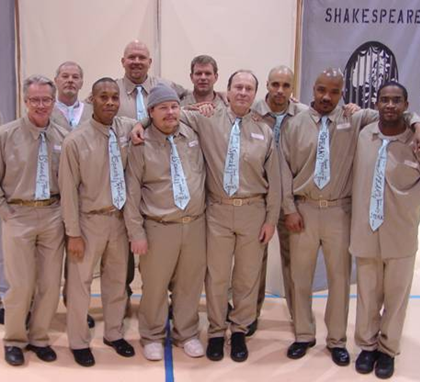
[The above picture was taken by Curt Tofteland and is from a previous year's performance. Front row, far left: Hal; fourth, fifth, and sixth from left are Leonard, Ron, and Louis. Back row, far left: Vaughn; second from left: Big G.]
I think the troupe member who made the profoundest impact on me was Ron, though I had memorable exchanges with others as well. When Curt introduced us and said I was from Pennsylvania, without missing a beat Ron asked, “Clinton or Obama?” My response (the latter) elicited a strong handshake and approving slap on the back—though Ron was quick to add that Obama had not gotten his support simply because they share the same skin color: “I listened to what Obama had to say, studied Hillary,” but he said he ultimately was turned off by her campaign tactics. When I agreed that this troubled me as well, he offered an appreciative, “That what I’m talkin’ about.”
As Curt entered the rehearsal space (and I positioned myself on the relative periphery of the circle), the men gradually left their private conversations and took their seats. Curt began by asking me to introduce myself and talk about why I was there; I did so and noted that I was excited about learning from them, keeping my comments (unlike my writing) brief. Curt opened the meeting by telling them that over the past weekend, one of the actors he’d hired to take part in the above-mentioned Caesar program was arrested for his second DUI. Curt told of how, prior to offering him the job, he’d asked the actor, an Iraq war veteran, if he was dealing well with his experiences in combat. The actor had answered that he was fine, but clearly he was seeking to dull the pain of his post-traumatic stress disorder with alcohol. The results of his actions: if convicted, he might serve some jail time; he has disappointed those who were there to help him (including Curt) but whose help he refused; and he has grossly inconvenienced the members of Curt’s troupe—and most specifically Curt, who now must find a new actor to step into the role with less than two weeks to go.
The undercurrent of Curt’s comments was unmistakable—that the mistakes we make have consequences that reach far beyond our own individual regrets, and that it is essential to ask for help when we think we may need it—but it was a message delivered smoothly, without heavy-handedness or pedantry.
Ron, who is one of the long-time members of SBB, spoke up and disagreed with some of what Curt said. “People in those situations think they have certain things under control,” he said, but in reality they continue to struggle to maintain that control. There are grey areas that we must respect, Ron insisted, because “some people are quick to make black-and-white determinations about right and wrong.” We must acknowledge the power of a disease like alcoholism, for example, rather than placing the blame on the actor for having failed to ask for help when he felt he was doing well.
Curt countered by saying that “change and responsibility begins in one place—and that is with the individual.” Change must be profound and resolute. To further illustrate his point, Curt brought up the case of Ricky, a participant in SBB who appears in the film; in figuring out how to endure a sentence of “two lifes without” (a double life sentence without possibility of parole), Rick decides to join SBB. “I’ve never finished anything in my life,” he says, so he’s determined to do this, and do it well.
Rick has been mentored into the program by Big G; new participants must be recommended by an existing member, have one year clear conduct, and must stay out of trouble or they will be unable to continue. Rick makes the unfortunate choice to get a tattoo in prison in violation of the rules, and landed in the hole, disqualifying him from being in SBB. Following the filming, Rick was transferred to another prison, the Kentucky State Reformatory, and after several months hanged himself with his shoelaces.
“Ricky slipped through the net,” Curt said, emphasizing the fact that he had a support network in SBB but declined to ask for help when he needed it, “but it was his choice.”
It was a fascinating conversation about whether we (as individuals, as a society) can focus on the need to ascribe and accept personal responsibility for our actions without sitting in condescending judgment of one another’s flaws and foibles. I had been there for ten minutes, and already I was in the midst of one of the most compelling philosophical exchanges of my life.
“What does Brutus say before he leaves the stage?” Curt asked Big G, who is playing the role.
“O that a man might know / The end of this day’s business ere it come,” G flawlessly recited from Act 5, scene 1. How will we handle the problems with which we will invariably be faced each day? Will be make it through unscathed? I am struck here with empathy, but it’s almost deeper than that: I can see myself in these men. This is not to say that I expect to commit murder or armed robbery or felony assault; it’s simply to suggest that these men are not substantively different from me, from any of us. They made mistakes, miscalculations; they lost control; they made poor choices. Their crimes don’t make them monsters, as the simplest among us might dismissively conclude. Their crimes make them human.
The discussion wraps up with a consideration of the ways in which men’s egos tend to prevent them from asking for—or accepting—the help we need. “People go out of their way to help, but we say, ‘Oh, I know what I’m doing,’” one inmate said. “Well, I didn’t know frickin’ squat, ‘cause now I’m sittin’ in this fuckin’ place.”
Curt seamlessly transitions from this discussion into the material, encouraging the men to find themselves in their roles. It’s time for the warm-up exercises, and I notice immediately the warmth that dominates Curt’s interactions with the men, and their interactions with one another. He’s also very physical with “his guys,” slapping them on the back in encouragement and greeting. It is unusual (and refreshing) to see men so comfortable with one another physically.
The warm-up scene in the film was one of my students’ favorite, partially because a few of them are actors, but mostly because it made them marvel at how a group of inmates threw themselves body and soul into the craft of acting.
First up is “Zip Zap Zop” (though I think they were saying “Zip Zap Zoh” here), a traditional acting exercise in which the men stand in a circle and “send” the energy across and around to the other men. One man claps crisply, makes eye contact with someone else in the circle, and “passes” the sound to him by directing his hand toward the receiver. It’s a drill that emphasizes clear expression, swift reaction, full engagement, careful listening and communication, and impeccable timing.
Then the men go around the circle reciting a monologue from Julius Caesar they had been given by Curt to memorize over the summer. It’s Antony’s soliloquy from the end of Act 3, scene 1, after he discovers his friend Caesar’s body and then shakes the bloody hands of the conspirators:
O, pardon me, thou bleeding piece of earth,
That I am meek and gentle with these butchers!
Thou art the ruins of the noblest man
That ever lived in the tide of times.
Woe to the hand that shed this costly blood!
Over thy wounds now do I prophesy,--
Which, like dumb mouths, do ope their ruby lips,
To beg the voice and utterance of my tongue--
A curse shall light upon the limbs of men;
Domestic fury and fierce civil strife
Shall cumber all the parts of Italy;
Blood and destruction shall be so in use
And dreadful objects so familiar
That mothers shall but smile when they behold
Their infants quarter’d with the hands of war;
All pity choked with custom of fell deeds:
And Caesar’s spirit, ranging for revenge,
With Ate by his side come hot from hell,
Shall in these confines with a monarch's voice
Cry ‘Havoc,’ and let slip the dogs of war;
That this foul deed shall smell above the earth
With carrion men, groaning for burial.
Here again, it’s the importance of eye contact, of communal pursuit—the circle breaks down, after all, if someone forgets the next word and must repeat the previous one—being emphasized with this exercise.
As the warm-up exercises die down and the men gear up for the rehearsal of a portion of the play, Ron came over and chats with me for a bit; this would be the first of several conversations over the course of my two-day visit, and I found him to be a most fascinating individual.
TO BE CONTINUED IN PART FOUR.
Monsoon Goes To Prison - Part Two
My friends,
After 1,300 travel miles, four states, and two prisons, I am safely back in Pennsylvania. I'm still gathering my thoughts about this incredible experience and will post them soon in Part Three of this series.
Thank you to Curt Tofteland, who was so gracious in inviting me to visit, so generous in sharing his program with me, and so kind in shepherding me around the greater Louisville area.
Thank you to Larry Chandler, warden of the Kentucky State Reformatory, who led us on a thorough and eye-opening tour of his facility.
Thank you to the staff members of both the Kentucky State Reformatory and Luther Luckett Correctional Complex, who made my visit a smooth and informative one.
And finally, thank you to the troupe members of Shakespeare Behind Bars, past and present, who welcomed me into their fold for a couple of days and allowed me to observe their little family.
It was an unforgettable experience that will inform and inspire me, and that I will always cherish.
Monsoon
Monsoon Goes To Prison - Part One
First, to set your minds at ease (or, for those of you who’d like to see me behind bars, to cruelly disappoint you): I am not being incarcerated, and I have not been accused of a crime; unless and until our government officially outlaws thinking for oneself, I hope never to be arrested or jailed.
Nor am I visiting an uncle or acquaintance in the pokey; none of my kith and kin are, to my knowledge, currently in jail.
It’s actually an educational opportunity (no, not “Scared Straight”) that will take me to the Luther Luckett Correctional Complex in La Grange, Kentucky next week.
About a year ago, I was flipping channels and happened upon a film on one of the premium channels called Shakespeare Behind Bars. I watched as convicted felons analyzed, parsed, rehearsed, reflected, and argued their way to creating a performance of Shakespeare’s The Tempest. Led by Curt Tofteland, the men who participated in the program which shares the film’s title were as breathtaking as the “forces of nature” that open the play.
[Check out the film's official website, which has the trailer, photos, and information about cast and crew.]
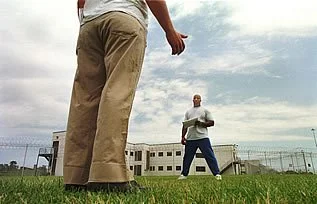
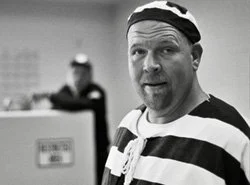
As I watched the film, I was struck by the fact that we met the members of the troupe first as actors, then as convicts. In moving scenes throughout the film, some of the principal players painfully and honestly discuss their crimes (one man killed his wife, another his mistress; one man is behind bars for armed robbery; still another sexually assaulted seven girls)—but not before we meet them as men. Our society has a frightening tendency to regard its incarcerated as less than human—cast-offs without whom society is far better off. But the reality is that these are flawed individuals, like all of us (though, as an inmate named Leonard acknowledges in the film, their mistakes are far more grave than most of ours).
The program exists largely thanks to then-Warden Larry Chandler, who believed strongly that prisoners should be rehabilitated (it is, after all, the corrections system) because most of them are going to rejoin society at some point.
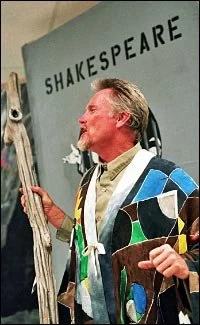
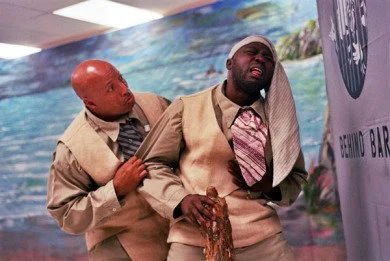
It’s a theme that runs through both the play they perform in the film and the film itself: restorative vs. retributive justice. In The Tempest, a character named Prospero (played by inmate Hal, below) is exiled to an island and spends twelve years honing his magical powers and plotting his revenge again his usurpers. When he creates a magnificent storm (the tempest of the title) that shipwrecks them and delivers them to his island, he gradually realizes the value of forgiveness: “Though with their high wrongs I am struck to th’ quick, / Yet with my nobler reason ‘gainst my fury / Do I take part. The rarer action is / In virtue than in vengeance” (5.1.32-36).
Inspired by the resonance and emotional power of the film, I contacted Curt Tofteland, who is the founder and volunteer director of the Shakespeare Behind Bars program. We began an email correspondence about the themes of the film, updates on the prisoners, and the background of the program.
Curt is a trained actor who became involved in the Kentucky Shakespeare Festival in the 1980s, becoming its director in the late 1980s and revitalizing the program. He began Shakespeare Behind Bars (SBB) in the 1990s and a few media outlets took notice; the Christian Science Monitor did an outstanding, in-depth piece on the program in 2002.
By the early aughts he was fielding requests from filmmakers who wanted to document his program. He reportedly turned many of them down, however, after viewing their previous work: he is understandably protective of SBB, and knew it had to be portrayed in just the right light in a film. Eventually filmmakers Hank Rogerson and Jilann Spitzmiller fit the bill; filming took place over a year in 2003-04; and it was released in 2005. Curt is planning on retiring from the Kentucky Shakespeare Festival (and SBB) next year and writing a book about the SBB program.
Shakespeare Behind Bars made a splash at Sundance, where it received enthusiastic and warm responses from packed houses all week. The actor and director Steve Buscemi attended a screening and said, “It's a wonderful film. I was amazed by what they could do and by Curt’s commitment. And I see that these men are trying and it's heartbreaking. I hope they all make it – it’s in our interest that they do,” he said. The movie “totally captivated me and it moved me—and that’s a great film.”
In the course of my email correspondence with Curt Tofteland, I explained that I was teaching the play The Tempest to my Honors English 11 class, and that I had purchased the DVD and would be showing the film immediately following our study of the play, then having the students write reaction pieces. He asked if I would send him copies of what the students wrote, and then extended a thrilling offer that stunned me with its openness:
glen,
if you would like to visit the sbb program, let me know. we are preparing julius caesar for may performances.
blessings,
curt
He sent me a list of rehearsal and performance dates; I decided it might be more fruitful to see rehearsals than the finished product (it is, after all, about the process) so I chose some dates in the middle of April. I made arrangements to drive out there (I eschew flying), filled out a security form, and that was that: I’m visiting Luther Luckett Correctional Complex next week!
My students read The Tempest and responded wonderfully to the play (and after having read two tragedies this year, Macbeth and Hamlet, they should have been thrilled to read a comedy/romance), after which I showed the Shakespeare Behind Bars. They were moved—if a bit troubled, at first—by the stories of these men, and wrote beautiful reaction pieces. “The prisoners gain an intense appreciation for Shakespeare’s art when they experience it on a personal level,” wrote one student. Another student echoed, “Curt Tofteland’s rigorous program requires the participants to fully analyze the play by searching beyond the text to make an emotional connection.” Still another observed, “I used to think that criminals were monsters who took great pleasure in doing heinous crimes. But as I listened to the confessions of the inmates, I realized that they weren’t monsters at all but were as human as everyone else.”
After we had viewed and discussed the film, I told them of my plans to visit the program in April. “Can we come too?” was one immediate question (no; when I talked to my principal about the potential visitation, he went pale as a ghost until he realized that I wanted to undertake the visit alone and was not interested in taking my students to the prison). “Will you stay overnight in the prison?” was another (no; again, this is not “Scared Straight,” and one of my greatest fears is confinement. One hour in a cell and I’d be crying out like new prisoner “Fat Ass” in the beginning of the film The Shawshank Redemption: “You don’t understand! I’m not supposed to be here!”). Mostly they were excited that I would be getting to meet Curt Tofteland and some of the prisoners (many of whom, after all, are still in prison and involved with the program), that I would take copious notes, and that I would be sure and share all the details on my return.
And so I’m off on a grand adventure to La Grange, Kentucky. It may seem to some like a strange way to use one’s personal days, but I wouldn't want to spend them stuck on some beach. I think my trip to the Luther Luckett Correctional Complex will be an engaging and unforgettable. No matter what happens, though, I can be certain of one thing: I’ll have good stories to tell!
Monsoon
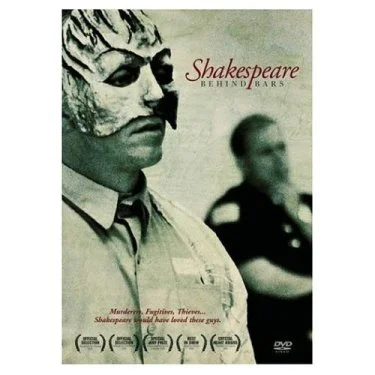
[Shakespeare Behind Bars can be purchased directly from the filmmakers’ website, via amazon.com, or at any number of other outlets, but is generally not available as in-stock merchandise in stores.]