Monsoon's Newseum Review and Television Debut
If, as Jean-Paul Sartre wrote, hell is other people, then people in their hordes and crowds and maundering packs of listlessness must constitute a new circle in Dante’s Inferno. Trying to have a meaningful museum-going experience amidst the sweaty multitudes is a nearly fruitless pursuit. Dodging visor-and-fanny-pack-bedecked tourists, restless adolescent Boy Scouts and their harried scoutmasters, giggling imps, and fusty society ladies can take all the magic out of taking a look at some nice-assed art.
Seeing a large wooden track for homemade model cars bisecting a portrait gallery in the Smithsonian (it was some sort of Scouting and crafts weekend) was as disheartening as it was shocking.
Surely a museum of that magnitude can be appreciated by patrons of all ages simply on the basis of its cultural and artistic merits without being turned into a Night at the Museum come to life. Judging from the Scouting chaos, the little girl who almost knocked over a statue (prevented from doing so by my alarmed yawp, after which her parents ushered the stunned toddler from the gallery), the disinterested tweens texting obsessively, and the brazenly loud cellphone conversations carried on unapologetically in front of artistic treasures, the answer to that question is a resounding no.
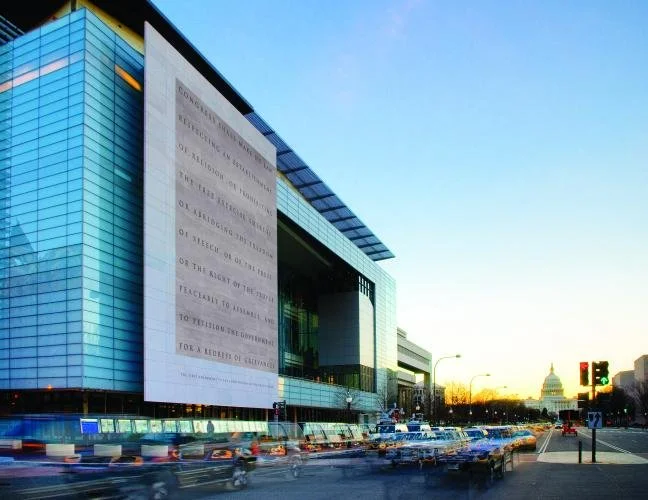
But truly and sincerely, the Newseum was well worth the effort of enduring the inappropriateness, insensitivity, lack of museum etiquette and just plain presence of other people—teeming, snorting, prating, obstructing, farting, shuffling people.
As a person who teaches a journalism elective course, has worked briefly in journalism, and harbors a long-standing interest in the field, I have been excited about the Newseum since it was reported in its planning stages.
The Newseum is on Pennsylvania Avenue between 5th and 6th Streets, and is open 9 to 5 daily (closed only on Thanksgiving, Christmas, and New Year’s Day). Unlike the Smithsonian museums, which are free, it costs $19.95 for adult admission. Let me hit some of the highlights of this museum; my recollections are by no means intended to be exhaustive, though by the end of this post you may feel much as I do when my mother says “to make a long story short” well into a longwinded saga.
Into the façade of the Newseum is etched the so-called Establishment Clause from the First Amendment, and the length of the building is lined with the current front pages of newspapers around the country and (on the sixth floor) world.
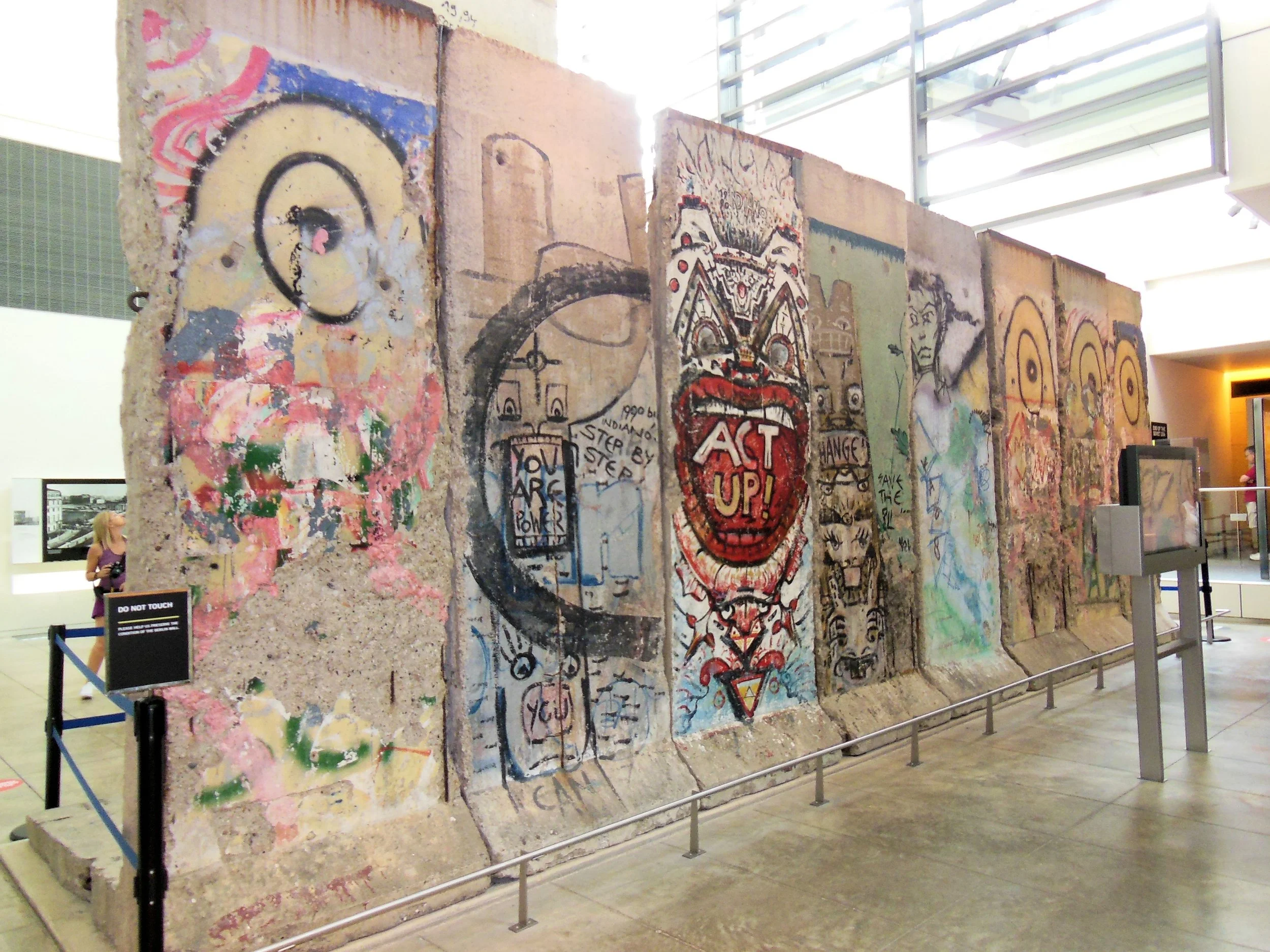
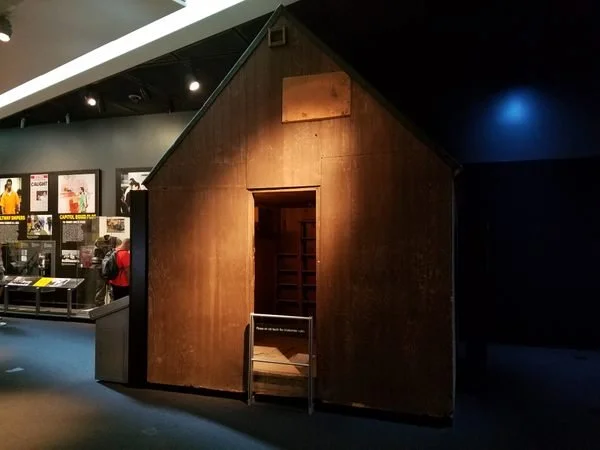
We began on the concourse level, one of the highlights of which was the largest hunk of the Berlin Wall outside Germany (including guard tower), which was supplemented with many informative placards and interactive touchscreens. (The Newseum, like most museums, integrates new technologies and media into its exhibits; however, unlike in many other places, the incorporation of these tools is seamless and overwhelmingly effective.) Another concourse highlight was the changing exhibit “G-Men and Journalists: Top News Stories from the FBI’s First Century,” which included powerful artifacts relating to the Oklahoma City bombing, the DC sniper case, the Branch Davidian compound siege, the fight against hate groups, and the Unabomber case (including Ted Kaczynski’s actual cabin).
From there we were whisked up a hydraulic glass elevator, past the gigantic LCD monitor and up to the 6th floor, which wasn’t great. (This is the recommended path for exploring the Newseum—concourse, then 6th floor and work your way down—and we followed it.) From the 6th floor we could see down to the 4th floor, which is dominated by a 9/11 exhibit that focused too much on the outrage of the American people and not enough on journalism’s role in covering the attacks.
The 5th floor, though—once we got there (it was a little difficult to figure out how to access it)—was staggering. Visitors are just overwhelmed by the sheer magnitude of information: News History traces the history of news-gathering in the US from its earliest examples through its transformations and milestones and vicissitudes. The room is dominated by rows of drawers containing glass-encased newspapers and magazines, chronicling not only the story of us as a people, but journalism as a field. Ringing the room are interactive pieces focusing on various major topics—satire, plagiarism, Watergate, tabloids, the publishing barons, etc. All contain a masterfully conceived admixture of actual artifacts, news items, video clips, and more. There are also several small theaters on the outer edge of the room—and, in fact, throughout the entire museum—showcasing issues in journalism, exploring ethics and news values, discussing photojournalism, etc.
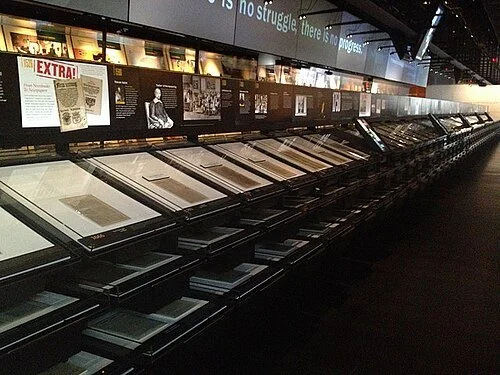
My only complaint for the 5th floor was that the lighting was too dim to read beyond the headlines, and the arrangement of the drawers at knee-level and in vertical columns meant that closer examination—to say nothing of sharing material with another museumgoer—was impractical. But really, these are comparatively minor quibbles.
The 3rd floor was a’ight: stuff about Edward R. Murrow, internet news, and a memorial to journalists killed while covering the news. It should be noted that throughout the Newseum are actual pieces of journalistic history that go beyond the newspapers and typewriters: news vans and helicopters, studio cameras, satellite dishes, and the like.
Friends, on the 2nd floor, I became a child again. The 2nd floor is home to the Interactive Newsroom, where one can queue up and become part of an actual “newscast”! To be honest, the opportunity was seized mainly by children, but I could not resist even the fleeting fulfillment of a longtime dream: to be a weatherman.
The results:
Mrs. Monsoon can be heard near the end of the video laughing loudly at my inexplicable antics: the saucy delivery, the tentative, pointless gestures, and just the obvious glee I took in being in front of the camera. Your comments are, always, welcome.
Finally on the first floor are the 4D theater (skipped it), the gift shop, and one of the most moving exhibits I’ve ever seen. The gift shop has lots of what you would expect—key chains, magnets, pencils, shot glasses, and more emblazoned with the Newseum name. It also has some great DVDs, mugs that read “Not tonight dear … I’m on deadline” and—the pièce de résistance —a book called Correct Me if I’m Wrong. This slim volume collects the best selections from the Columbia Journalism Review’s popular feature “The Lower Case,” which reproduces unintentionally funny headlines and press blunders. Some examples—which are also printed on tiles in the Newseum’s bathrooms—include:
Nuns forgive break-in, assault suspect
Crack in toilet bowl leads to 3 arrests
Literarcy week observed
Parking lot floods when man bursts
Drunk gets nine months in violin case
Farmer Bill Dies In House
…and my personal favorite…
Johnson Teacher Talks Very Slow
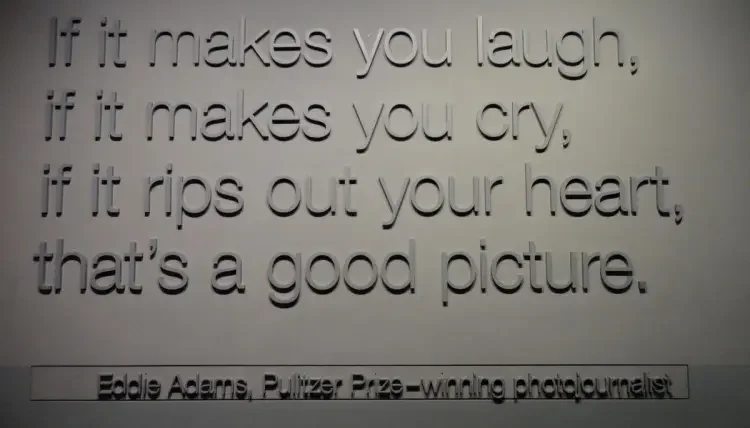
The first floor is also home to the permanent exhibition of Pulitzer Prize winning photographs. All of the winners are reproduced in small prints, but there are 30-40 enlarged photographs, each with a bit about the context of the piece and a reflective comment from the photojournalist responsible for the image. I had not seen some of these photographs, but even with the ones with which I was familiar—the execution of a Viet Cong prisoner in Saigon, the iconic image of a firefighter carrying an injured infant after the Oklahoma City bombing, the famous photo in the aftermath of the Kent State massacre—seeing them in a gallery setting, presented not just as photojournalism but really as art, was profoundly affecting. Many museum visitors were moved to tears by some of the photographs. I marveled at how impactful, how intense a photograph can be—far more moving and eloquent, in many cases, than a video of the same event, or an eyewitness account.
Not to be missed, and never to be forgotten.
The Many Jobs of Monsoon: Volume Five
Friends,
Here is the fifth and final installment in my Many Jobs series from 2006. I wanted to draw your attention to a new feature on the weblog: I've added a "widget" on the sidebar of each page that automatically archives all of my entries, sorted into categories. So if you want to access all five "Many Jobs" forecasts, look on the right side of the page under the "Powered by Squarespace" icon, and click on "Many Jobs of Monsoon." Cool, huh?
The Many Jobs of Monsoon Forecast: Volume Five
Monday, 20 November 2006
As I mentioned in my previous forecast, two “temp” jobs turned into “permanent” (though not entirely, since I eventually left them) employment. The first was at American International Group (AIG) in Philly, where I worked in the National Union division, which handled professional liability insurance policies. A few years back, in fact, there was a sprawling scandal regarding illegal business practices involving AIG’s many tentacles; one of the most egregious violations was that underwriters in National Union were binding policies that had not actually been purchased. In other words, they fabricated income for the company in order to meet fiscal goals. Around the time I worked there. Good stuff.

I worked there as an assistant underwriter—first as a temp, then as an actual employee of National Union—from early 1997 to the middle of 1998. The job itself was not notable in any way, involving fairly pedestrian data entry (though not at the breakneck speeds required at the collection agency), client contacts, filing, and so forth like that.
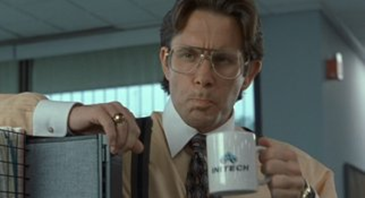
My first boss there was a man named Frank Castro, the regional manager of our division, who was in his late twenties at most. If you have seen the movie Office Space and can recall the manner of Gary Cole’s character, Bill Lumbergh, bring that performance up a few registers and increase the speed from 33 to 45 rpm and you have an idea of the man. Frank Castro was from California and seemed rather laidback, but in point of fact was a desperately striving career insurance guy who would have killed (and cheated, it turns out) to make himself look good. He was the sort of corporate schmuck who would practice his golf swing (with no club) while you were standing there talking to him.
The most memorable aspect of Frank Castro’s tenure at AIG was his indiscriminate, almost savant-like use of management euphemisms. If he wanted us to adopt a new policy, it was to be done “on a go-forward basis.” If he wanted us to contact a client, we were to “touch base.” We were concerned with the “bottom line” and how our fiduciary health looked “at the end of the day.” When moving on to a new topic, he would “change gears” before “pulling the trigger” on his next deal. And so, friends, it would not be unusual to hear the following out of his mouth during a staff meeting: “Alright, people, I’ve been looking at some bottom line figures here and at the end of the day, we’re just not thinking outside the box. So on a go-forward basis I’m going to need you to go ahead and touch base with your brokers and pull the trigger on some new deals. Switching gears for a moment, someone’s taking pens again from the supply closet. And folks, that dog just won’t hunt. So on a go-forward basis, you’ll need to go ahead and go through Terri to get your office supplies, mmkay?”
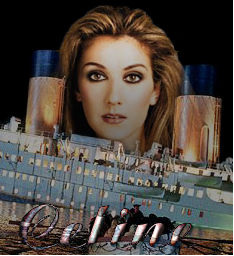
That’s “Terri” as in Terri Flint, the Underwriting Assistant whose desk was just over a shared cubicle wall from mine during most of my tenure there. And Terri played her radio incessantly set to a soft-rock station whose playlist seemed to be drawn from a catalog of songs that would be guaranteed to make me drive letter openers into my earholes. Most memorably, though: Terri loved the Titanic theme, “My Heart Will Go On,” sung by Celine Dion, aka the Trilling Canadian She-Demon And Inflictor Of Auditory Pain Whose Oeuvre Is An Affront to Good Music Everywhere. And when that song, that #$*&%ing song, would come on…as soon as she heard those ethereal first few notes from some kind of Celtic flute…Terri would turn in up. I mean, she would crank it! “Every night in my dreams / I see you / I feeeeel you / That is how I know you go onnnnnnnn.” And on, and on, several times a day, ad nauseam, till we all puke.
There was, of course, a diverse cast of characters who worked at AIG, and among others (big ups to Tondra!) I found a kindred spirit in a guy named Eric Barnes. One day we were talking about the fact that I was collecting View-Master viewers and reels at the time, and he said he hadn’t seen them in a long while. So I brought in a couple of viewers and some reels, and at lunchtime, we went into the file room, pointed our viewers toward the fluorescent lights and transported ourselves back to our childhoods. At some point, Terri walked in and was greeted with this scene: two grown, bearded men in shirts and ties, lying flat on their backs, looking through View-Master viewers and gasping “Wow!” and “Oo!” like a couple of ten-year-old boys. Later I overheard her on the phone with a friend saying, “I mean, I can’t [bloody well] believe that these two [tossers] have time to sit in the [bleedin’] file room [buggering] around while I’m out here with a stack of work! [Bollocks]! They should be [bleedin’] [sacked]!” I’ve cleaned up Terri’s potty-mouthed, Northeast-Philly-inflected dialogue a bit by substituting some British profanity and slang, which somehow seem more genteel…

Perhaps the most unforgettable and haunting episode from my tenure at AIG involved my second boss (Frank Castro’s successor), Chris. He was both less intense and less overtly full-of-malarkey than Frank had been, but otherwise nothing much changed in the way we did our jobs. Soon we learned that he, too, was leaving; he would begin working in the Chicago office in a week. As a result, Chris was something of a lame duck, and I harbored the conviction that he was inappropriately heaping work upon the assistants to tie up loose ends before he left. Several days before his departure, he sent an email to Terri and me that included a litany of relatively small but annoying projects he wanted done ASAP, on top of the everyday responsibilities of our positions. I was unreservedly fed up, so I forwarded the email to Terri and said as much. My missive was an unbridled venting of my frustrations stemming from the fact that I felt Chris was taking advantage of us, and that he should do his own [bloody] work, and where does he get off heaping all this work on us at the last minute, yada, yada, yada.
A minute or two later, I bebopped over the Terri’s cubicle and said, “Didya get my email?” She said, “No.” I said, “Hmm,” and went over to my computer. Yep, there was my message, and it says it was sent, so I don’t understand OH MY GOD I HIT REPLY INSTEAD OF FORWARD OH MY GOD [BUGGER] [WANK] [BLOODY HELL]!!!!!
Friends, I had sent the email I described above right to the man whom I was maligning in it. I considered collapsing but wasn’t sure what that would accomplish. I tried to “recover” the email (cancel its delivery) but that seldom worked, and did not seem to in this case. I ran over and told Terri breathlessly what I had done. “Oh, no,” she said. For this was really so bad that it was beyond what could be alleviated by profanity. She had the idea to run into his office and delete the email from his computer, because she thought he was not there. I staggered into the bathroom and tried to figure out a way to become invisible. Perspiration, which is seldom in short supply on my body, began to issue forth is streams and rivulets beginning at my temples and ending in my shoes. I looked in the mirror and actually said, “This is all just a dream,” because one time when I was little, during a nightmare I shouted, “This is a dream!” and woke up straight away. But this time, I was still looking in the mirror at my hopeless visage, sweating profusely, trembling and wondering if I would soon be out of a job.
I mustered the resolve to return to my desk after what seemed like 15 minutes, but was probably only about two. “Glen?” came Chris’s voice from within his office. “Can you come in here?” My stomach did a somersault and I flushed a deeper crimson than the devil’s arsehole. I went in.
Chris, to his credit, was calm in his approach. “If you have a problem with the way I’m doing my job, you need to come to me directly about it,” and so on. He evidently had deduced that he was not the intended recipient of my smart-alecky email. “Yes, you’re right. That shouldn’t have happened,” I said. Now, folks, Monsoon don’t scare. And it’s not often that Monsoon will back down from a challenge or disagreement. But shucks, I just plum had no excuse. My actions were inappropriate, ill-advised, and though unintentional, they were ultimately indefensible. I left his office relieved at having made it through the meeting with my job—if not my dignity—intact.

[ 1700 Market Street , home of AIG toward the end of my tenure.]
Not long after the email debacle, Mrs. Monsoon and I decided to relocate to Lancaster County to pursue more meaningful career opportunities and enjoy a more tranquil lifestyle. As I noted earlier, I spent a bit of time pinballing around from one short-term temp job to another. In late 1998, however, I got my big break. I was called to Precision Medical Products in Denver to be trained as a replacement for Mary, their receptionist, who was just weeks away from delivering a child and beginning her maternity leave. Precision Medical was a fairly new company when I came to work there, having been formed in 1997 after a break with Reading’s Arrow International. To their credit, the executives at this smallish medical supplies manufacturer were more open-minded than Alpha Boss at the pretzel factory, and were persuaded that everything would be just fine with (in all likelihood) the only male receptionist in Lancaster County.

Mary left, and gave birth, and never came back. The job was mine until I left in early 2000 to pursue my teaching certification.
What can I say about this experience? It was one of the more pleasant work environments of which I’ve ever been a part. I sometimes worked back in the shipping and receiving department with one of the funniest people I’ve ever met, Steve Nelson. Lou Menga, the materials manager, was (and still is) a musician who puts out a Christmas album every year. My boss, Tom Kubacki (“TK”) was hands-down the best boss I have ever had—laidback, fun to chat with, and seriously kind. Of course, there were the interminable PowerPoint presentations in the meeting room about meeting ISO 9000 certification standards. But over all—divine. And by all accounts, I made a perfectly lovely receptionist (“Good morning, Precision Medical!”).
Incidentally, PMP is the “birthplace” of Monsoon Martin, so to speak. In my position at the front desk I had a clear view of the outside world, while many of the company’s workers—particularly those at interior cubicles and the hourly workers in the plant—could not see outside. When it rained, therefore, I felt it was appropriate to make an announcement over the “page all” function; after all, as the receptionist, I lorded over the company’s entire telecommunications system. “This is your receptionist. It is raining. Those of you who left your windows down this morning may want to sprint out and roll them up. Thank you.” Since this was the beginning of Glenn “Hurricane” Schwartz’s heyday (he began at NBC-10 in 1995) and my interest in the field of meteorology was piquing, a co-worker bestowed upon me the name "Monsoon Martin." Damned if it hasn't stuck.

[The approach of an actual monsoon, in southern Asia]

[Wrestling Legend Robert Otto “Gorilla Monsoon” Marella]
After a whirlwind tour of the joys of education, I was awarded a secondary English teaching certificate by the state of Pennsylvania in December 2000. By the beginning of January 2001, I landed a position as a long-term substitute at a Berks County middle school that shall remain nameless. By the end of January, I had nearly lost my ever-loving mind and abandoned the profession altogether.
On my first day, the principal had the look of a man who had bad news to impart—but was trying to project an optimistic attitude—as he described the job to me. For medical reasons, the school’s half-time art teacher would be unable to return to work for at least another month. Since I was not (am not, could not possibly become) art certified, I would only be able to serve in this capacity for roughly four weeks. In the mornings I would teach art; in the afternoons I would cover whatever classes needed to be covered in the rest of the school. This is going to be interesting, I thought, but manageable.
Having apparently glimpsed the look of cautious but optimistic confidence on my face, the principal led me upstairs to a small supply closet. When he opened the door, I swear he fixed on my expression with an almost morbid anticipation—the sort of thrill you feel when you’ve handed your rancid sandwich to your friend with the words, “Taste this; it’s horrible,” and he’s about to take a bite.
In the closet, my good people, was a Frankenstinian monstrosity that sends chills down my spine, lo these nearly six years later. It was a green, three-tiered utility cart piled impossibly with what appeared to be a metric ton of art paraphernalia, the summit of which was well above my head. Slack-jawed, I took it all in for a moment: bins of colored pencils, markers, and paints; scissors, rulers, glue, brushes, paper and Styrofoam plates, and small plastic bowls; handouts, folders, library books, mat boards, manila file folders, composition paper, construction paper, and art paper of varying sizes; charcoal pencils, erasers, clay, unidentified ceramics projects (and fragments thereof). All was stacked precariously in once-piles on crooked, collapsing shelves.
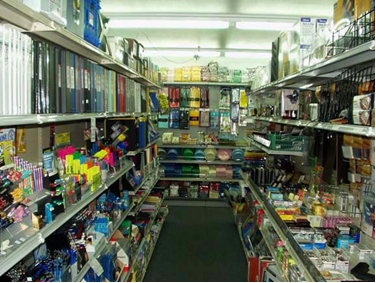
[Since I couldn’t find a picture that would do justice to the Frankencart with which I was faced, I need you to join me in a little visualization. Imagine that everything you see in the art supply store above was blown off the shelves by a tornado measuring F2 on the Fujita scale. Then imagine that it was picked up by a monkey on crack and put onto a cart somewhat taller than the one below. And there you have it.]
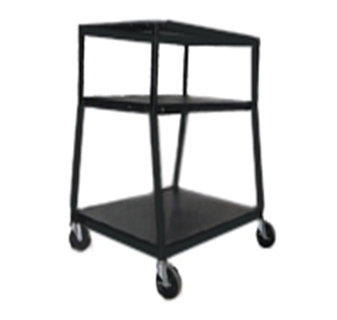
I saw what looked to be a lesson plan among the arty detritus and pulled it off the cart, causing a minor avalanche of paint tubes, worksheets and rulers. I looked at the principal. He looked away—I’d like to think because he was feeling badly about what he was getting me into, but quite honestly he could have been stifling a laugh. Since the reality of the situation was just beginning to set in, I was not yet in the proper frame of mind to be able to find the humor in this nascent fiasco.
When I asked where I would be teaching, the principal looked positively forlorn, but—more determined than ever to present this as if it was all very reasonable and normal—he led me down a long hallway and into the cafeteria. Before I could fully comprehend what he was telling me, he said that each morning I would wheel the aforementioned cart into the cafeteria, teach art in there, and then scoot out prior to the beginning of lunch. It was, in short, “art on a cart.” In a flash he was gone—perhaps in an effort to thwart any second thoughts I might have in accepting this post. I recall having the impulse to run, not because of something I’d done wrong (as in the AIG email ignominy), but because of a wrong that was about to be done to me.
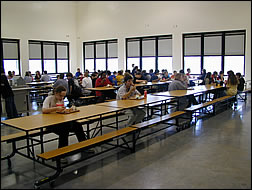
[Not the actual scene of my art-ventures, but a close enough representation, except that my venue had poorer lighting.]
Reader, to say that I did not thrive under such circumstances would be an appalling understatement. You see, I am an orderly person. Some might say I am an obsessively neat person. Some may say anal retentive. Some may refuse to mince words and insist that I am an incurable fussypants. But yes—I like a clean environment in which to live and work. Filth gives me the sweats; askew piles give me hives. When I have work or grading to do, I would much rather do it right away than have it sit on my desk, looming as items on a “to do” list in my head, or sometimes, written down. When I watch “Monk” on USA, I am not only amused by him; I understand him. I feel what makes him tick.
So: wheeling an unstable cart filled with utterly disorganized art materials into a cafeteria each morning, then having middle schoolers create art—under my tutelage!—and then having to clean it up and load up the cart and swing it back down the hall and into the closet…too much.
I soon learned that even under ideal circumstances, I was not cut out to teach middle schoolers. I had several sections of rammy (and unimaginably tiny!) sixth graders; a section of utterly delinquent seventh graders; and a couple of classes of eighth graders who were, by and large, really quite nice. Among the class notes I took as I tried to manage this three-ring circus:
“Sydney and Nicholas have a penchant for hoarding colored pencils.”
“Note: come up with projects that do not involve paint or excessive messes.”
“Dwayne sent to ISS at beginning of period for hitting other students, trying to vandalize pencil sharpener, belligerence, throwing book and pencils. … I can scarcely overstate the level of misbehavior in this class.”
The first project I undertook with my sixth grade students was to have them use 11x14 oak tag paper and acrylic paints to produce “fishy color wheels.” I handed out paintbrushes and paints; Styrofoam plates on which students could mix colors; small dishes to wash out their brushes; and sheets of oak tag so that they could make color wheels that formed the body of great, rotund fishes. When they finished painting each other and the cafeteria tables (and sometimes the actual paper), they had to take their plates and dishes to the bathroom—on the other side of the cafeteria—and wash them out.

To use an intentional pun, allow me to paint a picture of the end of a typical one of these classes. Students were dismissed one table at a time to the bathrooms to begin cleanup. Other groups would scour and scrub their tables and immediate areas. I would hear bangs and shouts from the lavatories and have to dash over there to quell an inevitable disturbance. Finally the closing bell would ring and they would adjourn from my presence. In a sort of shell-shocked catatonia, I’d scan the lunch room as if surveying the destruction wrought by some unmerciful, uncontainable, and frenzied force of nature. The paint on the cafeteria tables was smeared, rather than cleaned off. The floor in the area where we held class, and leading to the bathrooms, was dotted with paint droppings of all conceivable hues.
Oh, the hues! The hues. When I recall this experience, I still shudder involuntarily when I think about the paint drippings, and the rainbow of droplets that were to be found everywhere after a class. I’m feeling a tad dizzy. Allow me to pause for a moment and visit my happy place…

Under my artless tutelage, the “fishy color wheels” were a disaster. The kids hated it, I hated them, and the janitors and cafeteria workers hated me for the mess that was left. From then on, I undertook only projects that used tidier materials—using charcoal and colored pencils to draw value scales, for example; or an overly ambitious, ill-advised (and far too abstract for sixth graders) project I called “Draw the Poem.”
The experience had a bit of a silver lining: I gained a new and profound appreciation for the work Mrs. Monsoon does each day as an art teacher. Hers is a world of constant cries for assistance, perpetually not-quite-completed projects, stained smocks, sticky hands, exploding plaster, yarn off its spool, beads spilling all over the place, paint and clay and ceramic dust and art supplies scattered hither and yon. It’s far more than I could ever cope with, and she does it with aplomb.
All in all, I learned a lot about myself and my career propensities as a result of my many jobs:
Hot dogs cooked on rollers are repugnant, as are baking, soon-to-be pretzels
The wrong song (Paula Abdul’s “Will You Marry Me?”; Montell Jordan’s “This is How We Do It”; Celine Dion’s “My Heart Will Go On; etc.) can ruin an otherwise pleasant work experience, or intensify an unpleasant environment beyond what a reasonably sentient being can be expected to endure
Journalism is not a growth industry
I need to work with (or for) people who say amusing things like “We just can’t have people pissin’ on desks”
I should not be in a job that requires me to open boxes that might contain foreign insects (or really, insects of any kind)
I have a “problem with assholes” and in general, do not suffer fools gladly
I need a job in which I am free to write strongly-worded letters with impunity
I like things neat and orderly; chaos is contrary to every natural instinct I possess
I cannot be held to unreasonably lofty performance standards in my job
To be extremely busy is to be unhappy
Before sending an email, I need to quadruple-check the “To” field to make sure it’s not inadvertently going to someone who shouldn’t be seeing it (and I still do, every single time)
Temporary employment agencies vary widely in their dedication to finding jobs for the workers who have registered with them
Unethical ideals, sweatshop conditions, and uninvited solicitations are not business practices of which I want any part
It is more difficult than it might seem to perch atop a commode
UNION YES!
I cannot work in an environment that is dominated by foul smells or loud noises
I cannot work with or for alpha male jackasses
Middle-school-age children are far too loud, and have far too much restless and kinetic energy; I should not ever be forced to deal with them
I would not, could not, and shall not ever be an art teacher because in this job, one must exist in a state of what appears to be barely-contained pandemonium—or what my wife likes to call “controlled chaos”
And so—friends, family, colleagues—I have landed at Governor Mifflin High School, where I have taught for five years. With a few outstanding exceptions, this line of work conforms to the career prerequisites I have laid out above after watching myself bumble, loaf, shuffle, argue, flounder, protest, fritter, try, and fail (and, on rare occasions, succeed) my way through more than a decade of labor experiences.
Thank you for accompanying me on my journey…
The Many Jobs of Monsoon: Volume Three
Another blast from the past, as promised: the third of my five-volume opus of employment woes, from 2006. Enjoy!
The Many Jobs of Monsoon Forecast: Volume Three
Wednesday, 1 November 2006
After graduating from Albright in May 2005 and before heading out to The Ohio State University for my graduate studies in August, I needed to find a situation that was straightforward, low-impact, and laidback—a place where my well-being would not be imperiled, a job that could make me some decent coin before my trip.
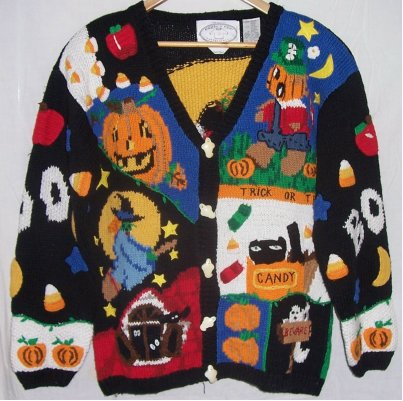
Instead, I secured work for nearly three months at the Eagle’s Eye Northlane Warehouse in Conshohocken, PA. If you’re not familiar with the Eagle’s Eye clothing brand, they import mostly holiday-themed sweaters in varying degrees of gaudiness made in Malaysian sweatshops and sell them to sartorially audacious women all across this great land at outrageous prices. There is even an Eagle’s Eye outlet in the Berks County region, I believe. If you’ve seen a bright orange sweater with black jack-o-lanterns, witches’ hats, bats, cats, corn stalks, bats, and other sundry Halloween-inspired images and phrases (“Boo!”; “Trick or Treat!”; “Spooky Fun!”), you have in all likelihood seen an Eagle’s Eye garment.
First, let me issue a caveat of sorts: I have seldom been accused of having a strong work ethic. I tend to avoid and resist grueling physical labor as I would dental x-rays, or an afternoon of in-service training at school: with no small amount of whining, and violently if necessary. Hard work and I are usually on perpendicular paths—at cross purposes, if you will—and I feel that is as fate intended it.
But friends, this place straight-up sucked. Ask anybody.
The Northlane Warehouse was a place where boxes and boxes of unfortunate clothing were received from Malaysia and other exotic southeast Asian locales, checked in, and then moved around aimlessly until they were needed to fill orders. Then the clothing articles would be placed into flow racks by “replenishers,” where “pickers” would fill the orders; then send them down a crude conveying system made of rollers, where “packers” would box up the merchandise and send it on to its destination.

During the summer, Eagle’s Eye’s busiest time of the year, things are especially hectic around the warehouse, and supervisors are especially jumpy. In addition to the year-round staff, the “summer help” consisted of high school kids, college students, and even a teacher or two. Throughout my tenure, I think I performed nearly every single job in the whole joint: I unloaded boxes from 120-degree truck trailers; I climbed up the storage racks to retrieve boxes (there was only one forklift for the whole place); I used a pallet jack to move about fourteen thousand pallets hither and yon in the warehouse; I broke down boxes (with a utility knife—me! And I left with all my fingers intact); I picked orders; I packed orders; I swept the floor. If you can believe it, I made time to complain more than a little bit about the deplorable conditions in the warehouse, as well.
There was, of course, the inescapable heat; there was very little air moving through the building, so a gauze of oppressive, filthy, breathtakingly humid air enveloped every unfortunate soul who worked in the warehouse. When I recall the memory sensations I have retained from that experience, I feel the heat and I hear the songs that blared over and over from the radios that summer: “Gangsta’s Paradise” by Coolio, from the film Dangerous Minds; “This is How We Do It” by Montell Jordan; and “Here Comes the Hotstepper” by Ini Kamoze: “Act like you know, Rico / I know what Bo don’t know / Touch ‘em up and go, uh-oh! / Ch-ch-chang chang / Here comes the hotstepper, murderer!”
I remember that sometimes when we opened the boxes that had been shipped from southeast Asia, strange, large, spindly-legged bugs—bugs with faces, with stubble—would emerge. Those of you who know me well understand how I feel about domestic bugs; how do you think I reacted when one of these super-sized rainforest predatorial foreign insects spazzed its way out of a box? Need I go on?
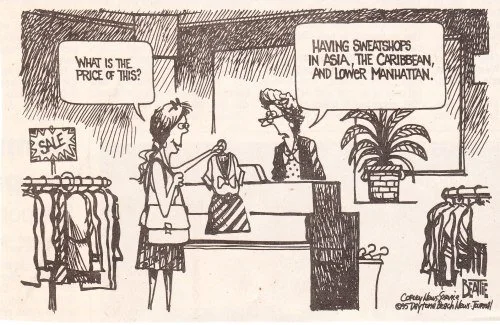
Toward the end of my tenure, I found a cartoon about sweatshops and realized that in many ways (though not quite approaching the level of misery in the Malaysian sweatshops that had produced the clothing), the conditions at Eagle’s Eye Northlane Warehouse met the criteria of a sweatshop: arbitrary discipline, forced overtime, lack of adequate break time, no living wage, hazardous conditions, and other indignities. Of course, I was reading a lot of Chomsky, Marx and Engels, so I was loaded for bear as it was. Fighting the Power and Sticking it to the Man were two of my most dearly held aspirations at this point in my life. (Come to think of it, not much has changed in that regard…)
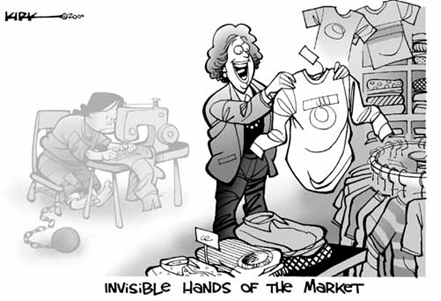
[This is not the actual cartoon mentioned above; it has been lost to me. But this one, by the exceptionally talented political cartoonist Kirk Anderson, conveys a similar idea. *Please see update following this piece!]
So I went in to work with my little cartoon, popped in to the office area (off-limits to “floor” workers), and used the office photocopier to make 20 or 30 copies of the cartoon. As I was finishing, Alan Loberstein, the warehouse’s Operations Manager, bopped by and admonished me for doing what I was doing—but luckily, he didn’t see what I was copying, so my plan could go on as devised. I took the cartoons over to my workstation (I was a “packer” that day, as fortune had smiled upon me) and throughout the day, many of the boxes contained—in addition to the unsightly garments and the packing slip—a copy of the sweatshop cartoon. Stores, wholesalers, and individual customers across the United States received what I imagined they’d see as a cry for help from the oppressed workers who had produced and packaged their precious crap, and I further envisioned that they would as a result reconsider doing business with Eagle’s Eye.
I also recall being singled out for my resistance to the “voluntary” weekend overtime that had been offered (read: forced upon) us all. As a summer worker, I felt I could turn down these opportunities with impunity. But good old Alan Loberstein didn’t see it that way; he called me over to him at one point in the waning weeks of my Eagle’s Eye residency and asked why I hadn’t signed up for the “voluntary” overtime. “Because I have other things going on,” I answered simply. “But Glen…you’re really hurting your chances for advancement if you don’t pitch in a bit on the overtime thing. Don’t you want to work here in the future?” I will admit to being rather smug, and perhaps even elitist, in my reply, but having been screamed at by supervisors, hounded repeatedly about meaningless rules, and involved in work team “pep rallies” that would have insulted the intelligence of even a pre-schooler, I had had enough. “Alan, if I find myself working here again anytime in the future, ever, I will literally kill myself.”

My “parting shot” as I took my leave of the Eagle’s Eye Northlane Warehouse was one of the first strongly-worded letters I ever composed. (At the risk of detouring too dramatically from the narrative roadway we’re traveling together, I should explain: I have become quite well-known among friends and family—and beyond—for my “strongly-worded letters.” I’ve crafted these missives and sent them to companies that have discontinued products I enjoy; legislators and entities whose actions rankle me; acquaintances and colleagues whose actions have annoyed, offended, or horrified me; and many others. I suppose it’s my love of writing, together with my rather strong opinions and inflexible tastes, which compels me to write these letters.)
About a month prior to my departure, I had approached Alan with some safety concerns, and he dismissively recommended that I “put them in writing” and he’d see what he could do. And so, on the day I completed my tenure there, I sent a three-page, single-spaced letter to Alan Loberstein; to Diane, my immediate supervisor; and to Alan’s boss in the Eagle’s Eye Corporation. In it, I vented my ire in painstaking detail, chronicling the pattern of (what I saw to be) humiliation, maltreatment, negligence, and downright villainy being perpetrated under the guise of normal business operations there. Near the beginning, I said: “I disagree with the assumption that in order to elicit the greatest effort from workers, they must be demeaned, belittled, and put in danger. I feel respect and trust can produce a better work environment as well as more efficiency and profit for The Eagle’s Eye.” A few months at a warehouse and I was coming on like I’d earned a fricking Harvard MBA.
I went on: “I feel the absolute emphasis on productivity - on making rate - does not inspire workers to work harder; it results in fear and discouragement. Unrealistically inflated productivity goals serve only to prove to the workers that the supervisors are not really concerned with their safety or the quality of their work, but instead are thinking in terms of an economic bottom line which devalues and commodifies the lives and abilities of the individual workers themselves.” This was based on my observations at the warehouse. All anyone did—even the permanent workers there—was just enough to make rate, but not anything that might help the company make an extra buck. Why should they? The company obviously looked on them with nothing but disdain and disgust, no matter what kind of effort they put forth.
My rhetorical histrionics reached new heights when I attacked the company’s “voluntary” overtime policy: “I also feel mandatory two-thirds overtime is an incredibly unfair tactic to employ against loyal workers who toil forty hours per week as it is. Overtime should be offered as a choice - an essential element of a respectful relationship, after all, is the freedom of choice - rather than held over the workers’ heads like a terroristic threat. … Supervisors treat workers almost without fail as though they are stupid and inept, often blaming their own mistakes on the workers who work under them.”
I ended my letter—and, forever, my relationship with The Eagle’s Eye—by listing some of the safety violations I saw (and suffered from) during the time I served at the Northlane Warehouse. “The flow racks have incredibly sharp, uncovered edges. Countless pickers and replenishers have been put in danger by the various flaws in the flow rack system, which I hope will be corrected during the upcoming automation project,” I began. This safety concern was near and dear to my heart—literally—because I had suffered an injury to a sensitive location on my chest when running into the sharp corner of a flow rack with my torso. I still carry a scar in the affected region that was perforated by the rack’s jagged metal edge. “The roof of the warehouse leaks seriously and unpredictably in various places, producing hazardous wet spots,” I continued. “The rail system which runs throughout the entire warehouse inhibits safe and convenient passage through all areas, and especially in the kids' replenishment area,” and on and on, until I had purged myself of the rage I’d accumulated while I worked at Eagle’s Eye.
I left several days later for Columbus, Ohio and graduate school—but that’s a story for another forecast…


Update
on 2009-01-07 00:57 by Monsoon Martin
While going through some boxes in 2008, I found the actual cartoon I copied on Eagle's Eye's photocopiers and placed inside outgoing boxes containing Eagle's Eye clothing. Here it is: