
Monsoon's Newseum Review and Television Debut
If, as Jean-Paul Sartre wrote, hell is other people, then people in their hordes and crowds and maundering packs of listlessness must constitute a new circle in Dante’s Inferno. Trying to have a meaningful museum-going experience amidst the sweaty multitudes is a nearly fruitless pursuit. Dodging visor-and-fanny-pack-bedecked tourists, restless adolescent Boy Scouts and their harried scoutmasters, giggling imps, and fusty society ladies can take all the magic out of taking a look at some nice-assed art.
Seeing a large wooden track for homemade model cars bisecting a portrait gallery in the Smithsonian (it was some sort of Scouting and crafts weekend) was as disheartening as it was shocking.
Surely a museum of that magnitude can be appreciated by patrons of all ages simply on the basis of its cultural and artistic merits without being turned into a Night at the Museum come to life. Judging from the Scouting chaos, the little girl who almost knocked over a statue (prevented from doing so by my alarmed yawp, after which her parents ushered the stunned toddler from the gallery), the disinterested tweens texting obsessively, and the brazenly loud cellphone conversations carried on unapologetically in front of artistic treasures, the answer to that question is a resounding no.
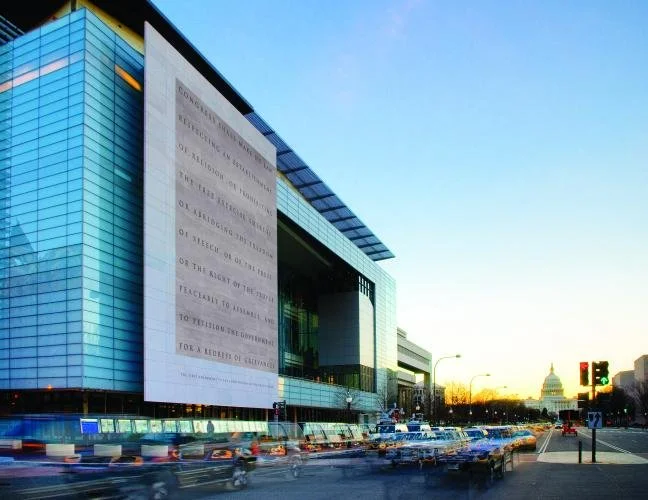
But truly and sincerely, the Newseum was well worth the effort of enduring the inappropriateness, insensitivity, lack of museum etiquette and just plain presence of other people—teeming, snorting, prating, obstructing, farting, shuffling people.
As a person who teaches a journalism elective course, has worked briefly in journalism, and harbors a long-standing interest in the field, I have been excited about the Newseum since it was reported in its planning stages.
The Newseum is on Pennsylvania Avenue between 5th and 6th Streets, and is open 9 to 5 daily (closed only on Thanksgiving, Christmas, and New Year’s Day). Unlike the Smithsonian museums, which are free, it costs $19.95 for adult admission. Let me hit some of the highlights of this museum; my recollections are by no means intended to be exhaustive, though by the end of this post you may feel much as I do when my mother says “to make a long story short” well into a longwinded saga.
Into the façade of the Newseum is etched the so-called Establishment Clause from the First Amendment, and the length of the building is lined with the current front pages of newspapers around the country and (on the sixth floor) world.
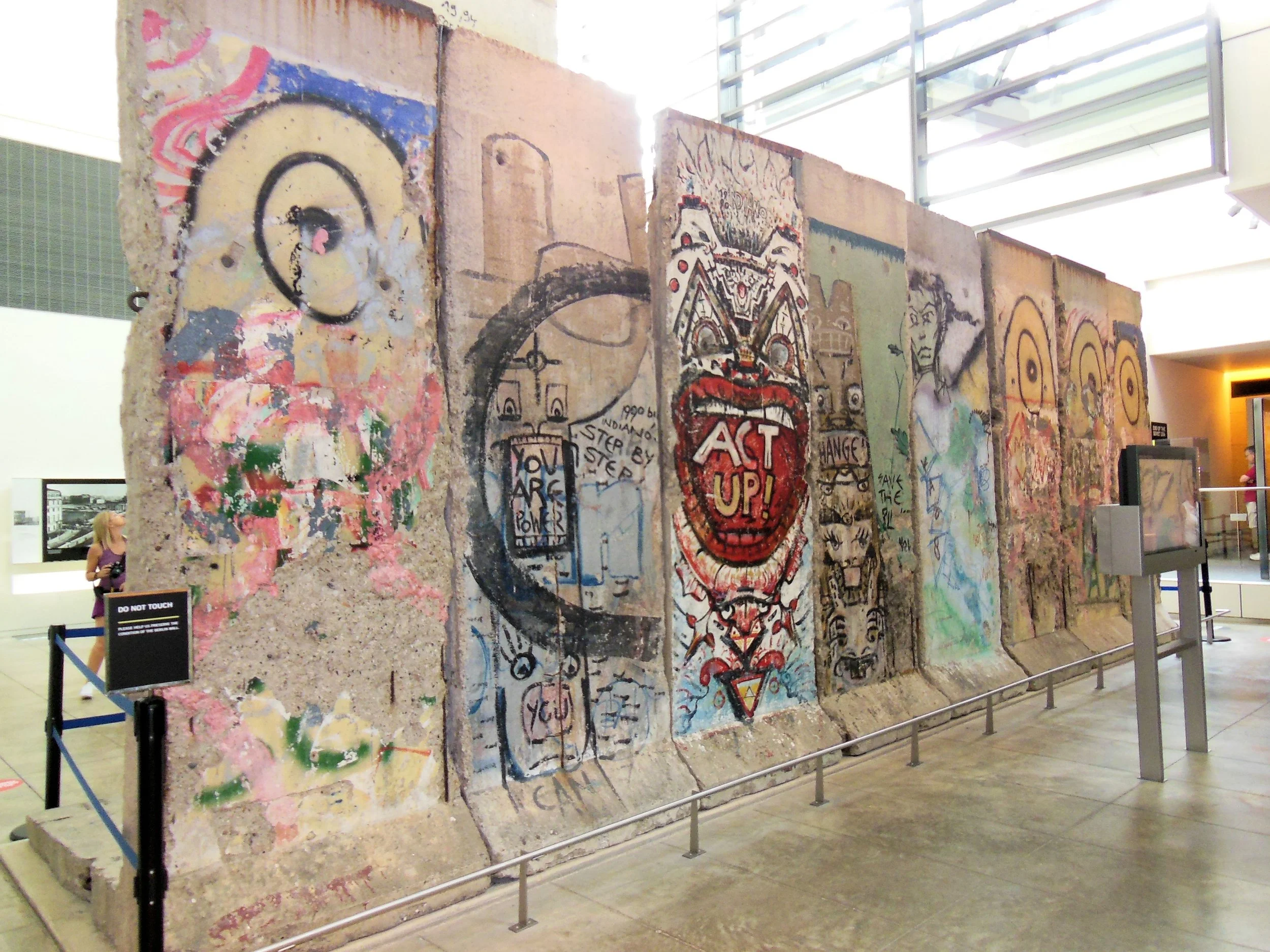
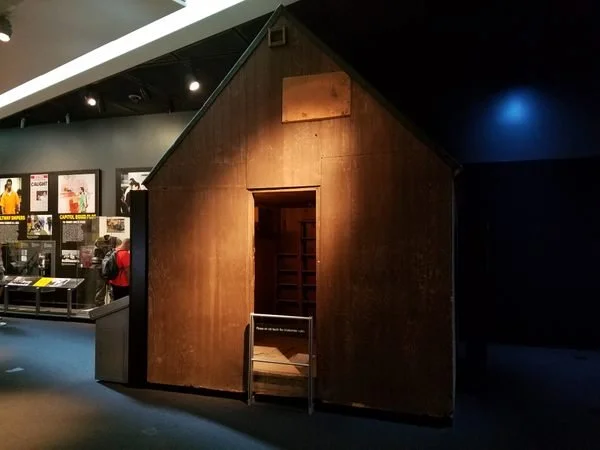
We began on the concourse level, one of the highlights of which was the largest hunk of the Berlin Wall outside Germany (including guard tower), which was supplemented with many informative placards and interactive touchscreens. (The Newseum, like most museums, integrates new technologies and media into its exhibits; however, unlike in many other places, the incorporation of these tools is seamless and overwhelmingly effective.) Another concourse highlight was the changing exhibit “G-Men and Journalists: Top News Stories from the FBI’s First Century,” which included powerful artifacts relating to the Oklahoma City bombing, the DC sniper case, the Branch Davidian compound siege, the fight against hate groups, and the Unabomber case (including Ted Kaczynski’s actual cabin).
From there we were whisked up a hydraulic glass elevator, past the gigantic LCD monitor and up to the 6th floor, which wasn’t great. (This is the recommended path for exploring the Newseum—concourse, then 6th floor and work your way down—and we followed it.) From the 6th floor we could see down to the 4th floor, which is dominated by a 9/11 exhibit that focused too much on the outrage of the American people and not enough on journalism’s role in covering the attacks.
The 5th floor, though—once we got there (it was a little difficult to figure out how to access it)—was staggering. Visitors are just overwhelmed by the sheer magnitude of information: News History traces the history of news-gathering in the US from its earliest examples through its transformations and milestones and vicissitudes. The room is dominated by rows of drawers containing glass-encased newspapers and magazines, chronicling not only the story of us as a people, but journalism as a field. Ringing the room are interactive pieces focusing on various major topics—satire, plagiarism, Watergate, tabloids, the publishing barons, etc. All contain a masterfully conceived admixture of actual artifacts, news items, video clips, and more. There are also several small theaters on the outer edge of the room—and, in fact, throughout the entire museum—showcasing issues in journalism, exploring ethics and news values, discussing photojournalism, etc.
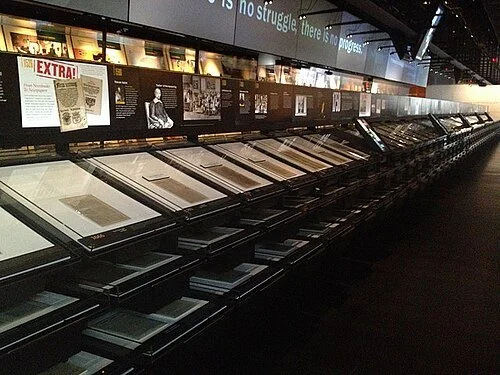
My only complaint for the 5th floor was that the lighting was too dim to read beyond the headlines, and the arrangement of the drawers at knee-level and in vertical columns meant that closer examination—to say nothing of sharing material with another museumgoer—was impractical. But really, these are comparatively minor quibbles.
The 3rd floor was a’ight: stuff about Edward R. Murrow, internet news, and a memorial to journalists killed while covering the news. It should be noted that throughout the Newseum are actual pieces of journalistic history that go beyond the newspapers and typewriters: news vans and helicopters, studio cameras, satellite dishes, and the like.
Friends, on the 2nd floor, I became a child again. The 2nd floor is home to the Interactive Newsroom, where one can queue up and become part of an actual “newscast”! To be honest, the opportunity was seized mainly by children, but I could not resist even the fleeting fulfillment of a longtime dream: to be a weatherman.
The results:
Mrs. Monsoon can be heard near the end of the video laughing loudly at my inexplicable antics: the saucy delivery, the tentative, pointless gestures, and just the obvious glee I took in being in front of the camera. Your comments are, always, welcome.
Finally on the first floor are the 4D theater (skipped it), the gift shop, and one of the most moving exhibits I’ve ever seen. The gift shop has lots of what you would expect—key chains, magnets, pencils, shot glasses, and more emblazoned with the Newseum name. It also has some great DVDs, mugs that read “Not tonight dear … I’m on deadline” and—the pièce de résistance —a book called Correct Me if I’m Wrong. This slim volume collects the best selections from the Columbia Journalism Review’s popular feature “The Lower Case,” which reproduces unintentionally funny headlines and press blunders. Some examples—which are also printed on tiles in the Newseum’s bathrooms—include:
Nuns forgive break-in, assault suspect
Crack in toilet bowl leads to 3 arrests
Literarcy week observed
Parking lot floods when man bursts
Drunk gets nine months in violin case
Farmer Bill Dies In House
…and my personal favorite…
Johnson Teacher Talks Very Slow
The first floor is also home to the permanent exhibition of Pulitzer Prize winning photographs. All of the winners are reproduced in small prints, but there are 30-40 enlarged photographs, each with a bit about the context of the piece and a reflective comment from the photojournalist responsible for the image. I had not seen some of these photographs, but even with the ones with which I was familiar—the execution of a Viet Cong prisoner in Saigon, the iconic image of a firefighter carrying an injured infant after the Oklahoma City bombing, the famous photo in the aftermath of the Kent State massacre—seeing them in a gallery setting, presented not just as photojournalism but really as art, was profoundly affecting. Many museum visitors were moved to tears by some of the photographs. I marveled at how impactful, how intense a photograph can be—far more moving and eloquent, in many cases, than a video of the same event, or an eyewitness account.
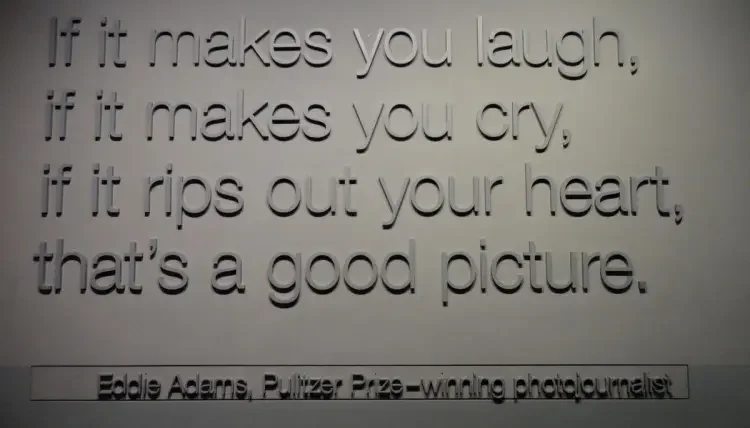
Not to be missed, and never to be forgotten.
Monsoon Martin's The Wire - Journalism Terms Glossary (episode 51)
My Weather-Friends,
As many of you know, I consider “The Wire” the finest television show in the history of the medium. It has just begun its fifth and final season on HBO, and the focus this go-round is the media and its struggles and failures. The season will be centered around a newsroom (a fictional Baltimore Sun) while still following some of the other plot threads (schools, drug trade, police activity, city hall) that have developed over the previous four seasons. Since there was a lot of jargon being thrown around in Episode 51, and because I have some background in the field of Journalism, I thought I'd put together a sort of running glossary/guide for the terminology used. I am, of course, open to corrections or clarifications on any of these points. (I would also like to thank the members of the Yahoo! Wire group in advance for the fine-tuning this list has already undergone.) The show airs Sunday nights at 9 on HBO with episodes appearing On Demand the Monday previous to airing.
Enjoy!
Monsoon
“The Wire” Journalism terms
Episode 51
The Baltimore Sun is the newspaper of record for the state of Maryland, having been founded in 1837. It is now owned by the Tribune Company in Chicago, which also owns the LA Times, the Orlando Sentinel, and other papers in addition to its broadcast media holdings.
The open floor plan layout of the Sun’s newsroom on “The Wire” is very true to life. It was designed as such to maximize interaction among a newspaper’s various departments and desks, unlike a traditional office, which is usually fragmented by a series of high cubicle walls. As the Sun’s City Editor Gus Haynes (played by Clark Johnson) says, “I’ll tell you what a healthy newsroom is. It’s a place where people argue about everything, all the time.” More competition, overworked and younger employees, and lack of job security have dampened this free and spirited exchange of ideas in modern newsrooms. Though the (real) Sun’s TV critic pans the portrayal of his newspaper on “The Wire” as simplistic and mired in jargon, I think it’s nuanced and brilliant.

The Managing Editor referred to in the first conversation is the second-highest in rank after the executive editor, and is directly responsible for most of the day-to-day operation of the newspaper.
A Foreign Bureau is physically located in a foreign country and usually includes reporters and an administrative staff (whereas a Foreign Affairs Desk is dedicated to foreign reporting but is physically located on the premises of the publication). In the first news scene, the three gentlemen are discussing the rumored closings of all foreign bureaus, including Johannesburg and Beijing. Foreign bureaus are typically expensive to maintain, so cost-cutting measures target them aggressively, opting to rely instead on foreign reporting by the
Associated Press (AP) or other foreign bureaus.
The three gentlemen by the newspaper loading dock are also discussing impending layoffs and buyouts, “as bad as in Philly.” This refers to the recent downsizing of staff throughout layoffs, early retirements, and buyouts at the Philadelphia Inquirer and Daily News. This is endemic to mid-size to large newspapers throughout the country, which are still profitable—but less so, due to declining circulation, loss of readership and ad revenues, etc. The publishers and managing partners of the news outlets panic because profitability is down—though still fairly robust compared with other industries—and begin laying off workers. It has been argued that profitability is down as well because content is made freely available online, which is not the case in other countries. Buyouts began in earnest in the 1990s and in most cases, when a worker is “bought out,” the job itself is eliminated as well. David Simon himself took one of the initial buyouts at the Sun. Many departments are now expected to churn out the same quality product with half its former staff size.
An illustration of this phenomenon is when another, smaller paper “scoops” the Sun on a transportation story the Sun should have gotten. While Haynes reminds the managing editor that the Sun has not had a transport reporter since the last round of buyouts, the managing editor reminds his staff that “just because Chicago does a little belt-tightening is no reason for us to fall down,” referring to the Tribune Company’s ownership of—and immediate and incessant cost-cutting measures at—the Sun. He then utters the famous phrases (which resonates through the police subplot as well), “You’ll just have to do more with less.” In one of the HBO documentaries about the fifth season, David Simon adds, “Of course you don’t do more with less; you do less with less.”
Haynes complains to a reporter that he’s always having to rework his lead. The lead (sometimes spelled lede) refers to the first sentence or two of a news piece, which conveys as much of the 5W and 1H (who, what, where, when, why and how) as possible. Particularly in today’s world of short attention spans, the headline and lead are often the only things a reader will actually read as he or she peruses the newspaper. Here is a very good example of a lead from the January 2nd edition of the Washington Post: “Candidates for the Democratic and Republican presidential nominations rallied supporters in Iowa today on the eve of the state's caucuses, as new polls showed tightening races among the leading contenders in both parties.”
Later in this exchange, Haynes asks the reporter to get him material by the “e-dot deadline” and later mentions a “double-dot deadline.” According to a Yahoo! Wire group member: “Dots are also called bugs. They're tiny marks you see at the top of the page if the page has been reworked for a later edition. Pages for the first edition (also called Four-Star) have an 11:30pm deadline (approx) and have no extra mark on the page. Five-star, or E-dot, is marked with one dot and would be the the five-star (next edition, the deadline is around 12:30am). Five-star chase, or double dot, is the final, marked with a letter F or C or a dot and a letter F or C and that close is anywhere from 1:15am to 2:30am depending on what kind of news day is happening.”
A deadline, of course, is the time set by which a step of the reporting process must be completed—copy deadline refers to when a story’s finished draft must be submitted to a copy editor; print deadline refers to the moment an edition must be finished and laid out to be sent to the printer. An article is often referred to as a “piece.”
From another Yahoo! Wire group member: “The path is story creation, then source editing (do the facts make sense? too much or too little of something in the story), copyediting (correct typographical errors), slot editing (does it fit on the page space allotted to it? plus putting in the headline, pull quotes and so on), then the page is checked and approved. You can't have all the stories done at the same time, because then your various editors would have too much to do all at once.
“Similarly, they can't send all the pages at once, because there is a limited number of plates that can be made at once. If they want to change ten pages on deadline, it's a really big deal, and they may let the pages go if they're not actually erroneous and do a ‘chase.’ This is where they replace the plates on the press after printing the first few, or if it's multiple presses they hold back on one press and put on the new ones, then stop the first and replace the old ones, all so they won't miss the press deadline for first good paper out of the pressroom.
“Color pages require multiple copies (cyan magenta yellow black) and every page has to have two plates because they put two copies on the drum, so plate A impresses and then plate B. Unless it's a "collect" run, but that doesn't happen very often.”
A columnist is a newspaper employee who is paid to write periodic (usually weekly or biweekly) columns for the paper, which can be humorous, lifestyle, related to politics or civic life, business, sports, or any number of niches.
It’s one of the few places in the newspaper (the other being the op-ed page, or opinion-editorial page) where a newspaper employee may offer his or her opinion. Haynes derisively remarks that columnists are “paid to sit on [their] asses.”
The Associated Press (AP) is a news organization that employs a vast (though shrinking) network of reporters to produce stories that will be syndicated throughout the country—and sometimes the world. Sometimes the AP will “pick up” a story that is of wider interest from a local or regional newspaper and syndicate it to other news outlets. On these occasions, the local reporter receives additional pay and his or her newspaper is highlighted as one that is producing quality journalism. Newspapers must pay to use AP articles, of course.
Haynes shouts on a couple of occasions that he needs “budget lines.” He’s looking for shorter pieces of background relating to the developing city budget. Another theory from a Yahoo! Wire group member: “The budget is the list of stories scheduled to be printed that night. Without more context I'm not sure what Haynes is asking for, but he's probably asking to be allowed to put more stories in.”
A reporter asks, “What about art for the Hopkins press conference?” Art here refers to photographic illustration of a story, which is essential for prominent pieces. Because downsizing occurs among the photography staff of a newspaper too, though, it’s difficult to get a photographer to every newsworthy event.
A couple of things related to newspaper “art”: first, a “grip-and-grin” is a derisive term for a photograph of a civic event that features participants shaking hands and posing—as the announcement of a new initiative, the donation of funds, etc. Also, Haynes is incensed when he receives the “art” for an East Baltimore row house fire because it features a charred doll in the foreground. This composition is a common—and lazy—way for a photographer to convey the sense of loss and the ways in which a fire may have affected a home’s children.
Haynes speculates that since all of the photographer’s fire photos have a burnt doll or singed toy in the foreground, he must have a trunk full of them and some lighter fluid so he can stage the photograph just right.
Various desks are mentioned—state desk, metro desk, city desk. These are dedicated “departments” whose reporters cultivate knowledge of, and write pieces about, civic affairs in the city, metropolitan area, and state. The reporting in these areas has suffered mightily as a result of cutbacks, particularly at a place like the Sun, because older reporters with lots of contacts and expertise are being “bought out” and inexperienced recruits fresh out of “j-school” (journalism school), who will work cheaply, are hired.
Another cost-cutting measure that has been used for years by newspapers is the use of floaters and stringers. A floater is a part-time or full-time reporter who is not bound to any particular desk or specialty. The problem here is that one becomes mediocre at lots of different things, but not excellent at any of them. A stringer is a freelance writer hired by the newspaper on an as-needed basis and paid per article. Stringers sometimes have specialized knowledge (like the “College Park stringer” mentioned in the episode) and are often used to attend municipal meetings, cover local sporting events, and the like.
The editors discuss “20 inches” and “15 inches” at different times here. This refers to the length of an article, and is technically measured in “column-inches.” A column-inch is a one inch deep (long) and one newspaper
column wide. Reporters—particularly ambitious ones, or those for whom brevity is difficult—are forever trying to get more inches.
Some stories “go national” (are picked up by the national press because their appeal or newsworthiness transcends regional considerations, as with the 22 bodies story). Another reporter, however, contends that this story did not “have legs”—meaning that it did not become the source of ongoing follow-up pieces or deeper investigation. The ultimate story with “legs” was Watergate.
The ambitious reporter Scott Templeton (played by Tom McCarthy) is chagrined at being sent to “pull clips” and “check the morgue files” so he can write the “A-matter” on Ricardo’s history. He is being asked to check through the Sun’s archives (electronic files, physical clippings, and possibly even microfiche or film) to find previous articles about the principals in this story so he can provide the background material (which will be presented “up front”) against which the story can be told. It’s essential but unglamorous work that young reporters often draw.
The editors, late at night, determine that the Ricardo story “deserves a front” and will appear on the “front page, below the fold.” This means that the story is newsworthy enough to merit inclusion on the “jump page” or front page, but will not appear “above the fold” where screaming headlines and attention-grabbing images are shown. The “jump page” is so called because this is typically the only page in the first section from which articles “jump” (are continued on a subsequent page, indicated by a “jump line”—please see Ricardo on A12). In this configuration, six or seven articles can be included on the front page, with probably only one or two above the fold, and they all jump to the inside pages. Note that there has been some discussion about whether the jump page actually might refer to the page to which many of the jumps go.
Alma Gutierrez (Michelle Paress) is complimented on her ability to secure a quote from the article’s subject when Haynes says to her, “Good pull.” For her efforts, she receives a contributing line (or contrib line), which doesn’t
impress Templeton, but means she’ll receive something like “with additional reporting by Alma Gutierrez” under the main reporter’s byline (name) or (usually) at the conclusion of the piece. A “pull quote” is also the name for a quote that is featured in larger font surrounded by rules (lines, or a box) in an article to draw the reader in; Alma may have contributed a quote from the subject that was used in a pull.
Templeton states that he wishes to get out of Baltimore because it has “shit news,” but Alma is clearly invigorated by her work and feels that “the Sun is still a pretty good paper.” Templeton wants to move up and out—when asked
where, he answers, “The Times or Post, where else?” He’s referring to the New York Times and the Washington Post, the two most respected newspapers in the United States, widely considered the pinnacle of the profession.
“When did this break?” is asked of the Ricardo story. Bill Zorzi’s character (is he playing himself?) is asking when the story “became” news—not only when it occurred, but when someone realized it was newsworthy.
Finally, Templeton asks Haynes who is “doing the react piece” on the Ricardo story, because he sees that it could be a story that “has legs.” A react(ion) piece seeks to broaden the story by talking with associates of the principals, political figures, and others to assess the impact of the original story.
END OF EPISODE 51 NOTES.