
Monsoon's Newseum Review and Television Debut
If, as Jean-Paul Sartre wrote, hell is other people, then people in their hordes and crowds and maundering packs of listlessness must constitute a new circle in Dante’s Inferno. Trying to have a meaningful museum-going experience amidst the sweaty multitudes is a nearly fruitless pursuit. Dodging visor-and-fanny-pack-bedecked tourists, restless adolescent Boy Scouts and their harried scoutmasters, giggling imps, and fusty society ladies can take all the magic out of taking a look at some nice-assed art.
Seeing a large wooden track for homemade model cars bisecting a portrait gallery in the Smithsonian (it was some sort of Scouting and crafts weekend) was as disheartening as it was shocking.
Surely a museum of that magnitude can be appreciated by patrons of all ages simply on the basis of its cultural and artistic merits without being turned into a Night at the Museum come to life. Judging from the Scouting chaos, the little girl who almost knocked over a statue (prevented from doing so by my alarmed yawp, after which her parents ushered the stunned toddler from the gallery), the disinterested tweens texting obsessively, and the brazenly loud cellphone conversations carried on unapologetically in front of artistic treasures, the answer to that question is a resounding no.
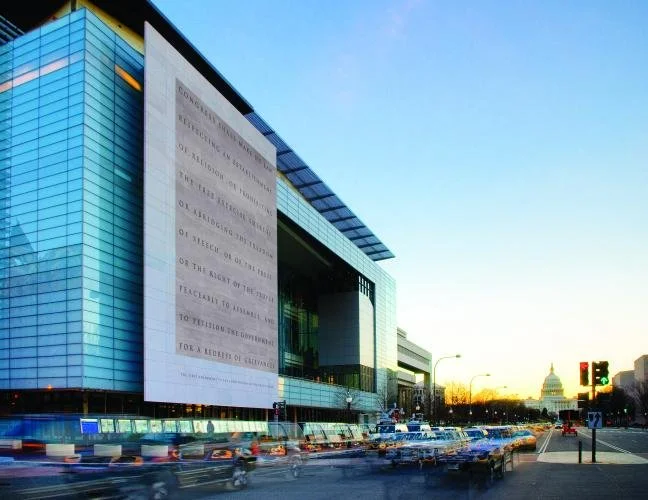
But truly and sincerely, the Newseum was well worth the effort of enduring the inappropriateness, insensitivity, lack of museum etiquette and just plain presence of other people—teeming, snorting, prating, obstructing, farting, shuffling people.
As a person who teaches a journalism elective course, has worked briefly in journalism, and harbors a long-standing interest in the field, I have been excited about the Newseum since it was reported in its planning stages.
The Newseum is on Pennsylvania Avenue between 5th and 6th Streets, and is open 9 to 5 daily (closed only on Thanksgiving, Christmas, and New Year’s Day). Unlike the Smithsonian museums, which are free, it costs $19.95 for adult admission. Let me hit some of the highlights of this museum; my recollections are by no means intended to be exhaustive, though by the end of this post you may feel much as I do when my mother says “to make a long story short” well into a longwinded saga.
Into the façade of the Newseum is etched the so-called Establishment Clause from the First Amendment, and the length of the building is lined with the current front pages of newspapers around the country and (on the sixth floor) world.
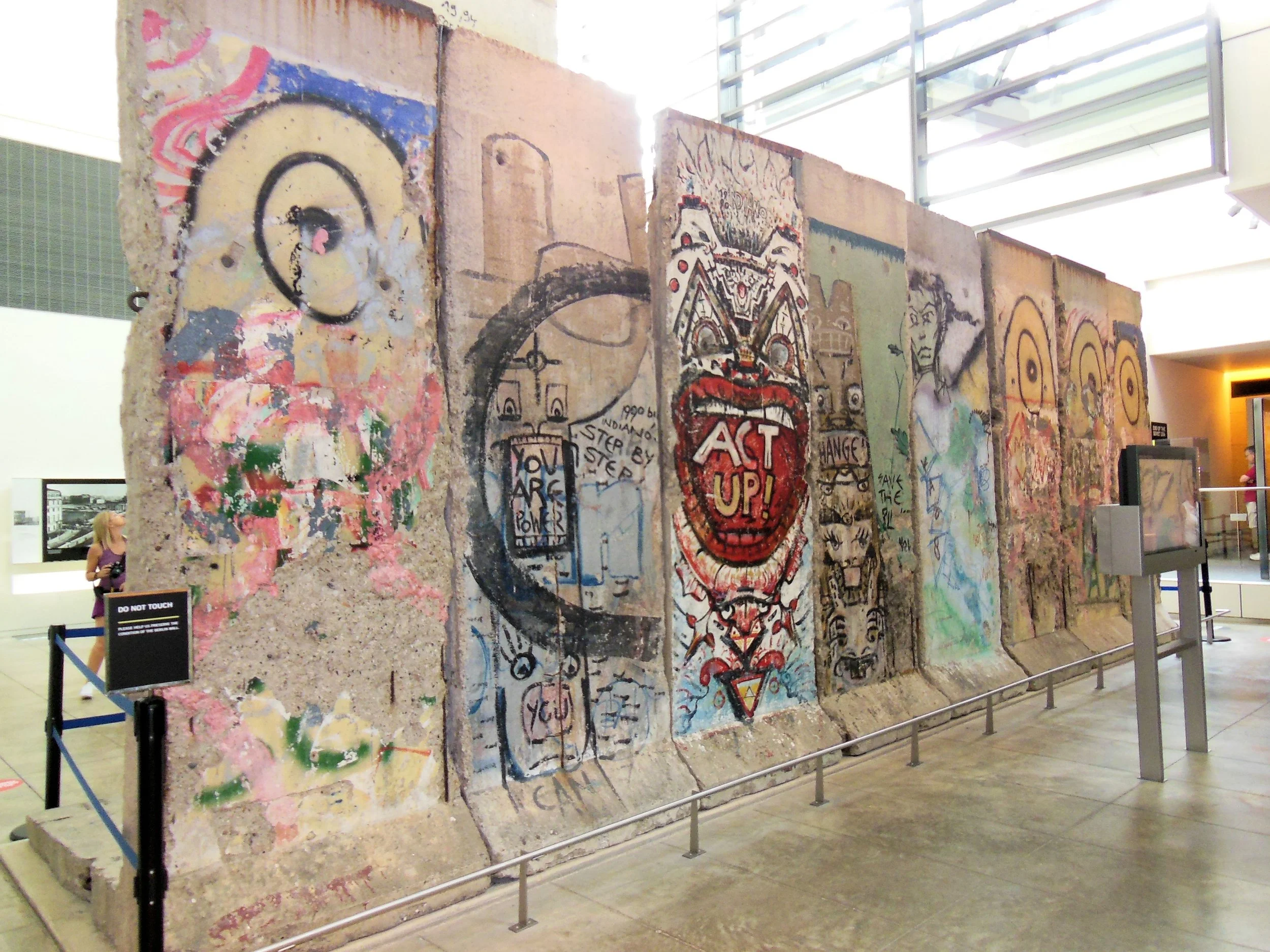
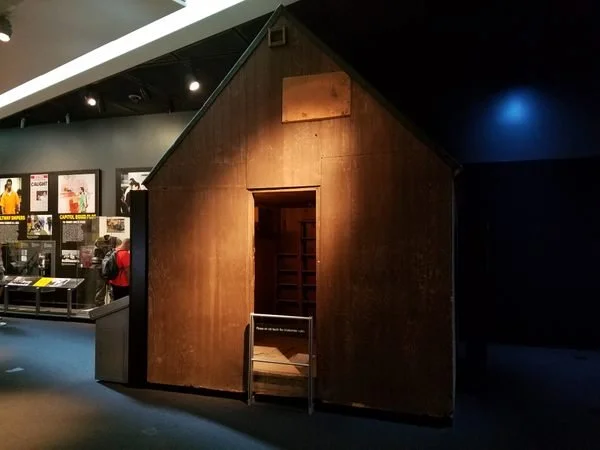
We began on the concourse level, one of the highlights of which was the largest hunk of the Berlin Wall outside Germany (including guard tower), which was supplemented with many informative placards and interactive touchscreens. (The Newseum, like most museums, integrates new technologies and media into its exhibits; however, unlike in many other places, the incorporation of these tools is seamless and overwhelmingly effective.) Another concourse highlight was the changing exhibit “G-Men and Journalists: Top News Stories from the FBI’s First Century,” which included powerful artifacts relating to the Oklahoma City bombing, the DC sniper case, the Branch Davidian compound siege, the fight against hate groups, and the Unabomber case (including Ted Kaczynski’s actual cabin).
From there we were whisked up a hydraulic glass elevator, past the gigantic LCD monitor and up to the 6th floor, which wasn’t great. (This is the recommended path for exploring the Newseum—concourse, then 6th floor and work your way down—and we followed it.) From the 6th floor we could see down to the 4th floor, which is dominated by a 9/11 exhibit that focused too much on the outrage of the American people and not enough on journalism’s role in covering the attacks.
The 5th floor, though—once we got there (it was a little difficult to figure out how to access it)—was staggering. Visitors are just overwhelmed by the sheer magnitude of information: News History traces the history of news-gathering in the US from its earliest examples through its transformations and milestones and vicissitudes. The room is dominated by rows of drawers containing glass-encased newspapers and magazines, chronicling not only the story of us as a people, but journalism as a field. Ringing the room are interactive pieces focusing on various major topics—satire, plagiarism, Watergate, tabloids, the publishing barons, etc. All contain a masterfully conceived admixture of actual artifacts, news items, video clips, and more. There are also several small theaters on the outer edge of the room—and, in fact, throughout the entire museum—showcasing issues in journalism, exploring ethics and news values, discussing photojournalism, etc.
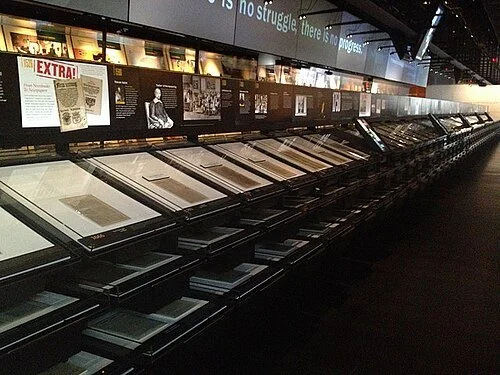
My only complaint for the 5th floor was that the lighting was too dim to read beyond the headlines, and the arrangement of the drawers at knee-level and in vertical columns meant that closer examination—to say nothing of sharing material with another museumgoer—was impractical. But really, these are comparatively minor quibbles.
The 3rd floor was a’ight: stuff about Edward R. Murrow, internet news, and a memorial to journalists killed while covering the news. It should be noted that throughout the Newseum are actual pieces of journalistic history that go beyond the newspapers and typewriters: news vans and helicopters, studio cameras, satellite dishes, and the like.
Friends, on the 2nd floor, I became a child again. The 2nd floor is home to the Interactive Newsroom, where one can queue up and become part of an actual “newscast”! To be honest, the opportunity was seized mainly by children, but I could not resist even the fleeting fulfillment of a longtime dream: to be a weatherman.
The results:
Mrs. Monsoon can be heard near the end of the video laughing loudly at my inexplicable antics: the saucy delivery, the tentative, pointless gestures, and just the obvious glee I took in being in front of the camera. Your comments are, always, welcome.
Finally on the first floor are the 4D theater (skipped it), the gift shop, and one of the most moving exhibits I’ve ever seen. The gift shop has lots of what you would expect—key chains, magnets, pencils, shot glasses, and more emblazoned with the Newseum name. It also has some great DVDs, mugs that read “Not tonight dear … I’m on deadline” and—the pièce de résistance —a book called Correct Me if I’m Wrong. This slim volume collects the best selections from the Columbia Journalism Review’s popular feature “The Lower Case,” which reproduces unintentionally funny headlines and press blunders. Some examples—which are also printed on tiles in the Newseum’s bathrooms—include:
Nuns forgive break-in, assault suspect
Crack in toilet bowl leads to 3 arrests
Literarcy week observed
Parking lot floods when man bursts
Drunk gets nine months in violin case
Farmer Bill Dies In House
…and my personal favorite…
Johnson Teacher Talks Very Slow
The first floor is also home to the permanent exhibition of Pulitzer Prize winning photographs. All of the winners are reproduced in small prints, but there are 30-40 enlarged photographs, each with a bit about the context of the piece and a reflective comment from the photojournalist responsible for the image. I had not seen some of these photographs, but even with the ones with which I was familiar—the execution of a Viet Cong prisoner in Saigon, the iconic image of a firefighter carrying an injured infant after the Oklahoma City bombing, the famous photo in the aftermath of the Kent State massacre—seeing them in a gallery setting, presented not just as photojournalism but really as art, was profoundly affecting. Many museum visitors were moved to tears by some of the photographs. I marveled at how impactful, how intense a photograph can be—far more moving and eloquent, in many cases, than a video of the same event, or an eyewitness account.
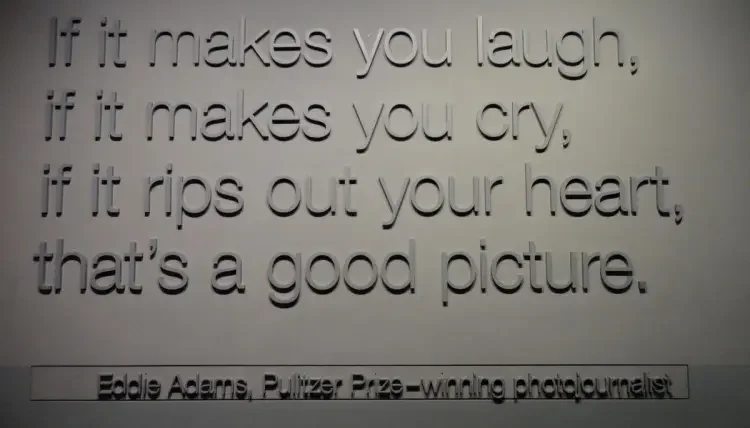
Not to be missed, and never to be forgotten.