
Monsoon Martin's Election Night 2008 Comment
Barack Obama was elected the 44th President of the United States tonight.
At 11pm, when the cable-news talking heads could finally retire their touch-screen floating maps and tentative conjectures, the projection was made.And I cried.
I, hard-hearted cynic, longtime sufferer of political malaise, was swept up in the moment.
It wasn’t just the euphoria that accompanies the triumph of a candidate one has supported, argued for, defended strongly, written about, donated to.This felt different.
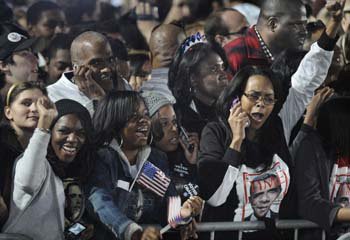
The term “historic” is maddeningly overused by those who seek to endow the mundane present with the swelling significance of the past.It’s only as these events recede into history that we can take true measure of their impact, their place.
And yet, the election of a Black man as President feels like a watershed, a defining moment.A break with the sordid inequalities that predated our country’s birth and persisted long thereafter; an evolution into the best of what we always imagined this country could be.
Barack Obama’s election tonight and his inauguration will not solve all of our problems.Far from it.He faces a maelstrom of challenges—political, economic, foreign and domestic.
But he does so with the support of (it now appears) more than 50% of the voting electorate, and a groundswell of grass-roots engagement nearly unprecedented in modern politics.And even though I don’t agree with his every stance, his every utterance, I have the feeling he will do the extraordinary as President: he’ll listen.
Bradley Effect, Schmadley Effect: tens of millions of people of all backgrounds cast their ballots for an African American candidate today because they believed he was the best person for the job.That says a lot about us, to us—and to the rest of the world.
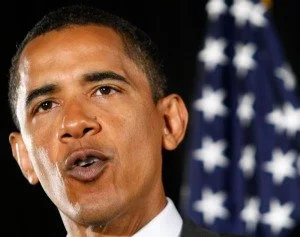
Congratulations, Senators Obama and Biden.
January 20th, 2009 is no longer only Bush’s last day—it’s also now Obama’s first.
Monsoon's "Obama Bucks" Campaign Racism Update
Habari mori,
What better way to start off your Monday than with a little old-fashioned, vintage, unadulterated, and almost unbelievable conservative racism? (Big-ups to Tim for letting me know about this story!)
It comes in the form of a little cartoon that appeared in the October newsletter of the Chaffey County Republican Women, Federated (a volunteer group in San Bernardino, California that is not directly affiliated with the state Republican party). It reads “Obama Bucks” and depicts Barack Obama as a donkey on a fictional food stamp. Obama’s ass-likeness is surrounded by—I shit you not—watermelon, ribs, Kool-Aid, and a bucket of fried chicken.
Diane Fedele, President of the Chaffey County Republican Women, Federated, (you can reach her by email here) insisted that when she created the newsletter and included the picture, she was just trying to make a connection to Barack Obama’s statement that McCain’s campaign is trying to scare people away from voting for Obama because he “doesn’t look like all those other presidents on the dollar bills.” Fedele insists that she just saw food arrayed around him and didn’t notice what it was, denying there was any intent to invoke longstanding African American stereotypes.
“It never connected,” she said. “It was just food to me. It didn’t mean anything else.” As Sigmund Freud didn’t say, “Sometimes a bucket of fried chicken is just a bucket of fried chicken.” And sometimes, it’s goddamned racist.
“I absolutely apologize to anyone who was offended,” she said in her non-apology apology. “That clearly wasn’t my attempt.” “Clearly”? Really??
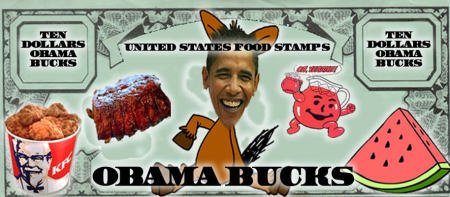
The whole matter is complicated by the fact that the image was evidently created by a liberal blogger to satirize the bigoted attacks on Obama by small-government hating ultraconservatives. The image was apparently taken literally—as satire too often is—and forwarded among those fine citizens in the right-wing Nobama set. Eventually, good old Diane Fedele got ahold of the picture, plopped it in her little volunteer newsletter, and the rest is pure, racist gold.
Only 15 more days until the election…it’s almost over!
Monsoon "The Plumber" Martin's Final Presidential Debate Analysis
As entertaining and engaging as this third and final debate was on Wednesday night, I have to admit that I was “flipping” back and forth between MSNBC’s coverage and the Phillies-Dodgers game—and “flipping out” when the Phillies won the pennant with an impressive Game 5 victory. (The last time the Phils were in the World Series, I was in college; the last time they won the World Series, I was jumping up and down in my footy pajamas on the shag carpet in my parents’ living room.)
But now that I’ve had a proper frolic with the debate transcript and watched key clips online, I feel I can present an informed bit of analysis here.
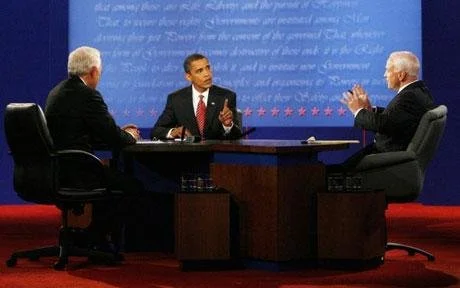
Barack Obama went into the debate with a commanding lead in national polls (and those in swing states) ranging from six to sixteen points, so he’s essentially settled on a strategy of “running out the clock” and avoiding any mistakes—heaven knows, there are segments of the electorate that are still uncomfortable with the notion of voting for a Black man and are just looking for an excuse to switch allegiances.
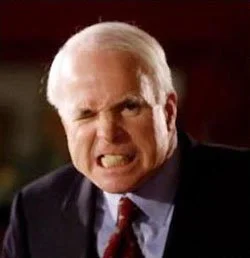
The most striking contrast in the Hofstra debate, once again, was demeanor—and based on polling following the debate (58% of debate watchers in one poll rated Obama the winner, compared with 31% who felt McCain had the better showing), this is what most Americans responded to. John McCain projected agitation, bitterness, sarcasm, and frustration when Barack Obama would not wallow in the smear-sty with him. His eye-rolls, mock surprise, and furious scribblings on his notepad while Obama was speaking revealed a candidate who does not seem to be in control of his impulses and emotions.
On the other hand, Barack Obama was the epitome of cool. When McCain tried to goad him into the muck, when he made sneering comments and interrupted testily, Obama’s response bespoke a level, steady, and perpetually unflustered bearing. In this frighteningly uncertain economic climate, Americans are looking for—to use John McCain’s boating cliché, which I derisively referred to as a gardening metaphor in my previous post—a steady hand on the tiller. Based upon their appearances, their personal histories, and especially the foil of barking, sputtering rage provided by John McCain in the three presidential debates, Barack Obama is that steady hand.
While John McCain rudely and impertinently interrupted either moderater Bob Schieffer or Obama no fewer than twenty times throughout the debate, Barack Obama smiled indulgently (though this smile seemed a bit strained at times) at McCain’s attacks and paroxysms, then calmly but insistently offered his rejoinders.
There were some telling statements, exchanges, and recurring themes throughout the debate that may explain why many observers lauded Barack Obama’s performance—and yet, a feistier, more aggressive performance and a few zingers also led some to claim victory of Senator McCain. Not surprisingly, I beg to differ. Lemme splain.
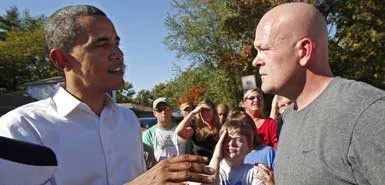
John McCain was—like his Wasilla Chatty Cathy doll running mate—a one-note Johnny in repeating ideas, even when they had been successfully rebutted, and even when he sounded ridiculous doing so. Three examples of many: he described the American people as “angry” at least five times, clearly trying to tap into a wellspring of bitterness that might be directed at Obama; he thrice described his VP mate Sarah Palin as a “reformer” despite the fact that she was just found by an independent panel to have abused her power as governor in the Troopergate scandal; and he mentioned Joe the Plumber at least 17 times (that I was able to count) in insisting that Barack Obama was going to raise taxes and effectively make it impossible for small business owners to stay afloat—continuing along this line even after Obama had debunked McCain’s tenuous claims. McCain insisted that under Obama’s plan, “we’re going to take Joe’s money, give it to Senator Obama, and let him spread the wealth around. … [it’s] class warfare.” Surely most Americans realize that it’s not “class warfare” to provide tax relief for the working and middle classes while shifting some of the tax burden to the upper classes; it’s common fairness.
Another example of McCain repeating long-since-deflated stump soundbites was when he said, “We have to stop sending $700 billion a year to countries that don’t like us very much.” In fact, according to various sources (including the excellent fackcheck.org), the U.S. spends less than half that amount importing foreign oil—the majority of it from “friendly” countries like Canada.
He also reheated that little chicken nugget about the “$3 million for an overhead projector in a planetarium in his hometown” that Obama supposedly earmarked. Never mind that it was to overhaul the digital projection system at a science museum, part of a community revitalization effort undertaken with bipartisan support; Obama didn’t even dignify it with a response (though in this case, maybe he should have set the record straight). The lies, like the universe, are inscrutable, innumerable, and infinite in their scope.
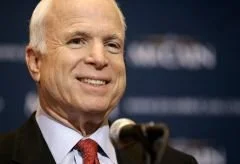
Obama actually responded to the “spending freeze” proposed by McCain, describing it as a “hatchet” when a scalpel is needed: “Now, Senator McCain talks a lot about earmarks. That’s one of the centerpieces of his campaign. Earmarks account for 0.5% of the total Federal budget. There’s no doubt that the system needs reform and there are a lot of screwy things that we end up spending money on, and they need to be eliminated. But it’s not going to solve the problem.”
One of Barack Obama’s best “zingers” was tucked away in his response to a question about the economy, when he said that “the fundamentals of the economy were weak even before this latest crisis.” It successfully tied John McCain to the failed economic management policies of George W. Bush, and it alluded to McCain’s ridiculous assertions that “the fundamentals of the economy are strong” even as the markets began their historic collapse.
Speaking of “zingers,” John McCain seemed to get one in about a third of the way through the debate. When Obama noted that “Senator McCain voted for four out of five of President Bush’s budgets,” McCain retorted, “Senator Obama, I am not President Bush. If you wanted to run against President Bush, you should have run four years ago. I’m going to give a new direction to this economy in this country.”
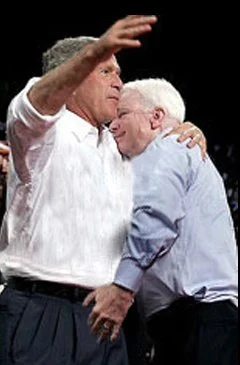
True enough: he is not President Bush, and in fact engaged in a bitter primary fight against Bush in 2000. He’s clashed with the administration on torture. But facts are facts, as Barack Obama noted: “So the fact of the matter is that if I occasionally have mistaken your policies for George Bush’s policies, it’s because on the core economic issues that matter to the American people, on tax policy, on energy policy, on spending priorities, you have been a vigorous supporter of President Bush.” I’d call that exchange a tie.
The real (bull)shit hit the fan, though, when Schieffer asked the candidates if they were willing “to sit at this table and say to each other’s face what your campaigns and the people in your campaigns have said about each other?” In daring John McCain to confront Barack Obama with the most dearly-held smears involving Fannie Mae and William Ayers, Schieffer gave McCain the chance to either score significant points with his lunatic fringe base—which has been clamoring for him to do just that—or bitterly disappoint his wing-nuttiest supporters.
First, McCain blamed Obama for the skanky campaign McCain had been running: if only you had agreed to the “town hall” debates I proposed, we could have had 10 of them already, and we could have avoided all this ugliness. I would ask: who is running the negative ads, Senator McCain? You, ass.
Then he repeated a bit of outrageously manufactured outrage ( see this clip ) that he first disgorged in a television interview earlier in the week. “A man I admire and respect—I’ve written about him—Congressman John Lewis, an American hero, made allegations that Sarah Palin and I were somehow associated with the worst chapter in American history, segregation, deaths of children in church bombings, George Wallace. That, to me, was so hurtful.”
Congressman Lewis released a statement reacting to the fact that supporters of McCain and Palin were shouting such epithets as “terrorist,” “kill him!” “off with his head,” and “traitor” at rallies, and neither candidate condemned or repudiated these frothing fascists—in fact continuing to make statements that might incite such remarks. In his statement, Congressman Lewis said, in part, “What I am seeing reminds me too much of another destructive period in American history. Sen. McCain and Gov. Palin are sowing the seeds of hatred and division, and there is no need for this hostility in our political discourse.” Unassailably true. He went on to discuss the climate created by the likes of George Wallace—who “never threw a bomb” but nonetheless incited others to violence. Congressman Lewis later said his comments were a little over the top, and Obama’s campaign had nothing to do with the release of his original statement. It’s disingenuous and cheap for John McCain to simper with false outrage at this alleged wound.
McCain, for his part, insisted that he’s always repudiated inappropriate outbursts (he hasn’t), accused Obama of being permissive with similar outbursts at his appearances (he isn’t, so far as I’ve seen, sniping “we don’t need that” when his supporters began to boo at his mention of Senator McCain’s name last week), and issued the following backhanded endorsement of his own base: “Let me just say categorically I’m proud of the people that come to our rallies. Whenever you get a large rally of 10,000, 15,000, 20,000 people, you’re going to have some fringe people. You know that. And I’ve—and we’ve always said that that’s not appropriate.”
McCain also whimpered that Obama’s campaign had been running “attack ads” on his health care plan, on his position on immigration, and on stem cell research. Senator McCain, these are not attack ads. These are issue ads. They deal with legitimate policy and platform differences, which should be the basis for the electorate’s decision-making process. “Attack ads” are personal: assailing a candidate’s morality, his or her patriotism, his or her ethics. Swift Boat Veterans for Truth: those were attack ads. The pamphlets distributed by the Bush campaign in 2000 alleging that you’d fathered an illegitimate Black baby: those were attack ads. Willie Horton in 1988 was an attack ad, maybe the consummate one. And the ads seeking to connect Barack Obama with voter registration fraud in ACORN, with a domestic terrorist named William Ayers, with criminals: these are attack ads. (Obama noted that 100% of McCain’s ads were negative, which is true of the last few weeks, but a bit less so when examining the whole campaign.)
[I have to share a picture that depicts John McCain reacting in an almost unhingedly goofy way to walking the wrong direction offstage at the debate's conclusion. I like to think he is actually retching and kecking because of the lies he's just told and the nasty, untethered turn his campaign has taken. It has quickly become one of my favorite pictures in the whole wide world.]
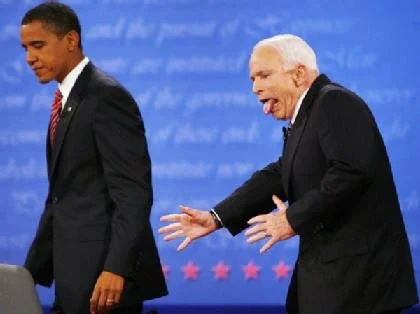
Barack Obama’s response to these unsubstantiated smears and false outrage was to go on the offensive in an impressive way, seizing control of the debate’s tone. “Senator McCain’s own campaign said publicly last week that, if we keep on talking about the economic issues, we lose, so we need to change the subject.” In one sentence, he painted the McCain campaign as wildly desperate and cravenly unscrupulous. He also brought up the William Ayers issue, forcing John McCain to wield it, then masterfully and unequivocally undercut its relevance: “Mr. Ayers is not involved in my campaign. He has never been involved in this campaign. And he will not advise me in the White House. So that’s Mr. Ayers.” He went on to dismiss ACORN, which “had nothing to do with us,” and which in fact is a non-story. He finished by talking about who he does associate with, insisting that these will be the people who have inspired him and who will shape his policies in the White House. When McCain interrupted, as he did often, reasserting his incorrect or incomplete information, Obama responded with a firm but unruffled “that’s absolutely not true” or “that’s just not so.” He laid the ethical smackdown: “And I think that the fact that this [Ayers issue] has become such an important part of your campaign, Senator McCain, says more about your campaign than it says about me.” Boo-ya!
Obama’s most powerful statement along this line of discussion punctuated the Lewis matter and disabled McCain’s attacks: “The important point here is, though, the American people have become so cynical about our politics, because all they see is a tit-for-tat and back-and-forth. And what they want is the ability to just focus on some really big challenges that we face right now, and that’s what I have been trying to focus on this entire campaign.” He later reiterated a call to “disagree without being disagreeable,” no doubt calling many viewers’ attention to the sighing, mugging, histrionics of the disgruntled candidate to his left.
A few of John McCain’s statements went beyond mere condescension into outright belligerence, and in at least once case, racism. On NAFTA, he said, “By the way, when Senator Obama said he would unilaterally renegotiate the North American Free Trade Agreement, the Canadians said, ‘Yes, and we’ll sell our oil to China.’ You don’t tell countries you’re going to unilaterally renegotiate agreements with them.” This was punctuated by a Cheshire Cat grin and stageworthy eye roll for full effect.
Another time, when discussing the need to become independent of foreign energy sources, McCain said, “Well you know, I admire so much Senator Obama’s eloquence. And you really have to pay attention to words. He said, we will ‘look at offshore drilling.’ Did you get that? ‘Look at.’ We can offshore drill now.” First of all, whether he intended it or not—and I’m loath to give McCain the benefit of the doubt, even in this case—calling Obama “eloquent” recalls the racist, paternalistic praise historically directed toward African Americans who speak “well,” using standard English, as “articulate.” Secondly, it’s just another example of McCain’s fearmongering: this smooth-talking Black dude is using euphemistic language to bilk you all.
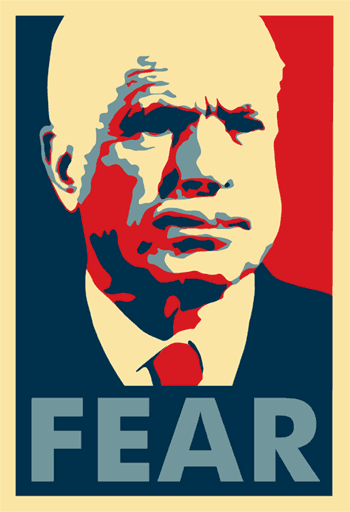
More fearmongering, this time turning Obama’s health care plan into a nightmare of socialized medicine, bureaucratic gridlock, and six-month waits for surgery: “Senator Obama wants to set up health care bureaucracies, take over the health care of America through—as he said, his object is a single-payer system.”
Senator McCain also spent some time hammering away at base-pleasing ideas like curtailing government intrusion: “Hey, Joe, you’re rich, congratulations. Because what Joe wanted to do way buy the business that he’s been working for 10-12 hours a day, seven days a week, and you said that you wanted to spread the wealth, but—in other words, take Joe’s money and then you decide what to do with it,” he sputtered. “Now, Joe, you’re rich, congratulations,” he repeated inanely.
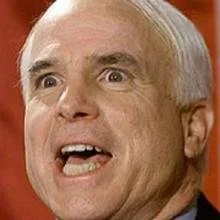
When Bob Schieffer brought up Roe v. Wade and the abortion issue, I was disappointed because I see this as a “wedge” culture war issue that has—at least in the past 25 years or so—been a distraction from more pressing national affairs in politics. But their exchanges revealed a whole lot about each candidate.
Obama hewed to his platform in declaring, “But what I ultimately believe is that women in consultation with their families, their doctors, their religious advisers, are in the best position to make this decision.” McCain, likewise, spoke of a “culture of life” and declared himself “proudly pro-life.” After McCain tried to stymie Obama by bringing up a couple of “present” votes in the Illinois legislature, Obama explained them away easily.
“With respect to partial-birth abortion, I am completely supportive of a ban on late-term abortions, partial-birth or otherwise, as long as there’s an exception for the mother’s health and life, and this [bill for which Obama voted ‘present’] did not contain that exception.” He went on to say that he hopes the divergent viewpoints on abortion can be “reconciled.”
Senator McCain, rather than joining his opponent in exploring this spirit of reconciliation, attacked Obama for being well-spoken: “Just again, the example of the eloquence of Senator Obama. He’s health for the mother. You know, that’s been stretched by the pro-abortion movement in America to mean almost anything. That’s the extreme pro-abortion position: quote, ‘health.’” John McCain’s statement is breathtaking in its utter disregard for women’s health and right to choose. That’s right, Senator McCain, when you start guaranteeing exceptions for the “health” or “safety” of the mother, who knows what kind of guaranteed rights these women will want next.
The final topic of the night was education: Obama is for early childhood education initiatives like Head Start, offer teachers “higher pay” and “give them more professional development and support in exchange for higher standards and accountability.” I find this a little alarming because it seems to open the door for merit pay and testing, but he’s spoken against these two trends in the past, so I remain hopeful that Barack Obama will be an education-friendly President.
But McCain is even more alarming in his educational priorities (he’s for vouchers, hard) and his disdain for Head Start: “By the third grade many times children who were in the Head Start program aren’t any better off than the others.” In fact, a number of studies have been done over the past 40 years or so since Head Start was introduced, and the results have been mixed: in some cases, little discernible benefit can be found when comparing students who attended Head Start with those who did not. But: these studies are notoriously difficult to place methodological controls on, making their results less valid in measuring benefits and less reliable in predicting future benefits. In addition, there have been more than a few studies that suggest the benefits of Head Start participation are very real, in both the short- and long-term: vocabulary, phonemic awareness, self-esteem, healthful living, community awareness, and critical thinking have been shown to benefit in many children from Head Start programs. With a cavalier wave of the hand, John McCain made the chronically underfunded and underappreciated program seem like an utter failure and complete waste of resources.
It was in Barack Obama’s closing statement that I think he connected best with the independent and moderate Democrat voters he needs to win this election: “We need fundamental change in this country, and that’s what I’d like to bring. … But it’s not going to be easy. It’s not going to be quick. It is going to be requiring all of us—Democrats, Republicans, independents—to come together and to renew a spirit of sacrifice and service and responsibility. I’m absolutely convinced we can do it. I would ask for your vote, and I promise you that if you give me the extraordinary honor of serving as your President, I will work every single day, tirelessly, on your behalf and on the behalf of the future of our children.”
In eighteen days, we’ll see if the electorate will give him that chance.
Monsoon Martin's "Town Hall" Presidential Debate Analysis for 7 October 2008
My friends,
[a phrase I’m hereby retiring because it’s a gratingly ingratiating verbal tic of John McCain’s]
I haven’t written about the presidential election for some weeks (since the “Moose Shootin’ Mama” post, which just about depleted my life-force). Over all, I have to say I’m just goddamned sick of it all: the plans, the surrogates, the smears, the ads, the interviews, the debates, the pundits, the polls. What else is there really to learn about either of these candidates? I am flabbergasted at the notion that there are undecided voters left at all. I’d just like to see the election take place tomorrow and end this foolishness already.
All that said, I’ve watched all three debates thus far and will watch the fourth, as my political junkie-hood cannot remain unfed for long.
I don’t have much to say about the first two debates, especially given that so much has already been written and discussed about them. In the initial presidential debate, I thought Barack Obama acquitted himself very well, and that John McCain came off as a seething, petulant pee-pee-pants when challenged on his falsehoods; I also found it troubling that he seemed unable (or unwilling) to look his opponent in the eye when the ineffectual moderator Jim Lehrer tried to get the two to interact.
The Biden-Palin vice-presidential debate was such a farce that I can scarcely comment. It was like watching an infomercial for Mary Kay Cosmetics and C-SPAN coverage of a Senate debate on split-screen coverage. Sarah Palin’s relentlessly, manically folksy verbal tics (“bless their hearts,” “you betcha,” “Joe Six-Pack,” “shout-out,” ad nauseam) and the fact that she—brazenly, admittedly—refused to actually answer most of the questions asked of her just proved that she is incapable of leadership or nimble thought. Listening to her parrot the party line that had been drilled into her—and in that jarring, customer-service-clerk-at-a-Wasilla-Wal-Mart voice—was almost literally too much for me to stand.
I found tonight’s debate a little more interesting, though, and despite the fact that it was not all that “town-hall-y” at all, I’ll share some thoughts.
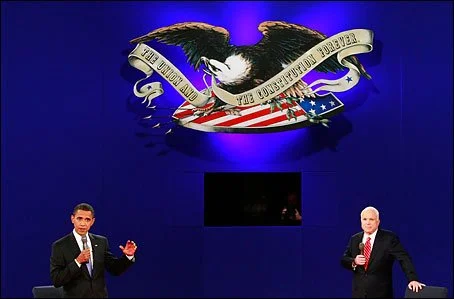
Barack Obama scored some points right away by noting that AIG executives (my former employer, again making me proud) had spent $440,000 on an extravagant junket after the company was “bailed out” by the US government, and calling for these executives to be fired. John McCain’s response was to try and ply the slimy trade of tying Obama to Fannie Mae (or was it Freddie Mac? Who can tell the difference?) in terms of fundraising and lobbying.
It was here—early on—that I feel Barack Obama asserted his control over the debate, and may have established himself as the winner. He answered the question that had been posed by an audience member, and then said, “And I’ve just got to correct Senator McCain’s history, not surprisingly.” He answered the F.M. charge (see? easier) effortlessly by alluding to McCain’s record of deregulation, then said, “But you’re not interested in hearing a couple of politicians pointing fingers at one another; you want to hear how the economic realities are going to affect your lives.”
[A note about quotations: these are based upon my fevered jottings during the debate—I haven’t examined a transcript—and are accurate in spirit if not in precise wording.]
What Barack Obama was able to do there was to make John McCain look desperate—like a candidate who would say anything to get elected, even distort the truth. Then he placed himself (but not McCain) above the political fray, positioning himself as the one candidate who wants to move beyond dirty politics and personal attacks. It was an absolute masterstroke.
The other aspect of Obama’s debating prowess I felt was especially strong tonight was his anticipation of McCain’s rebuttal arguments and casual decimation thereof.
John McCain seemed halting and awkward during the debate, and I think he continued to come off as erratic and inauthentic, which is painfully apparent to American voters. Maybe at one time, and in some situations, he was truly a “maverick”; but now, he seems unmoored and at the whim of political efficacy. As Gertrude Stein once observed about Los Angeles (but I think applies here in describing the candidate): “There’s no there there.”
McCain mentioned some sort of “pork barrel” earmark that Barack Obama apparently secured for his home district—a $3 million overhead projector for a planetarium in Chicago. I don’t know the full story here, but I think most people realize that politicians are elected to serve the best interests of their constituents—and they’ve learned not to trust McCain’s every word, so I’d wonder if this would truly fall under the umbrella of “wasteful” spending. The grizzly bear study McCain referenced in the first debate, for example, has come back to (sorry for the pun, but you’re welcome for the image) bite him in the ass: it turns out McCain voted for the study his own damn self. Finally, I just wonder if this is really going to resonate with the American people?
When asked what sacrifices each candidate would ask the American people to make in addressing the country’s problems, Barack Obama had a brilliant response: he said he wouldn’t tell the American people to “go shopping,” as GWB did after 9/11, but would instead ask the American people to look for ways to conserve energy and to seek volunteering opportunities, expanding programs like the Peace Corps.
Throughout the debate, I noticed that Obama stepped on the red lights—he exceeded time limits and the agreed-upon debate rules to get his points across. I applaud his tactics in taking control of the debate; unlike Sarah Palin, who undermined the rules and refused to respond to the questions at all, Obama used his overages to expound upon his ideas and debunk the allegations slung by McCain.
A few notes about McCain's gaffes/falsehoods: he again (falsely) claimed that he "suspended" his campaign to address the financial crisis, and referred to Barack Obama as "that one," as in, "you'd never know who voted for it--that one," about an energy bill. "And you know he voted against it? Me," he added with a shit-eating grin. I'm not going to say "that one" was racist, but it at the very least revealed an irritable and dismissive temperament.
John McCain said that trying to define Obama’s tax plan is like trying to “nail Jell-O to the wall” in that Obama’s proposals keep changing. Here we go with the charming idioms again. (Note to self: try nailing actual Jell-O to an actual wall. I don’t think it would be as impossible as the idiom suggests, particularly if it is nice and firm.) McCain keeps insisting that Obama will raise taxes on all kinds of people (including 50% of small businesses) despite the inconvenience that the facts belie this notion. It’s the politics of fear: the big government, big spending liberal will take money out of your pockets. Meanwhile, the runaway spending of the Bush administration (defense contractors, mercenaries, in Iraq, the war itself, the bailouts, and on and on) has saddled the nation with its largest-ever deficit. McCain says, “Let’s not raise anybody’s taxes,” when any sane person knows it’s just not possible to do that and pay the country’s bills. Obama’s rejoinder—“The Straight Talk Express lost a wheel on that one”—had me cheering. In point of fact, Barack Obama’s tax plan calls for cuts to be enacted for 95% of Americans.
In terms of rhetorical strength, Obama effectively tainted McCain with the tang of the Bush administration’s policies, successfully linking the two at least three separate times.
Let me go back to John McCain’s demeanor for a moment. While Obama is answering questions, McCain is wandering around the stage, fidgeting, and even once or twice gesturing to someone offstage, doddering around distractingly. When McCain is speaking, Obama sits quietly. The contrast is striking.
Random observation: both McCain and Obama are left-handed. (The next President would be the eighth lefty—though the number is disputed—to hold the office, and the first since Bill Clinton.) Disclosure: I am left-handed, and once owned a pin that read, “Kiss Me, I’m Left-Handed.” I wore it to school at least once when I was in elementary school. True story: no one did.
McCain just said, “our wonderful Ronald Reagan.” I find that troubling and creepy and weird.
A significant contrast between the two candidates—and one that I think needs to be examined more closely by Americans who have a knee-jerk aversion to “liberal” policies—is the role of government in our lives. It emerged during a discussion of the candidates’ health care plans. According to John McCain (and Palin, in her debate), the government is a wasteful, soul-sucking, inept behemoth that intrudes into people’s lives. Barack Obama (rightly, I think) looks at government as an instrument of the people’s will: it is set up (on the local, state, and national levels) to carry out needed projects, to protect its citizens, to assist them in myriad ways, and to expand their opportunities. It’s admittedly imperfect, and sometimes bureaucratic to the point of gridlock, but it’s necessary, it would seem. Barack Obama said, “It is important for government to crack down on insurance companies that are cheating their customers.” John McCain wants to shrink government—he even said he’d look to eliminate some agencies and initiatives when addressing his first budget.
Obama said that John McCain “believes in deregulation in every circumstance.” Well-stated, and I think it’s proving difficult for him to shake this reputation. If the polls are any indication, McCain’s bungling of the financial crisis—and his shaky record on the economy, dating back to the Keating Five scandal—has not gone unnoticed by potential voters. McCain alleged that Obama will levy fines against individuals and small businesses that do not insure their children and workers, respectively. Obama answered, but as Brokaw went on to the next question, McCain sneered, “Are we going to hear the size of the fine?” He sounded aggressive, huffy, and foolish.
On to foreign policy: McCain said that “America is the greatest force for good in the history of the world” (ask the indigenous peoples of this land, Africans, Mexicans, and the Vietnamese about this, to name just a portion of those who would dispute this claim) and “we are peacekeepers and peacemakers” (peace through war: it’s 1984) the world over. McCain snidely asserted that Obama is not ready to be commander-in-chief: “We don’t have time for on-the-job training, my friend.” He also insists that a “cool hand on the tiller” is needed in deploying troops for humanitarian purposes (and later wraps up by saying we need a “steady hand on the tiller”), using a gardening metaphor that he’s trotted out many times before. I’m left shaking my head: old temper-tantrum McCain is the steady hand on the tiller?!
Obama answered McCain’s charges of inexperience on foreign policy in a brilliant way: “Senator McCain is fond of saying that I don’t understand. It’s true. There are some things I don’t understand: I don’t understand how we ended up invading a country that had nothing to do with 9/11, while Osama Bin Laden and Al Qaeda are setting up base camps and safe havens to train terrorists to attack us. That was Sen. McCain's judgment and it was the wrong judgment.”
Senator McCain made a reference to his hero, Teddy Roosevelt, who actually said, “Speak softly and carry a big stick, and you will go far,” quoting an African adage to describe his foreign policy. Tonight, McCain said, “Walk softly … talk softly and carry a big stick. Senator Obama likes to talk loudly.” Huh? Not only did he botch the most famous quote uttered by his hero, but his assertion that Obama speaks “loudly” (Obama allegedly had announced that we were going to invade Pakistan, which he never said) is ridiculous when compared with the bellicose foreign policy of Bush (“bring it on,” anyone?) supported by McCain. Jeez.
A telling exchange: Obama said, “Just a quick follow-up…” and McCain barked, “If we’re gonna have follow-ups, then I’ve gotta have one too…” and there was crosstalk while Brokaw sought to reassure the pouty septuagenarian that he would, indeed, have his own follow-up. What a crotchety prick.
Obama used a mixed metaphor: “Senator McCain says I am green behind the ears…” It’s just “green” (inexperienced) or “wet behind the ears” (i.e., just born, with amniotic fluid still clinging to the fold between the ear and neck). “Green behind the ears” sounds like the first symptom of scurvy.
Obama called McCain on his “Bomb bomb bomb, bomb bomb Iran,” sung to the tune of “Barbara Ann,” at a rally to illustrate McCain’s “speaking loudly” about foreign policy matters. McCain responded that “I hate to get into this” at all but explained that he’d simply been “joking” with a veteran friend of his when he sang that. Joking about going to war: classy. I think on this one, he just sank himself deeper into his own pit of hawkish bullshit.
I’m losing patience and nearly consciousness by this point, given that I’ve been watching and reading their speeches, their debates, their position papers for what seems like several years now. It’s all flowing together into one great big river of red-white-and-blue verbal vomit. I’m ready for Barack Obama to stop campaigning and start governing.
Speaking of which, McCain just repeated a line from the previous debate and from countless speeches: “When I look into Vladimir Putin’s eyes, I see three letters, K, G, and B.” In answering a question about avoiding a renewed Cold War with Russia, isn’t he actually advocating a Cold War? Almost pining away for the Cold War by invoking the KGB?
The final question is a great one: “What don’t you know, and how will you learn it?” apparently from some hippie in New Hampshire. The question had potential, but unfortunately each candidate dodged it (“What I do know is…”) and ended with his stump speech. McCain, after referencing his prisoner-of-war ordeal and military service, said he wants another chance to serve his country.
Over all, I don’t think McCain did anything to reverse the downward spiral of his poll numbers; Obama continued to look unflappable and “presidential.” And I am going to bed, more desperate than ever for this blasted election to happen already (27 days and counting!).
As always, I welcome your own observations and comments…