
Monsoon Martin's "The Wire" Episode 56 notes and analysis
“The Wire” notes and analysis – Episode 56, “The Dickensian Aspect”
Please note that this episode is available only at HBO On Demand and has not yet aired; it will premiere on HBO on Sunday, February 9th. Also be forewarned that as “The Wire” contains adult language and themes, my post will reflect these elements; reader discretion is advised.
Finally, this post contains spoilers about episode 56; please do not read further if you have not yet seen it and do not want details about this episode.
S
P
O
I
L
E
R
S
P
A
C
E
The episode (tagline: “If you have a problem with this, I completely understand.” – Freamon) opens with someone from the Medical Examiner’s office carrying a body away from the apartment building where the shootout in the last episode took place. For a fraction of a second my heart sank because I thought it may have been Omar, but then I realized it was more likely Butchie’s friend Donnie, who had been killed in the shootout. This becomes even clearer as both Chris and Snoop hunt all over the city for Omar—Snoop visits every ER in the city, figuring Omar must have injured himself and sought care at a hospital, but comes up with nothing. Nothing is found in the Dumpsters or sewers in the area, either. There’s even a besuited young man whom I don’t recognize posing as a detective and asking questions, who also comes up empty. Omar seems to have quite literally vanished.

Chris reluctantly goes back to Monk’s apartment building to meet Marlo, who is incredulous not only that they let Omar get away, but the manner in which he did so: “Don’t seem possible … some Spiderman shit there.” On closer inspection it seems Omar jumped from the 5th or 6th floor balcony (I had guessed 3rd floor in last week’s post). Marlo also has a sense of the enormity of their failure, and shows real exasperation and perhaps even worry for the first time I can remember in the series: “We missed our shot. Now he gon’ be at us.”

In the first scene after the credits we see Omar in a janitor’s closet, sobbing in pain as he tries to tend to his right ankle or leg, which seems to have been badly broken in the leap from the window. As he uses a long-handled mop as a crutch and makes his way out of the janitor’s closet and outside the building, we realize he was in Monk’s apartment building the whole time. It’s difficult to imagine how Chris and Snoop could have been so hyperopic that they would have searched all over the city for Omar and missed the fact that he had dragged himself back inside the building.
Bunk, who is reexamining the 22 bodies case (now 25, given that the triple-murder from earlier this season has now been linked to Marlo’s crew), utters a line to McNulty a line that he’s said at least three times before, in a variety of situations (it even appears as a dialogue clip on the Wire soundtrack CD): “You happy now, bitch?” McNulty replies, “I am content, yes.” Bunk guesses that Jimmy has called the reporter, but Jimmy corrects him: “No, actually – that asshole’s making up his own shit.” This is the first time we get confirmation that McNulty realizes Templeton is cooking his stories.

Cut to The Sun, where Executive Editor Whiting and Managing Editor Klebanow are thrilled with the ongoing homeless murder pieces by Scott Templeton. Scott is busy admiring his all-caps, banner headline appearing above the fold, “SERIAL KILLER PREYS ON CITY HOMELESS,” when his bosses come up to give him an “atta boy” and ask about where he’ll be taking the story. Scott’s idea is to spend the night with the homeless and “see what they see.” Klebanow also notes that the national news and cable outlets have been calling to try and secure comments and appearances from the star reporter; Klebanow advises Scott to avoid local media but that he should feel free to make national media appearances “in a responsible manner.” Scott, who cannot possibly mean what he says, says, “I’m just not all that comfortable having myself in the center of the story like this.”
This bit of unmitigated bullshit, given his fabrications, is all the more incredible since we know Scott has a “hot nut” to get out of Baltimore and secure a more prestigious job. I have an updated prediction for the end of the season: Scott’s fabrications will become obvious to only a few at the paper (Gus, for sure, and Alma and Fletch, perhaps) but he’ll receive such accolades from his series on the homeless murders that his bosses will remain oblivious—or in denial. Templeton will land a job at The Washington Post will Gus and the rest of the staff are left to pick up the pieces.
Soon thereafter, Whiting pulls Gus aside and lets it be known that the coverage of the homeless murders should “reflect the Dickensian aspect of the homeless, the human element.” The look on Gus’s face says it all—he is tired of the buzzwords, tired of the paper being run by people who wouldn’t know real news if it was sitting on their faces.
The story moves to Lester and Sydnor (Corey Parker Robinson), who were on the Stanfield case. Lester is preparing to tell Sydnor about the deceptions that are being orchestrated in the name of securing wiretaps. The cynical opening of Lester’s speech prompts Sydnor to ask if Lester’s going to retire, but he assures Sydnor that he’s not retiring (“yet,” possibly a bit of foreshadowing). Lester says, “When they took us off Marlo this last time, said they couldn’t pay for further investigation, I regarded that decision as illegitimate.” As a result he’s going to press the case “without regard to the usual rules.” Lester has enough gravitas and experience to make such radical statements and still sound reasonable, and Clarke Peters has been doing an outstanding job in a role that has seen more focus this season than perhaps any other.
Lester comes clean on the illegal wiretap and uses the show’s tagline, “If you have a problem with this, I completely understand,” as a way to offer Sydnor a clean exit, but Sydnor is in.

In explaining the wiretap to Sydnor and later McNulty, Lester begins to unravel the import of the “silent” or seemingly scrambled phone calls: “When they talk is bullshit, but there are calls when no one says a thing,” which he later determines, with the help of surveillance, to be picture messages.
Bunk, who has found Randy Wagstaff’s (Maestro Harrell) name and photo in a file about one of last year’s murders, decides to pay a visit to Randy at a Baltimore group home and see if he can extract any new information or cooperation. He finds there a young boy who has ensconced himself within walls of sullenness, posturing, and anger. Randy, whose foster mother was killed in a fire set by those who suspected him of snitching, was lost the moment he walked into his group home and saw “snitch bitch” written on his bed, then desperately tried to fight off the beat-down that ensued. Randy refuses to be manipulated, coaxed, or coerced by Bunk, as he’s been failed by police before: “That’s what y’all do, ain’t it? Lie to dumb-ass niggas?” He’s been hardened utterly, and one wonders if it’s too late for him to be “saved.”

Carcetti, whose news conference opening a new, upscale harborside condo complex is attended by scant few—save for a disorderly Nick Sobotka (Pablo Schreiber), who shouts “Fuck you!” at the mayor and is quickly arrested—must now hold a press conference about the homeless murders. It’s not lost on Carcetti that this press conference if far more well attended than his earlier one, even drawing national media: “It would appear that media attention is always focusing on the negatives when it comes to Baltimore but you guys aren’t around when we’re making real progress.” The harbor story—which assuredly is good news for a few, but certainly not for the dock workers and many others—will now be buried in the Metro section because of the front-page homeless coverage.
Carcetti then delivers an impassioned and apparently impromptu speech that surprises even Norman. He notes that his administrative tenure will be judged most correctly by how the weakest and most vulnerable citizens are treated, and states that the killer will be found. Carcetti hands it over to Rawls, who quickly hands it over to Daniels, the commissioner-in-waiting. Daniels is smooth, composed, and confident: “a natural,” according to Rawls.
McNulty and Pearlman (who used to be an item, way back in season one, I believe) go to see Judge Phelan (Peter Gerety of “Homicide” fame) and get a wiretap on Scott Templeton’s phone. After noting that the reporter’s First Amendment rights might be violated by such an act, Phelan explains the reason for his hesitation in challenging The Sun: “Never pick a fight with anyone who buys ink by the barrelful,” a long-held maxim that perhaps reflects a bygone era in newspapers in terms of primacy and might.
Back to The Bunk, who is being chastised by Kima for his tentativeness in handling the Medical Examiner’s office, who have still not provided lab analysis of the evidence in many of the vacant murders. “Well, what would the Bunk do? Take no for a fuckin’ answer?” Soon Bunk is down talking to Ron, who is spewing a litany of excuses and woes that led to the ongoing delays, including staff shortages, malfunctioning equipment, and much more. Bunk responds, “My heart pumps purple piss for you,” a marvelously alliterative rejoinder and an example of the colorful and delightful language that makes “The Wire” the gem it is. In truth, the Medical Examiner’s office is a shambles. A temporary worker (or “temp,” which I have been more than a few times in my life) has been hired to catalogue evidence and do paperwork. In a fantastic twist of fate and an example of the bureaucratic absurdities that often prevent even the most pedestrian of progress from being made, the temp didn’t understand the abbreviation “et al” (short for the Latin “et alia” plural meaning “and others”) and the evidence on the murders can no longer be differentiated. The budget crisis, along with mismanagement and good, old-fashioned human error have collaborated to create a five-alarm clusterfuck—and in encountering it, Bunk and Kima are exasperated, but sadly, not surprised.
At the co-op meeting, Joe’s chair stands empty, so Marlo takes it upon himself to address the group. He admits he is responsible for killing Prop Joe, thereby establishing himself as the de facto leader of the co-op—and as a target for anyone who is loyal to Joe and would dare come at him. Marlo also doubles the bounty on Omar: “100 large for a whiff of that dick-suck; 250 for his head.” And in this briefest of meetings, Marlo decides to suspend the meetings indefinitely—no big surprise since his intense dislike of them, and of the co-op in general, has been all too evident from the start. (As a man who would generally rather set my own head on fire than attend a meeting of any kind, I am right there with him.) “Anybody got a problem from here on out, bring it to me or sit on that shit.” He doesn’t want to manage anything but his own organization, and doesn’t want to hear about petty squabbles or turf battles. And finally—the price of the product is going up. So far, Marlo’s tenure in leading the co-op does not seem destined to be a popular one. With his attention distracted further by Omar, it seems likely that he’ll be brought down by the end of the season.
Back at the newsroom, the guys are watching Scott Templeton’s appearance on the CNN Headline News show “Nancy Grace.” The odious Grace guest-starring on “The Wire” is ironic and rather brilliant given the conversation among Lester, Bunk and Jimmy earlier in the season that yielded the tagline, “This ain’t Aruba, bitch.”

Her obsessive coverage of the Natalee Holloway case and sensationalistic style of “journalism” are a symptom of the problem of being dead “in the wrong zip code,” as Fletch put it earlier in the season. On the show, Grace calls Templeton the “Jimmy Breslin of Baltimore,” alluding to the Newsday columnist’s correspondences with the “Son of Sam” killer in the 1970s. Breslin once famously observed, “Rage is the only quality which has kept me, or anybody I have ever studied, writing columns for newspapers.”

Templeton plays the ostensibly spotlight-shunning professional perfectly, insisting that “as a reporter you expect to be in harm’s way at some points. It’s what we do.” Gus, it should be noted, walks away from the television screen dejectedly, rejecting the attention that is being lathered on his reporter. Gus is fed up with the dropping of the Pulitzer-baiting schools piece, the undeserved celebrity of Templeton, and the erosion of journalistic standards. At some point, will he explode?
Meanwhile, McNulty and Lester are reaching an impasse in their fabricated serial killer case. “They need another body, don’t they?” McNulty asks, which is going to be more difficult than it seems. When Rhonda visits Lester in the former Stanfield investigation headquarters, Lester needs to usher her out quickly to protect his illegal wiretap. His comment that “you’d be surprised what you can get done when no one’s looking over your shoulder” is brilliantly offhand and captures one of the essential themes of “The Wire”: the near-futility of trying to escape the suffocation of bureaucracy to do important, vital work.
Omar spends much of the show’s last half sending strong messages to Marlo that he is not to be trifled with. He points a gun at Rick’s head and delivers the message that he doesn’t believe Marlo has it in him to go after Omar. Later, the still-limping Omar robs one of Marlo’s corners and demands the bag full of money—today’s haul. But instead of taking it—“it ain’t about the paper”—he dumps it in one of Marlo’s SUVs and torches the vehicle. Omar sends a similar message to the corner boy he has shot in the leg: tell Marlo “he ain’t man enough to come down to the street with Omar.” I am left wondering if it’s wise that Omar continues to bait Marlo in this manner. I almost can’t bear to think it, but it seems as though Omar has placed himself a path that can only lead to his destruction. (In the “Next on The Wire” montage: is that Omar sticking a gun into the back of Michael’s head to send another message to Marlo? Is that Michael in the “box”? Stay tuned!)
Bunk, having struck out with inscrutable Randy Wagstaff, is going to work the murder of Michael Lee’s stepfather, whom we know was brutally bludgeoned to death by Chris. He meets with Michael’s mother, who puts Bunk onto Michael, and reveals that Michael is running with Chris and Snoop now.
Carcetti, meanwhile, has found his core issue in homelessness; his impassioned speech at the press conference kicked it off, and it resonates in a potential gubernatorial campaign because of the current Republican governor’s failure to address homelessness. The irony here, of course, is that the entire issue is based upon a series of lies: McNulty’s fabricated homeless murders case, picked up by the serial fabricator Templeton, is now informing the mayor’s campaign strategy. “The bigger the lie, the more they’ll believe,” said Bunk in the opening scene of the first episode this season, and the theme is carrying through.
Back to the ongoing homeless murders story, which clearly has “legs,” or ongoing appeal, we find Scott wandering awkwardly under a bridge looking for the true “homeless experience,” running away from a charging German shepherd, and generally looking out of place. My feeling initially was that he’d simply go home and make the story up, but later we see him doing actual reporting, talking to a homeless Marine vet. The man describes the shell shock he still endures from his time served in Fallujah, Iraq; when his vehicle was hit by an IED (improvised explosive device) and the driver’s hands were blown off, the driver laughed and said, “look, ma, no hands!” He is clearly haunted by the experience and clearly knows the lingo and terminology of the armed forces, but because it’s Scott, I just expect it to be made up (by the interviewee, in this case) or otherwise hinky.
Once the story is filed (or submitted to by copyedited), some of the editors—including Gus, notably—are gushing over the piece. Gus calls Scott over and says, pointedly, that it “feels like the real deal” because he didn’t “overwrite” it. To overwrite is to write with too much elaboration, to use superfluous details, to employ too many adjectives; it’s a problem faced especially with younger journalists who are used to writing flowery English papers with meandering and sophisticated explications. Good journalistic writing is simple and direct but impactful—and hard as hell to do. Gus praises Scott’s use of “no extra color, no puffy adjectives” and his reliance instead on “tight, declarative sentences” to tell his story. “No extra color, no puffy adjectives” means that Scott doesn’t spend an inordinate amount of time padding his story with unnecessary descriptions of setting and context. “Tight, declarative sentences” are sentences with very few clauses or commas that are designed to convey information or make direct statements. While most of my sentences here are declarative—as it is by far the most common type of sentence—most of them would not be described as “tight,” since they contain myriad clauses, em dashes (the double dashes that crop up frequently in my writing), commas, and ornate, copious adjectives.
Speaking of Scott, he is questioned by Gus about a piece he wrote a few weeks earlier about a woman who died due to a seafood allergy; Fletch had been told something by a community member that called the facts of his article into question. A bit later, when pressed on the matter by Gus, Scott insists he made some calls and confirmed that his article was sound—but Gus seems to remain unconvinced.
By the end of the episode, McNulty and Lester seem to have reached another level of depravity in their fabricated serial killer case: they’ve kidnapped a disabled homeless man, whom they’re calling “Donald,” but whose name may or may not be Donald, and stowing him in a D.C. shelter. It’s very confusing and very troubling, and seems certain to land one or both of them in serious trouble. The plan, it would seem, is to take cell-phone pictures of the homeless man, bound and with a ribbon on his wrist, and send them to Templeton, who will think they are from the killer. Once a warrant is approved to surveil and/or decode cell-phone picture messages, Lester will use this illicitly to crack or access Marlo’s picture messages. Judging from the scene shown in “Next week on The Wire,” in which McNulty says to Lester, “Get me out of this, Lester, as fast as you can,” it’s all going to go horribly wrong.
There’s an interesting scene near the end that was almost brief enough to overlook, but which seems destined to have serious repercussions in the final four episodes. Assistant state’s attorney Rhonda Pearlman visits the state’s attorney (Rupert Bond) and presents him with sealed affidavits taken from the desk of Prop Joe; Rhonda had gotten them from her boyfriend Daniels, who had gotten them, I believe, from Bunk. “We have a leak,” she said.

Over all it was an exciting episode, and one that makes me feel both a sense of anticipation and one of impending loss for the final four episodes of the series.
END OF EPISODE 56 NOTES
Quick Weather Update from Monsoon - 1/31/08
Thursday 1/31: sunny throughout the day; increasing clouds this evening. Light freezing rain developing late (perhaps 11pm or so) and perhaps mixing with snow at times, continuing on and off overnight. Some periods of heavier precipitation are likely toward Friday morning. High 38, low 27.
Friday 2/1: Sleet and freezing rain in the morning have the potential to make roads slick for the morning commute; becoming all rain—heavy at times—by late morning and ending in the late afternoon or early evening. Clearing a bit late with high winds. High 40, low 31.
Probability of delay Friday: 65%. (Slick road surfaces and ice-coated limbs and power lines, particularly in rural or hilly areas, could make it a dicey commute.)
Probability of cancellation Friday: 25%.
This weekend: Partly cloudy, mild and pleasant; highs in the mid 40s, perhaps reaching 50 on Sunday; lows in the upper 20s.
Next week: We start the week with mild conditions; rain is possible (no frozen precipitation) on Monday and Tuesday. Beyond that, it cools off a bit, but no deep freeze—highs will be in the upper 30s and low 40s for the most part.
Beyond: Colder the following weekend (February 9th and 10th) with highs in the low 30s and lows in the teens, setting up our next really good chance for wintry weather.
Next good chance for snow: Monday 2/11 and Tuesday 2/12 or thereabouts.
Monsoon's Weather Update for Tuesday, 29 January 2008
Tuesday 1/29: Freezing rain in the morning and early afternoon, followed by a bit of rain in the late afternoon as temperatures rise; steadier rain beginning late evening and continuing overnight. Cloudy throughout the day. High 39, low 36.
Wednesday 1/30: Early AM showers, then eventual sunshine with very strong winds; becoming colder at night. High 43, low 21.
Thursday 1/31: Sunny and seasonably cold; becoming cloudy late with some snow and sleet. High 38, low 30.
Friday 2/1: Freezing rain to start, then clearing and quite windy. High 36, low 29.
[Stay tuned for updates, including school closing/delay predictions and precipitation amounts and types, on the Thursday-to-Friday system. Right now I’m going to say that Thursday evening’s commute and evening activities will be unaffected, but on Friday morning I’ll give it a 55% chance of delay and 15% chance of cancellation due to slick roadways. No appreciable frozen precipitation will result, and whatever is left over will melt over the weekend.]
The weekend: Nice and unseasonably mild with highs in the low 40s and lows in the mid to upper 20s.
Next week: More of the same; then colder toward the end of next week.
Beyond: The following weekend and the next week look cold, with highs struggling to reach freezing and lows in the teens much of the time. Next chances for snow seem to be February 8th and 11th, but given the duds we’ve been seeing this winter, don’t hold your breath…I am trying to accommodate those of you who have been pining (wishing in silence) and clamoring (wishing loudly, in my ear and email inbox) for a snow day!
Monsoon
Monsoon Martin's "The Wire" episode 55 notes, observations and analysis
“The Wire” episode 55: REACT QUOTES
This post contains some notes, observations, and analysis of episode 55, which is appearing on HBO On Demand and will not air until February 3rd. As such, if you haven’t yet seen the episode, please be advised that spoilers appear below. Please be advised that as “The Wire” airs on HBO and features strong language, my examination of the episode—quoting and referring to the show itself—will utilize adult language as well. Reader discretion is advised.
S
P
O
I
L
E
R
S
P
A
C
E
It’s hard to believe that the final season is halfway over as of the end of this episode!
The episode’s tagline: “Just ‘cause they’re in the street doesn’t mean they lack opinions.” – Gus Haynes
Speaking on the phone to Alma, McNulty insists that the motive now seems sexual; “the killer is acting from sexual compulsions.” Alma says she’ll run it by the metro desk, but seems to suspect that they’ll need more to run the piece.
At The Sun’s 4 o’clock meeting: according to Klebanow, the front page stories will be Clay Davis’ indictment (“obviously”), Congressional hearings on Iraq, Price’s piece on the money raised for Carcetti’s gubernatorial campaign, and John Waters is filming in Baltimore again (but only if it has “good art”). Gus brings up the budget line for the story Alma gave him about the homeless men being murdered—McNulty’s manufactured story. He’s told to “run it inside” and “report it some more” because it’s “too vague for [page] A1.”
Bonds, the state’s attorney, speaks on the indictment of Clay Davis, who is said to have abused the “public trust of public servants” and treated the taxpayers’ money like his “personal ATM machine.” We in the Philadelphia region have heard similar statements relating to the tenure of Mayor John Street, who has just left office.
Vondas gives Marlo a cell phone and says the Greek and company will deal with Marlo only. Why did he give Marlo the phone? He gives Marlo very specific instructions on what he can use it for, and shows Marlo something on the phone, which the audience cannot see. Is he setting Marlo up? I may have missed something. When Marlo meets with Levy and gives his lawyer his cell number, Levy muses to Herc after Marlo leaves, “I have a feeling this firm is going to have quite a payday from Mr. Stanfield and his people.”

As Zorzi is writing a story on the Clay Davis scandal—presumably for A1—Gus Haynes and a copyeditor loom over his shoulder, reading as Zorzi is writing. This clearly irritates him. The copyeditor notes that in the 5th graph (paragraph), Zorzi needs to attribute a dependent clause. The phrase “a pattern of widespread influence peddling over a period of years” needs to be clearly attributed; either the indictment shows this, or it does not. Gus also observes that Zorzi began three paragraphs in a row with a gerund. [A gerund is a verb that has been made into a noun through the addition of the suffix –ing. The use of a gerund phrase is a common way to vary sentence structure while cramming more information into a sentence, and sometimes writers—particularly those on a tight deadline—can overuse them. Examples of the way gerunds or gerund phrases might be used to begin a sentence include: Preparing to testify; Denying the state’s attorney’s allegations; Maintaining his innocence.] Zorzi, fed up, asks, “How can I write with your fingers in my eyes?” and petulantly cries, “at least let me turn the copy in before you stomp on it!” As an English teacher and someone who has experience with the journalistic profession, I love these scenes on “The Wire”; not only do they highlight the (sometimes contentious) give-and-take in a newsroom, but also represent perhaps the only mention of grammar in major television productions (save for the “whomever/whoever” debate on an episode of “The Office” earlier this season, which I’ve excerpted below for your amusement).
Ryan: You know what I really want? What I really want is for you to know (the computer system) so you can communicate it to your people here, to your clients, to whomever ...
Michael: (Snort) OK.
Ryan: What?
Michael: It's whoever not whomever.
Ryan: It's whomever.
Michael: No. Whomever is actually never right.
Jim: Well, sometimes it's right.
Creed: Michael is right. It's a made-up word used to trick students.
Andy: No. Actually, whomever is the formal version of the word.
Oscar: Obviously, it's a real word, but I don't know when to use it correctly.
Michael (to camera): Not a native speaker.
Kevin: I know what's right. But I'm not going say, because you're all jerks who didn't come to see my band last night.
Ryan: Do you really know which one is correct?
Kevin: I don't know.
Pam: It's whom when it's the object of a sentence and who when it's the subject.
Phyllis: That sounds right.
Michael: Sounds right, but is it right?
Stanley: How did Ryan use it, as an object or a subject?
Ryan: As an object.
Kelly: Ryan used me as an object.
Stanley: Is he right about that ... ?
Toby: It was: Ryan wanted Michael, as the subject, to explain the computer system, the object, to whomever, meaning us, the indirect object, which is the correct usage of the word.

Back to the newsroom, Alma is taking about the need to do “more reporting” on the homeless serial killer piece; Scott, who should be working on preliminaries for the schools series, perks up. “What—he wants publicity?” he asks. The combination of McNulty, who shamelessly fabricates an entire case to force the department’s hand in another investigation, and Templeton, who shamelessly fabricates quotes and circumstances to suit his own preconceived ideas and further his career, are a match made in hell—together they’re bound to do enough creative cooking to give Wolfgang Puck a run for his money.
Alma and Scott meet with McNulty in a bar. Scott says the story needs more “juice” (or, more completely, “juicy details”) than just vague statements about sexual intent. “We need to tell people what his is about, why he’s doing it. We need to make this thing live on the page, or they’ll bury it like the last one.” What Templeton really means here is that the paper needs to tell its readers what to think and how to perceive the story, but also that there has to be an “angle” or an “in” that will appeal to readers—an approach to a story, an emphasis on certain aspects that will be the most titillating or engaging. In Scott’s case, as we have seen, he will provide that “juice” if need be.
Alma asks, “Can we say he’s molesting them?” and McNulty shrugs. “Give us something with a twist,” says Scott. Finally McNulty nibbles (pun intended): “He started biting them. Inside thigh, right ass cheek, left nipple. Is that twisted enough for you?” McNulty adds that the killer is “maturing.”
Herc gets Marlo’s number (he’s still mad about the camera), then gives it to Carver (as penance for all the things he’s done wrong), who gives it to Lester, who is going to build a case around it. Later, we find McNulty and Lester plotting about how to “squeeze a wiretap out of the serial killer” and use the phone number to their advantage. An incendiary scene between Lester and Daniels contains outstanding acting and leaves us—and the two men—with a deeper understanding of the frustrations each faces. As the episode ends, we see McNulty and Lester setting up some kind of bogus wiretap that will allow them to be surreptitiously “up” on Marlo’s phone. With Lester observing, the phone is dialed, and only electronic signals seem to be coming through. Is this a fax machine? Is the signal scrambled somehow? It’s not clear what’s happening here—I suppose it will become clearer as the season continues.
Cutty is back! It was great to see him, and he seems to have settled nicely into his position running the gym (and he seems to have healed from that beat-down he took at the end of last season, too). He tries to train Duquan, who has just taken a beat-down of his own, and who was brought to the gym by Michael—though Michael quickly leaves. Duquan is hopeless in the ring—though I’m surprised he didn’t try a bit more to train him. A good trainer would have seen it as his mission to help Duquan be less intimidated in the ring. Cutty and Duquan sit and talk a while, and Duquan almost sweetly observes how big Michael has gotten (when in reality, of the two Duquan is the one who’s had the growth spurt). Cutty tries to encourage his new charge to seek his “place” outside of West Baltimore: “The world is bigger than here.” (Michael later echoes this sentiment when he tries unsuccessfully to teach Duquan to fire a gun, pointing out that Duquan’s talent lies in his intelligence.) Duquan, in a heartbreaking moment, asks, “How do you get from here to the rest of the world?” Cutty replies, “I wish I knew.” I have to say the writers are giving Duquan (Jermaine Crawford, from last season) some great lines this year, and he’s rising to the occasion with stellar acting.

McNulty again grabs a paper from an honor box on someone else’s coin (this time running to the box to do so), and gets only a dirty look from the paying customer. Alma and Scott share the byline on her article, headlined “Sexual motive seen in killings of homeless” with a subhead of “Bite marks tied to serial slayer.” [Subheads are more and more common in today’s newspapers, elaborating on the headline; they’re predicated on the notion that the average reader spends minimal time scanning the newspaper.] The article appears on the front page of the Metro section, above the fold, a nice bump for Alma and Scott.
Scott, anxious to get deeper into the story (and neglect the Pulitzer-baiting schools series he’s supposed to be working on with another reporter), asks Gus Haynes what he can do next—maybe some background on the homeless men who were killed? Fletch has already been sent out to do this work, so Gus sends Scott out to procure react quotes from the homeless. Gus is perplexed as to what kind of material he’s going to get from the homeless, to which Gus replies, “Just ‘cause they’re in the street doesn’t mean they lack opinions,” this week’s tagline. Scott further shows his provinciality by asking, “Where’m I gonna find homeless people?” to which Gus rejoins, “Not at home, I’d imagine.” Gus is clearly frustrated by Scott’s poor reporting and grousing, and is likely beginning to doubt the veracity of some of his sources and quotes, but as Templeton has been anointed by the managing and executive editors, there’s little Haynes can do.
McNulty triumphantly presents the news article to Landsman, who yawns loudly and insists, “Just because you got some fuckin’ reporter to buy your weak shit does not mean everyone else buys it.” But they’re beginning to do just that; it’s gone up the chain of command to the mayor, and the net result of McNulty’s efforts will be unlimited overtime for two detectives to start.
Clay continues making his rounds of arm-twisting and kicking and screaming when he visits Nerese’s office and says, “I do not fall alone.” He then follows this with “Sheeeeeeeeeeeeeiiiiiit,” one of his best ever, even if it does seem a little forced. Nerese uses the vile phrase “It is what it is,” which means nothing, to indicate that Clay is going to be taken care of in the end if he “stands tall” now. (Incidentally, I’ve heard that among some young “urban” fans of “The Wire” the phrase “Clay Davis” sometimes playfully replaces the word “shit” in conversation.)
Bubs is still working cleaning dishes at the soup kitchen, and the director wants him to start serving food. Worlds collide when Scott comes through seeking homeless react quotes, only to learn (after conducting a few interviews, it seems), that most of those who use the shelter are the working poor. The soup kitchen director says to Bubs, “The reporter the Sun paper sent over – not exactly Bob Woodward,” referring of course to one-half of the young, dynamic pair of reporters (the other being Carl Bernstein) who broke the Watergate scandal for The Washington Post in the early 1970s. Later, Bubs approaches Walon about getting tested for “the bug” (AIDS). Bubs’ AIDS test is negative, but Bubs feels guilty about this. Walon (Steve Earle) urges Bubs to let the past, along with his guilt and shame about it, go.
Bunk pulls McNulty into the box as Kima is assigned as the other detective on the homeless killer—as Bunk notes, being pulled off legitimate murders to work a fake case. Though Bunk has become a bit one-dimensional this season, with his one speed being incredulity and outrage over McNulty’s unethical and illegal tactics, he gives a whopper of a speech here: “You’ve lost your fuckin’ mind, Jimmy. Half-lit every third night, dead drunk every second. Nut deep in random pussy. What little time you do spend sober and limp-dicked, you’re working murders that don’t even exist.” This seems to have some impact on Jimmy, who insists that Kima keep working her triple murder investigation, but it’s too late to reconsider; Jimmy has set himself on a path now from which he can no longer escape.
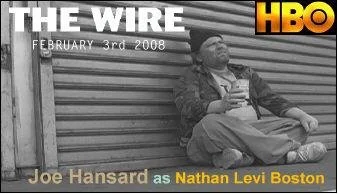
Scott Templeton, when mingling with the homeless to try and find usable react quotes, encounters some of the same characters McNulty did earlier—they’re mentally ill, merely quirky, downright reticent, or just plain hostile. A good example of this is a man (played by Joe Hansard) who gives his name as Nathan Levi Boston and seems on the verge of telling Scott who did the homeless murders, but then says, “Do you believe Satan walks the earth in a fleshly form?” Scott is utterly stymied and defeated. The scene in the shelter and among the homeless suggests that Scott has no ability to connect with ordinary people—nor does he seem to have the ability to empathize with his subjects or think outside his own experience, perhaps explaining why he finds it necessary to fabricate (more on that later).
Clay Davis appears on an African American AM talk radio station (it may have been WOLB 1010 AM—and was that Larry Young, who has a morning show on the station, interviewing him? If that’s so, it was a brilliant bit of casting; Young is a former state legislator from Baltimore who was expelled in 1998 for allegedly taking kickbacks and improper dealings). A rally is to be held at 2pm outside the courthouse to support Clay, who is presenting himself as just another example of a Black leader who is only trying to do good, but is persecuted for it by the white power establishment. Clay says, “It’s time to lift ev’ry voice,” a reference to the “Negro National Anthem” by James Weldon Johnson. Later, Royce speaks on Clay’s behalf at the aforementioned rally because Royce is dirty too, and Clay is going to carry the water for all of them. While smiling and holding up Clay’s hand for the photo op, Royce mutters to Clay that he’d better stand tall on this, meaning he needs an assurance that Clay will absorb all the punishment in return for Royce’s ongoing support.

Back in the newsroom, Alma informs Gus that more manpower has been assigned, according to the PIO (which stands for Public Information Office, I believe). Fletch turns in great background work, including the fact that the first victim was an ex-Marine. Scott breezes in, having magically found react quotes from a whole family of four living under the Hanover Street bridge. The name of the father was Nathan Levi Boston—a name actually given to him by crazed individual who kept invoking the devil. He even describes how the mother kept stroking her son’s blond hair. Templeton has quite obviously fabricated this entire family and all the quotes and information gathered. His invention of a blond-haired boy represents pandering of the worst sort—he believes the paper’s (particularly white, middle class) readership will respond more strongly and empathetically to a white homeless family than an African American or family of color. Shortly thereafter, Scott insists the homeless serial killer story has legs and he continues neglecting the schools series—and as we’ll soon learn, Scott knows exactly why the story has legs.
McNulty ignores his ex-wife’s phone calls, then finally shows up at her house, having missed his son’s play. His sons, who seem to be in their mid-teens, are practically indifferent to their absentee father’s short visit and nervous jokes. It’s a sad commentary on how skewed his priorities have become, as he’s now a hackneyed stereotype: a philandering divorced man, an alcoholic who buries himself in his work and the bottle to bury his pain. His ex-wife, Elena (Callie Thorne) then talks to Jimmy outside the house, noting that she talked to Beadie, who is at the end of her rope with him. The ex-wife says she was actually happy for him and Beadie when he’d seemed to turn things around—but now he’s throwing it all away. McNulty, who is expert at avoiding his problems, just walks away. In a later scene, Beadie meets briefly with Bunk in desperation to try and make sense of what’s happening with McNulty—for she’s about to “put him out.” Bunk, also bewildered by his friend’s behavior, is torn between his allegiance to McNulty and Jimmy’s obviously hurting companion; he makes vague excuses for McNulty’s behavior, downplaying his transgressions, and Beadie leaves disappointed.

In the first scene in which we observe the actual machinations of Templeton’s dishonesty, Scott uses a payphone to call his cell, then writes notes in a reporter’s notebook while listening to neither. His fabrications are bound to emerge somehow, but it’s still unclear how. A subsequent scene occurs in The Sun’s boardroom and features Klebanow, Gus Haynes, Scott, McNulty, and perhaps the publisher. Scott claims to have spoken to the serial killer, who called his cell from a payphone; he’s in deep now. According to the “killer,” he will produce twelve bodies before he’s finished, after which he’ll go somewhere else. The “killer” goes on to insist that they wanted him to bite them, that they asked for it. He complains that the article made him sound like a pervert. After Scott asked the “killer” if he was angry at the men, the caller hung up.
McNulty’s reactions in this scene are priceless: he knows it’s all fabricated, but he doesn’t know how to play this. This development—a reporter now fabricating developments—could ruin or make his case. Scott goes on to make up details: it was a white guy in his 40s who spoke in a calm monotone. McNulty says that the Homicide unit received a similar phone call (he’s lying, clearly, to play along and capitalize on his sudden good fortune). As Gus leaves the meeting, he remarks, “Ten minutes ago I’d have said this whole thing was complete bullshit. Shows what I know, I guess.” He’s on to Scott, but can he prove it? Surely he’ll get the evidence he will need—I can’t wait to see how this will play out.
Omar, with Butchie’s friend Donnie (Larry Andrews), stakes out Marlo’s lieutenant, Monk—not to be confused with America’s favorite obsessive-compulsive detective, played by Tony Shalhoub on USA. Omar’s patient, waiting night after night, but he seems oblivious to the fact that he’s also being watched and, as it turns out, set up. This seems to me like a blunder quite out of character for Omar. When he and Donnie decide to ambush Monk’s family, they encounter Snoop, Chris and Michael, who have been lying in wait for them. There is a heart-stopping shootout, during which Omar dives behind a couch and seems to show real fear for the first time since he was sent to prison. After Donnie is killed, Omar takes a Batman-like flying leap (his trenchcoat even billows like a cape) out the third-floor window, seemingly disappearing into thin air. Michael, Chris and Snoop peer off the balcony, baffled as to where he’s gone. (Where the hell did he go?)

Next on “The Wire”: we see Randy—he’s grown too! The mayor gives a speech about the homeless murders; Marlo is doubling the bounty (on Omar?) and seems to be making a play for control of the coop.
END OF EPISODE 55 NOTES
Monsoon's Weather Update for Friday, 25 January 2008
Forecast Update…
Friday 1/25: mostly sunny and breezy; clouding up late. High 32, low 16.
Saturday 1/26: partly cloudy; cloudier late with snow showers—trace or no accumulation. High 34, low 23.
Sunday 1/27: partly cloudy and not quite as frigid. High 40, low 26.
Monday 1/28: partly to mostly sunny and milder. High 45, low 29.
Tuesday 1/29: cloudy and quite windy. High 40, low 27.
Wednesday 1/30: partly sunny and windy; chills in the 20s during the day and teens at night. High 37, low 22.
Thursday 1/31: partly to mostly cloudy and rather windy. High 38, low 27.
Friday 2/1: cloudy and breezy; clearing late. High 34, low 17.
Next weekend: highs in the mid 30s and lows in the low 20s; maybe some snow and/or sleet on Sunday into Monday.
Beyond: Warmer on Monday and Tuesday the 4th and 5th (highs in mid to upper 40s) as lots of moisture moves in, then a cold front sweeps through and sends us back into the 30s during the day and teens at night. The timing of the moisture and cold on Monday and Tuesday will be critical; if anything changes, we could be in for some frozen precipitation. As of now, though, I don’t see any snowstorms on the horizon. (For those of you who hate snow: you’re welcome. For those of you who crave snow: I don’t make the weather; I just report it.)
Have a great weekend!
Monsoon
Flashback Friday: What I Did On My Summer Vacation from 8/29/05
It's FLASHBACK FRIDAY again, kids! I'd like to take you back to the beginning of the 2005-06 school year, when I opened with a story about my wife, me, a turtle, and the Pennsylvania Turnpike. Enjoy! --Monsoon
What I Did On My Summer Vacation by Monsoon Martin
Monday, 29 August 2005
“I have a question for you, Glen. Think back to July 18th. Were you…walking on the Pennsylvania Turnpike?” This seemingly off-the-wall question posed by a colleague last week took me back to one of the most exhilarating, strange, well-intentioned, but ill-advised memories of my summer vacation. “Yes, that was me,” I replied sheepishly, and was quite understandably called upon to explain why.

First, let me inaugurate the 2005-06 school year with the forecast for the next few days. I wish I could say it’s going to be sunny and pleasant with low humidity as we begin the school year. But alas, I cannot. That kind of weather will have to wait until next week…
Monday night : Scattered showers and thunderstorms may develop in the evening. Due to the influx of tropical moisture, it will be quite humid. Low 68.
Tuesday : The first day of school for Muhlenberg. Mostly cloudy in the morning, with showers and thunderstorms developing in the afternoon. Rain could be heavy at times as the moisture from Katrina begins to be drawn into our area. Humid. High 83, low 70.
Wednesday : The first day of school for Mifflin. The remnants of Hurricane Katrina will come through midday Wednesday into Thursday. As of now, it appears this system will track a bit west of our area, but will still produce moderate winds and some heavy downpours. An inch to two inches of rain may fall Tuesday into Wednesday; more could fall in some locations. We need the rain, but this heavy rainfall could produce localized flooding. Watch for gusty thunderstorms. Still humid. High 83, low 66.
On July 18th, in the late afternoon, [name redacted] and I were motoring peacefully westbound on the Pennsylvania Turnpike, when suddenly my sweet wife exclaimed, “A turtle! Did you see that?” Since I was focused on the safe operation of our motor vehicle, I had not. Before I could answer, this reasonable woman said, “Pull over!” As luck would have it, there was a “pull-off” just ahead on the right. We pulled off and had barely come to a complete stop when this otherwise rational, sane woman said, “I’ve got to go get that turtle!” and bounded out of the car, walking alongside the Pennsylvania Turnpike.
At this point it is prudent to cite regulation 601.10 from the Turnpike’s rules, of which we were then blissfully unaware: “Pedestrian travel or entry on the right-of-way of the Turnpike System is prohibited.”
Bewildered, but deciding that I didn’t want my dear spouse to be running around on the Turnpike alone, I waited a moment and then walked after her, back to the site where she had seen the turtle. By the time I arrived, [name redacted] had already walked across two lanes of automobiles traveling at 70 miles per hour or better, and was trying to pick up an object that was about the size of a hubcap—a monster truck hubcap—and was brownish green in color. The turtle had evidently tried to cross the road, but had made it only halfway (miraculously without being flattened by a speeding tractor trailer in the westbound lanes) before its journey was cruelly stymied by the concrete barrier in the middle.
A split second later [name redacted] recoiled from the animal, then dashed back across the road to where I was waiting. “It tried to bite me!” she said with an admixture of outrage, shock, and fear, since it should have been obvious to the imperiled creature that she was only trying to help. And then: “You go pick it up!” I then crossed all the fast traffic and came face to face with the prehistoric reptile. The beast, in a word, was pissed.

Thursday : Katrina scoots by; rain ending in the A.M. Some peeks of sunshine in the afternoon. High 84, low 62.
Friday : The tropical moisture is pushed out of the area and high pressure settles in. Dramatic decrease in humidity; mostly sunny skies. High 81, low 60.
Saturday : Continued pleasant and sunny. High 80, low 58.
Right about now, dear reader, you may be thinking: These are two seemingly level-headed educators. Why in the hell did they think it was a good idea to go running around the Turnpike after a turtle? Didn’t they think to call someone? Or just keep driving? And all I can say is, No. We did not.
After a few unsuccessful attempts to pick the being up myself—forestalled by its prodigiously long neck and powerful jaws—we felt we needed a different tack in capturing the wayward animal and returning it to safety. My wife, who solves a dizzying array of problems each and every day in her classroom, proposed this solution: “I know! I’ll get my coat. We can throw it over the turtle”—presumably to disorient it—“and then we’ll be able to pick it up.” As [name redacted] went to get her coat in the car, she motioned for me to come back to the side of the road from my current location—next to the concrete traffic divider with my new friend. I did not understand this motion and gave her the thumbs-up. I remained in the middle of the Pennsylvania Turnpike.
I spent part of this time noting the faces of drivers as they scorched past me—faces that said, “What the bloody hell is that guy doing? Is he crazy?” I spent the other portion of my quiet time reasoning with the turtle, which according to my wife was more than a little bit amusing to behold. “Alright, now, my friend. Let’s cut the crap. I’m only trying to help you. No—now, hissing at me is just unfriendly. I’m going to pick you up and—OK, maybe I’m not. Boy, you almost really bit me that time, you little—”
“Honey?” [name redacted] said. “Had any luck talking to the turtle?” My sullen deportment said all she needed to know. As planned, we placed the jacket over the turtle’s head. The turtle bit the jacket. We could not pick up the great creature. Our last-ditch plan was an unqualified failure.

Just then, I caught a flash of inspiration as I looked at the turtle’s alligator-like tail. If I could pick it up by the tail, perhaps then it would not be able to separate my hand from my arm. This just might work, I said to myself, as if hatching a plan in a movie. As [name redacted] watched for a break in traffic, I seized the beast—hissing and snapping futilely—by the tail, and ran across the road, inadvertently scraping its head slightly on the shoulder of the roadway. I deposited the turtle in a grassy area past the guardrail to ensure it would be safe, and it scampered (really, this thing could move) away from danger. (Whether it perceived the speeding vehicles or the two of us as a greater danger, I cannot say.) I believe my wife and I actually high-fived to celebrate this best of all possible scenarios: the turtle and both Martins had escaped the ordeal with their lives.
Sunday : More of the same: sunny and pleasant. High 80, low 58.
Monday : More of the same. High 78, low 57.
Back to school projection for Tuesday through Friday : We will have highs in the upper 70s and lows in the upper 50s with little humidity and pleasant breezes. (Rain is possible toward the end of next week.) Hopefully this weather will begin to dispel some of the stale air and stifling heat that has been collecting in the building all summer long. Soon enough, children whining about the heat, pitted-out dress shirts, and fainting spells will be distant memories…
A postscript to our tale: As we made our way back to the car, a state police car went by and flashed its lights at us; soon after, a Pennsylvania Turnpike worker stopped on the other side of the road, made his way across to us, and asked what was going on. We explained as briefly and reasonably as possible. His only comment was, “Well, I guess you’ve done your good deed for the day.” And we were off.
We didn’t realize it at the time, but our encounter was with an American Snapping Turtle (chelydra serpentina) weighing about 30 to 40 pounds. According to my research, these reptiles spend most of their time in fresh water and are characterized by muscular legs and long, saw-edged tails. Since the plastron (underside) of the turtle is much smaller than the carapace (upper part of the shell), this turtle cannot draw itself into its shell to protect itself. Therefore, when threatened on dry land, the turtle become aggressive (no kidding!), using the powerful jaws that gave the animal its common name to defend itself. Its neck can reach back halfway to its tail, so the range of motion is extraordinary, allowing the animal to “snap” quite effectively. It strikes with amazing speed and force; its powerful jaws can tear flesh quite badly.

These animals typically only come out on dry land from late June to mid July to dig a nest and lay eggs (so, we reasoned, our friend must have been a mama snapper looking for a place to lay her eggs). A lot of the best nesting sites are near roads, which is unfortunate for the turtles. Snapping turtles like to nest in the soft sand and gravel of road shoulders. The eggs need to be above water to survive, so the females search out dry gravely spots to lay their eggs. Snapping turtles have also been known to travel more than a mile to mate or lay eggs, putting them in harm’s way as they end up crossing roads. Sadly, many adult female snapping turtles are killed every year, during the egg laying season, on our roads and highways.
For most of their lives, they like to hang out in shallow lakes, streams or swamps with lots of plants. The snapper eats invertebrates, carrion, aquatic plants, fish, birds, and small mammals. It spends most of its time in the water, either floating close to the surface, or lying in the mud in shallower water (usually, with only eyes and nostrils protruding).
And that, friends, is how I spent my summer vacation.
Monsoon
Monsoon's Weather Update for MLK Day 2008
Hey Friends,
Just wanted to give you a quick weather update, but before I do that, I wanted to give you the latest on my back situation, as many of you have been kind enough to inquire since I sent out the Open MRI piece. Despite the fact that my back has actually been giving me little to no pain over the past week or so, the MRI result is that I have a herniated disk in the lower lumbar region. I’m meeting with a specialist to discuss the MRI, who I suspect will prescribe some sort of exercises or physical therapy, maybe some narcotics, maybe a shot or something. Anything short of surgery, let’s hope…
Monday 1/21: sunny and very cold. High 24, low 15.
Tuesday 1/22: breezy and becoming overcast with flurries and snow showers developing toward late afternoon. I’m thinking a dusting here and there, with isolated spots getting as much as an inch. But the atmosphere is so dry here right now, I don’t see much resulting from this. Snow showers taper toward midnight. High 35, low 24.
Wednesday 1/23: sunny; becoming cloudy late with an evening flurry not out of the question as another arctic cold front moves in. High 32, low 15.
Thursday 1/24: partly cloudy and cold. High 26, low 11.
Friday 1/25: sunny and continued cold, but not quite as frigid. High 32, low 18.
The weekend: cold with highs in the mid 30s and lows in the low 20s. Snow showers are possible on Sunday, but I don’t think this is anything to worry about just now. Stay tuned for updates.
Next week: more of the same…highs in the mid 30s, lows in the low 20s.
Next chance for snow: I’m looking now toward the following weekend for a potentially major event. Friday 2/1, Saturday 2/2—keep an eye on that. I’ll keep you posted…
Your Weather-Servant,
Monsoon
Monsoon's "The Wire" Notes - Episode 54
“The Wire” Episode 54 – TRANSITIONS
Notes and observations
Please be advised that this episode of “The Wire” is available only HBO On Demand and will not air on HBO until Sunday, January 27th at 9pm. The material below includes spoilers, so please do not read further if you do not want to know what happens in episode 54.
S
P
O
I
L
E
R
S
P
A
C
E
Episode 54 (tagline: “Buyer’s market out there” – Templeton) is one of those Wire episodes that is more about setting up explosive scenarios than actually depicting explosive action. (Though the ending is certainly haunting and startling.)
It begins with Tony Colicchio (Benjamin Busch) and another narcotics detective staking out a corner observing a young boy openly placing a lunch bag under a stoop, which they assume is filled with drugs for sale. They roll up and make everyone present get up against the wall. Soon Tony (the hot-headed police with the faux-military jackbooted flat-top) retrieves the paper back and sticks his hand inside, only to find that there is actually feces inside, and he has been the butt of a childish prank. In his anger and embarrassment, Tony begins slamming the boys against the police van and wantonly arresting them for little apparent reason. Soon Carver arrives and questions why it is necessary to block traffic in all directions with this police action. Just then an African American motorist asks insistently—but politely—that one of the police cruisers be moved so he can get where he’s going. Tony attacks the motorist, pulling him halfway out of his driver’s side window, before being restrained by several other officers. Most troublingly, I was not surprised by such openly unethical and racist conduct.
Later in the show, Carver tries to coach Tony on how to write up the report and informs Tony that he had been beating on a teacher who was trying to get to an after-school program. When Tony asks why the teacher hadn’t said that, Carver snaps back, “He didn’t have a chance.” Tony’s anger again boils to the surface when he says of the teacher, and the idea of writing a report explaining his actions, “Fuck his ignorant ass.” It’s difficult to think of a more poignantly ironic statement in the history of the show—an African American teacher trying to get to an after-school program is beaten by an unhinged cop, but the teacher is the ignorant one.
As a result of his actions and lack of contrition, Carver informs Tony he’s going to write him up for “excessive force” and “conduct unbecoming.” Toward the end of the show, Herc comes by to have a beer with Carver in the squad lot and tries to intervene on Tony’s behalf. Herc—who is predictably friends with Tony—tells Carver that Tony is facing suspension and all but asks Carver to reconsider. Carver then tells Herc about the situation involving Randy from last season, when Herc was supposed to deliver him the boy as a witness, with tragic consequences. Carver sums up how dramatically different his and Herc’s paths have diverged by saying, “It all matters. I know we thought it didn’t, but … it does.”
On to the newsroom, where Scott Templeton is discussing with Alma whether he should take the “Preakness piece” or the one about a firefighter’s death to his interview with the Washington Post. While Templeton is focused on his interview, Alma is excited by rumors she has heard that Mayor Carcetti will be firing Burrell today. Again a contrast is evident here: Scott is dedicated to furthering his own career, while Alma is focusing on doing good journalism.
Since the show is constantly being compared to a novel, I’ll apply a literary term here: foil. Foils are characters that are opposite in nature, and whose contrasting characteristics highlight these traits in one another. An example from the literature I teach is in Shakespeare’s Hamlet: while Hamlet is pensive and unwilling to take action—he thinks but does not act—Laertes is hot-headed and rash—he acts before he thinks. Laertes’ impetuousness serves to underscore Hamlet’s lack of action, and vice versa. Foils in “The Wire” off the top of my head include Carver and Herc (one dedicated and responsible, one not); Scott and Alma (one a career-focused fabricator, the other an eager and passionate journalist); Gus and Whiting (one of whom yearns for the days when journalists were allowed to do their jobs, the other a corporate automaton with his head up his arse); the examples are many. The idea with foils is not that one character is all good and the other all bad, but simply that there is some aspect of their behaviors and natures that provide a striking contrast. This topic might be an interesting one to parse further on the message board.
Templeton’s interview at the Washington Post is a disaster. In it, we learn that he started out at the Wichita Eagle, then went to the Kansas City Star for three years, and has been at The Sun for two years. The interviewer (I’m unsure of his position at the paper) says of his feature article, “Your feature work is a little raw, language-wise,” meaning that Scott’s writing is too colorful, peppered with colloquialisms and flowery adjectives. Scott says that his editors encouraged him to write that way, but that “I prefer to write it dry,” meaning just the facts, with plain prose. We know this to be utterly false, of course; not only does Scott like to write florid prose (referring to Oriole Park at Camden Yards as a “Colosseum”) but that he also likes to invent quotations and perhaps even people altogether. Scott also shoots himself in the foot when the interviewer notes that “The Sun’s a fine paper” and Scott replies, “Before the cutbacks, maybe,” after which the interviewer notes that The Post is still scooped by The Sun on occasion. Bashing one’s current employer is unattractive in interviews—and seriously diminishes his own value: if he works at what he thinks is a shitty rag, what kind of experience will he bring to us? Scott is told his résumé will be kept on file and sent briskly on his way. (When Alma later asks him how the interview went, he delivers the episode’s tagline: “Buyer’s market out there” and adds, somewhat unconvincingly, that “The Sun’s not so bad.”)
In the ensuing newsroom scene, one of the reporter’s chairs has an “I’m union and proud!” sticker on the back, which was a nice touch. It’s the attention to detail, as always, that makes this show what it is. (The “Fill-It-In” puzzle books on Prop Joe’s table later in the episode are another one of these seemingly throwaway touches that enhance the show’s naturalism.) Alma and another reporter are struggling to get comments or confirmation (even off the record) from police and government sources about the commissioner’s imminent firing, again underscoring the value of veteran reporters and their well-cultivated sources. Twigg, who is packing up his desk on his last day, gives the younger reporters a “gift” by placing a call to one of his sources (was it Stan Valchek?) as the e-dot deadline approaches.
At Carcetti’s “grip and grin” press conference, with Burrell and Daniels standing behind him, the mayor pays bureaucratic, politically prudent tribute to Burrell on his “retirement” while Gus, watching in the newsroom on television with a group of other reporters, “translates,” giving up the true meaning behind Carcetti’s pedestrian statements: “He feared and hated me, and I merely wanted him dead,” which sounds like Gus is quoting someone, but I can’t figure out who. When Carcetti talks about Burrell’s having played a role in “making Baltimore a safer city,” Gus quips, “don’t stray from the Inner Harbor,” and finishes off Carcetti’s speech with “It took a while, but I finally put his ass out to pasture.” When the mayor presents a plaque to Burrell at the end of the news conference, Gus says, “Plaques for hacks – prerogative of any big city mayor.” Gus Haynes is every bit the world-weary cynic, and Clark Johnson plays him with aplomb.
Soon, Managing Editor Thomas Klebanow, who has observed the tail end of Gus’s remarks, asks where the paper is with the story. Gus tells him that Twigg was the one who could “work department sources” and that a “veteran in the cop shop is what gets us over on a story like this” but, he adds sarcastically, “fuck if we didn’t buy ours out.” Klebanow’s response, which manages to be condescending while seeking to defuse the employee’s anger, will be familiar to anyone who has dealt with a hard-headed, perpetually-missing-the-point member of middle management: “I understand you’re disappointed with the cutbacks, but civility is important. I’ve been meaning to talk to you about your profanity. … A collegial atmosphere is essential.”
Immediately thereafter, the local news shows Clay Davis’ “perp walk,” orchestrated by the state’s attorney, leaving his Grand Jury testimony. (His comments to the assembled television reporters are vintage, oily Clay Davis, who composes himself quickly after being badly shaken when Rhonda reveals some of the evidence they hold against him.) Gus is dismayed to see a story on TV that his own paper has missed completely. When he calls over Bill Zorzi, who covers the Federal courts for The Sun, Zorzi reminds Gus that the paper no longer has daily city court coverage. Zorzi tells Gus facetiously that he’d be happy to take on the city courthouse coverage as well. “In fact,” he generously offers, “why don’t you just stick a broom up my ass and I’ll sweep the floor while I’m at it?” Great line, oft-repeated, can’t find its origin for the life of me.
Scott’s going to help Zorzi run down the Clay Davis story and play “catch up.” Gus closes the scene by lamenting the fact that when the state’s attorney leaked the fact that Clay Davis would be leaving his Grand Jury testimony (“setting up a perp walk”), the newspaper did not get a phone call. “All they care about is the video,” he grumbles.
The next newsroom scene is in the tradition of the “evacuate” scene in episode 51, and is one of the reasons I’m loving this season, as someone familiar with the journalistic profession, as an English teacher, and as a lover of language. A copy editor asks Gus to take a look at the “fifth graph” (paragraph) of Alma’s article about Burrell. It reads, “The mayor, incensed by the commissioner’s performance,…” Jay reads the copy and says “to incense is to inflame with wrath; it speaks to obsession. Is that the mayor’s state of mind?” Jay suggests they use “galled, vexed, annoyed—safer still, displeased.” This sort of back-and-forth banter and debate was more common in newsrooms of old, but is increasingly rare at today’s understaffed, overworked newspapers with high turnover. Gus admiringly says to Jay, “You’d take the crab out of crab soup,” by which I think he means that he’d cut anything unnecessary or errantly cited.
Gus also gives Scott a rare “atta boy” for his work on the Clay Davis piece, which is not likely to be his choice of words when it comes out that Scott has been cooking his articles.
(A possible error I noticed, which doesn’t happen often on “The Wire”: I thought Alma had the byline on the Burrell article, but when Landsman is reading the paper, it’s difficult to read but I think it’s Roger Twigg on the byline.)
Near the end of the episode, Prop Joe brings Marlo to meet with Levy to discuss his finances (namely, laundering and hiding them more effectively, it would seem). Sitting in Levy’s office reading the paper is Herc, now an investigator. Marlo looks at Herc and asks, “you ever find that camera?” and Herc replies, “it cost me the job.” Herc is such a clueless dolt that I actually enjoyed the fact that Marlo needled him here. As Levy meets privately with Marlo, Herc then makes small talk with Prop Joe about the fact that Burrell is out as commissioner. Prop Joe says, “Ervin was a year before me at Dunbar. He was in the glee club.” Pressed further, Joe says Burrell was “stone stupid.” “Dunbar” refers to Paul Laurence Dunbar High School in Baltimore, named after the African American poet (the school’s sports teams are even called the Poets).
Continuing with Prop Joe, who had a strong presence in this episode… He begins the episode in a flower shop, purchasing a funeral arrangement—foreshadowing if I’ve ever seen it—for Butchie. The card, according to Joe, should read, “Woe to them that call evil good, and good evil. Your true and loyal friend, Proposition Joe.” It’s an approximation of Isaiah 5:20: “Woe to those who call evil good, and good evil; who substitute darkness for light and light for darkness; who substitute bitter for sweet, and sweet for bitter! Who to those who are wise in their own eyes, and clever in their own sight!” Aside from its obvious implications to “The Wire” universe, sending that card to Butchie’s funeral not only sent a message to Omar that Joe was not involved in Butchie’s murder, but also sealed his fate with Marlo.
At the end of the episode, Prop Joe thinks he’s going to go away for a while to get out of Omar’s path, but Chris and Marlo emerge and it becomes clear to Joe that he is to be killed. In true fashion, his final words are, “A proposition, then…I’ll just go away, and you’ll never see me again.” Marlo assures Joe that he could no more change what he is that Marlo could. Then, in one of the most chilling scenes on the show, Marlo speaks in almost soothing tones to Joe, who sits before him at the table: “Close your eyes, relax. There now, breathe easy,” at which time Chris points a gun at the back of Joe’s neck and pulls the trigger. Marlo’s eyes—cold, remorseless, soulless—gaze dispassionately at Proposition Joe’s body, and the episode ends.
Judging from the previews—was that Snoop and Omar having a shootout, with Omar ducking behind a couch?—the next episode will be breathtaking.
END OF EPISODE 54 NOTES