
Monsoonian Rhapsody: Northern Lancaster County Shopping Destinations
My friends,
The time has again come for me to share with you some of my favorite things. Today I’ll be telling you about three northern Lancaster County businesses that make it a damned fine place to live.
Record Connection, 550 North Reading Road (Route 272), Ephrata, PA
Traveling south on 222 from the Reading area, Record Connection is just beyond the intersection of Garden Spot Road and Route 272 (where the gigantic Green Dragon sign is).

Hours of operation: Monday through Friday, 10 – 8; Saturday 9 – 7; Sunday 11 – 5.
Phone: 717-733-1641
Website: http://www.recordconnectionpa.com
The first thing you may notice about the store—and one of the reasons for its notoriety among residents of this area—is its rainbow-colored sign composed of large letters mounted above the overhang, advertising that it sells “TAPES RECORDS COMPACT DISCS.” But as the picture below clearly illustrates, the letters are arrayed—and their colors chosen—in a peculiar manner. Specifically, the only three yellow letters, when read top to bottom, spell out “P-O-T.”

Please understand that I am neither implying that this store sells marijuana, nor am I even suggesting that the letters were intentionally arranged to convey a subliminal message encouraging the consumption of illegal drugs by unsuspecting passers-by. All I am saying is that it is damned amusing and certainly distinguishes the establishment from the more staid, conservative businesses in the area. (Though I almost had an accident the first time I passed a neighboring antique store called Mother Tucker’s, whose old sign was in an ornate script and whose T looked at passing glance very much like an F.)
But the reason I love Record Connection goes way beyond a sophomoric visual joke about weed (hey, at least the street address isn’t 420). Record Connection is a kick-ass independent record store specializing in vinyl—at a time when there are very few stores around that exclusively carry recorded music, and even fewer that either specialize in vinyl or kick ass. I remember places like Repo Records and Plastic Fantastic on the Main Line, Record Revolution in Valley Forge and Reading. They’re all gone (though Repo Records has been reborn on South Street in Philly as an overpriced used-CD shop), but Record Connection keeps going.
You see, friends, I am a vinyl superfreak. Have been ever since I can remember, raiding my dad’s staggering collection of hundreds upon hundreds of LPs and 45s, listening to everything from Blodwyn Pig and the Mahavishnu Orchestra to The Who and Jethro Tull, from the Mothers of Invention and John Mayall to Grand Funk Railroad and Miles Davis, and every conceivable style and permutation in between. I’m a connoisseur of the crackles and pops of vinyl, the electric moment when the needle touches the record, the warmth of its tones and the richness of its timbre. And with all the advances in digital sound reproduction, the prevalence of CDs and mp3s, most music still sounds a hell of a lot better to me on vinyl. (A great illustration of this is one of the finest albums ever made, Electric Ladyland by The Jimi Hendrix Experience: on vinyl, the bass throbs and the guitar pulsates in a way that even remastered CD releases of the album can’t approach.)
So I find myself pulling into this little gem of a store and losing myself for hours on end, pawing through its overwhelming array of … stuff. Record Connection doesn’t just carry LP records and 45s—which take up three entire rooms and feature pretty much every conceivable release you might ever want—it has new and used CDs, new and used cassette tapes, used VHS and DVD, posters, and much more. Record Connection stocks over 100,000 LPs, 45s and EPs at any given time, and also purchases collections. The singles room is a wonder—boxes and boxes and boxes of records, filed alphabetically, most priced at $2-$3 apiece, including comedy, novelty, and colored-vinyl 45s. There is even a turntable with headphones so you can test out your finds before purchasing them.
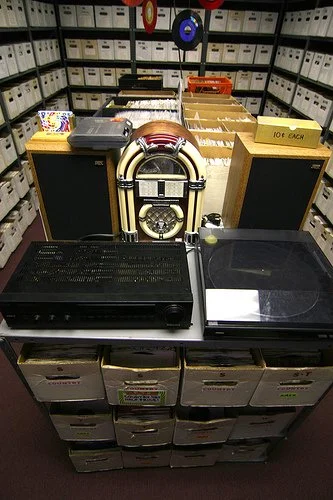
Record Connection’s inventory is strong in most genres—including jazz, reggae, soul, country/bluegrass, and comedy—but has the most comprehensive holdings in classic, psychedelic, and progressive rock.
Maybe my favorite part of Record Connection is the fact that they have anywhere from 8 to 12 full crates of LPs—usually just outside the singles room—with “New Arrivals” generally priced at a mere $2 apiece. Here is where I make my most exciting finds: long-out-of-print rarities, ill-advised celebrity forays into music, K-Tel compilations, off-label bombs, hidden soul treasures, spoken-word treatises on the free market economy, children’s music, and on and on. I will sometimes buy LPs mainly because of the cover art, which I think is unique to the long-playing album and is somehow not the same on the cover of a CD booklet.
I’ve scanned in a few of my favorite finds (some for the music, some for the cover art, and some for the pure kitsch value) and picture them below, including And me…I’m Ed McMahon (you haven’t truly lived until you have heard the gravely-voiced “Tonight Show” sidekick relieve “Georgy Girl” of its kick and take “Thank Heaven for Little Girls” to creepy new depths).

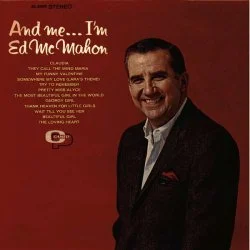
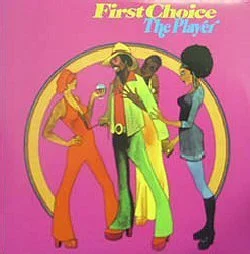
Record collector Andy Kamm opened Record Connection in 1985 and, as one would expect at an independent record store, has a colorful staff—the most notable being a full-bore, 1980s-throwback, singing-along-with-the-tunes, head-banging, sometime profane, non-sequitur-spewing metalhead named Nathaniel Kinsey, who is almost too good to be true. (When I purchased several used videos last summer in the Black Belt Jones and Superfly vein, along with an Isaac Hayes LP, he said the following as he was ringing me up: “Oh yeah, gettin’ a little Blaxploitation here, huh?” and then incorporated the word into a previously unimagined death metal song called “Blaxploitation Nation” that he proceeded to sing, complete with guitar solo. It was magic.)

The ambiance of the place also adds to the experience. When you walk in, a motion detector sounds to alert the employees—who may be buried under stacks and stacks of LPs in a distant corner—that a customer has come in. The sound is disconcerting: a clear, doorbell-like chime followed by a distorted, death-throes tone, like an aural question mark. And once you’ve made your way in, you’ll find the aisles cramped and just as much merchandise in crates underneath the display bins as are in the bins themselves. It’s a down and dirty enterprise, but it adds to the mystique, the sense of adventure of the place. Record Connection has already gone through at least one expansion, and could easily fill a space twice its current size.
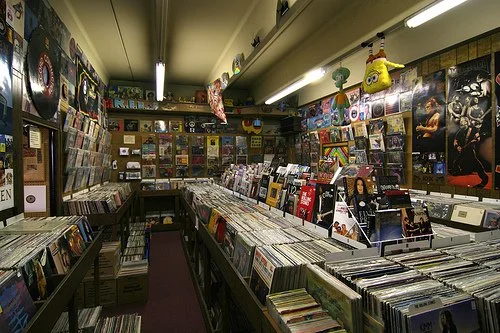
Record Connection is apparently a destination to which vinyl lovers flock from far and wide. Listening to patrons and reading internet chatter, it quickly becomes apparent that Record Connection is visited by folks from all across the US, Korea, Germany, and around the world. (An article on the RC website tells of a man from Korea who spent an entire day at the store and left with over 800 albums!) When I was visiting the store recently, and entire family from Alabama was there, having spent hours rummaging before making the trip back home.
They sell turntables and needles, too—so if you haven’t bought or played a vinyl record in 20 years and are looking to get back in the habit, they can hook you up!
Weaver Markets, Routes 272 and 897, Adamstown, PA
Hours of operation: Monday through Thursday and Saturday, 7am – 9pm; Friday 7am – 10pm; closed Sunday.
Phone: 717-484-4302
Website: http://www.weavermarkets.com
Mission Statement: To provide the customer with the best quality and value in regards to products and services and to help support and strengthen the surrounding community in every way possible.
I have a love for Weaver Markets (hereafter, and in local parlance, “Weaver’s”) that is sometimes belied by the actual quality of its goods and services, but over all this is a fantastic grocery store.
Founded in 1962 by Earl Weaver and now run by his sons Gene and Mike, Weaver’s has expanded several times and is now a 96,000-square-foot mecca of one-stop shopping and homemade goodness.
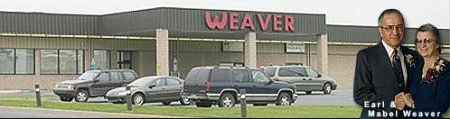
On the most basic level, Weaver’s is simply a very good grocery store, with a fine selection of grocery items (non-perishables), a very fancy new dairy section, a nice selection of meats and deli items at the lowest prices around, and a surprisingly broad assortment of organic and specialty foods, along with (less surprisingly) lots of local-made jams and the like.
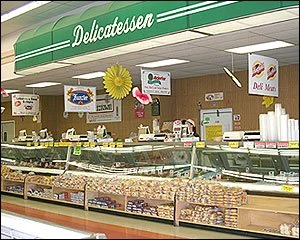
(Weaver’s also has an expanded produce section that used to be its crowning glory but has, in my opinion, fallen off in recent years. Green produce like broccoli, green beans, and zucchini tend to be consistently good, but their fruits—especially apples, bananas, and strawberries—are often aged, significantly bruised, or lack basic freshness. The tomatoes at Weaver’s have been a particularly bitter source of disappointment for me: too often the very old tomatoes are left to rot inside the pile, and more than once when foraging for a fresh one I have inadvertently poked a thumb or forefinger into the putrid guts of a rotten one. Screaming like a 9-year-old girl at a Hannah Montana concert in the middle of Weaver’s produce section does nothing for my street cred, folks.)
But the produce issue is a nitpick, and I can easily satisfy my unmet produce needs at an Amish-run produce stand on Route 272 near Ephrata called Evergreen Acres, or at Weis or Giant.
It’s the peripheral things, the specialties, the personal touches that make Weaver’s a worthwhile destination:
Weaver’s has a full bakery on-site that makes all sorts of delectable confections.
Weaver’s offers a dizzying array of party trays; most outstanding are their fruit and vegetable trays, which offer extreme freshness at very reasonable prices. Example: the veggie tray pictured below, which includes carrots, celery, broccoli, peppers, cauliflower, cucumbers, and choice of dip, is only $1.45 per person. If you need a tray for 8 people, you’re going to get out of there for under twelve bucks. Also, relating to the trays: when you’ve ordered a tray and want to pick it up, you go to Customer Service and pay for it, and then you drive around the building to Door 13 to pick it up. There’s something very clandestine about the whole process (and the fact that it’s Door 13 and not 12 or 14) that makes me feel like I’m on some sort of top-secret mission. Maybe it’s only me.

Weaver’s has a full kitchen that cooks “homemade” soups, potato and macaroni salad, and lots of other hearty dishes that can be purchased and heated later. Their soups (and pepper cabbage, and deviled eggs) are so good that I tote a load of these delicacies down to Norristown whenever I go to visit my parents.
At almost every checkout line, Weaver’s has actual baggers, actually bagging your purchases, and doing it carefully. Speaking of bagging, in addition to the traditional plastic bags, Weaver’s has brown paper bags with sturdy handles that hold plenty of food and lend themselves to myriad household uses—aside from being environmentally friendlier.
The ladies at the Customer Service desk are happy to work with customers to order an item that is not in stock or difficult to find. A couple of years ago, the stores near my father stopped carrying cans of Musselmann’s BC Orange Apricot juice, so I worked with the Customer Service desk to order cases of it for him. When the juice suddenly became unavailable, these nice women made some phone calls and learned that the item had been discontinued, forever. When they broke the news to me and I said my father would be devastated, since he had been drinking this juice since he was a child, they seemed genuinely to share in my disappointment. Now that is customer service.
The layout of Weaver’s is logical and pleasing—unlike what can be said of other local grocery stores. (In particular, whenever I make the mistake of entering a Redner’s, I am overwhelmed by the feeling that its layout was designed solely to confuse and frustrate the customer. I also question why, at places like Giant and Weis, peanut butter, jelly and bread products are found in the dairy aisle. Is it just me?)
When you call Weaver’s, an actual person answers the phone. Right away. There’s no automated system, no menu of options, no circuitous “hold” purgatory. The same can’t be said of Giant, or Weis, or Wal-Mart, or nearly any other major retail establishment I can think of. It’s a rare treat.
Weaver’s is closed on Sundays. Now, I have found this to be terribly inconvenient more than a few weekends since I’ve lived here, since it’s sometimes not until Sunday that I get my dook together and figure out what groceries we need for the coming week. But Weaver’s is run (and largely, staffed) by Mennonites, and while I don’t share their religious convictions, I have to admire their insistence on setting aside Sunday as a day of rest. I ain’t mad atcha.
Weaver’s has a bunch of “in-store entities” that I avail myself of from time to time, especially Anderson Pharmacy. There is also an Ephrata Medical Laboratory, film developing (including a new three-terminal Fuji digital photo kiosk), and a small flower shop in-store.
In the coming two years, Weaver’s will face a new challenge in the area. Final approvals have been secured for a massive new shopping center to be built just off the Turnpike exit 286 ramp between Routes 222 and 272 in Denver. Its three anchors will be a 24-hour Giant, Lowe’s, and an as-yet unnamed large anchor (I’m hoping it’s Target), along with smaller shops and restaurants. At present, the closest major grocery stores to Weaver’s are Weis and Redner’s in Ephrata (6 miles south) and Giant in West Lawn (7 miles north). The construction of a 24-hour Giant will present a level of competition Weaver’s hasn’t yet faced. I’m convinced, though, the Weaver’s blend of personal service and homemade goods, along with reasonable prices and broad selection, will make them viable well into the future; I hope my neighbors continue to support this family-owned, locally-invested business.
Clay Book Store, 2450 West Main Street, Ephrata, PA
Take 272 South and pick up Route 322 West; follow this for about 4 miles until you see a sign for the Township of Clay. The bookstore will soon appear on your left (and is sporting a spiffy new sign, pictured below).

Hours of operation: Monday, Thursday, Friday, 8am – 9pm; Tuesday, Wednesday, Saturday, 8am – 5pm; closed Sunday.
Phone: 717-733-7253
Website: No internet presence. That is how they roll.
Mrs. Monsoon and I found this place when out on one of our Sunday drives (which have been curtailed significantly due to the high gas prices). Like Weaver’s, it’s owned and operated by Mennonites; like Record Connection, you could spend an entire day rummaging around here.
The variety of materials contained in this modest-sized store is incredible: maps (including Geological Survey and topographical maps, as well as road maps and atlases), school supplies (from scissors and glue to poster board and teacher planners), toys and puzzles and stickers, and of course, books.
To the left when you enter the Clay Book Store is a large section of new books that is dominated by fundamentalist literature. There’s some material in this section for the secular browser (books about Amish and Mennonite culture, how-to books, Pennsylvania history and coffee-table books, and so on). But it’s heavily geared toward Anabaptist theology (Mennonites and Amish fall under the Anabaptist umbrella) and Christianity in general: hymnals, bibles, bible study books, prayer books, and guides to holy living. There is also a generous helping of Christian values literature—mostly in the form of pamphlets and short volumes—that can quickly make a self-respecting progressive type feel out of place. This includes books about the evils of abortion, the unfortunate and fiery eternal bummer awaiting nonbelievers, and of course, the travesty of homosexuality. (The book pictured below considers the question, “Homosexuality: Is it Natural?” arriving rapidly at an emphatic and biblically-justified “No!”)

Looking at some of this literature, I was reminded of a George Carlin routine about religious morality, part of which went: “Catholics and other Christians are against abortions, and they're against homosexuals. Well who has less abortions than homosexuals?! … Here is an entire class of people guaranteed never to have an abortion! And the Catholics and Christians are just tossing them aside! You'd think they'd make natural allies.”
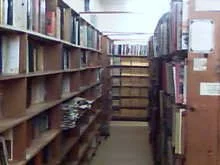
But it’s the rear portion of the Clay Book Store that has some great stuff: that’s where the used books and magazines are. In the rear on the right side are old textbooks (mostly from the 70s and 80s or earlier) that can be used for low-cost home schooling—or, in my case, for the sole purpose of nostalgia. Remember those old music and social studies books from the 1970s—the rainbows, the bell-bottoms, the wide collars, the children wearing red tees ringed with white, in motion shots in cityscapes? The vibrant, silly illustrations in children’s literature books evocative of Schoolhouse Rock? They’re all here.

(So are textbooks specifically geared toward Christian education, which are…interesting to peruse. You’re not going to find any talk about the universe being 13 billion years old, or that most species of dinosaurs became extinct 65 million years ago, in a children’s biology textbook called God’s Marvelous Works.)
Also on the right rear are reference books, including encyclopedia sets and lots of old dictionaries (of which I’ve purchased a few: just a couple of weeks ago, I got a massive 1940s two-volume set of the New Century Dictionary in great condition for five bucks).
Moving to the rear left, there are several stacks of used religious books (remember, folks, this is run by hardcore Mennonites) but it also has nonfiction books, repair manuals, hardcover and softcover fiction, pamphlets, field guides, old copies of Reader’s Digest and National Geographic (as well as lots of other magazines)—all for dirt cheap.
There’s even a section of foreign-language books, where I recently found a copy of the 1970s textbook we used in my late-1980s high school German class. It’s called Unsere Freunde (“Our friends”) and contains some sidesplitting pics and text.

The one that seized on our imagination was when we met the parents of the young people who were guiding us through the wonderful world of German language. Soon we met Gabi’s mother, who “managt die Tankstelle” (or “managed the gas station”). This phrase became the ultimate insult when applied to anyone else’s mother in the class. (Jeez, we were geeks.) And so, I send a shout-out to Amelia with the following allegation: Deine Mutter managt die Tankstelle!

It does not generally seem that a lot of sorting has taken place before the books (which are typically sold as collections to the store or donated) were shelved, so you should be prepared for a good, leisurely poke-around if you visit the Clay Book Store. But it can be great fun.
Enjoy!
The Many Jobs of Monsoon: Volume Five
Friends,
Here is the fifth and final installment in my Many Jobs series from 2006. I wanted to draw your attention to a new feature on the weblog: I've added a "widget" on the sidebar of each page that automatically archives all of my entries, sorted into categories. So if you want to access all five "Many Jobs" forecasts, look on the right side of the page under the "Powered by Squarespace" icon, and click on "Many Jobs of Monsoon." Cool, huh?
The Many Jobs of Monsoon Forecast: Volume Five
Monday, 20 November 2006
As I mentioned in my previous forecast, two “temp” jobs turned into “permanent” (though not entirely, since I eventually left them) employment. The first was at American International Group (AIG) in Philly, where I worked in the National Union division, which handled professional liability insurance policies. A few years back, in fact, there was a sprawling scandal regarding illegal business practices involving AIG’s many tentacles; one of the most egregious violations was that underwriters in National Union were binding policies that had not actually been purchased. In other words, they fabricated income for the company in order to meet fiscal goals. Around the time I worked there. Good stuff.

I worked there as an assistant underwriter—first as a temp, then as an actual employee of National Union—from early 1997 to the middle of 1998. The job itself was not notable in any way, involving fairly pedestrian data entry (though not at the breakneck speeds required at the collection agency), client contacts, filing, and so forth like that.
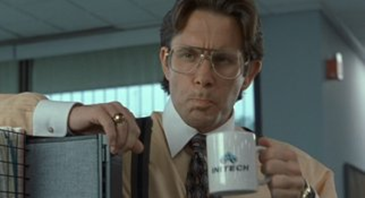
My first boss there was a man named Frank Castro, the regional manager of our division, who was in his late twenties at most. If you have seen the movie Office Space and can recall the manner of Gary Cole’s character, Bill Lumbergh, bring that performance up a few registers and increase the speed from 33 to 45 rpm and you have an idea of the man. Frank Castro was from California and seemed rather laidback, but in point of fact was a desperately striving career insurance guy who would have killed (and cheated, it turns out) to make himself look good. He was the sort of corporate schmuck who would practice his golf swing (with no club) while you were standing there talking to him.
The most memorable aspect of Frank Castro’s tenure at AIG was his indiscriminate, almost savant-like use of management euphemisms. If he wanted us to adopt a new policy, it was to be done “on a go-forward basis.” If he wanted us to contact a client, we were to “touch base.” We were concerned with the “bottom line” and how our fiduciary health looked “at the end of the day.” When moving on to a new topic, he would “change gears” before “pulling the trigger” on his next deal. And so, friends, it would not be unusual to hear the following out of his mouth during a staff meeting: “Alright, people, I’ve been looking at some bottom line figures here and at the end of the day, we’re just not thinking outside the box. So on a go-forward basis I’m going to need you to go ahead and touch base with your brokers and pull the trigger on some new deals. Switching gears for a moment, someone’s taking pens again from the supply closet. And folks, that dog just won’t hunt. So on a go-forward basis, you’ll need to go ahead and go through Terri to get your office supplies, mmkay?”
That’s “Terri” as in Terri Flint, the Underwriting Assistant whose desk was just over a shared cubicle wall from mine during most of my tenure there. And Terri played her radio incessantly set to a soft-rock station whose playlist seemed to be drawn from a catalog of songs that would be guaranteed to make me drive letter openers into my earholes. Most memorably, though: Terri loved the Titanic theme, “My Heart Will Go On,” sung by Celine Dion, aka the Trilling Canadian She-Demon And Inflictor Of Auditory Pain Whose Oeuvre Is An Affront to Good Music Everywhere. And when that song, that #$*&%ing song, would come on…as soon as she heard those ethereal first few notes from some kind of Celtic flute…Terri would turn in up. I mean, she would crank it! “Every night in my dreams / I see you / I feeeeel you / That is how I know you go onnnnnnnn.” And on, and on, several times a day, ad nauseam, till we all puke.

There was, of course, a diverse cast of characters who worked at AIG, and among others (big ups to Tondra!) I found a kindred spirit in a guy named Eric Barnes. One day we were talking about the fact that I was collecting View-Master viewers and reels at the time, and he said he hadn’t seen them in a long while. So I brought in a couple of viewers and some reels, and at lunchtime, we went into the file room, pointed our viewers toward the fluorescent lights and transported ourselves back to our childhoods. At some point, Terri walked in and was greeted with this scene: two grown, bearded men in shirts and ties, lying flat on their backs, looking through View-Master viewers and gasping “Wow!” and “Oo!” like a couple of ten-year-old boys. Later I overheard her on the phone with a friend saying, “I mean, I can’t [bloody well] believe that these two [tossers] have time to sit in the [bleedin’] file room [buggering] around while I’m out here with a stack of work! [Bollocks]! They should be [bleedin’] [sacked]!” I’ve cleaned up Terri’s potty-mouthed, Northeast-Philly-inflected dialogue a bit by substituting some British profanity and slang, which somehow seem more genteel…

Perhaps the most unforgettable and haunting episode from my tenure at AIG involved my second boss (Frank Castro’s successor), Chris. He was both less intense and less overtly full-of-malarkey than Frank had been, but otherwise nothing much changed in the way we did our jobs. Soon we learned that he, too, was leaving; he would begin working in the Chicago office in a week. As a result, Chris was something of a lame duck, and I harbored the conviction that he was inappropriately heaping work upon the assistants to tie up loose ends before he left. Several days before his departure, he sent an email to Terri and me that included a litany of relatively small but annoying projects he wanted done ASAP, on top of the everyday responsibilities of our positions. I was unreservedly fed up, so I forwarded the email to Terri and said as much. My missive was an unbridled venting of my frustrations stemming from the fact that I felt Chris was taking advantage of us, and that he should do his own [bloody] work, and where does he get off heaping all this work on us at the last minute, yada, yada, yada.
A minute or two later, I bebopped over the Terri’s cubicle and said, “Didya get my email?” She said, “No.” I said, “Hmm,” and went over to my computer. Yep, there was my message, and it says it was sent, so I don’t understand OH MY GOD I HIT REPLY INSTEAD OF FORWARD OH MY GOD [BUGGER] [WANK] [BLOODY HELL]!!!!!
Friends, I had sent the email I described above right to the man whom I was maligning in it. I considered collapsing but wasn’t sure what that would accomplish. I tried to “recover” the email (cancel its delivery) but that seldom worked, and did not seem to in this case. I ran over and told Terri breathlessly what I had done. “Oh, no,” she said. For this was really so bad that it was beyond what could be alleviated by profanity. She had the idea to run into his office and delete the email from his computer, because she thought he was not there. I staggered into the bathroom and tried to figure out a way to become invisible. Perspiration, which is seldom in short supply on my body, began to issue forth is streams and rivulets beginning at my temples and ending in my shoes. I looked in the mirror and actually said, “This is all just a dream,” because one time when I was little, during a nightmare I shouted, “This is a dream!” and woke up straight away. But this time, I was still looking in the mirror at my hopeless visage, sweating profusely, trembling and wondering if I would soon be out of a job.
I mustered the resolve to return to my desk after what seemed like 15 minutes, but was probably only about two. “Glen?” came Chris’s voice from within his office. “Can you come in here?” My stomach did a somersault and I flushed a deeper crimson than the devil’s arsehole. I went in.
Chris, to his credit, was calm in his approach. “If you have a problem with the way I’m doing my job, you need to come to me directly about it,” and so on. He evidently had deduced that he was not the intended recipient of my smart-alecky email. “Yes, you’re right. That shouldn’t have happened,” I said. Now, folks, Monsoon don’t scare. And it’s not often that Monsoon will back down from a challenge or disagreement. But shucks, I just plum had no excuse. My actions were inappropriate, ill-advised, and though unintentional, they were ultimately indefensible. I left his office relieved at having made it through the meeting with my job—if not my dignity—intact.

[ 1700 Market Street , home of AIG toward the end of my tenure.]
Not long after the email debacle, Mrs. Monsoon and I decided to relocate to Lancaster County to pursue more meaningful career opportunities and enjoy a more tranquil lifestyle. As I noted earlier, I spent a bit of time pinballing around from one short-term temp job to another. In late 1998, however, I got my big break. I was called to Precision Medical Products in Denver to be trained as a replacement for Mary, their receptionist, who was just weeks away from delivering a child and beginning her maternity leave. Precision Medical was a fairly new company when I came to work there, having been formed in 1997 after a break with Reading’s Arrow International. To their credit, the executives at this smallish medical supplies manufacturer were more open-minded than Alpha Boss at the pretzel factory, and were persuaded that everything would be just fine with (in all likelihood) the only male receptionist in Lancaster County.

Mary left, and gave birth, and never came back. The job was mine until I left in early 2000 to pursue my teaching certification.
What can I say about this experience? It was one of the more pleasant work environments of which I’ve ever been a part. I sometimes worked back in the shipping and receiving department with one of the funniest people I’ve ever met, Steve Nelson. Lou Menga, the materials manager, was (and still is) a musician who puts out a Christmas album every year. My boss, Tom Kubacki (“TK”) was hands-down the best boss I have ever had—laidback, fun to chat with, and seriously kind. Of course, there were the interminable PowerPoint presentations in the meeting room about meeting ISO 9000 certification standards. But over all—divine. And by all accounts, I made a perfectly lovely receptionist (“Good morning, Precision Medical!”).
Incidentally, PMP is the “birthplace” of Monsoon Martin, so to speak. In my position at the front desk I had a clear view of the outside world, while many of the company’s workers—particularly those at interior cubicles and the hourly workers in the plant—could not see outside. When it rained, therefore, I felt it was appropriate to make an announcement over the “page all” function; after all, as the receptionist, I lorded over the company’s entire telecommunications system. “This is your receptionist. It is raining. Those of you who left your windows down this morning may want to sprint out and roll them up. Thank you.” Since this was the beginning of Glenn “Hurricane” Schwartz’s heyday (he began at NBC-10 in 1995) and my interest in the field of meteorology was piquing, a co-worker bestowed upon me the name "Monsoon Martin." Damned if it hasn't stuck.

[The approach of an actual monsoon, in southern Asia]

[Wrestling Legend Robert Otto “Gorilla Monsoon” Marella]
After a whirlwind tour of the joys of education, I was awarded a secondary English teaching certificate by the state of Pennsylvania in December 2000. By the beginning of January 2001, I landed a position as a long-term substitute at a Berks County middle school that shall remain nameless. By the end of January, I had nearly lost my ever-loving mind and abandoned the profession altogether.
On my first day, the principal had the look of a man who had bad news to impart—but was trying to project an optimistic attitude—as he described the job to me. For medical reasons, the school’s half-time art teacher would be unable to return to work for at least another month. Since I was not (am not, could not possibly become) art certified, I would only be able to serve in this capacity for roughly four weeks. In the mornings I would teach art; in the afternoons I would cover whatever classes needed to be covered in the rest of the school. This is going to be interesting, I thought, but manageable.
Having apparently glimpsed the look of cautious but optimistic confidence on my face, the principal led me upstairs to a small supply closet. When he opened the door, I swear he fixed on my expression with an almost morbid anticipation—the sort of thrill you feel when you’ve handed your rancid sandwich to your friend with the words, “Taste this; it’s horrible,” and he’s about to take a bite.
In the closet, my good people, was a Frankenstinian monstrosity that sends chills down my spine, lo these nearly six years later. It was a green, three-tiered utility cart piled impossibly with what appeared to be a metric ton of art paraphernalia, the summit of which was well above my head. Slack-jawed, I took it all in for a moment: bins of colored pencils, markers, and paints; scissors, rulers, glue, brushes, paper and Styrofoam plates, and small plastic bowls; handouts, folders, library books, mat boards, manila file folders, composition paper, construction paper, and art paper of varying sizes; charcoal pencils, erasers, clay, unidentified ceramics projects (and fragments thereof). All was stacked precariously in once-piles on crooked, collapsing shelves.
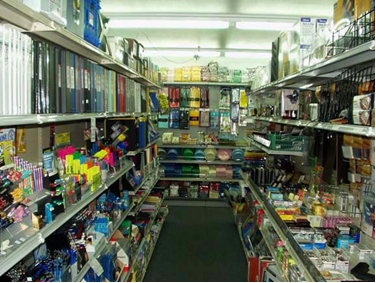
[Since I couldn’t find a picture that would do justice to the Frankencart with which I was faced, I need you to join me in a little visualization. Imagine that everything you see in the art supply store above was blown off the shelves by a tornado measuring F2 on the Fujita scale. Then imagine that it was picked up by a monkey on crack and put onto a cart somewhat taller than the one below. And there you have it.]
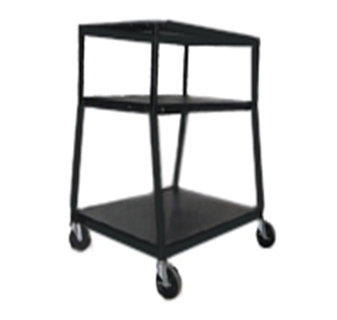
I saw what looked to be a lesson plan among the arty detritus and pulled it off the cart, causing a minor avalanche of paint tubes, worksheets and rulers. I looked at the principal. He looked away—I’d like to think because he was feeling badly about what he was getting me into, but quite honestly he could have been stifling a laugh. Since the reality of the situation was just beginning to set in, I was not yet in the proper frame of mind to be able to find the humor in this nascent fiasco.
When I asked where I would be teaching, the principal looked positively forlorn, but—more determined than ever to present this as if it was all very reasonable and normal—he led me down a long hallway and into the cafeteria. Before I could fully comprehend what he was telling me, he said that each morning I would wheel the aforementioned cart into the cafeteria, teach art in there, and then scoot out prior to the beginning of lunch. It was, in short, “art on a cart.” In a flash he was gone—perhaps in an effort to thwart any second thoughts I might have in accepting this post. I recall having the impulse to run, not because of something I’d done wrong (as in the AIG email ignominy), but because of a wrong that was about to be done to me.
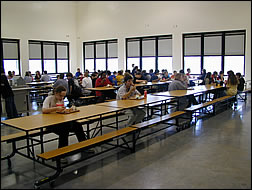
[Not the actual scene of my art-ventures, but a close enough representation, except that my venue had poorer lighting.]
Reader, to say that I did not thrive under such circumstances would be an appalling understatement. You see, I am an orderly person. Some might say I am an obsessively neat person. Some may say anal retentive. Some may refuse to mince words and insist that I am an incurable fussypants. But yes—I like a clean environment in which to live and work. Filth gives me the sweats; askew piles give me hives. When I have work or grading to do, I would much rather do it right away than have it sit on my desk, looming as items on a “to do” list in my head, or sometimes, written down. When I watch “Monk” on USA, I am not only amused by him; I understand him. I feel what makes him tick.
So: wheeling an unstable cart filled with utterly disorganized art materials into a cafeteria each morning, then having middle schoolers create art—under my tutelage!—and then having to clean it up and load up the cart and swing it back down the hall and into the closet…too much.
I soon learned that even under ideal circumstances, I was not cut out to teach middle schoolers. I had several sections of rammy (and unimaginably tiny!) sixth graders; a section of utterly delinquent seventh graders; and a couple of classes of eighth graders who were, by and large, really quite nice. Among the class notes I took as I tried to manage this three-ring circus:
“Sydney and Nicholas have a penchant for hoarding colored pencils.”
“Note: come up with projects that do not involve paint or excessive messes.”
“Dwayne sent to ISS at beginning of period for hitting other students, trying to vandalize pencil sharpener, belligerence, throwing book and pencils. … I can scarcely overstate the level of misbehavior in this class.”
The first project I undertook with my sixth grade students was to have them use 11x14 oak tag paper and acrylic paints to produce “fishy color wheels.” I handed out paintbrushes and paints; Styrofoam plates on which students could mix colors; small dishes to wash out their brushes; and sheets of oak tag so that they could make color wheels that formed the body of great, rotund fishes. When they finished painting each other and the cafeteria tables (and sometimes the actual paper), they had to take their plates and dishes to the bathroom—on the other side of the cafeteria—and wash them out.

To use an intentional pun, allow me to paint a picture of the end of a typical one of these classes. Students were dismissed one table at a time to the bathrooms to begin cleanup. Other groups would scour and scrub their tables and immediate areas. I would hear bangs and shouts from the lavatories and have to dash over there to quell an inevitable disturbance. Finally the closing bell would ring and they would adjourn from my presence. In a sort of shell-shocked catatonia, I’d scan the lunch room as if surveying the destruction wrought by some unmerciful, uncontainable, and frenzied force of nature. The paint on the cafeteria tables was smeared, rather than cleaned off. The floor in the area where we held class, and leading to the bathrooms, was dotted with paint droppings of all conceivable hues.
Oh, the hues! The hues. When I recall this experience, I still shudder involuntarily when I think about the paint drippings, and the rainbow of droplets that were to be found everywhere after a class. I’m feeling a tad dizzy. Allow me to pause for a moment and visit my happy place…

Under my artless tutelage, the “fishy color wheels” were a disaster. The kids hated it, I hated them, and the janitors and cafeteria workers hated me for the mess that was left. From then on, I undertook only projects that used tidier materials—using charcoal and colored pencils to draw value scales, for example; or an overly ambitious, ill-advised (and far too abstract for sixth graders) project I called “Draw the Poem.”
The experience had a bit of a silver lining: I gained a new and profound appreciation for the work Mrs. Monsoon does each day as an art teacher. Hers is a world of constant cries for assistance, perpetually not-quite-completed projects, stained smocks, sticky hands, exploding plaster, yarn off its spool, beads spilling all over the place, paint and clay and ceramic dust and art supplies scattered hither and yon. It’s far more than I could ever cope with, and she does it with aplomb.
All in all, I learned a lot about myself and my career propensities as a result of my many jobs:
Hot dogs cooked on rollers are repugnant, as are baking, soon-to-be pretzels
The wrong song (Paula Abdul’s “Will You Marry Me?”; Montell Jordan’s “This is How We Do It”; Celine Dion’s “My Heart Will Go On; etc.) can ruin an otherwise pleasant work experience, or intensify an unpleasant environment beyond what a reasonably sentient being can be expected to endure
Journalism is not a growth industry
I need to work with (or for) people who say amusing things like “We just can’t have people pissin’ on desks”
I should not be in a job that requires me to open boxes that might contain foreign insects (or really, insects of any kind)
I have a “problem with assholes” and in general, do not suffer fools gladly
I need a job in which I am free to write strongly-worded letters with impunity
I like things neat and orderly; chaos is contrary to every natural instinct I possess
I cannot be held to unreasonably lofty performance standards in my job
To be extremely busy is to be unhappy
Before sending an email, I need to quadruple-check the “To” field to make sure it’s not inadvertently going to someone who shouldn’t be seeing it (and I still do, every single time)
Temporary employment agencies vary widely in their dedication to finding jobs for the workers who have registered with them
Unethical ideals, sweatshop conditions, and uninvited solicitations are not business practices of which I want any part
It is more difficult than it might seem to perch atop a commode
UNION YES!
I cannot work in an environment that is dominated by foul smells or loud noises
I cannot work with or for alpha male jackasses
Middle-school-age children are far too loud, and have far too much restless and kinetic energy; I should not ever be forced to deal with them
I would not, could not, and shall not ever be an art teacher because in this job, one must exist in a state of what appears to be barely-contained pandemonium—or what my wife likes to call “controlled chaos”
And so—friends, family, colleagues—I have landed at Governor Mifflin High School, where I have taught for five years. With a few outstanding exceptions, this line of work conforms to the career prerequisites I have laid out above after watching myself bumble, loaf, shuffle, argue, flounder, protest, fritter, try, and fail (and, on rare occasions, succeed) my way through more than a decade of labor experiences.
Thank you for accompanying me on my journey…
The Many Jobs of Monsoon: Volume Four
The fourth of five volumes, from November 2006...enjoy!
The Many Jobs of Monsoon Forecast: Volume Four
Wednesday, 15 November 2006
I graduated from The Ohio State University with a master’s degree in Black Studies—but no marketable skills—in 1996 and moved to the Illadelph to peep out gainful employment. I applied to every newspaper in the town, including the Tribune, an African American newspaper. When I called the UPI (United Press International) office in Philly to inquire about openings, the reporter who answered replied rather forlornly, “Well, actually, this office is closing in a couple of weeks, and I’m gonna be out of a job. So if you know of any openings in the field, be sure and let me know, huh?” This should have tipped me off to the depressed state of the industry I was hoping to break into.
I applied to nonprofit foundations and community organizations. Having had some limited experience at OSU as a graduate teaching assistant, I applied to area colleges and private schools for adjunct teaching positions. I even sent my résumé to the Afro-American Historical and Cultural Museum in Philadelphia (now the African American Museum). And every day my mailbox would be a yawning void of bills and junk mail, but no job offers (most of them didn’t even have the common civility to send a rejection letter).
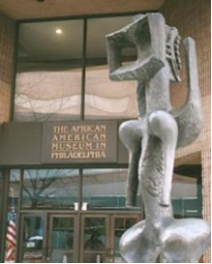
[The African American Museum in Philadelphia, where Monsoon was not employed]
Oh, there were a handful of interviews. I remember getting all tarted up in my jacket and tie and going out to some swanky private boys’ school on the Main Line. Had a lovely visit and what I thought was a strong interview with the head of the English department. Never heard from them again. I interviewed with a nonprofit organization in West Philly near the el tracks. As was the case in graduate school, my lack of pigment was conspicuous among the denizens of the neighborhood and the outfit to which I was applying. And as was the case in graduate school, I was not welcomed at this particular nonprofit by my melanin-gifted brothers and sisters with open arms.
(I suspect that I landed this interview—and some others—on the strength of my résumé, which might reasonably lead one to believe that I was African American. I can only imagine what was racing through their heads sometimes when they expected Denzel Washington to walk in and got a bearded Ned Beatty instead.)
No phone call, no letter, no telegram. No “thanks for your time,” no “we’re moving in another direction,” no “go to Hell.” Nothing.
So inevitably, and after a period of depressed inactivity, I began to visit temporary employment agencies. My friends, from roughly 1996 to 2000 I was registered with—and in most cases, employed by—at least seven different temporary agencies: Kelly Services (yes, I was a Kelly Girl!), Office Team/Accountemps (both divisions of Robert Half International), Mack, Manpower, Labor Ready, Gage, and Human Assets. I have taken more Microsoft Word and Excel proficiency evaluations and timed typing speed tests than I care to recall. My typing speed was 75 wpm (words per minute) in my peak secretarial and data-entry days, and my fingers are still rather dexterous on the old keyboard. (For example, I typed the above paragraph in twelve seconds. Or thereabouts.)

Now, those of you who have spent any time learning about the Wonderful World of Monsoon can attest to the fact that I do not thrive on uncertainty, nor do I handle major changes with grace or aplomb. My favored milieu is a consistent palette of the routine and the stable, spiced up intermittently with mild surprises and intriguing diversions. And yet sometimes, routine becomes tedious and coagulates into a dull, deadening, mechanical repetition that is utterly intolerable. Such, you see, are the many contradictions that make me such a complicated chap. Still, the dominant emotion I experienced during this nomadic professional period was consternation spiked with frustration and anxiety.
I worked at offices, mostly. I did some light construction in 1996 when I joined about 20 baby-daddies in northeast Philly building a new Hollywood Video. They talked about their desire to join a class-action lawsuit that was apparently pending against the makers of the infant formula Similac—which turned out to be a hoax—and ducking their child-support payments. It was certainly an education. To this day, whenever I pass a Hollywood Video store, I inevitably say, “I helped build one of those!” Sometimes it’s to no one in particular that I make this declaration. When Mrs. Monsoon is with me, she inevitably—and with no small amount of bemused exasperation—says, “Yes, I know, honey.”

By and large, my misadventures in temporary employment during the last half of the nineties fall into two categories: gigs that I could only stomach for one day; and gigs that just kept going, eventually becoming full-time, “permanent” jobs.
A smattering of my most noteworthy one-day engagements:
1. PIRG, 1996. I responded to an ad for the Public Interest Research Group (PIRG), which was looking for entry-level applicants in nonprofit marketing and fundraising. When I arrived for the interview, I met with a dreadlocked white girl (for the record, I am virulently anti-dread when it comes to the honky peoples) in a drab little office. And—I swear, y’all—Ani DiFranco was playing on a boombox in the corner. You couldn’t make this stuff up.
She hired me to begin working on a “fundraising and awareness” campaign for the Sierra Club that involved “community outreach.” Sounded like it was right up my alley.

Turns out, it was right in the alley. The actual job: using a list of potential donors in the western edge of Center City Philadelphia, canvass the area trying to sell Sierra Club memberships (you get a free calendar!). I went door-to-door with my chipper little mentor Lucinda, and recited my memorized sales pitch into the faces of those who actually came to the door. Most were friendlier, it occurred to me, than I would have been if visited at my home by a solicitor of any kind. Few forked over a red cent, which (I soon learned) posed a problem because there was some kind of sales quota to be met, and we weren’t nearly there.
It was a depressing and disheartening endeavor, and I couldn’t wait for the day to end. But the decisive moment—the moment that make this a one-day job—came when we knocked on the door of a hopping-mad little man who opened his front door and hollered at us through the screen: “Get the hell out of here! I can’t believe you would come to my door and bother me with this [matter]. [Vulgarity] off!” And I thought, You know, he’s right. And I went home. Never did collect my paycheck for that day of work…
2. A collection agency in Plymouth Meeting, 1997. This actually began as a temporary placement; I spent a week in a dingy office doing data entry on what had to be one of the very first desktop computers ever made—I think they were actually Wangs—and making phone calls to harass people who hadn’t paid their medical bills. I found this all positively loathsome, but I was desperate for a more stable position, and jumped at the one that was offered me.
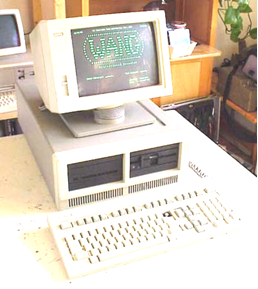
A catch: since the collection agency was offering me a “contracted” position immediately after I had been placed there by a temp agency, the temp outfit (Office Team) was entitled to a hefty “finder’s fee” paid by my new employer. My supervisor had agreed to this very explicit clause when he signed my time card. And yet, he was almost supernaturally cheap, so he decided he’d just bring me on and conceal the fact from Office Team.
On my first day, my placement specialist from Office Team popped in to see how I had performed the previous week, and inquire whether the collection agency had any further needs that could be met by their parent company, Robert Half International.
Upon seeing her walk in the door, my new boss bounded out of his office, flailed his arms to attract my attention, and somehow communicated to me that I needed to hide. And so I ducked into the bathroom and perched atop a commode so I would not be seen by someone looking underneath the stalls. (I am not what one would call “nimble,” but this little maneuver is much more difficult than it tends to appear in the movies.)
I was not detected, but another complication arose. I began to notice something I hadn’t during my “temp” week: the women who worked around me (I was the sole hourly worker there with a Y chromosome) seldom got up. They took five-minute lunches—at their desks. They never seemed to have to relieve themselves. I soon realized why: performance benchmarks. These poor souls were practically chained to their desks, scrambling to enter enough data and make enough calls to save their jobs each day. Need it be said that this was not a union operation?
Screw this noise, I said to myself. This place is hinky. And so I went home. Never got paid for that day, either…
[A silver lining to this experience: during one lunch break in my “temp week” there, I went to the Plymouth Meeting Mall and saw a little Dalmatian up for adoption in the pet store window. I called Mrs. Monsoon and she came down that evening to see this dog, whose name was “Nacho” due to a patch over her right eye, and the fact that she had been named by a three-year-old. We met the liver-spotted canine, who was so excited to make our acquaintance that she urinated prolifically. We had dinner and decided that we absolutely could not handle a second dog—much less another Dalmatian—in our fairly small rowhome. Then we went and got her. I proudly carried her out of the mall, renamed her “Ruthie,” and brought her home…]

3. A pretzel factory in Lititz, 1998. Now living in Lancaster County, I contacted a whole new slew of temp agencies and landed some humdingers. One was to be two-week job filling in for the receptionist at a pretzel factory in Lititz; I’m fairly sure it was Keystone Pretzels. First, the smell. If you have never been in a pretzel factory, know this: the yeast, the dough, the salt, and the infernal process of pretzel fabrication conspire to produce the odor of a sweaty gym sock filled with rancid anchovies. It is an olfactory assault I hope never to repeat.
And comrades, this foul stench permeated every cubic liter of air in the wood-paneled, recreation room-like offices that occupied the same structure as the stinky pretzel-making apparatus.
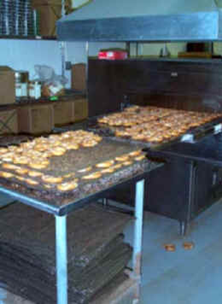
[A brief aside, if I may: Smell is perhaps the most overdeveloped of my five senses. An odd odor or unpleasant aroma can turn Monsoon from glad to sad instantaneously. I have been told that I am also quite expressive and demonstrative when I am faced with a pungent tang. Well, that’s how I do. In my “classroom expectations” sheet this year I included the following passage: “Students will refrain from adjusting makeup, spraying perfumes, or applying lotions” in the classroom. And just between us, the only reason for any of this is because I do not want their dousings, scents and slatherings to distract or sicken me.]
Already nauseated, I was doing my level best to focus on learning the rudiments of my new position—answering phones, entering manufacturing data, and so on—when I met my boss.
He came through the front door and looked over toward where I sat, training for my new temp position with the current receptionist, who was headed on a two-week vacation. When he saw me, he looked as if he had just discovered that someone had spiked his pretzel dough with dung—which, I might add, would scarcely have made the stanky funk any worse. I soon overheard heated discussions between Alpha Boss, as I shall henceforth call him, and his underlings in the Pretzelair. He was horrified, in short, that a man had been hired as their temporary receptionist. In addition—though I had been told by my Mack Employment Services placement coordinator that this was a “very casual” work environment and had as a result dressed in khaki pants and a short-sleeve polo shirt—he felt I was criminally underdressed for his Pretzel Palace.
Now, let me tell you about Alpha Boss. He was one of these men. You know the type—one of these hyper-masculine, ultra-conservative, huntin’ an’ fishin’, order-barking, steely-glare, my-way-or-the-highway, USA-love-it-or-leave-it, women-belong-in-the-kitchen jagoffs. When I went into his office later in the day to give him something, a glance around at the deer heads “decorating” his wall and the gun case behind him (in his office) confirmed my suspicion: he was an unabashed schmuck. I was leaving his office when he blustered after me: “You—tuck your shirt in.” “You”?? I thought. Aw, hell no.

It has been suggested to me over the years that I have a “problem with authority”—much like Martin Riggs in the Lethal Weapon movies, albeit without the mullet or death wish. But I’d like to argue that in point of fact, I have a problem with what I view to be unearned or illegitimate authority. Or more accurately, and very simply, I have a “problem with assholes.”

Instead of tucking in my shirt, I walked out the front door, never to return. Needless to say, I never did get compensated for the time I spent there...
Stay tuned for Volume Five of the Many Jobs of Monsoon, on its way next week—just in time for Thanksgiving! I know I said there’d be four volumes to this. There are going to be five now. Okay?
The Many Jobs of Monsoon: Volume Three
Another blast from the past, as promised: the third of my five-volume opus of employment woes, from 2006. Enjoy!
The Many Jobs of Monsoon Forecast: Volume Three
Wednesday, 1 November 2006
After graduating from Albright in May 2005 and before heading out to The Ohio State University for my graduate studies in August, I needed to find a situation that was straightforward, low-impact, and laidback—a place where my well-being would not be imperiled, a job that could make me some decent coin before my trip.
Instead, I secured work for nearly three months at the Eagle’s Eye Northlane Warehouse in Conshohocken, PA. If you’re not familiar with the Eagle’s Eye clothing brand, they import mostly holiday-themed sweaters in varying degrees of gaudiness made in Malaysian sweatshops and sell them to sartorially audacious women all across this great land at outrageous prices. There is even an Eagle’s Eye outlet in the Berks County region, I believe. If you’ve seen a bright orange sweater with black jack-o-lanterns, witches’ hats, bats, cats, corn stalks, bats, and other sundry Halloween-inspired images and phrases (“Boo!”; “Trick or Treat!”; “Spooky Fun!”), you have in all likelihood seen an Eagle’s Eye garment.

First, let me issue a caveat of sorts: I have seldom been accused of having a strong work ethic. I tend to avoid and resist grueling physical labor as I would dental x-rays, or an afternoon of in-service training at school: with no small amount of whining, and violently if necessary. Hard work and I are usually on perpendicular paths—at cross purposes, if you will—and I feel that is as fate intended it.
But friends, this place straight-up sucked. Ask anybody.
The Northlane Warehouse was a place where boxes and boxes of unfortunate clothing were received from Malaysia and other exotic southeast Asian locales, checked in, and then moved around aimlessly until they were needed to fill orders. Then the clothing articles would be placed into flow racks by “replenishers,” where “pickers” would fill the orders; then send them down a crude conveying system made of rollers, where “packers” would box up the merchandise and send it on to its destination.
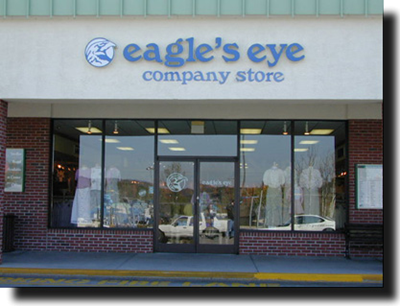
During the summer, Eagle’s Eye’s busiest time of the year, things are especially hectic around the warehouse, and supervisors are especially jumpy. In addition to the year-round staff, the “summer help” consisted of high school kids, college students, and even a teacher or two. Throughout my tenure, I think I performed nearly every single job in the whole joint: I unloaded boxes from 120-degree truck trailers; I climbed up the storage racks to retrieve boxes (there was only one forklift for the whole place); I used a pallet jack to move about fourteen thousand pallets hither and yon in the warehouse; I broke down boxes (with a utility knife—me! And I left with all my fingers intact); I picked orders; I packed orders; I swept the floor. If you can believe it, I made time to complain more than a little bit about the deplorable conditions in the warehouse, as well.
There was, of course, the inescapable heat; there was very little air moving through the building, so a gauze of oppressive, filthy, breathtakingly humid air enveloped every unfortunate soul who worked in the warehouse. When I recall the memory sensations I have retained from that experience, I feel the heat and I hear the songs that blared over and over from the radios that summer: “Gangsta’s Paradise” by Coolio, from the film Dangerous Minds; “This is How We Do It” by Montell Jordan; and “Here Comes the Hotstepper” by Ini Kamoze: “Act like you know, Rico / I know what Bo don’t know / Touch ‘em up and go, uh-oh! / Ch-ch-chang chang / Here comes the hotstepper, murderer!”
I remember that sometimes when we opened the boxes that had been shipped from southeast Asia, strange, large, spindly-legged bugs—bugs with faces, with stubble—would emerge. Those of you who know me well understand how I feel about domestic bugs; how do you think I reacted when one of these super-sized rainforest predatorial foreign insects spazzed its way out of a box? Need I go on?
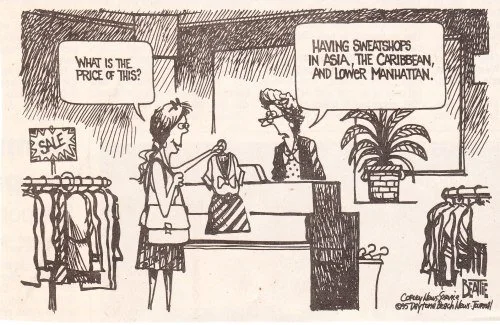
Toward the end of my tenure, I found a cartoon about sweatshops and realized that in many ways (though not quite approaching the level of misery in the Malaysian sweatshops that had produced the clothing), the conditions at Eagle’s Eye Northlane Warehouse met the criteria of a sweatshop: arbitrary discipline, forced overtime, lack of adequate break time, no living wage, hazardous conditions, and other indignities. Of course, I was reading a lot of Chomsky, Marx and Engels, so I was loaded for bear as it was. Fighting the Power and Sticking it to the Man were two of my most dearly held aspirations at this point in my life. (Come to think of it, not much has changed in that regard…)
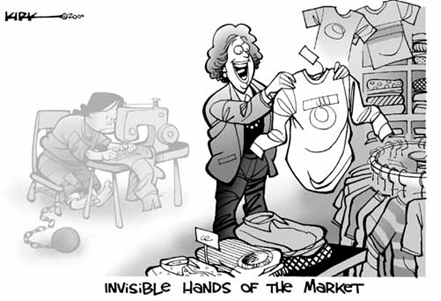
[This is not the actual cartoon mentioned above; it has been lost to me. But this one, by the exceptionally talented political cartoonist Kirk Anderson, conveys a similar idea. *Please see update following this piece!]
So I went in to work with my little cartoon, popped in to the office area (off-limits to “floor” workers), and used the office photocopier to make 20 or 30 copies of the cartoon. As I was finishing, Alan Loberstein, the warehouse’s Operations Manager, bopped by and admonished me for doing what I was doing—but luckily, he didn’t see what I was copying, so my plan could go on as devised. I took the cartoons over to my workstation (I was a “packer” that day, as fortune had smiled upon me) and throughout the day, many of the boxes contained—in addition to the unsightly garments and the packing slip—a copy of the sweatshop cartoon. Stores, wholesalers, and individual customers across the United States received what I imagined they’d see as a cry for help from the oppressed workers who had produced and packaged their precious crap, and I further envisioned that they would as a result reconsider doing business with Eagle’s Eye.
I also recall being singled out for my resistance to the “voluntary” weekend overtime that had been offered (read: forced upon) us all. As a summer worker, I felt I could turn down these opportunities with impunity. But good old Alan Loberstein didn’t see it that way; he called me over to him at one point in the waning weeks of my Eagle’s Eye residency and asked why I hadn’t signed up for the “voluntary” overtime. “Because I have other things going on,” I answered simply. “But Glen…you’re really hurting your chances for advancement if you don’t pitch in a bit on the overtime thing. Don’t you want to work here in the future?” I will admit to being rather smug, and perhaps even elitist, in my reply, but having been screamed at by supervisors, hounded repeatedly about meaningless rules, and involved in work team “pep rallies” that would have insulted the intelligence of even a pre-schooler, I had had enough. “Alan, if I find myself working here again anytime in the future, ever, I will literally kill myself.”

My “parting shot” as I took my leave of the Eagle’s Eye Northlane Warehouse was one of the first strongly-worded letters I ever composed. (At the risk of detouring too dramatically from the narrative roadway we’re traveling together, I should explain: I have become quite well-known among friends and family—and beyond—for my “strongly-worded letters.” I’ve crafted these missives and sent them to companies that have discontinued products I enjoy; legislators and entities whose actions rankle me; acquaintances and colleagues whose actions have annoyed, offended, or horrified me; and many others. I suppose it’s my love of writing, together with my rather strong opinions and inflexible tastes, which compels me to write these letters.)
About a month prior to my departure, I had approached Alan with some safety concerns, and he dismissively recommended that I “put them in writing” and he’d see what he could do. And so, on the day I completed my tenure there, I sent a three-page, single-spaced letter to Alan Loberstein; to Diane, my immediate supervisor; and to Alan’s boss in the Eagle’s Eye Corporation. In it, I vented my ire in painstaking detail, chronicling the pattern of (what I saw to be) humiliation, maltreatment, negligence, and downright villainy being perpetrated under the guise of normal business operations there. Near the beginning, I said: “I disagree with the assumption that in order to elicit the greatest effort from workers, they must be demeaned, belittled, and put in danger. I feel respect and trust can produce a better work environment as well as more efficiency and profit for The Eagle’s Eye.” A few months at a warehouse and I was coming on like I’d earned a fricking Harvard MBA.
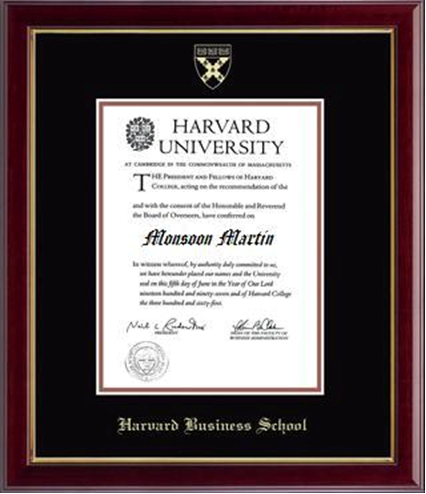
I went on: “I feel the absolute emphasis on productivity - on making rate - does not inspire workers to work harder; it results in fear and discouragement. Unrealistically inflated productivity goals serve only to prove to the workers that the supervisors are not really concerned with their safety or the quality of their work, but instead are thinking in terms of an economic bottom line which devalues and commodifies the lives and abilities of the individual workers themselves.” This was based on my observations at the warehouse. All anyone did—even the permanent workers there—was just enough to make rate, but not anything that might help the company make an extra buck. Why should they? The company obviously looked on them with nothing but disdain and disgust, no matter what kind of effort they put forth.
My rhetorical histrionics reached new heights when I attacked the company’s “voluntary” overtime policy: “I also feel mandatory two-thirds overtime is an incredibly unfair tactic to employ against loyal workers who toil forty hours per week as it is. Overtime should be offered as a choice - an essential element of a respectful relationship, after all, is the freedom of choice - rather than held over the workers’ heads like a terroristic threat. … Supervisors treat workers almost without fail as though they are stupid and inept, often blaming their own mistakes on the workers who work under them.”
I ended my letter—and, forever, my relationship with The Eagle’s Eye—by listing some of the safety violations I saw (and suffered from) during the time I served at the Northlane Warehouse. “The flow racks have incredibly sharp, uncovered edges. Countless pickers and replenishers have been put in danger by the various flaws in the flow rack system, which I hope will be corrected during the upcoming automation project,” I began. This safety concern was near and dear to my heart—literally—because I had suffered an injury to a sensitive location on my chest when running into the sharp corner of a flow rack with my torso. I still carry a scar in the affected region that was perforated by the rack’s jagged metal edge. “The roof of the warehouse leaks seriously and unpredictably in various places, producing hazardous wet spots,” I continued. “The rail system which runs throughout the entire warehouse inhibits safe and convenient passage through all areas, and especially in the kids' replenishment area,” and on and on, until I had purged myself of the rage I’d accumulated while I worked at Eagle’s Eye.
I left several days later for Columbus, Ohio and graduate school—but that’s a story for another forecast…


Update
on 2009-01-07 00:57 by Monsoon Martin
While going through some boxes in 2008, I found the actual cartoon I copied on Eagle's Eye's photocopiers and placed inside outgoing boxes containing Eagle's Eye clothing. Here it is:
A Forecast Update From Monsoon
Tuesday 8/12: Partly sunny, breezy, pleasant and a bit warmer than the previous couple of days, but still unseasonably mild. High 80, low 61.
Wednesday 8/13: Sun mixed with clouds and warmer. Slight chance of a passing shower or thunderstorm, especially in the early evening. High 86, low 64.
Thursday 8/14: Partly sunny; becoming cloudy with a shower or two around in the evening. High 81, low 62.
Friday 8/15: Mostly sunny and pleasant. High 79, low 58.
Saturday 8/16: Partly sunny with the slight chance of a shower late. High 82, low 61.
Sunday 8/17: Partly to mostly cloudy with a few passing showers possible in the afternoon or evening; warmer and somewhat more humid. High 86, low 63.
Monday 8/18: Mostly sunny and warmish. High 84, low 63.
Tuesday 8/19: Cloudy and humid with showers and thunderstorms likely. High 80, low 68.
Wednesday 8/20: Partly cloudy, warm and humid. High 87, low 64.
Thursday 8/21: Partly to mostly sunny. High 90, low 66.
Friday 8/22: Hot and humid with hazy sunshine. High 93, low 67.
Next weekend: A return to unseasonable mildness; on Sunday, the high will not even make it out of the 70s.
Beyond: Clear and gorgeous for the first day of school (8/25). High of 74, low 57. After that, we’re looking at another little blast of heat and humidity, but nothing approaching even the mid to upper 90s.
Monsoonian Rhapsody: The Best of What’s Around
I wanted to introduce a new feature on the weblog: the Monsoonian Rhapsody. It will appear periodically and will consist of—as the tagline suggests—the best of what’s around. In these posts, I will rave about great music I’ve just heard; new television shows or movies; revolutionary, life-changing products; fantastic places to shop; and the like. It’s a little window onto the consumer delights that infuse my life with such joie de vivre.
The first installment will involve three rhapsodies: a CD, a television show, and a glorious new product. En-joie!!
Crowded House - Time on Earth
Witty, introspective songwriting, inventive instrumentation, ambient beauty and superb musicianship distinguish Time on Earth as the New Zealand/Australian band Crowded House’s finest, most coherent work.
Crowded House, formed from the shards of the very good early-80s new wave/pop band Split Enz, released its first album in 1986, which contained such popular songs as “Don’t Dream It’s Over” and “Something So Strong.” I had the cassette of this album, and listened to it so often I probably still know every word by heart. They moved on to a series of three uneven, sometimes brooding follow-up albums that produced memorable CH staples like “Better Be Home Soon,” “It’s Only Natural,” “Weather With You,” and “Distant Sun.”

After the group disbanded in 1996, lead singer and principal songwriter Neil Finn released a couple of fairly well-received (but little noticed) solo albums, collaborated with his big brother Tim (who led Split Enz and had collaborated with Crowded House periodically), and arranged for the release of CH compilations (1996’s Recurring Dream: The Very Best of Crowded House and 2000’s Afterglow, a compendium of b-sides and lost tracks, among which is one of the most gorgeous songs they have ever recorded, “Help is Coming”).
Neil Finn had been working on his third solo album when he received the news that Split Enz and CH drummer Paul Hester, who had a long history of depression and emotional volatility, had committed suicide. As a result Finn began collaborating with former CH bassist Nick Seymour on a series of songs whose underlying themes included loss and grief. They soon realized they wanted to make a new Crowded House album, and auditioned musicians to round out the group.
Released last summer in the US, Time on Earth is by no means uniformly excellent; it does have its lulls (“A Sigh,” “You Are the One to Make Me Cry”) and outright stinkers (“She Called Up,” “Transit Lounge”). But every other track on the album is outstanding, and only gets better with time. There’s the mid-tempo, guitar- and piano-driven lamentation on apathy which opens the CD, “Nobody Wants To.” There’s the upbeat, offbeat musing about GPS technology of “Don’t Stop Now,” the album’s first single and one of its strongest songs. (Its propulsive drums and dreamy melodies remind me of Smashing Pumpkins’ “1979.”)
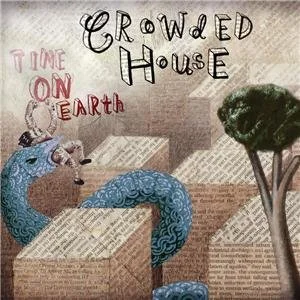
The three biggest standouts for me, though, are “Pour Le Monde,” “Heaven That I’m Making,” and “Silent House.” The first is a song of protest against the war and tells the story of a soldier wounded in action and the indifferent, cynical politicians that put him there. (“Pour Le Monde” means “For the World.”) The second is an ambient, ominous piece about stumbling upon the meaning of life. The song ends with the lyrics: “If there is hell on earth / there must be heaven too / Both in one place / And not a second to lose.” The third song listed, “Silent House,” was dedicated to the memory of Paul Hester but really deals in a broader sense with all the confused regret and nostalgia that infuses our recollections of home and family. Shockingly (to me, at least, since it’s such a good song) it was co-written by Neil Finn with the Dixie Chicks, who have their own (not shockingly, terrible) version of “Silent House” on their latest album, Taking the Long Way. This powerful, achingly evocative song begins: “These walls have eyes / Rows of photographs and faces like mine / Who do we become / Without knowing where we started from?”
Here is the Time on Earth link on amazon.com’s site , where you can listen to song samples and purchase the CD.
Here is a memorable performance of “Pour Le Monde” from the program “Austin City Limits,” which I watched late one Friday night with my sweet wife.
Primeval
A new show (to us in the US, anyway) show called “Primeval” debuted on BBC America last night, and it was a fantastic bit of fun. It’s a science fiction series involving dinosaurs rampaging through the suburbs, and the first episode was fast-paced and engaging (if marred by a few too many commercial breaks).
It seems there’s a portal that’s opened up in the Forest of Dean, in Gloucestershire, southwest England. The portal is essentially a “rip” in the fabric of the time-space continuum, allowing dinosaurs both large and small, huggable and snarling, to pass through into the present and wreak magnificent havoc in the surrounding area. The cast of characters was assembled (and their backstories introduced) rapidly: a jaded evolutionary biologist, a reptile expert, a curious young boy, a dinosaur fanatic / government conspiracy theorist, and a liaison sent by the Home Office (sort of a British FBI) to keep a lid on the whole thing. It’s frightening but not terrifying, and although the threat of horrid violence certainly looms, it’s not graphically violent thus far.

The first series (we’d call it a “season” here in the states) consisted of six episodes and originally aired on ITV in the UK beginning in February 2007; the 2nd series (7 episodes) aired in early 2008; the 3rd series (10 episodes) is currently being filmed.
Here’s a compilation of scenes from the first episode involving the menacing Gorgonopsid.
It’s on Saturday evenings at 9pm on BBC America, and it’s worth checking out!
Lysol Healthy Touch Hand Sanitizer
Despite the fact that its name seems to be pulled straight from a health-class video for elementary schoolers about protecting themselves from child predators (“Know the difference between a healthy touch and a bad touch, kids…”), this product is an absolute breakthrough for the germophobic / mysophobic community.
[Mysophobia is fear of contact with dirt and filth and is often seen in OCD sufferers; I bet you can guess what germophobes are afraid of.]
The cleanliness of my hands is something I hold very dear—I wouldn’t say I am obsessive about it to the point at which I’m washing my hands over and over and over. But I eschew dirt and soot and like to have something with me to cleanse me of such contaminants should the need arise. And in my line of work, contact with the foulnesses and pathogens emitted by children is unavoidable.
Wet-Naps and the like are useful, but often do not have the cleaning power to do the job that needs to be done. Purell and other hand gels are adept at neutralizing germs, but their high alcohol content often dries out the hands, which makes them more susceptible to further sullying and the introduction of contagions.

Into this dizzying array of products comes the one I will call The One: Lysol’s Healthy Touch Hand Sanitizer, rolled out in spring 2008. I first found it while wandering around a grocery store called Kroger in Louisville during my trip there for the Shakespeare Behind Bars program. (Hey, I had a few extra minutes before I had to meet Curt, and I find it fascinating to see how grocery stores in other places are laid out, what their prices are like, what kinds of exotic products they carry, etc. So sue me.) It turned out that Healthy Touch had been rolled out on a trial basis in Louisville as part of some test marketing, and when I returned to the Reading area I was dismayed to learn it wouldn’t be available there for several more weeks. But when it did come in, I was all over it—as were my students, who loved to use the canister of the product I had on my desk.
Here’s a commercial for Lysol Healthy Touch, which is basically like a horror film for me--albeit one with a happy ending.
It definitely has its alcohol content—it had better, considering its claim of zapping 99.9% of germs—but it also has moisturizing agents and mild fragrances to keep the hands smooth and eliminate that tacky (as in, sticky) Purell feeling. It comes in two sizes—1.58oz and 5.1oz—and coupons appear frequently in the Sunday papers for Healthy Touch. It doesn’t yet seem to be available everywhere (not at Weaver’s or Redner’s to my knowledge) but you can find them at Giant and, I think, Weis.
Getcha some!!
The Many Jobs of Monsoon: Volume Two
Another blast from the past: the second in a series of five pieces about my checkered employment history. Enjoy!
The Many Jobs of Monsoon Forecast: Volume Two
Thursday, 26 October 2006
In my junior year of college, in preparation to become a Resident Assistant (RA) in my senior year, I took part in a new program implemented by the Residence Life office. The Housing Director had the idea to put upperclassmen into the freshman “residence hall” (as we were told to call it), so that the “first-year students” (as we were told to call them) would have us to look up to in addition to their RAs. As a Role Model (RM) the parameters of my job were ill-defined to say the least, but generally included basic counseling, directing the students to on- and off-campus services, and basically setting an upstanding example for my tenderfooted neighbors in Crowell Hall. And RMs got single rooms, so that was sweet.
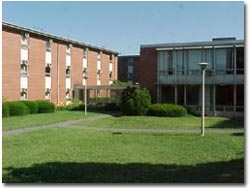
The problem that emerged with the RM program straightaway was that those students who’d been enlisted into this bold experiment were of widely varying restraint, integrity, and rectitude. One of the RMs (there were approximately six of us in the coed dorm) was growing weed in his closet. Another RM who was a junior—and is currently a trusted educator of youth—began dating a freshman girl who lived right down the hall from him. Others helped their dormmates get into alcohol-soaked fraternity parties at the Albright Woods, an apartment complex on the edge of campus. Probably not exactly the kind of ideal guidance or exemplary modeling that had been visualized by the Housing Director when he began the RM program.
But in early 1994, one Role Model in particular put all the other questionably qualified RMs to shame, and distinguished himself as one of the all-time outstanding dunderheads of his generation.
I was sitting in my room at the west end of the first floor with my good friend and former roommate Dave, who at the time was actually an RA in another building. We were in all likelihood talking about our next move in our campaign to hasten the downfall of Greek life on Albright’s campus. (We had written an editorial about why fraternities are divisive, and the process required to join them humiliating, in Albright’s newspaper; the license plate of Dave’s truck read “GDI,” which stood for God Damn Independent. Not surprisingly, one of Albright’s fraternities assigned the stealing of this plate as a pledge activity.)
All of a sudden, we heard an extremely loud noise that I said at the time sounded like someone had taken a large metal desk and dropped it from the ceiling. Since this was my third year living in a dorm, I had become sort of inoculated to clamor and cacophony. Dave recognized more immediately that there may be a serious problem, though, and we bounded curiously out into the hallway—which was rapidly filling with smoke that seemed to be originating from the opposite (east) end of the hall.
As we hurried down the hall toward the smoke, pounding on doors and shouting that folks should make their way out of the building expeditiously, we saw a figure emerge from the room that was apparently the one emitting all the smoke. This charred, dazed figure staggered past us and out the side door. Dave and I looked at each other incredulously. “That was Don Bitting!” I said, referring to one of my fellow Role Models, a quiet, aloof fellow who lived at the opposite end of the hallway. “His eyebrows are off!” Dave observed. And, as I made a point of verifying later when I saw Don, they were.
Dave and I covered our mouths with our shirts and rushed to the room from which Don had issued forth in a stunned stupor only moments earlier. We halted at the threshold and would have gasped at what we saw, except that we would have aspirated a lungload of smoke and collapsed. The walls were charred, the ceiling was charred. Nearly every loose object in the room—cups, pillows, books, posters, Cheetos—had been pulled into the center of the room, where they lay in a charred pile. There was only smoke (no fire) and it was beginning to dissipate a bit, so we could see more clearly what had been wrought in the dorm room. We got out of there just as the fire whistles and emergency sirens began to wail urgently in the distance.
Once everyone was outside—dorm residents, RAs, RMs, RDs (Resident Directors), emergency personnel, campus police—a clearer picture of what had happened began to come into focus. A singed, perplexed, and comically browless (but all in all, uninjured) Don Bitting was being simultaneously treated by paramedics and questioned by campus security and fire police.
It seems that Don—who was, it bears repeating, living in Crowell Hall as a Role Model—had been trying to make a bomb in his room. (He was apparently constructing the incendiary device simply for kicks, and did not bear any ill intent in terms of its potential use.) The key blunder in Don’s recreational pursuit was that he was building the bomb on top of the desk in his room, right in front of the heater. The high temperature from the heating register somehow ignited what he had finished of da bomb, triggering a massive implosion, or a violent collapse inward. Unlike an explosion, in which matter bursts outward, an implosion causes matter to be pulled toward the center of the vessel that is imploding; hence the bizarre mess we found inside Don Bitting’s room after the loud noise we heard.

[Above is a typical Albright dorm room, for illustration purposes. Don was doing his little science project on the desk right under the window, over the heating vent.]
According to the firefighters, Don’s little exploding surprise was not even a quarter finished; if it had been, the resulting blast could have taken out half the building. The aftermath? Don’s eyebrows grew back, the building didn’t sustain any major damage, no one was seriously injured. Albright’s housing department came through in fine style. Even though Don endangered the lives of all of his fellow residents, and broke innumerable of school regulations and actual laws, he was allowed to pay a small fine and move into another room in campus housing (but tragically was stripped of his Role Model status). Because I felt it was ridiculous that he had not been expelled, or even robustly disciplined, I gave Don the stinkeye every time I saw him about campus.
Since I had not been a filthy letch, had a ganja garden in my room, or nearly blown the building to Kingdom Come, the Housing Director adjudged me fit to serve as a Resident Assistant (RA) in Crowell Hall, again the freshman dorm, during my senior year. Nearly every day of this job was filled with what would be considered “typical” RA fare: Performing initial room inspections in August; yelling at the residents throughout the year for clogging the commode with the gastrointestinal remnants of their bacchanalian exertions, littering beer cans (and actual beer) on the floor, playing their music too loudly, and behaving like inconsiderate slobs; and performing final room inspections in May.
Fortunately, I was afforded some opportunities to go beyond these administrative and executive duties and actually help them adjust a bit to college life. I provided career counseling (despite the fact that I was about to graduate with no clue as to my own career aspirations or qualifications), academic guidance, and the like.
One October evening, however, fomented a dramatic exception to this otherwise-routine experience. First, dear reader, permit me to acquaint you with the principals in this little tragicomedy:
Ozzie, a Role Model living across the hall cater-corner from me, was an African American junior at Albright. The low timbre of his voice, his rather robust physique, and his status as a starter on the football team projected an intimidating image to some. In actuality, though, Ozzie was an exceptionally gracious and considerate person with a fantastic sense of humor.
Angelo, a freshman student of Italian heritage who hailed from northern New Jersey, was pleasant enough, but was easily led and had a predilection for exercising remarkably poor judgment.
Angelo’s brother, aged approximately 23 years, had not attended college; he was visiting his younger brother on the weekend in question. He was rather huskily built, had slightly below-average personal hygiene, and well below-average natural intelligence. I cannot recall his name, but I’m going to call him “Bruno” because it fits well with what I can recall of him.
At 2:30am, very early on a Sunday morning, there was a knock at my door.
“Glen, you in there?” My initial impulse was to ignore the knock. Whatever it was could surely wait until morning. I had almost fallen completely back asleep when there was another, more insistent knock. Annoyed, I shuffled over to the door.
“There better be somebody dead out there,” I bellowed in the most authoritative voice I could muster at this ungodly hour, angry at having been disturbed from a sound slumber.
“There’s about to be,” I heard from the other side of the door, and my heart sank past my stomach and into my knees. That sounds like Ozzie’s voice, I thought.
“Coming,” I managed.
When I opened the door and squinted into the harsh hallway light, there stood Ozzie in his boxer shorts and a t-shirt, looking fairly peeved. Next to him stood a sheepish, disheveled, nervous-looking Bruno, reeking of beer and holding a roll of paper towels. Ozzie spoke first.
“I woke up and this dude was pissin’ on my desk.”
Now fully awake, but not entirely believing what I had heard, I looked to Bruno for argument or clarification. His silence spoke volumes: Ozzie’s brutally succinct summary of the situation had been precise.
When Bruno disappeared with his paper towels and found a bottle of cleaning solution, I realized with a start that it was my responsibility as the RA to figure out how in happy hell to handle this explosive matter. I vacillated between laughter and tears, never quite succumbing to either. After waking Angelo to help his brother clean Ozzie’s room, and depositing Ozzie in my room to become calm—though it must be noted that, all things considered, he handled this incident with uncanny grace, restraint, and understanding—I set about the monumental task of answering the questions swirling within me: What the…? How in the…? But why…?
After a long early morning of baffling interviews and staggering revelations, I pieced together what had happened. To explain it to you fine people, a diagram will need to be employed:
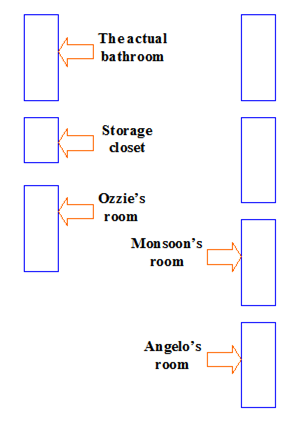
Having passed out in Angelo’s room after spending an evening earnestly pursuing a state of extreme intoxication, Bruno was awakened around 2:20am by an intense pressure on the inner wall of his bladder. He dragged himself into the hall and made a right toward the lavatory, which was at the end of the hall on the left. Unfamiliar surroundings and intense inebriation conspired to impair Bruno’s sense of spatial reasoning, however, and he made his left two doors too early.

Opening Ozzie’s unlocked door, Bruno made his way over to the desk that spanned the width of the room under the window (see “typical Albright dorm room” illustration above in the implosion tale). Feeling certain that he had reached the approximate location of the urinal, he relieved himself with full force and prodigious volume. Bruno soaked the top of the desk. Ozzie’s CD player. A book. Soon his pee spilled into the heater. Onto the floor. Into one of Ozzie’s sneakers.
Friends, to help you further envision what took place here, let me provide you with another diagram, this time a layout of Ozzie’s room:
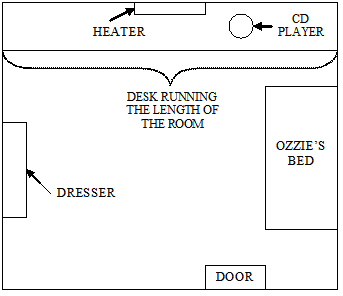
Ozzie was roused by the sound of liquid splashing on hard surfaces—and when he sat up in bed, he was greeted by the sight of a chunky figure silhouetted against the window in the moonlight, and the unmistakable odor of urine composed mostly of alcohol.
“What the [heck] are you doing?” he yelled, and turned on the light. Having been jarringly snapped out of his bladder-voiding reverie, Bruno zipped up, stammered an unintelligible explanapology, then fell silent as the produce of his wayward whiz was harshly illumed before him.
Soon thereafter, I heard that knock at my door.
The aftermath of this adventure was, for the most part, pedestrian. I filled out a write-up form, citing Angelo for failing to control his brother’s leak-taking, and submitted it to the housing office. Angelo and his brother spent much of the early morn cleaning and disinfecting the surfaces in Ozzie’s room that had been despoiled by Bruno’s mislaid tinkle; Angelo made at least one subsequent visit to ventilate and more thoroughly clean the affected areas. It was determined by the housing director that Angelo would be financially responsible to replace Ozzie’s CD player, book and sneakers—but to his credit and my amazement, Ozzie did not pursue this course of action. The CD player still worked, he said; the sneakers were old and ready to be discarded anyway; and only the cover of the book had been wetted, so it was fine.
About two weeks after the episode, a final meeting was held to wrap up this sordid affair and move on with our lives. Angelo and I met with the Dean of Students, Dr. Carolyn Brooks, in her office. Dr. Brooks hailed from the Deep South—Alabama or Mississippi, I believe, and she retained a thick accent. She was one of the most approachable (and one of the only capable) administrators I met while at Albright, but her stout frame and firm, authoritative drawl engendered fear in those who slipped up or crossed her. She was an admirably forthright kind of woman.

[Selwyn Hall, site of Dr. Carolyn Brooks’ office]
After briefly reviewing the circumstances that led to our meeting, Dr. Brooks asked Angelo to describe what he and his brother had done to rectify what wrongs had been done. He chronicled the disinfecting, the airing out, and apologies; Ozzie’s graciousness and unwillingness to insist on being compensated for his trouble. Dr. Brooks seemed satisfied with this outcome, but underscored the infractions that had been committed to ensure that the young man sitting before her grasped the senselessness and impropriety of the episode.
“Son, do you understand what I’m sayin’?”
“Yes, Dr. Brooks,” Angelo replied.
“I mean, we just can’t have people pissin’ on desks.”
Monsoon's Weather Update for Tuesday, 5 August 2008
Hey again, friends…
Here’s my first official forecast in a little while. A reminder that my predictions are focused on the weather in and around Shillington, PA (where I teach) and that generally minor fluctuations should be expected in surrounding areas.
We have a gorgeous and unseasonably mild stretch in front of us here: low humidity, moderate temperatures, and clear skies dominate the extended forecast.
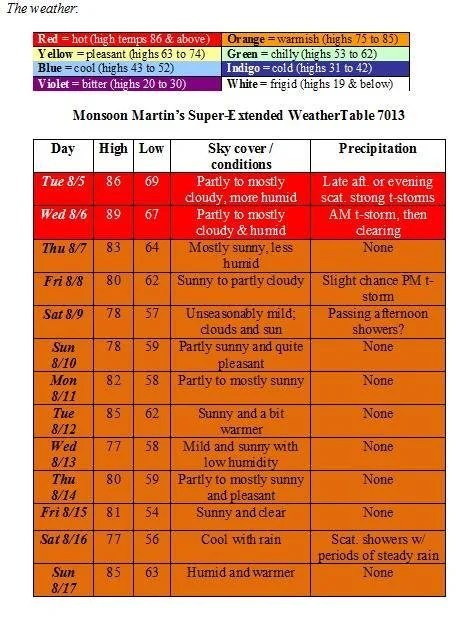
Weather narrative : Thunderstorms moving across the Midwest will arrive in our area later this evening and overnight. The storms currently affecting parts of Illinois, Indiana, and Ohio are quite violent, but by the time they reach us, they’ll be rather weakened. Still, look for strong winds and heavy rain with some of these storms. On Wednesday, we’ll start with high humidity and a few stray showers or storms, but then we’ll see clear and lowering dewpoints.
For the most part, through the end of this week and into next week we’ll see temperatures and humidity levels more typical for June or September than August. This time of year, highs average in the 85-87 degree range with lows in the mid 60s and high humidity.
After tomorrow, our next really solid chance for rain looks to be Saturday, August 16th.
Beyond the forecast: Believe it or not, the trend is actually for more mild weather, with highs the following week in the mid 70s and lows getting into the low to mid 50s! (Of course, all that can change, but that’s the way it looks to me now…)