
Monsoon's Weather Update for Wednesday, 7 May 2008
A quick weather update from Monsoon…
But first: congratulations to Senator Barack Obama for his double-digit win in the North Carolina primary and his two-point loss in Indiana; the overall gains he posted in the popular vote and delegate count; and moving us closer to ending this contentious primary battle, knocking Hillary Clinton out of the race once and for all, and allowing the party to focus on defeating McCain in November. (For my previous election coverage, type "Obama" in the weblog's search field on the upper right of the screen.)
Wednesday 5/7: unseasonably warm and mostly sunny with increasing cloud late; a shower or thunderstorm could move through late. High 82, low 56.
Thursday 5/8: partly to mostly cloudy with a shower or two in the afternoon; more frequent showers are likely in the evening. High 77, low 53.
Friday 5/9: overcast, breezy and rather cool with scattered showers throughout the morning and afternoon; tapering to showers in the evening. High 63, low 48.
Saturday 5/10: mostly sunny, breezy and gorgeous. High 69, low 44.
Sunday 5/11: mostly cloudy with evening showers likely. High 64, low 49.
Monday 5/12: chilly with rain and strong winds. High 58, low 43.
Tuesday 5/13: mostly cloudy but clearing late. High 64, low 45.
Wednesday 5/14: clear to partly cloudy and pleasant. High 70, low 48.
Thursday 5/15: overcast with perhaps a shower. High 66, low 46.
Friday 5/16: sunny to partly cloudy, cool and breezy. High 62, low 45.
Next weekend: rainy with highs in the low to mid 60s and lows in the upper 40s.
Beyond: warmer and generally pleasant with highs ascending into the 70s.
Ba-rack, rockin’ it!
Monsoon Martin's Pennsylvania Primary Primer - 22 April 2008
My friends,
The day has come to get out and vote in the Democratic primary for the United States presidency. Our state is center stage—Chris Matthews and Keith Olbermann are on MSNBC talking about what may happen in Lancaster County, the Lehigh Valley, the Reading area, and how it would affect the chances of either candidate—in a primary for the first time in my memory.
 I’ve written about this election before several times in this space, but let me reiterate here and now that I wholeheartedly endorse Barack Obama for President of the United States.
Below are two lists: the first, a list of reasons to vote for Barack Obama; the second, a list of reasons not to vote for Hillary Clinton. I have tried to be as succinct and straightforward as possible, and have based my comments on things I have heard and read from reliable sources.
Fifteen Reasons to Vote for Barack Obama
1. He was against the criminal, disastrous Iraq war from the start.
2. He wants to overhaul NAFTA and punish companies that outsource, both of which have damaged the base of manufacturing jobs in the U.S.
3. He takes no lobbyist or PAC money; he would be at least less beholden to special interests. I believe he would stand up to corporate bullying and obscene profits in American life.
4. He is not a divisive politician who engages in bickering and backbiting, but a visionary leader who will bring people together.
5. His experience as a community organizer and activist bespeak his connection with the problems of ordinary people and his ability to negotiate in good faith. His election as President, given his diverse background and broad worldview, would immediately raise the dismal status of the U.S. in the eyes of many around the world.
6. His March 18th speech on race and American life at the National Constitution Center is the most searingly honest and significant discourse on the topic in my lifetime.
7. His favorite TV show was “The Wire” and he would be the first president versed in hip-hop culture; he made a Jay-Z reference in a speech the other day, for god’s sake!
8. He has clear, substantive plans to tackle the problem of global climate change; as today is Earth Day, this should be in the forefront of voters’ minds.
9. He has stated he would create a prison-to-work incentive for former inmates transitioning back into society.
10. His views on education are progressive; he wants to abolish “teach-to-the-test” curricula and opposes vouchers.
11. He opposes death penalty in all but the rarest cases and is a proponent of legislation that makes it easier for innocent death-row inmates to win new trials.
12. He seems to genuinely have a sense of humor; that may seem like an insignificant trait, but I think it’d be pretty damned important if he wins the presidency.
13. He likes (and plays) the sport of basketball instead of being obsessed with tired, wanky pastimes of the rich and powerful like golf.
14. He voted against the use of cluster bombs in civilian areas.
15. As a colleague and I were discussing yesterday, he has the courage to disagree with his constituents on some issues rather than simply telling them what he thinks they want to hear. He will not insult the intelligence of the American people by pandering to the lowest common denominator. This is true leadership.
There are plenty of other compelling reasons to vote for Barack Obama, but these stand out for me as I sit here late on Monday night and contemplate the long-awaited primary battle.
If you’re still thinking of voting for Hillary Clinton—after all, you might say, some of the above are also true of her to some extent, notably numbers 8 and 10—I have compiled a list to try and sway your allegiance a bit. Again, all of these are based upon what I have seen or heard from reliable sources about Hillary Clinton.
Fifteen Reasons Not to Vote for Hillary Clinton
1. She voted for President Bush’s ill-conceived, ill-fated Iraq War, and has compounded the error by repeatedly reauthorizing funds to fight the war and refusing to acknowledge her error in failing to read the National Intelligence Estimate before her initial vote.
2. She voted for the USA PATRIOT Act of 2001 in the hysteria following the 9/11 attacks.
3. She supported Israel’s brutal military assault on civilian targets in Lebanon and Gaza; she has said she would support large-scale U.S. “retaliation” against Iran if it or any of its proxies attacked Israel. And finally, she was the only Democrat to vote for the aggressive Kyl-Lieberman Amendment to authorize unilateral U.S. force against Iran.
4. She opposes the full repeal of the conservative, anti-gay Defense of Marriage Act (DOMA).
5. She co-sponsored legislation that would have made it illegal to burn the flag of the United States, wasting precious congressional time on a symbolic issue around which she was pandering to conservatives.
6. She doesn’t seem to have any core convictions; she seemingly believes she is entitled to the presidency and will do anything to get elected. (Sure, this is an opinion. But it’s based upon what I’ve seen and heard, and it’s my weblog.)
7. She has engaged in unrelentingly dirty campaign tactics, seizing on minor gaffes and unrelated issues to obfuscate her own policy and leadership shortcomings; the day before the Pennsylvania primaries, her campaign released a fearmongering attack ad subtly linking Barack Obama with Osama bin Laden.
8. In an interview on “60 Minutes,” when asked whether Obama is a Muslim, she said he was not, then quickly added, “as far as I know.”
9. She lied shamelessly about the “harrowing” Bosnia plane landing in 1996, then lied to cover it up by claiming that her misstatements were out of fatigue rather than admitting they had been orchestrated to inflate the magnitude of her foreign policy experience while First Lady.
10. She served on the Wal-Mart board of directors and there is no evidence she challenged Wal-Mart’s fierce anti-union tactics; she served as a ruthless corporate attorney at the notorious union-busting Rose Law Firm. As a result of this history (and other factors), her populist rhetoric in the current campaign rings rather hollow.
11. She has been a cheerleader for the Democratic Leadership Council (DLC), which has moved the party away from its progressive roots and toward a more centrist, pro-business platform.
12. She was a member of the College Republicans and in some substantive ways, has never left the party.
13. She supports the death penalty, almost without exception.
14. She unconscionably voted against a resolution against using cluster bombs in civilian areas.
15. She is a war hawk, a polarizing figure here and abroad, and has demonstrated a disturbing tendency to respond with indignation and rage when her motives or policies are questioned.
Thanks for listening…now get out and vote!
MonsoonMonsoon Martin's Analysis of Barack Obama's Philadelphia Speech, 18 March 2008
Analysis of Barack Obama’s “More Perfect Union” speech at the National Constitution Center in Philadelphia, 18 March 2008
Senator Barack Obama’s speech on Tuesday was billed as “historic” before a word of it was even uttered, and has received near-unanimous praise since its delivery. I thought it was a very, very good speech with a lot to admire, but there were a few things that trouble me.
[A couple of notes here: first, I invite you to comment on and argue with my ideas here. Second, I’ve added a couple of new features to the weblog, which I’m still figuring out how to use to its fullest potential. You’ll notice that at the very end of each posting are links that read “Email” and “Print”—these will enable you to (you guessed it) easily email to your friends and print out each posting!]
Being an English teacher, I’ll first approach the speech as a work of literature, evaluating its structure, its pacing, its symbolism and recurring themes. Then I’ll try briefly to foresee how the speech might impact the primary election, and how Americans will respond to it.
First, the speech began with a quote. If one of my students had begun a writing piece with a quote—even one that set up the thematic milieu of his speech, as Obama’s did—he or she would have been docked points. But here, it was effective to begin with “We the people, in order to form a more perfect union,” because his speech then went on to discuss how “the American experiment” continues to work, sometimes falteringly, towards perfection.
Obama stood in front of six gigantic American flags in the National Constitution Center and romanticized the Constitutional Convention of 1787, whose resultant document was “a Constitution that promised its people liberty, and justice, and a union that could be and should be perfected over time.” Though the setting was so ham-handedly patriotic that it could have come out of a Jerry Bruckheimer film, Obama’s words softened the effect, talking as he did about America as a work in progress—citing protest, struggle, civil war and civil disobedience as part of the great history of perfecting this union. He also pointedly mentioned slavery as one of the Constitution’s—and our nation’s—great failings, and its eventual eradication as one of its great triumphs.

“This was one of the tasks we set forth at the beginning of this campaign,” he went on, deftly connecting America’s past struggles—grassroots and governmental—with his own candidacy. “To continue the long march of those who came before us, a march for a more just, more equal, more free, more caring and more prosperous America.” Obama went on to say that he has such faith in the ability of the American people to make change because of his own story, and went on to cite his oft-mentioned upbringing. “It’s a story that hasn’t made me the most conventional candidate. But it is a story that has seared into my genetic makeup the idea that this nation is more than the sum of its parts—that out of many, we are truly one,” he went on, citing the American motto “E pluribus unum.”
He moved then to an appraisal of his own campaign’s success at crossing racial lines and indeed transcending race: “Despite the temptation to view my candidacy through a purely racial lens, we won commanding victories in states with some of the whitest populations in the country.” Obama lamented several times that commentators, pundits, and media figures seemed to be playing too great a role in determining what the American public is regarding as important in the race. “At various stages in the campaign, some commentators have deemed me either ‘too black’ or ‘not black enough.’” In the last few weeks, he said, the primary elections have taken a decidedly “divisive” turn in their obsession with race:
On one end of the spectrum, we've heard the implication that my candidacy is somehow an exercise in affirmative action; that it's based solely on the desire of wide-eyed liberals to purchase racial reconciliation on the cheap. On the other end, we've heard my former pastor, Reverend Jeremiah Wright, use incendiary language to express views that have the potential not only to widen the racial divide, but views that denigrate both the greatness and the goodness of our nation; that rightly offend white and black alike.
Now he’s obviously referring to the racially charged comments made by Geraldine Ferraro about a week ago and referenced in one of my recent postings. And “purchase reconciliation on the cheap” is one of many examples in this speech of brilliant turns of phrase. (Remember that Obama writes most of his speeches, and reportedly wrote almost every single word of this one; he’s an accomplished wordsmith in addition to being a spellbinding orator.) He also brought up his former pastor, Rev. Jeremiah Wright, as expected.
The words he chose and forcefulness with which he condemned and dismissed Wright’s statements is where I part company with the candidate a bit. He referred to Wright’s comments as expressing a “profoundly distorted view of this country … a view that sees the conflicts in the Middle East as rooted primarily in the actions of stalwart allies like Israel, instead of emanating from the perverse and hateful ideologies of radical Islam.”
Oh, Barack. Wright’s views about the culpability of American foreign policy being causally responsible for the September 11th attacks; his suggestion that the CIA played a role, however distant, in fomenting the devastating crack epidemic in the inner cities; his criticisms of prisons and the justice system—these are views that are shared by plenty of intelligent, rational, clear-thinking individuals in this country and around the world. Granted, these are not mainstream views, but denigrating Wright’s views as “profoundly distorted” leave a very bad taste in my mouth as an Obama supporter.
And his simplistic appraisal of the Israeli-Palestinian conflict—essentially, that Israel can do no wrong, and Palestinians’ struggles are motivated solely by radical Islamic jihad or intifada—is alarming to me. (I had mentioned such concerns in my endorsement of Obama back at the beginning of February, and he’s shown me nothing to allay those concerns.) He may have scored a few points in distancing himself from rumors of being a Muslim, and attracted the fawning attention of Zionists, but his flip, absolutist summation of this morally and historically complex situation is unacceptable.
Obama got back on track, though, when he expressed a desire to move past a preoccupation with race and build unity in addressing a set of “monumental” problems: “two wars, a terrorist threat, a failing economy, a chronic health care crisis and potentially devastating climate change; problems that are neither black or white or Latino or Asian, but rather problems that confront us all.” It’s his inclusion of healthcare and economic concerns that gives me hope that Obama will live up to campaign promises to retool NAFTA, punish companies who outsource workers overseas, pursue serial polluters and predatory lenders, and force the reevaluation of a system that elevates profits above people. (Well, he hasn’t said all that explicitly, but I’m hoping he’ll tackle some of these issues.)
After denouncing (or rejecting, or whatever) Wright’s “distorted” views, Obama then stops short of casting aside his former pastor and mentor altogether. After all, he said, “that isn’t all that I know of the man.” Wright is a reflection of the Black community, Barack insisted, and very much a product of the turbulent era in which he grew up. The Black church, he explains, is misunderstood by many outsiders because of its complex admixture of the contemplative and the exuberant, the holy and the secular: “The church contains in full the kindness and cruelty, the fierce intelligence and the shocking ignorance, the struggles and successes, the love and yes, the bitterness and bias that make up the black experience in America.”
It was this passage that made me fall for Barack Obama all over again. Having studied African American culture for many years, I have often lamented that a lot of folks outside the community fail to grasp the complex forms of expression and variegated interactions inside the Black community. Black churches are houses of worship, yes, but many of them are also places of emotional release, of the struggle for social justice, of crass comparisons and exaggerations, of gossip and aid and tough love and mercy. Those who would dismiss Black churches—and by extension, the Black experience—as simple-minded, repetitive, overenthusiastic or inane are missing the richness and depth that has earned my profoundest respect and sustained my sincerest interest for more than 20 years.
“I can no more disown him,” Obama concluded here about Rev. Wright, “than I can disown the black community. He went on to very skillfully connect Rev. Wright’s ideas to the casual racial slurs of a relative:
I can no more disown him than I can my white grandmother – a woman who helped raise me, a woman who sacrificed again and again for me, a woman who loves me as much as she loves anything in this world, but a woman who once confessed her fear of black men who passed by her on the street, and who on more than one occasion has uttered racial or ethnic stereotypes that made me cringe.
Who among us does not have at least one stunningly ignorant distant relative who spouts racial slurs or anti-Semitic rants from time to time? Many of us even have a closer relative—a mother, a father, a sister, a brother-in-law—who is otherwise tolerant and sharp, but who once in a while lets a jaw-dropping homophobic phrase or embarrassing anti-Muslim stereotype slip? (I would not have been—nor am I generally—so forgiving or generous in dealing with racist white folks, but hey, he’s trying to run for President, here…) Speechmaking is all about getting the audience to identify with what the speaker is saying and feeling—where he or she is coming from. It’s an act of empathy, which is one of the most difficult things for a human being to do. I think he accomplished it here.
“These people are a part of me,” Obama stated pointedly—the patriots and the scalawags, the tolerant and the racist, the seekingly intelligent and the willfully ignorant. “And they are a part of America, this country that I love.”
Rev. Wright and others in his generation have experienced a great depth and breadth of the frustration and anger of the Black experience in this country—“the complexities of race in this country that we’ve never really worked through.” He cited school segregation, employment and real estate discrimination, and a “lack of economic opportunity” which all helped to “create a cycle of violence, blight and neglect that continue to haunt us.” (Another beautifully turned phrase.) He made several references to the “anger” and “bitterness” of those years and wrapped up his discussion of Wright’s generation by saying of this anger: “[It] is real; it is powerful; and to simply wish it away, to condemn it without understanding its roots, only serves to widen the chasm of misunderstanding that exists between the races.”
(Small criticism: “among the races” would have been better there, given that we’re not just talking about Black and white, but people of multiple ethnicities and backgrounds who have to work out their differences.)
Next, he moved on to white people, and I think this section has the potential to be the most soundbited and most pounced-upon by conservatives and 527 groups. But I thought it was strong and strikingly honest—like nearly all of the rest of his speech—and will work well for him. “Most working- and middle-class white Americans don’t feel that they have been particularly privileged by their race,” he said, and I think it’s quite possible that with that one sentence, he may have turned off the switch of racial animus in working whites all around this country. (Alright, maybe it’s not “off”; maybe if we could imagine the simmering and lingering racism of some whites as mood lighting, he may have dimmed it quite a bit right there.)
And he didn’t dismiss this resentment out of hand as merely inarticulate racism that needs to be discarded and buried; he acknowledged that there are legitimate experiences and sources of these feelings: “Politicians routinely expressed fears of crime for their own electoral ends. Talk show hosts and conservative commentators built entire careers unmasking bogus claims of racism while dismissing legitimate discussions of racial injustice and inequality as mere political correctness or reverse racism.” In one passage, he laid the smackdown on George H.W. Bush and his Willie Horton ad; while exposing the sniveling likes of Bill O’Reilly, Rush Limbaugh, and Glenn Beck for the fearmongering half-wits they really are. Bravo, Barack!
“Contrary to the claims of some of my critics, black and white,” he went on, “I have never been so naïve as to believe that we can get beyond our racial divisions in a single election cycle, or with a single candidacy—particularly a candidacy as imperfect as my own.” But the path before us provides a clear choice—remain stuck in the past or move together into the future. In this sense, it echoes Martin Luther King’s statement that “we must live together as brothers or perish together as fools.”
Obama illustrated the choice in this way:
The profound mistake of Reverend Wright’s sermons is not that he spoke about racism in our society. It’s that he spoke as if our society was static; as if no progress has been made; as if this country – a country that has made it possible for one of his own members to run for the highest office in the land and build a coalition of white and black; Latino and Asian, rich and poor, young and old -- is still irrevocably bound to a tragic past.
“In the end, then, what is called for is nothing more, and nothing less, than what all the world’s great religions demand—that we do unto others as we would have them do unto us. … For we have a choice in this country. We can accept a politics that breeds division, and conflict, and cynicism.”
Here I think he’s quite pointedly rejecting the dirty campaign tactics of Hillary Clinton and refusing to join her in the seamy muck of politics as usual in America.
“We can do that. But if we do, I can tell you that in the next election, we’ll be talking about some other distraction. And then another one. And then another one. And nothing will change.”
What a brilliantly succinct review of American politics over the past 20 years, at the very least.
That is one option. Or, at this moment, in this election, we can come together and say, “Not this time.” This time we want to talk about the crumbling schools that are stealing the future of black children and white children and Asian children and Hispanic children and Native American children. This time we want to reject the cynicism that tells us that these kids can’t learn; that those kids who don’t look like us are somebody else’s problem. The children of America are not those kids, they are our kids, and we will not let them fall behind in a 21st century economy. Not this time.
Obama went on to talk about the importance of addressing three other key issues in addition to education: healthcare, the economy, and ending the war.
The final couple of minutes of his speech, he told a story about a white woman organizing in a predominantly Black South Carolina district for the Obama campaign—a story that nicely illustrated the manner in which people of diverse backgrounds are coming together for real change in this election year, but which ultimately felt shoehorned in and somewhat forced.
But at this point, really, it didn’t matter. He’d already been dazzling, and he regained his stride in his final sentences: “But it is where we start. It is where our union grows stronger. And as so many generations have come to realize over the course of the two hundred and twenty-one years since a band of patriots signed that document in Philadelphia, that is where the perfection begins.”
Over all, I think Obama’s speech is one of the most important—and searingly honest—speeches about race made in my lifetime. And I think it’s going to be received extremely well by most Democrats and supporters of Obama.
But there are elements that are going to be picked apart and harped on. At one point, Obama seems to admit that he was present in the pews when Reverend Wright made some incendiary statements (though not for the ones being circulated in the videos). Some will jump on this as a contradiction of his earlier statements that he hadn’t been present for Wright’s remarks, and if he had been, he would have confronted him about them afterward. In addition, some of his comments about race—a subject that is rarely talked about openly in this country—may rankle some, particularly those he referenced in the speech as thinking that serious discussions about race are simply an instance of political correctness run amok.
The speech in history it reminds me most of is Lincoln’s 1858 “House Divided” speech, in which he urges unity for the sake of saving the union: “A house divided against itself cannot stand.” It’s a paraphrase of Matthew 12:25, and it’s a powerful and evocative phrase that influence many citizens’ views on the matter and led eventually to the Civil War.
Obama’s speech revived his campaign, solidified his frontrunner status, and likely comforted many “superdelegates” whose votes are ultimately going to decide the nomination. He may still not win Pennsylvania, but I think he’ll win the nomination handily.
Monsoon's "Wright Back to the Obama Drama" News Analysis
In the last few days, yet another minor uproar has arisen stemming from comments made by an associate of Senator Barack Obama—this time a series of videos depicting Obama’s pastor, Rev. Jeremiah Wright of Chicago’s Trinity United Church of Christ, making incendiary statements about US foreign and domestic policies.
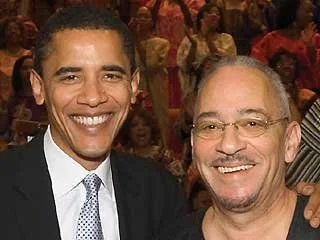
On the Huffington Post website, Obama posted a statement in which he categorically denounces and rejects the words of his long-time spiritual adviser, and the man who officiated at his wedding.
To his credit, though, Obama refused to “repudiate” Rev. Wright as a man in an interview with Keith Olbermann on MSNBC, insisting that it is possible to deeply respect a person and disagree with some of the things that person says or does. And though Obama’s opponent in the general election—or rather, 527 groups handling the dirty work for John McCain—will surely seize on the Reverend’s comments as evidence that Obama is insufficiently patriotic, at least maybe those rumors that he’s really a Muslim will be put to rest!
Obama clearly had to distance himself from Reverend Wright’s most inflammatory remarks, given that many of those whose votes he is courting will have knee-jerk responses to the remarks as deeply offensive and borderline treasonous. But I thought I’d take a closer look at Reverend Wright’s remarks in the three principal video clips that are currently circulating and try to consider just how unreasonable or off-base they are.
In the first clip, delivered several days after the September 11, 2001 attacks, Reverend Wright says: “We bombed Hiroshima, we bombed Nagasaki and we nuked far more than the thousands in New York and the Pentagon, and we never batted an eye. We have supported state terrorism against the Palestinians and black South Africans, and now we are indignant because the stuff we have done overseas is now brought right back to our own front yards. America’s chickens are coming home to roost.”
The concluding statement here echoes one made by Malcolm X at the end of his association with the Nation of Islam (in fact, this statement was one of the factors that brought about this break). After the assassination of President John F. Kennedy in November 1963, Malcolm X was asked by a reporter for his reaction to the event. It’s a case of “the chickens coming home to roost,” he replied, adding that “Being an old farm boy myself, chickens coming to roost never did make me sad, they’ve always made me glad.” Later that day, he clarified his statement by explaining that there has long been a climate of hate and brutality in the United States, particularly against Black people. The death of President Kennedy is a natural “result of that way of life and thinking.” The New York Times ran a screaming headline the next day citing his chickens comment, and Malcolm X was further marginalized and vilified by American society.
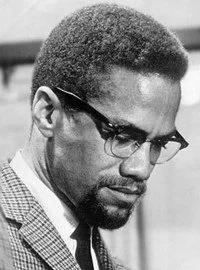
Two things were wrong with Malcolm’s comments, as far as most Americans were concerned: they suggested that the beloved President somehow deserved to be killed, and their timing right after his death bespoke an alleged insensitivity on Malcolm’s part. What folks missed here is that Malcolm did not seem to have been stating that President Kennedy deserved to die; he was arguing that a sense of karmic retribution had come to pass—that the oppression and abuse of minorities in this country had finally boomeranged to victimize one of the elites. Its timing was problematic, perhaps, but what more opportune time would there have been for Malcolm X to reach large numbers of people with his message—in this hope that they might begin questioning their own responses to President Kennedy’s assassination?
I think similar arguments hold up what scrutinizing Reverend Wright’s comments from September 16th, 2001. He cites the actions of this government in inflicting or supporting the infliction of pain and death upon untold millions around the world in the last 60 years or so, citing the Japanese atomic bombs and state support for the terrorism of foreign governments. (He might also have mentioned the My Lai massacre, the invasion of Grenada—or the US-backed military coup of Chile’s democratically elected president on September 11, 1973, which installed General Augusto Pinochet, who soon became known for his flagrant human rights abuse and widespread corruption.)
Surely it was not proper for the leaders of this country to think that they could perpetrate such wantonly violent, extreme, and usually unprovoked attacks on other peoples and not deliver the consequences to their own shores, to their own people? “Why do they hate us?” was the familiar refrain after the attacks. “They hate our freedoms,” was the pat answer. But more honestly, they hate our actions—not those of its individual citizens, necessarily, but the actions of the country in which we live and to whose allegiance we pledge each morning. I cannot imagine that he was suggesting the repugnant notion that those who died on September 11, 2001 deserved to die; but the question of whether America, by its actions, its dirty politics, its aggressive foreign policy, may have rightfully earned the animus of folks throughout the world—that’s another, more complicated, question, and one whose answer is too uncomfortable for many Americans to deal with.
As for the “timing” problem, I’ll return to my argument from above: What better time to challenge one’s flock than when they are still grappling with their own grief and indulging the a great national orgy of victimhood and outrage? Surely some minds were changed, some thinking was challenged, by this sermon—though I suspect that now, it is just dismissed out of hand as the anti-American rantings of a leftist preacher caught up in his own argument and the power of his pulpit. That’s unfortunate.
The second clip from a 2003 sermon deals with the reasons African Americans should be critical of their government: “The government gives them the drugs, builds bigger prisons, passes a three-strike law and then wants us to sing ‘God Bless America.’ No, no, no. God damn America, that’s in the Bible for killing innocent people. God damn America for treating our citizens as less than human. God damn America for as long as she acts like she is God and she is supreme.”
Whoa. First he’s referring to some of the more frequently cited reasons for the continued socioeconomic disadvantage of African Americans in relation to whites: the prison-industrial complex and the disparate incarceration of African Americans. Angela Davis has written eloquently on this subject, particularly in her book Are Prisons Obsolete?. In a controversial series in 1996 that appeared in the San Jose Mercury News, Gary Webb wrote extensively about an alleged link among the CIA, Nicaraguan Contras, and crack cocaine; the article implied, but did not establish, that the CIA was at least indirectly responsible for introducing crack cocaine into the inner cities in the early 1980s, devastating those neighborhoods.
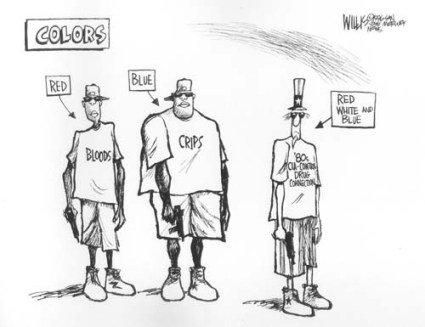
You all know I love a good conspiracy theory, and this is as plausible as any, as far as I’m concerned. (In fact, there’s a conspiracy theory within a conspiracy theory here: Gary Webb was found dead of an apparent suicide in his apartment in 2004, but the circumstances surrounding the “suicide” are very suspicious. Is’t possible that the US government not only orchestrated the sale of crack cocaine to the inner cities, but sought to cover it up years later by killing the journalist who exposed them? Yes.)
Though African Americans and Latinos make up only 25 percent of the US population, they constitute 63 percent of the prison population in this country. Much of this disparity is caused by the “three strikes” and other laws, as well as the “drug war.” Blacks are prosecuted much more aggressively for crack or rock cocaine than their white counterparts for power cocaine. So his complaints at the beginning of this statement are legitimate. (Find a nice summation of grievances about racial bias in the US corrections system here on the website of Human Rights Watch.
But Reverend Wright got himself into some rhetorical trouble when he began vitiating the sacred phrase “God bless America.” Politicians frequently end their speeches with “God bless you, and God bless America!” And of course after the September 11th attacks, the phrase became as ubiquitous on bumper stickers and t-shirts as “My child is an honor student at…” With all apologies to Irving Berlin, who wrote the song, and Lee Greenwood, who altered it slightly for his star-spangled jingo-fest “God Bless the USA,” I’ve always loathed this phrase. It sums up what people outside this country dislike so much about it—so we think God is on our side, apparently? God wants us to go bomb the living shit out of other people? As if God concerns herself with protecting the citizens of one country at the exclusion of citizens of all other countries.
I’ve noted a couple of instances in recent popular culture that tried to tweak this saying: In the otherwise vapid and dreadful movie Head of State, Chris Rock’s ultra-conservative Republican opponent ends speeches by saying, “God bless America—and no one else!” Nothing could have better captured the xenophobic “we Merkins are special, and all you foreigners suck” attitude of the most knee-jerk and cravenly nationalistic among us. I’ve seen bumper stickers recently as well that read, “God bless the whole world, no exceptions.” It’s an inclusive message—one that emphasizes the fact that the bonds we all share as humans are (or should be) far stronger than the bonds we share because we live within the same geographical entity.
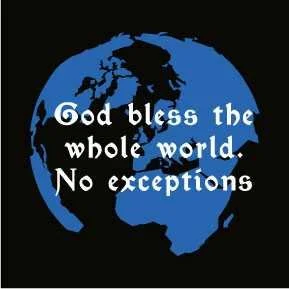
So while I agree with the content of his comments there, even I realize that you can’t go around saying “God damn America” and not expect to have your ass handed to you on a red-white-and-blue platter.
The third clip is more recent and specifically discusses the relative merits of a Hillary Clinton vs. a Barack Obama candidacy: “Barack knows what it means to be black man living in a country and a culture that is controlled by rich white people. Hillary can never know that. Hillary ain’t never been called a nigger.”
Now, aside from the fact that Reverend Wright was surely “preaching to the choir” in making these comments to his mostly-black congregation, I see no problem with the first sentence. The notion that this country is controlled by “rich white people”—is there anyone who doesn’t realize the essential truth of this statement? The second and third sentences give me pause, though. Surely it’s valuable to have someone with Obama’s experiences in the White House—someone who knows what it’s like to be discriminated against, someone who has a diverse background and experiences. But it seems as though Reverend Wright is suggesting that Barack Obama’s experiences of discrimination and bias have been more valuable than what Hillary Clinton has experienced because of her gender.
You all know that I do not like Hillary Clinton—and in fact, I doubt that I’d be able to bring myself to vote for her if she was the Democratic nominee—but she does not deserve the mean-spirited attacks she endured through much of the 90s from the right. (Remember the “vast, right-wing conspiracy” she talked about at the time? It’s real.) She doesn’t deserve to be referred to as disrespectfully as she was back in November by a (female!) McCain supporter who assumed Hillary would be the Democratic nominee and asked McCain at a campaign event, “How do we beat the bitch?” (McCain’s response, without missing a beat or expressing disappointment at her choice of words—he even seemed kind of amused—was, “That’s an excellent question. You might know that there was a poll yesterday, a Rasmussen poll, identified, that shows me three points ahead of Senator Clinton in a head-to-head matchup.” Classy guy.)
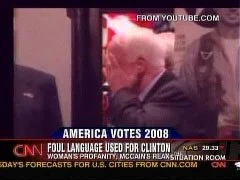
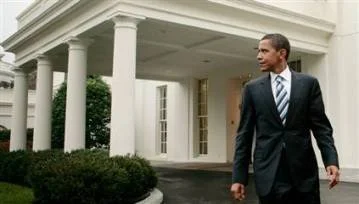
So…the verdict on Barack Obama’s pastor, Reverend Jeremiah Wright? Obviously Obama needs to distance himself from Wright’s statements for political reasons, and it would seem that Reverend Wright might begin to choose his own words more carefully. But I hope that when he wins the White House in November, Obama does not forget some of the most though-provoking questions his pastor raised in those controversial clips. By considering issues like America’s role in the world and bias in the US correctional system, Obama can evolve into the true leader this country—and world—so sorely needs.
Monsoon
Monsoon Martin's Weather Update for Wednesday, 12 March 2008
Daylight Saving Time can kiss my dragging arse. And so can the yammering hair helmet on the evening news who keeps telling me to check my frigging smoke alarms when I change my clocks. (OK—I checked ‘em, they’re A-OK, Muffy. Now sod off!) And so can George W. Bush (for this and many other reasons), who signed an idiotic bill in 2005 extending DST from March to November rather than April to October, which was bad enough. And, for that matter, so can Ben Franklin, whose precious ramblings formed the basis for DST in the first place.
And while we’re at it, Hillary Clinton can pucker up and plant a big one on my hindquarters, too, for proving that she will leave no dirty campaign tactic unslung. Barack Obama’s foreign policy adviser Samantha Power was fired for saying in an interview that Clinton is a “monster” who will “tell any lie” and “stop at nothing to win.” Well, I have no such high-profile ties to the Obama campaign, so I will say it now: Hillary Clinton is a monster who will tell any lie and stop at nothing to win. (A note about the picture below: I realize it is a horribly unflattering and almost daemonic picture of the candidate, but please understand that I have never made—nor would I ever make—any pretense of unbiased reporting here on the Monsoon weblog.)

Finally, Hillary Clinton operative and one-time Vice-Presidential candidate Geraldine Ferraro can go to hell (I don’t want her anywhere near my arse) for her unequivocally racist statement, “If Obama was a white man, he would not be in this position. And if he was a woman (of any color) he would not be in this position. He happens to be very lucky to be who he is. And the country is caught up in the concept.” This statement has not been repudiated, nor has Ferraro been either denounced or rejected, by the Clinton campaign.

I hope that on April 22nd Pennsylvania Democrats reject her pandering, her divisive politics, and vote in large numbers for Barack Obama—who won both the Wyoming caucuses and the Mississippi primary with 61% of the vote and still has a lead of more than 100 delegates—as the next President of the United States.

But on to nicer, more palatable topics: spring is only a bit more than a week away, the two-week forecast is relatively dry, and the temperatures are (eventually) going to start edging up in accordance.
Today will be partly to mostly cloudy; becoming rather windy, but nothing like the high, damaging winds of last weekend. High 53, low 30.
Thursday will see some sunshine during the day, but clouds will dominate in the evening and overnight. High 48, low 36.
Friday will be overcast and quite mild with the chance of showers on and off throughout the day. High 56, low 38.
Saturday will be breezy and somewhat colder with rain and drizzle in the afternoon and evening. High 45, low 33.
Sunday is looking sunny to partly cloudy and pleasant with temperatures a bit below normal for late winter. High 42, low 28.
Monday 3/17 will be partly cloudy and nice. High 46, low 33.
Tuesday looks overcast with the slight chance of a sprinkle or two. High 52, low 36.
Wednesday will be partly cloudy and milder still. High 55, low 30.
Thursday and Friday look to be partly to mostly cloudy and colder with highs in the low 40s and lows in the mid 20s.
Next weekend will be more of the same, essentially: highs in the low to mid 40s, lows in the low to mid 20s.
Beyond: the cooler pattern breaks the following week, I think, when highs will be in the 50s and we will have left below-freezing temperatures behind us until December.
Monsoon
Monsoon Martin's Ba-rack, rockin' it! Forecast for Monday, 3 March 2008
“Well, I blew that one.” These were my words to no one in particular on Saturday morning when I awoke to discover that the expected snowfall had amounted to a few, non-accumulating flurries and squalls, and was currently tapering to drizzle. “A good, old-fashioned blown forecast.” I have no defense; I could explain what happened, but since it would sound like justification, I will refrain.
I would like to make a bold prediction (as if my prognosticating skills amount to jack squat about now) about the upcoming Democratic presidential primaries tomorrow. Many of you recall that recently in this space I endorsed Illinois senator Barack Obama for the nomination; see my post from 2/8/08 for details.
One additional key factor that supports my feeling that Barack’s a good guy and deserves our support is this: back in January, responding to a reporter’s question, Obama declared his favorite TV show to be “The Wire” (my fave) and his favorite character to be Omar (also my fave, though it may be a tie with Bubs): “He’s this gay gangster who only robs drug dealers, and then gives back. You know, he’s sort of a Robin Hood. And he’s the toughest, baddest guy on this show, but he’s gay, you know. And it’s really interesting. It’s a fascinating character.”
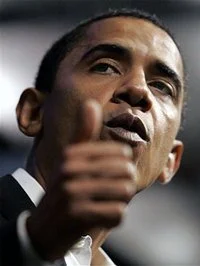
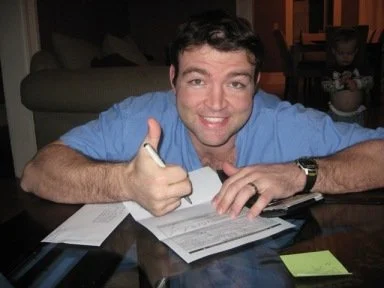
Another indication that Obamamania is unstoppably sweeping the nation is that lovably gruff orthopedic resident Bob Greenleaf, former old-school Lancaster County Republican, has been corrupted by city life (and his awesomely liberal wife Steph) and switched party affiliations! He is now a registered, Obama-supportin’ Democrat. (See actual photo of him completing the actual paperwork below.)
Anyway, the predictions for the March 4th primaries:
Texas: Obama 48%; Clinton 44%
Ohio: Clinton 49%; Obama 47%
Vermont: Obama 63%; Clinton 34%
Rhode Island: Clinton 51%; Obama 44%
Furthermore, I think Hillary Clinton, who needs not only victories but decisive ones to reinforce the viability of continuing her campaign, will nonetheless prolong the race—thus making the April 22nd Pennsylvania primary key and bringing about at least one PA debate and lots of appearances by both candidates.
Moving forward with the weather, we’re looking at unseasonable warmth (though today’s temperature will not quite approach the record high for this date of 70 in Reading). I don’t see any winter weather (snow, sleet, freezing rain) but I’m not ready to declare a definitive end to winter weather yet; given the below-normal temperatures that have predominated lately, I think we could have a winter event anytime through the first week of April.
The forecast…
Today will be partly cloudy and mild with light breezes; increasing clouds late. A bit of drizzle can’t be ruled out overnight. High 59, low 41.
Tomorrow will be mostly cloudy with a shower or two and some scattered fog throughout the early part of the day, followed by steadier rain in the evening and overnight, when rain may be heavy at times and localized flooding is possible. A thunderstorm may even move through late at night, and winds will kick up behind the system. High 51, low 42.
Wednesday could see some early showers, but otherwise it’ll turn out partly cloudy, windy, and cooler. High 46, low 25.
On Thursday we’ll see increasing cloudiness with showers late in the evening and into the night. High 46, low 34.
Friday will be partly to mostly cloudy with breezy and seasonably cool conditions. High 44, low 29.
The weekend looks even cooler with brisk winds both days; highs will be in the upper 30s and lows in the mid to upper 20s.
Next week is looking far better than the winter weather “mess” I hinted at in my last forecast. We’ll see warmer temperatures over all, with highs in the upper 40s (perhaps even reaching into the 50s again) and lows only in the mid to upper 40s. Next chance for rain—and only rain—is Wednesday the 12th and Thursday the 13th as a warm front moves through, sending temperatures to near 60.
Beyond will be seasonably cooler with highs in the mid to upper 40s and lows in the upper 20s (about normal for this time of the year).
We are the UL-ti-mate! (Ba-rack, rockin’ it!)
Monsoon
Monsoon Martin's "Ba-RACK the Vote" Campaign Statement
Hey again friends...
I just wanted to take a moment here on my weblog to congratulate Barack Obama for yet another win in the Democratic primaries and caucuses last evening (two, actually).

Since I endorsed Obama in my post of February 8th, he has won ten straight primaries and caucuses, most of them decisively: Louisiana, Nebraska, Washington, U.S. Virgin Islands, Maine, D.C., Maryland, Virginia, Wisconsin and Hawaii. The evidence is overwhelming, therefore, that it was my endorsement that put him over the top--it was the "tipping point" in his campaign, if you will. You're welcome, Barack!
Notable upcoming primaries include Ohio, Texas, Rhode Island and Vermont on March 4th and Pennsylvania on April 22nd.
Good luck, Barack!
Monsoon
Monsoon Martin Announces Endorsement in 2008 Presidential Race

I think anyone who knows me at all understands implicitly that none of the Republican candidates is in danger of receiving my endorsement, so at this point it’s rather obviously a matter of choosing between Senators Barack Obama (D-IL) and Hillary Clinton (D-NY).
(Speaking of the Republicans, though, it is amusing to watch them implode after enjoying roughly 14 years of power in national government, foisting their closed-minded, pro-corporate, and jingoistic policies on the country. Soulless right-wing pundit Ann Coulter has said of the insufficiently conservative senator John McCain (R-AZ) that if he wins the Republican nomination for President—which seems more and more likely with every passing primary—she will actually campaign for Hillary Clinton!)
To date in the Democratic Presidential primary, Obama has racked up endorsements from The Chicago Tribune, Philadelphia Inquirer, and Los Angeles Times, as well as Caroline Kennedy, The Oprah, MoveOn.org, author Toni Morrison, George Clooney and Matt Damon; Hillary Clinton has been endorsed by TheNew York Times, Kansas City Star, Denver Post, along with the National Organization for Women (NOW), Steven Spielberg, Jack Nicholson, Ed Rendell, Maya Angelou, and Billie Jean King. When it comes to endorsements, though, none is more coveted, more ballyhooed, than the Monsoon Martin weblog endorsement.
Before I get to the endorsement, I’ll dispense with the historical platitudes: the election for the 44th President will mark the first time either an African American or female candidate has secured the nomination of a major party in this country. It is certainly noteworthy that for the first time in history, there is a really good chance that the United States will have a President that is not white and male.
But to take a step back from all this barrier-breaking delirium: it will be a hollow victory indeed for feminists and/or people of color if the person elected to the White House does not faithfully represent the views and needs of all of his or her constituents. A perfect case in point is Condoleezza Rice, who is the first African American woman to hold the post of United States Secretary of State. This would seem to be cause for celebration, if not for the fact that she is a truth-muddying Bush sycophant whose stints as National Security Advisor and Secretary of State have advanced some of the most wrongheaded, brutal, and hawkish foreign policies this country has even seen. William Fletcher of the TransAfrica Forum once famously called Rice “very cold and distant and only black by accident,” and she has been accused by Rep. Nancy Pelosi and many others of being a master of obfuscation and misdirection in her servile allegiance to the Bush administration’s policies. In short, despite having secured her status an a “first,” will not be mentioned with the likes of Harriet Tubman, Mary McLeod Bethune, Shirley Chisolm, and Marian Wright Edelman in the pantheon of great African American female leaders.
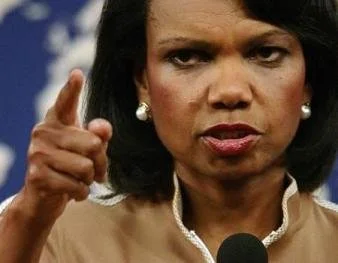
The point of such a long digression is simply to assert that, as much as the sexism and racism of those on the right who oppose these candidates is repugnant and makes us feel like leaping to their defense, we have just a deep a responsibility to evaluate them on their merits, their opinions, and their records.
It is with this in mind that I hereby endorse Barack Obama to be the Democratic nominee for President of the United States.
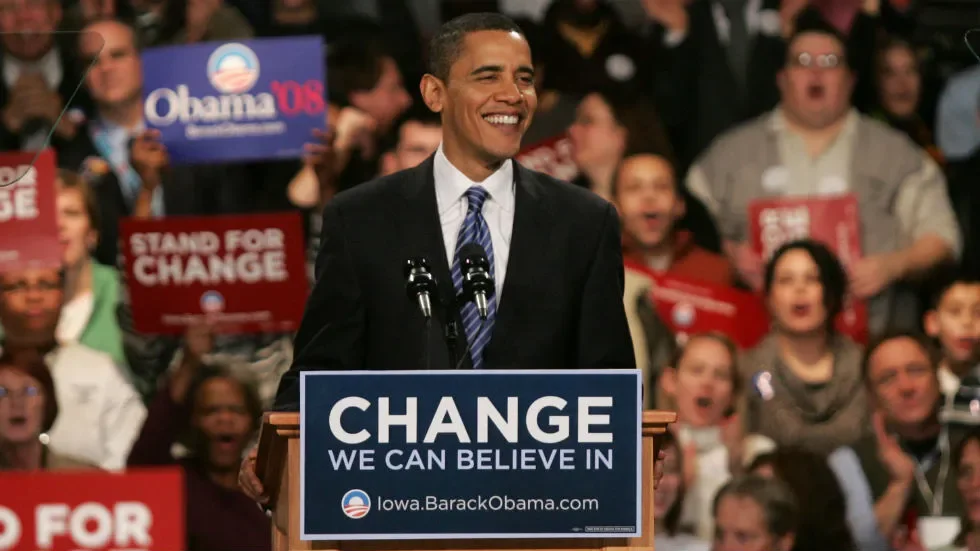
I believe he has the vision, the experience, and the conviction to breathe new life into the executive branch of our government. I will try to be as succinct as possible in laying out my reasons for supporting him, but those of you who have been reading my work for some time now realize what an empty promise that could turn out to be. And finally, all of the information about candidates Obama and Clinton I have included here is correct to the best of my knowledge. I have included citations where possible, but much of the information comes from television reports, newspaper articles, and other sources that are now lost to me. I very much welcome corrections and rebuttals to my ideas; use the “post a comment” feature below this post to record your thoughts.
First, the positive aspects of Obama and his candidacy:
Having worked as a community organizer, he has shown an ability to build a coalition that would include progressives, moderates, and even conservatives in the national conversation about how to progress beyond the tired, old political games.
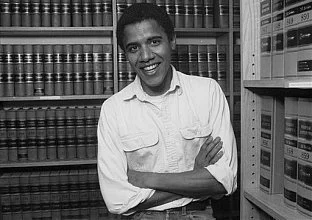
He worked a civil rights attorney, so he is attuned to the problems of discrimination, inequitable opportunities, and workers’ rights.
He is strongly against the failed, ridiculous, and dangerous policy of “don’t ask, don’t tell” regarding homosexuals in the military.
He was against the Iraq invasion from before the United States waged unprovoked war on that sovereign nation; he spoke at a massive anti-war rally in Chicago in March 2003 well before he was elected to the U.S. Senate in 2004.
Obama states that upon entering office he’ll establish a timetable for the withdrawal of combat troops within 16 months.
He has stated unequivocally that a new era of corporate responsibility is desperately needed, focusing on the issues of exorbitant CEO pay, living wages, union busting, curtailing of outsourcing, and environmental stewardship.
Obama’s stance on the oft-criticized and underfunded educational initiative known as “No Child Left Behind” is generally amenable to the problems teachers have long had with the legislation. He says it needs to be completely reevaluated (though it would be more comforting to hear that he wants to scrap it altogether and start over), and that any initiatives need to be fully funded. Also on education, he wants to raise teacher salaries—which would seem like a difficult task, since they are set by individual school districts—and help defray some of the costs of student loans, since many college students graduate having incurred mountains of debt.
I like the fact that he’s lived many places and gathered many experiences, increasing the likelihood that he can be genuinely empathetic about global crises and foreign policy. I also can’t deny that the prospect of someone who has had the experienced of being a Black man in American occupying the Oval Office is thrilling. (Of course, he’s no Angela Davis, who would be my all-time first choice for President, but it’s exciting nonetheless.)
Obama has an encouragingly progressive record in the Illinois legislature—which includes introducing bills monitoring racial profiling, ensuring a living wage for workers, and child care.
There are a few negatives in evaluating Obama that I’d be remiss if I glossed over:
Though he stood firmly against the war in 2003 and his initial Senate votes reflected this, by 2005 and 2006 he supported unconditional funding for the ongoing military action.
Though he took a balanced approach to the Israeli-Palestinian conflict earlier in his career, in recent years he has been moving toward nearly unreserved support of the hard-line Israeli government’s often brutal policies.
Obama supports same-sex unions with all the rights of traditional marriage, but does not believe that individuals of the same gender should be allowed to marry (he thinks it should be left up to the individual houses of worship whether to sanction such unions).
An optimistic view of Obama’s drift toward the center since 2005 would posit that he was playing down his progressivism a bit to appeal to a broader cross-section of voters, but will return to his core values when he becomes President.
My decision to endorse Barack Obama for the Democratic nomination has mostly to do with my belief that he will be a good President, but also has a bit to do with what I see as serious weaknesses in his opponent’s record.
There are positives in Hillary’s campaign, to be sure, and I wholly agree with some of her statements and stances; for example, Hillary has been stronger in saying NCLB relies too heavily on testing, and wants a “student borrowers’ bill of rights” to keep interest rates under control and eliminate predatory lending, and favors universal preschool. And some of her policies have similarities to Obama’s. But there are lots of negatives that make me ultimately unable to offer her my support:
She is divisive, having long been hated by lots of conservatives—though for mostly sexist and invalid reasons.
Hillary Clinton introduced a bill in 2005 that would have banned flag burning; this move was an obvious pander to the right-wing patriotic types she knew she’d need to court in her Presidential bid. As a member of the ACLU, I value my First Amendment rights rather highly.
She is extremely hawkish on foreign policy, having voted for the initial Iraq war authorization and all subsequent funding packages; she still refuses to acknowledge her initial vote as a mistake, saying that flawed intelligence and poor planning led to the Iraq quagmire. But plenty of people—including Obama, though perhaps not in these terms—saw Iraq for what it was from the beginning: a dishonest, cruel and criminal undertaking perpetrated against the world which has taken hundreds of thousands of Iraqi lives and killed nearly 4,000 US servicemembers.
Clinton has said she will “immediately” convene the Joint Chiefs to begin withdrawing the troops, but has set no timetable for actual withdrawal.
Clinton served on the Board of Directors of Wal-Mart (pictured below) for six years prior to her husband’s run for the presidency. Despite reports that she tried to get the retail behemoth to hire more women in management positions, all evidence points to the fact that she had no effect on this corporation and its anti-union, immigrant labor-exploiting, sexist and bullying tactics. In addition, she worked for the Rose Law Firm, a prestigious gang of corporate lawyers that specialized in union-busting. There was also a scandal in which she allegedly overbilled clients and continued working for the firm (of which the state of Arkansas was a client) while her husband was the state’s governor, raising questions of impropriety.
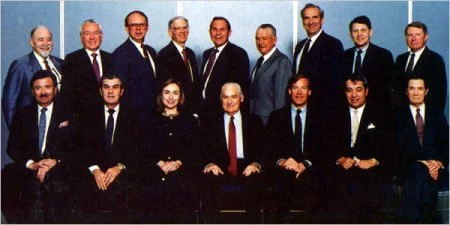
Clinton has shown an eagerness to engage in sleazy tactics. Of the many extant examples already is a New Hampshire mailing prior to the primary implying that Obama would not be a friend to pro-choice activists because he’d voted “present” on some legislative issues relating to reproductive rights. But the fact that this had been part of a Planned Parenthood legislative strategy—an organization he strongly supports—was never mentioned.
She supports Israel’s military assaults in the region and the nation’s primacy in the Middle East unquestioningly.
Hillary Clinton, in sum, is the establishment candidate. Her centrist tendencies are well-documented, while Obama’s progressive history at least leaves room for hope.
Much has been made of Obama’s purported lack of experience, or “electability,” but as one of the articles below illustrates, it all depends on how one quantifies “experience” and what kind of experience is important. Hillary Clinton is the candidate of the past, reflecting the supremacy of the Democratic Leadership Council (DLC) and of government through equivocation. After eight years of disastrous consequences courtesy of the Bush administration, do we really want to return to the previous eight years of the Clinton administration’s betrayals, unfulfilled promises, and duplicity?
Barack Obama is the candidate of the future, and even if some of his rhetoric turns out to be overblown, I think we’ll be in far better shape as a country under his leadership.
Monsoon
More here on Obama and the evolution of his policy on the Middle East:
http://www.commondreams.org/archive/2008/01/11/6312/
More here on Hillary Clinton’s pandering flag burning bill: http://www.washingtonpost.com/wp-dyn/content/article/2005/12/14/AR2005121401887.html
More here on Hillary Clinton’s propensity for dirty campaign tactics: http://www.commondreams.org/archive/2008/01/18/6468/
More here on Hillary Clinton and Wal-Mart: http://www.commondreams.org/views06/0207-34.htm
More here on the supposed gulf between Hillary Clinton’s and Barack Obama’s experience: http://doubledemon.newsvine.com/_news/2008/02/06/1282777-obamas-experience-vs-clintons-experience