
Monsoon Martin's Analysis of Barack Obama's Philadelphia Speech, 18 March 2008
Analysis of Barack Obama’s “More Perfect Union” speech at the National Constitution Center in Philadelphia, 18 March 2008
Senator Barack Obama’s speech on Tuesday was billed as “historic” before a word of it was even uttered, and has received near-unanimous praise since its delivery. I thought it was a very, very good speech with a lot to admire, but there were a few things that trouble me.
[A couple of notes here: first, I invite you to comment on and argue with my ideas here. Second, I’ve added a couple of new features to the weblog, which I’m still figuring out how to use to its fullest potential. You’ll notice that at the very end of each posting are links that read “Email” and “Print”—these will enable you to (you guessed it) easily email to your friends and print out each posting!]
Being an English teacher, I’ll first approach the speech as a work of literature, evaluating its structure, its pacing, its symbolism and recurring themes. Then I’ll try briefly to foresee how the speech might impact the primary election, and how Americans will respond to it.
First, the speech began with a quote. If one of my students had begun a writing piece with a quote—even one that set up the thematic milieu of his speech, as Obama’s did—he or she would have been docked points. But here, it was effective to begin with “We the people, in order to form a more perfect union,” because his speech then went on to discuss how “the American experiment” continues to work, sometimes falteringly, towards perfection.
Obama stood in front of six gigantic American flags in the National Constitution Center and romanticized the Constitutional Convention of 1787, whose resultant document was “a Constitution that promised its people liberty, and justice, and a union that could be and should be perfected over time.” Though the setting was so ham-handedly patriotic that it could have come out of a Jerry Bruckheimer film, Obama’s words softened the effect, talking as he did about America as a work in progress—citing protest, struggle, civil war and civil disobedience as part of the great history of perfecting this union. He also pointedly mentioned slavery as one of the Constitution’s—and our nation’s—great failings, and its eventual eradication as one of its great triumphs.

“This was one of the tasks we set forth at the beginning of this campaign,” he went on, deftly connecting America’s past struggles—grassroots and governmental—with his own candidacy. “To continue the long march of those who came before us, a march for a more just, more equal, more free, more caring and more prosperous America.” Obama went on to say that he has such faith in the ability of the American people to make change because of his own story, and went on to cite his oft-mentioned upbringing. “It’s a story that hasn’t made me the most conventional candidate. But it is a story that has seared into my genetic makeup the idea that this nation is more than the sum of its parts—that out of many, we are truly one,” he went on, citing the American motto “E pluribus unum.”
He moved then to an appraisal of his own campaign’s success at crossing racial lines and indeed transcending race: “Despite the temptation to view my candidacy through a purely racial lens, we won commanding victories in states with some of the whitest populations in the country.” Obama lamented several times that commentators, pundits, and media figures seemed to be playing too great a role in determining what the American public is regarding as important in the race. “At various stages in the campaign, some commentators have deemed me either ‘too black’ or ‘not black enough.’” In the last few weeks, he said, the primary elections have taken a decidedly “divisive” turn in their obsession with race:
On one end of the spectrum, we've heard the implication that my candidacy is somehow an exercise in affirmative action; that it's based solely on the desire of wide-eyed liberals to purchase racial reconciliation on the cheap. On the other end, we've heard my former pastor, Reverend Jeremiah Wright, use incendiary language to express views that have the potential not only to widen the racial divide, but views that denigrate both the greatness and the goodness of our nation; that rightly offend white and black alike.
Now he’s obviously referring to the racially charged comments made by Geraldine Ferraro about a week ago and referenced in one of my recent postings. And “purchase reconciliation on the cheap” is one of many examples in this speech of brilliant turns of phrase. (Remember that Obama writes most of his speeches, and reportedly wrote almost every single word of this one; he’s an accomplished wordsmith in addition to being a spellbinding orator.) He also brought up his former pastor, Rev. Jeremiah Wright, as expected.
The words he chose and forcefulness with which he condemned and dismissed Wright’s statements is where I part company with the candidate a bit. He referred to Wright’s comments as expressing a “profoundly distorted view of this country … a view that sees the conflicts in the Middle East as rooted primarily in the actions of stalwart allies like Israel, instead of emanating from the perverse and hateful ideologies of radical Islam.”
Oh, Barack. Wright’s views about the culpability of American foreign policy being causally responsible for the September 11th attacks; his suggestion that the CIA played a role, however distant, in fomenting the devastating crack epidemic in the inner cities; his criticisms of prisons and the justice system—these are views that are shared by plenty of intelligent, rational, clear-thinking individuals in this country and around the world. Granted, these are not mainstream views, but denigrating Wright’s views as “profoundly distorted” leave a very bad taste in my mouth as an Obama supporter.
And his simplistic appraisal of the Israeli-Palestinian conflict—essentially, that Israel can do no wrong, and Palestinians’ struggles are motivated solely by radical Islamic jihad or intifada—is alarming to me. (I had mentioned such concerns in my endorsement of Obama back at the beginning of February, and he’s shown me nothing to allay those concerns.) He may have scored a few points in distancing himself from rumors of being a Muslim, and attracted the fawning attention of Zionists, but his flip, absolutist summation of this morally and historically complex situation is unacceptable.
Obama got back on track, though, when he expressed a desire to move past a preoccupation with race and build unity in addressing a set of “monumental” problems: “two wars, a terrorist threat, a failing economy, a chronic health care crisis and potentially devastating climate change; problems that are neither black or white or Latino or Asian, but rather problems that confront us all.” It’s his inclusion of healthcare and economic concerns that gives me hope that Obama will live up to campaign promises to retool NAFTA, punish companies who outsource workers overseas, pursue serial polluters and predatory lenders, and force the reevaluation of a system that elevates profits above people. (Well, he hasn’t said all that explicitly, but I’m hoping he’ll tackle some of these issues.)
After denouncing (or rejecting, or whatever) Wright’s “distorted” views, Obama then stops short of casting aside his former pastor and mentor altogether. After all, he said, “that isn’t all that I know of the man.” Wright is a reflection of the Black community, Barack insisted, and very much a product of the turbulent era in which he grew up. The Black church, he explains, is misunderstood by many outsiders because of its complex admixture of the contemplative and the exuberant, the holy and the secular: “The church contains in full the kindness and cruelty, the fierce intelligence and the shocking ignorance, the struggles and successes, the love and yes, the bitterness and bias that make up the black experience in America.”
It was this passage that made me fall for Barack Obama all over again. Having studied African American culture for many years, I have often lamented that a lot of folks outside the community fail to grasp the complex forms of expression and variegated interactions inside the Black community. Black churches are houses of worship, yes, but many of them are also places of emotional release, of the struggle for social justice, of crass comparisons and exaggerations, of gossip and aid and tough love and mercy. Those who would dismiss Black churches—and by extension, the Black experience—as simple-minded, repetitive, overenthusiastic or inane are missing the richness and depth that has earned my profoundest respect and sustained my sincerest interest for more than 20 years.
“I can no more disown him,” Obama concluded here about Rev. Wright, “than I can disown the black community. He went on to very skillfully connect Rev. Wright’s ideas to the casual racial slurs of a relative:
I can no more disown him than I can my white grandmother – a woman who helped raise me, a woman who sacrificed again and again for me, a woman who loves me as much as she loves anything in this world, but a woman who once confessed her fear of black men who passed by her on the street, and who on more than one occasion has uttered racial or ethnic stereotypes that made me cringe.
Who among us does not have at least one stunningly ignorant distant relative who spouts racial slurs or anti-Semitic rants from time to time? Many of us even have a closer relative—a mother, a father, a sister, a brother-in-law—who is otherwise tolerant and sharp, but who once in a while lets a jaw-dropping homophobic phrase or embarrassing anti-Muslim stereotype slip? (I would not have been—nor am I generally—so forgiving or generous in dealing with racist white folks, but hey, he’s trying to run for President, here…) Speechmaking is all about getting the audience to identify with what the speaker is saying and feeling—where he or she is coming from. It’s an act of empathy, which is one of the most difficult things for a human being to do. I think he accomplished it here.
“These people are a part of me,” Obama stated pointedly—the patriots and the scalawags, the tolerant and the racist, the seekingly intelligent and the willfully ignorant. “And they are a part of America, this country that I love.”
Rev. Wright and others in his generation have experienced a great depth and breadth of the frustration and anger of the Black experience in this country—“the complexities of race in this country that we’ve never really worked through.” He cited school segregation, employment and real estate discrimination, and a “lack of economic opportunity” which all helped to “create a cycle of violence, blight and neglect that continue to haunt us.” (Another beautifully turned phrase.) He made several references to the “anger” and “bitterness” of those years and wrapped up his discussion of Wright’s generation by saying of this anger: “[It] is real; it is powerful; and to simply wish it away, to condemn it without understanding its roots, only serves to widen the chasm of misunderstanding that exists between the races.”
(Small criticism: “among the races” would have been better there, given that we’re not just talking about Black and white, but people of multiple ethnicities and backgrounds who have to work out their differences.)
Next, he moved on to white people, and I think this section has the potential to be the most soundbited and most pounced-upon by conservatives and 527 groups. But I thought it was strong and strikingly honest—like nearly all of the rest of his speech—and will work well for him. “Most working- and middle-class white Americans don’t feel that they have been particularly privileged by their race,” he said, and I think it’s quite possible that with that one sentence, he may have turned off the switch of racial animus in working whites all around this country. (Alright, maybe it’s not “off”; maybe if we could imagine the simmering and lingering racism of some whites as mood lighting, he may have dimmed it quite a bit right there.)
And he didn’t dismiss this resentment out of hand as merely inarticulate racism that needs to be discarded and buried; he acknowledged that there are legitimate experiences and sources of these feelings: “Politicians routinely expressed fears of crime for their own electoral ends. Talk show hosts and conservative commentators built entire careers unmasking bogus claims of racism while dismissing legitimate discussions of racial injustice and inequality as mere political correctness or reverse racism.” In one passage, he laid the smackdown on George H.W. Bush and his Willie Horton ad; while exposing the sniveling likes of Bill O’Reilly, Rush Limbaugh, and Glenn Beck for the fearmongering half-wits they really are. Bravo, Barack!
“Contrary to the claims of some of my critics, black and white,” he went on, “I have never been so naïve as to believe that we can get beyond our racial divisions in a single election cycle, or with a single candidacy—particularly a candidacy as imperfect as my own.” But the path before us provides a clear choice—remain stuck in the past or move together into the future. In this sense, it echoes Martin Luther King’s statement that “we must live together as brothers or perish together as fools.”
Obama illustrated the choice in this way:
The profound mistake of Reverend Wright’s sermons is not that he spoke about racism in our society. It’s that he spoke as if our society was static; as if no progress has been made; as if this country – a country that has made it possible for one of his own members to run for the highest office in the land and build a coalition of white and black; Latino and Asian, rich and poor, young and old -- is still irrevocably bound to a tragic past.
“In the end, then, what is called for is nothing more, and nothing less, than what all the world’s great religions demand—that we do unto others as we would have them do unto us. … For we have a choice in this country. We can accept a politics that breeds division, and conflict, and cynicism.”
Here I think he’s quite pointedly rejecting the dirty campaign tactics of Hillary Clinton and refusing to join her in the seamy muck of politics as usual in America.
“We can do that. But if we do, I can tell you that in the next election, we’ll be talking about some other distraction. And then another one. And then another one. And nothing will change.”
What a brilliantly succinct review of American politics over the past 20 years, at the very least.
That is one option. Or, at this moment, in this election, we can come together and say, “Not this time.” This time we want to talk about the crumbling schools that are stealing the future of black children and white children and Asian children and Hispanic children and Native American children. This time we want to reject the cynicism that tells us that these kids can’t learn; that those kids who don’t look like us are somebody else’s problem. The children of America are not those kids, they are our kids, and we will not let them fall behind in a 21st century economy. Not this time.
Obama went on to talk about the importance of addressing three other key issues in addition to education: healthcare, the economy, and ending the war.
The final couple of minutes of his speech, he told a story about a white woman organizing in a predominantly Black South Carolina district for the Obama campaign—a story that nicely illustrated the manner in which people of diverse backgrounds are coming together for real change in this election year, but which ultimately felt shoehorned in and somewhat forced.
But at this point, really, it didn’t matter. He’d already been dazzling, and he regained his stride in his final sentences: “But it is where we start. It is where our union grows stronger. And as so many generations have come to realize over the course of the two hundred and twenty-one years since a band of patriots signed that document in Philadelphia, that is where the perfection begins.”
Over all, I think Obama’s speech is one of the most important—and searingly honest—speeches about race made in my lifetime. And I think it’s going to be received extremely well by most Democrats and supporters of Obama.
But there are elements that are going to be picked apart and harped on. At one point, Obama seems to admit that he was present in the pews when Reverend Wright made some incendiary statements (though not for the ones being circulated in the videos). Some will jump on this as a contradiction of his earlier statements that he hadn’t been present for Wright’s remarks, and if he had been, he would have confronted him about them afterward. In addition, some of his comments about race—a subject that is rarely talked about openly in this country—may rankle some, particularly those he referenced in the speech as thinking that serious discussions about race are simply an instance of political correctness run amok.
The speech in history it reminds me most of is Lincoln’s 1858 “House Divided” speech, in which he urges unity for the sake of saving the union: “A house divided against itself cannot stand.” It’s a paraphrase of Matthew 12:25, and it’s a powerful and evocative phrase that influence many citizens’ views on the matter and led eventually to the Civil War.
Obama’s speech revived his campaign, solidified his frontrunner status, and likely comforted many “superdelegates” whose votes are ultimately going to decide the nomination. He may still not win Pennsylvania, but I think he’ll win the nomination handily.
Monsoon Martin's No-Frills Weather Update for Monday afternoon, 17 March 2008
The no-frills weather update...
Monday night will be cold with increasing cloudiness ahead of some rain moving in Tuesday. Low 29.
Tuesday 3/18 will be overcast and chilly with scattered drizzle and showers throughout the day and into the evening. Don’t expect high rainfall totals with this one, but just a rather dreary day. High 43, low 36.
Wednesday 3/19 will be much milder with steadier rainfall and perhaps even a thunderstorm in the late afternoon or evening. High 61, low 47.
Thursday 3/20 will be partly cloudy, cooler and very windy behind the front that brought us rain; northwest winds will whip through at 20-30mph and gusts will approach 50mph, particularly in the morning and afternoon. High 45, low 28.
Friday 3/21 will feature patchy clouds and diminishing winds toward daybreak. High 47, low 31.
Saturday 3/22 will be partly cloudy with increasing clouds late; unseasonably cold temperatures will move in. High 41, low 26.
Sunday 3/23 will be mostly cloudy and rather breezy with moderating temperatures. High 46, low 33.
Next week looks mild and pleasant with fairly dry conditions. Highs will trend from the upper 40s into the upper 50s by week’s end; lows will be in the mid to upper 30s. Look for rain possible on Thursday 3/27 or Friday 3/28.
The following weekend will be sunny and clear with seasonable temperatures. Highs around 50; lows in the mid 30s.
Beyond and into April will be quite a bit milder with highs rising through the 50s and into the 60s.
Monsoon
Monsoon's "Wright Back to the Obama Drama" News Analysis
In the last few days, yet another minor uproar has arisen stemming from comments made by an associate of Senator Barack Obama—this time a series of videos depicting Obama’s pastor, Rev. Jeremiah Wright of Chicago’s Trinity United Church of Christ, making incendiary statements about US foreign and domestic policies.
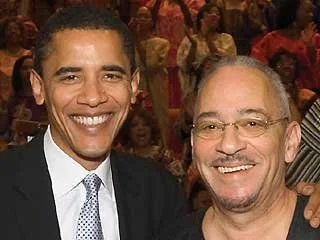
On the Huffington Post website, Obama posted a statement in which he categorically denounces and rejects the words of his long-time spiritual adviser, and the man who officiated at his wedding.
To his credit, though, Obama refused to “repudiate” Rev. Wright as a man in an interview with Keith Olbermann on MSNBC, insisting that it is possible to deeply respect a person and disagree with some of the things that person says or does. And though Obama’s opponent in the general election—or rather, 527 groups handling the dirty work for John McCain—will surely seize on the Reverend’s comments as evidence that Obama is insufficiently patriotic, at least maybe those rumors that he’s really a Muslim will be put to rest!
Obama clearly had to distance himself from Reverend Wright’s most inflammatory remarks, given that many of those whose votes he is courting will have knee-jerk responses to the remarks as deeply offensive and borderline treasonous. But I thought I’d take a closer look at Reverend Wright’s remarks in the three principal video clips that are currently circulating and try to consider just how unreasonable or off-base they are.
In the first clip, delivered several days after the September 11, 2001 attacks, Reverend Wright says: “We bombed Hiroshima, we bombed Nagasaki and we nuked far more than the thousands in New York and the Pentagon, and we never batted an eye. We have supported state terrorism against the Palestinians and black South Africans, and now we are indignant because the stuff we have done overseas is now brought right back to our own front yards. America’s chickens are coming home to roost.”
The concluding statement here echoes one made by Malcolm X at the end of his association with the Nation of Islam (in fact, this statement was one of the factors that brought about this break). After the assassination of President John F. Kennedy in November 1963, Malcolm X was asked by a reporter for his reaction to the event. It’s a case of “the chickens coming home to roost,” he replied, adding that “Being an old farm boy myself, chickens coming to roost never did make me sad, they’ve always made me glad.” Later that day, he clarified his statement by explaining that there has long been a climate of hate and brutality in the United States, particularly against Black people. The death of President Kennedy is a natural “result of that way of life and thinking.” The New York Times ran a screaming headline the next day citing his chickens comment, and Malcolm X was further marginalized and vilified by American society.
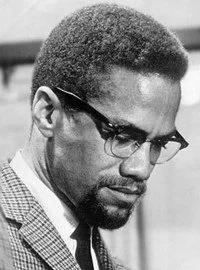
Two things were wrong with Malcolm’s comments, as far as most Americans were concerned: they suggested that the beloved President somehow deserved to be killed, and their timing right after his death bespoke an alleged insensitivity on Malcolm’s part. What folks missed here is that Malcolm did not seem to have been stating that President Kennedy deserved to die; he was arguing that a sense of karmic retribution had come to pass—that the oppression and abuse of minorities in this country had finally boomeranged to victimize one of the elites. Its timing was problematic, perhaps, but what more opportune time would there have been for Malcolm X to reach large numbers of people with his message—in this hope that they might begin questioning their own responses to President Kennedy’s assassination?
I think similar arguments hold up what scrutinizing Reverend Wright’s comments from September 16th, 2001. He cites the actions of this government in inflicting or supporting the infliction of pain and death upon untold millions around the world in the last 60 years or so, citing the Japanese atomic bombs and state support for the terrorism of foreign governments. (He might also have mentioned the My Lai massacre, the invasion of Grenada—or the US-backed military coup of Chile’s democratically elected president on September 11, 1973, which installed General Augusto Pinochet, who soon became known for his flagrant human rights abuse and widespread corruption.)
Surely it was not proper for the leaders of this country to think that they could perpetrate such wantonly violent, extreme, and usually unprovoked attacks on other peoples and not deliver the consequences to their own shores, to their own people? “Why do they hate us?” was the familiar refrain after the attacks. “They hate our freedoms,” was the pat answer. But more honestly, they hate our actions—not those of its individual citizens, necessarily, but the actions of the country in which we live and to whose allegiance we pledge each morning. I cannot imagine that he was suggesting the repugnant notion that those who died on September 11, 2001 deserved to die; but the question of whether America, by its actions, its dirty politics, its aggressive foreign policy, may have rightfully earned the animus of folks throughout the world—that’s another, more complicated, question, and one whose answer is too uncomfortable for many Americans to deal with.
As for the “timing” problem, I’ll return to my argument from above: What better time to challenge one’s flock than when they are still grappling with their own grief and indulging the a great national orgy of victimhood and outrage? Surely some minds were changed, some thinking was challenged, by this sermon—though I suspect that now, it is just dismissed out of hand as the anti-American rantings of a leftist preacher caught up in his own argument and the power of his pulpit. That’s unfortunate.
The second clip from a 2003 sermon deals with the reasons African Americans should be critical of their government: “The government gives them the drugs, builds bigger prisons, passes a three-strike law and then wants us to sing ‘God Bless America.’ No, no, no. God damn America, that’s in the Bible for killing innocent people. God damn America for treating our citizens as less than human. God damn America for as long as she acts like she is God and she is supreme.”
Whoa. First he’s referring to some of the more frequently cited reasons for the continued socioeconomic disadvantage of African Americans in relation to whites: the prison-industrial complex and the disparate incarceration of African Americans. Angela Davis has written eloquently on this subject, particularly in her book Are Prisons Obsolete?. In a controversial series in 1996 that appeared in the San Jose Mercury News, Gary Webb wrote extensively about an alleged link among the CIA, Nicaraguan Contras, and crack cocaine; the article implied, but did not establish, that the CIA was at least indirectly responsible for introducing crack cocaine into the inner cities in the early 1980s, devastating those neighborhoods.
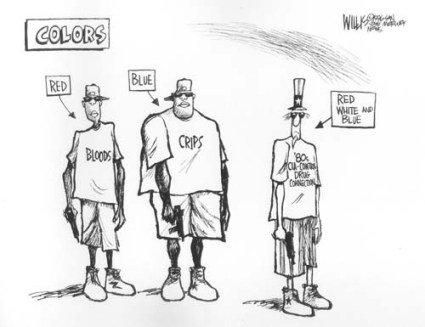
You all know I love a good conspiracy theory, and this is as plausible as any, as far as I’m concerned. (In fact, there’s a conspiracy theory within a conspiracy theory here: Gary Webb was found dead of an apparent suicide in his apartment in 2004, but the circumstances surrounding the “suicide” are very suspicious. Is’t possible that the US government not only orchestrated the sale of crack cocaine to the inner cities, but sought to cover it up years later by killing the journalist who exposed them? Yes.)
Though African Americans and Latinos make up only 25 percent of the US population, they constitute 63 percent of the prison population in this country. Much of this disparity is caused by the “three strikes” and other laws, as well as the “drug war.” Blacks are prosecuted much more aggressively for crack or rock cocaine than their white counterparts for power cocaine. So his complaints at the beginning of this statement are legitimate. (Find a nice summation of grievances about racial bias in the US corrections system here on the website of Human Rights Watch.
But Reverend Wright got himself into some rhetorical trouble when he began vitiating the sacred phrase “God bless America.” Politicians frequently end their speeches with “God bless you, and God bless America!” And of course after the September 11th attacks, the phrase became as ubiquitous on bumper stickers and t-shirts as “My child is an honor student at…” With all apologies to Irving Berlin, who wrote the song, and Lee Greenwood, who altered it slightly for his star-spangled jingo-fest “God Bless the USA,” I’ve always loathed this phrase. It sums up what people outside this country dislike so much about it—so we think God is on our side, apparently? God wants us to go bomb the living shit out of other people? As if God concerns herself with protecting the citizens of one country at the exclusion of citizens of all other countries.
I’ve noted a couple of instances in recent popular culture that tried to tweak this saying: In the otherwise vapid and dreadful movie Head of State, Chris Rock’s ultra-conservative Republican opponent ends speeches by saying, “God bless America—and no one else!” Nothing could have better captured the xenophobic “we Merkins are special, and all you foreigners suck” attitude of the most knee-jerk and cravenly nationalistic among us. I’ve seen bumper stickers recently as well that read, “God bless the whole world, no exceptions.” It’s an inclusive message—one that emphasizes the fact that the bonds we all share as humans are (or should be) far stronger than the bonds we share because we live within the same geographical entity.
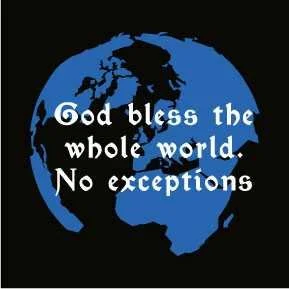
So while I agree with the content of his comments there, even I realize that you can’t go around saying “God damn America” and not expect to have your ass handed to you on a red-white-and-blue platter.
The third clip is more recent and specifically discusses the relative merits of a Hillary Clinton vs. a Barack Obama candidacy: “Barack knows what it means to be black man living in a country and a culture that is controlled by rich white people. Hillary can never know that. Hillary ain’t never been called a nigger.”
Now, aside from the fact that Reverend Wright was surely “preaching to the choir” in making these comments to his mostly-black congregation, I see no problem with the first sentence. The notion that this country is controlled by “rich white people”—is there anyone who doesn’t realize the essential truth of this statement? The second and third sentences give me pause, though. Surely it’s valuable to have someone with Obama’s experiences in the White House—someone who knows what it’s like to be discriminated against, someone who has a diverse background and experiences. But it seems as though Reverend Wright is suggesting that Barack Obama’s experiences of discrimination and bias have been more valuable than what Hillary Clinton has experienced because of her gender.
You all know that I do not like Hillary Clinton—and in fact, I doubt that I’d be able to bring myself to vote for her if she was the Democratic nominee—but she does not deserve the mean-spirited attacks she endured through much of the 90s from the right. (Remember the “vast, right-wing conspiracy” she talked about at the time? It’s real.) She doesn’t deserve to be referred to as disrespectfully as she was back in November by a (female!) McCain supporter who assumed Hillary would be the Democratic nominee and asked McCain at a campaign event, “How do we beat the bitch?” (McCain’s response, without missing a beat or expressing disappointment at her choice of words—he even seemed kind of amused—was, “That’s an excellent question. You might know that there was a poll yesterday, a Rasmussen poll, identified, that shows me three points ahead of Senator Clinton in a head-to-head matchup.” Classy guy.)
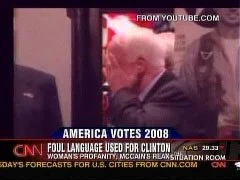
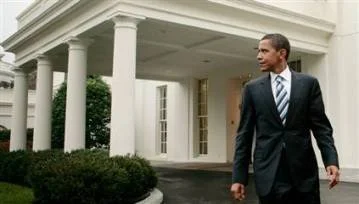
So…the verdict on Barack Obama’s pastor, Reverend Jeremiah Wright? Obviously Obama needs to distance himself from Wright’s statements for political reasons, and it would seem that Reverend Wright might begin to choose his own words more carefully. But I hope that when he wins the White House in November, Obama does not forget some of the most though-provoking questions his pastor raised in those controversial clips. By considering issues like America’s role in the world and bias in the US correctional system, Obama can evolve into the true leader this country—and world—so sorely needs.
Monsoon
Monsoon Martin's Weather Update for Wednesday, 12 March 2008
Daylight Saving Time can kiss my dragging arse. And so can the yammering hair helmet on the evening news who keeps telling me to check my frigging smoke alarms when I change my clocks. (OK—I checked ‘em, they’re A-OK, Muffy. Now sod off!) And so can George W. Bush (for this and many other reasons), who signed an idiotic bill in 2005 extending DST from March to November rather than April to October, which was bad enough. And, for that matter, so can Ben Franklin, whose precious ramblings formed the basis for DST in the first place.
And while we’re at it, Hillary Clinton can pucker up and plant a big one on my hindquarters, too, for proving that she will leave no dirty campaign tactic unslung. Barack Obama’s foreign policy adviser Samantha Power was fired for saying in an interview that Clinton is a “monster” who will “tell any lie” and “stop at nothing to win.” Well, I have no such high-profile ties to the Obama campaign, so I will say it now: Hillary Clinton is a monster who will tell any lie and stop at nothing to win. (A note about the picture below: I realize it is a horribly unflattering and almost daemonic picture of the candidate, but please understand that I have never made—nor would I ever make—any pretense of unbiased reporting here on the Monsoon weblog.)

Finally, Hillary Clinton operative and one-time Vice-Presidential candidate Geraldine Ferraro can go to hell (I don’t want her anywhere near my arse) for her unequivocally racist statement, “If Obama was a white man, he would not be in this position. And if he was a woman (of any color) he would not be in this position. He happens to be very lucky to be who he is. And the country is caught up in the concept.” This statement has not been repudiated, nor has Ferraro been either denounced or rejected, by the Clinton campaign.

I hope that on April 22nd Pennsylvania Democrats reject her pandering, her divisive politics, and vote in large numbers for Barack Obama—who won both the Wyoming caucuses and the Mississippi primary with 61% of the vote and still has a lead of more than 100 delegates—as the next President of the United States.

But on to nicer, more palatable topics: spring is only a bit more than a week away, the two-week forecast is relatively dry, and the temperatures are (eventually) going to start edging up in accordance.
Today will be partly to mostly cloudy; becoming rather windy, but nothing like the high, damaging winds of last weekend. High 53, low 30.
Thursday will see some sunshine during the day, but clouds will dominate in the evening and overnight. High 48, low 36.
Friday will be overcast and quite mild with the chance of showers on and off throughout the day. High 56, low 38.
Saturday will be breezy and somewhat colder with rain and drizzle in the afternoon and evening. High 45, low 33.
Sunday is looking sunny to partly cloudy and pleasant with temperatures a bit below normal for late winter. High 42, low 28.
Monday 3/17 will be partly cloudy and nice. High 46, low 33.
Tuesday looks overcast with the slight chance of a sprinkle or two. High 52, low 36.
Wednesday will be partly cloudy and milder still. High 55, low 30.
Thursday and Friday look to be partly to mostly cloudy and colder with highs in the low 40s and lows in the mid 20s.
Next weekend will be more of the same, essentially: highs in the low to mid 40s, lows in the low to mid 20s.
Beyond: the cooler pattern breaks the following week, I think, when highs will be in the 50s and we will have left below-freezing temperatures behind us until December.
Monsoon
Monsoon Martin's "The Wire" - episode 60 notes and analysis
The Wire episode 60 – Series Finale Notes and Analysis
“-30-”
Tagline: “…the life of kings.” – H.L. Mencken
[Note: Unlike in many of my other posts about “The Wire” episodes, I’ve made no effort to be a completist here in my recap. I’m going to comment below on interesting scenes, quote memorable lines, and say farewell to some of the most complex, authentic characters ever brought to screen.]
First, to discuss the meaning of the episode’s title: “-30-” is used to indicate the end of an article. Its origin is murky, but among other guesses, it has been suggested that it stems from the “XXX” Roman numeral once used to indicate the end of handwritten copy (X marked the end of a sentence, XX the end of a paragraph, XXX the end of the article); a reference to supposed article quota for Associated Press reporters; or the use of telegrapher’s shorthand “30” to end the first articles, which were transmitted by telegraph.
I should have known from the opening scene in which Carcetti stammers in bewildered rage and Norman gets the giggles that the show would be a celebration of institutional absurdity—and that nothing would, or ever could, really change. As he notices Norman laughing, Carcetti booms, “Hey Norman, this is my ass here.” Norman barely contains his snickers as he plays the contrite aide: “That’s true, boss … but it does have a certain charm to it. They manufactured an issue to get paid; we manufactured an issue to get you elected governor. Everybody’s gettin’ what they need behind some make-believe.” After some more backroom wrangling and the departure of a stunned and steaming Daniels and Pearlman, Norman can’t resist punctuating the moment: “I wish I was still at the newspaper so I could write on this mess. It’s too fuckin’ good.”
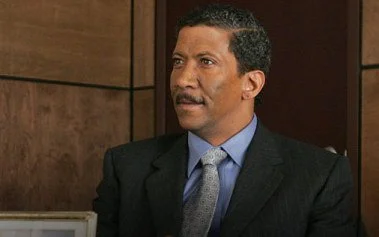
It’s been made clear by Steintorf and Carcetti that the fabrication will be buried at least until the November elections, and Daniels is indignant. Few actors I’ve ever seen can pull off such an accomplished, seething slow burn better than Lance Reddick. “McNulty, Freamon, Sydnor—anyone who has the smell of this on ‘em should be gone by the end of business today.” But after a chat with Pearlman, Daniels realizes that her career will be ruined if he reveals what’s been going on. He will play along—for now.
In the next scene, Fletcher is seen hawking the paper he writes for while Bubs sits reading his article. It’s very much against the guidelines of good journalism to show a subject the piece beforehand—the danger being that the subject might exert influence to control what will be published, tarnishing the profession. But Fletcher clearly has such respect for Reginald that he wants to ensure that his subject is completely comfortable with its contents before the article runs. Bubs has reservations, though: “What good is a story like that … what good do any of that do to put in the newspaper?” Fletcher’s response is straight out of J-school, and sounds like it might have been uttered by David Simon himself when he was a cub reporter for The Sun: “People will read it, think about it. Maybe see things different.” It’s a million miles from the striving, bottom-line ethics of Whiting and Klebanow, who are after prizes and profits rather than journalism that matters. Later in the newsroom, Gus tells Fletcher that he loved the piece, and Fletcher cautions Gus that he has yet to receive final go-ahead from the subject on publication. Fletcher says he wants to feel “clean” about the article. Gus mutters, “I remember clean,” as he casts a steely glare in the direction of Scott’s desk. At the end, Bubs sees his article, which has garnered a “Sunday front” and is titled “The road home,” and he’s at peace with its publication. In the closing montage, we see Bubs at long last joining his sister and her child upstairs for dinner. Trust and love, it seems, can be rebuilt from the ruins.
Never before in the history of the series can I recall shady political deals being brokered with such wantonness and nakedness. First, Steintorf and Carcetti pressure the police brass to sit on the McNulty fabrication. Then Steintorf tells Rawls to hold back his leverage and he will be rewarded with the position of State Police Superintendent when Carcetti is governor (and by the end, sure enough, Governor Carcetti is anointing Rawls thus). And despite Grand Jury Prosecutor Gary DiPasquale’s admission that he is dirty, Levy somehow continues to have all the power. It was nice seeing him sweat as Pearlman played the recording of him talking to DiPasquale, if even for a moment. In the end, Pearlman forces Levy accept life without parole for Chris Partlow, who will plead to all the murders, and 20 years for Monk. Marlo, for his part, walks scot-free—but he must leave “the game” because his case, which will be consigned to the Stet Docket (inactive case register), can be reactivated after the elections.
And finally, on the subject of deals, Daniels stands up again as a man who is unwilling to bend further to political will. Daniels tells Steintorf that “the stats are clean, and they’re going to stay clean.” Steintorf goes to Nerese (who, as Mayor Campbell, is seen in the closing montage naming Valcheck police chief). Nerese has the file containing Daniels’ dirt; she goes to Marla, who then goes to see her ex-husband to try and talk some sense into him. She insists that he can bend without breaking, but he insists, “if you bend too far, you’ve already broken.”
Duquan’s fate was sealed last week, I suppose, when Michael dropped him off; still, it was difficult to see him lie to Prez, who still clearly has such affection for him. (A nice moment, though: when Prez firmly scolds one of his students, Duquan says, “Looks like you got the hang of it!”) When Duquan returns to the junk man with $200 from his former teacher, the junk man remarks, “Damn! Teacher must love your black ass!” In the closing montage, Duquan is injecting himself with heroin, it appears, and we can anticipate his emergence as another Bubs. It’s disheartening, and serves to temper the optimism with which we’ve watching Bubs’ transformation into Reginald this season.
After McNulty asks an exasperated Landsman to reduce manpower on the homeless case, Bunk observes wryly: “Shit is like a war, isn’t it? Easy to get in, hell to get out.” The parallels to Bush’s war in Iraq are obvious, but I don’t know that we’re meant to extend the metaphor beyond this. The scene made me smile because it almost seemed as though David Simon was saying to critics of this season, “Oh yeah? You don’t like the homeless serial killer subplot because you don’t think it’s ‘realistic’ enough? How about a lie that’s resulted in tens of thousands of civilian deaths, three thousand-plus US servicemember deaths, and untold billions of American money?”
The scene in which McNulty slinks into the elevator next to Daniels is a classic because of what can be said with little or no dialogue: we know these characters so intimately that what isn’t said is almost more powerful than what could have been spoken in that moment. Daniels’ chilling parting words—“To be continued…”—would have made me befoul my drawers were I in McNulty’s position, without question.
Soon thereafter, when another “serial killer” murder is found, McNulty is summoned in to the “box” with Rawls and Daniels. While Rawls rants, Daniels glowers. “You’re not killin’ ‘em yourself, McNulty; at least assure me of that,” he demands. McNulty, who looks as if is paralyzed, manages to shake his head. At the end of the scene, Rawls sums up the relationship between him and McNulty wonderfully: “If you’re half the detective you think you are, you’ll put this one down fast and take us all off the hook.” Fortunately, he solves it quickly and further damage is averted.
In the newsroom, as always it’s the details that make this storyline so authentic, and I say that in defiance of all the critics who have blasted it as ham-fisted and too broad. An editor is saying plaintively, “Just because it happened doesn’t mean it’s news. There’s always a salmonella outbreak somewhere. Why do we have to write about this one?” Regional Affairs Desk Editor Rebecca Corbett (Sara Quick) points out to Gus that Scott has written a front-page article in which the paper is crediting its own coverage of the serial killer story with changing the governor’s mind. “I’m already to the jump and there’s not a quote from anyone crediting us with anything of the sort,” she says. In other words, she has reached the jumpline—the point at which a front-page article is continued to a page deeper in the section—and has no quotes, no attribution. It is complete self-congratulation, a story where none exists, which should be anathema to good and serious journalism. Rebecca says that Whiting “can smell” a Public Service Pulitzer; sure enough, Scott is seen in the closing montage accepting his Pulitzer at Columbia University, Whiting and Klebanow by his side, all three wearing the shit-eatingest grins I’ve ever seen.
“The Wire” universe is one of juxtapositions, of obsessive attention to detail. One such moment that stood out to my wife (but I missed) was when McNulty was pretending to attack Beadie’s kids with a “crab claw” (his hand). In the very next scene, Bubs is eating a crab claw while Walon advises him on whether the article should run. It’s the little things that give the most pleasure…
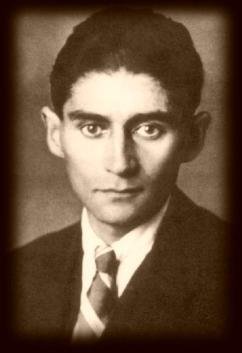
In that scene, Walon shares a Franz Kafka quote with Bubs (who calls him “Fonzie Kafka”) and while neither man has read the Czech author, they seem to derive profound meaning from his statement: “You can hold back from the suffering of the world; you have free permission to do so and it is in accordance with your nature, but perhaps this very holding back is the one suffering you could have avoided.” It is an interesting paradox to consider in terms of the themes of the show.
When approaching the finale, I think I was most interested in the fate of Gus Haynes, whom I was almost sure would end up quitting or in a different job by the end. After Scott fabricates yet another aspect of the case—a man in a gray van has supposedly tried to abduct a homeless man right in front of The Sun building—Gus explodes in Klebanow’s office: “Our job is to report the news, not to manufacture it,” which gets a hearty “Fuck you, Gus,” from a storming-out Scott, and that in turn elicits a “Nice” from a fed-up Gus. He ends his meeting with Klebanow by saying, “Maybe you win a Pulitzer with his stuff … and maybe you gotta give it back.” As Gus leaves at Klebanow’s request (“This has gotten really personal between you two”), Templeton shouts, “It’s in my notes!” Once Scott again storms away, Alma looks at Scott’s reporter’s notebook and discovers it empty. She reports this to Gus later, but he does nothing with it; she takes it to Whiting herself, and an unwanted and punitive transfer to the Carroll County Bureau—where she’ll be miserable, and wasted—is all the thanks she gets.
When he later bids farewell to Alma, Gus sums up the newspaper storyline neatly: “Look around. The pond is shrinking, the fish are nervous. Get some profile, win a prize. Maybe find a bigger pond somewhere.” Scott will get his Pulitzer, Gus correctly predicts. “Me? I’m too fuckin’ simple-minded for all that. I just wanted to see something new every day and write a story with it.” It could have been spoken by David Simon himself, fifteen years ago. Behind Gus on the wall of The Sun’s lobby appears a quote by H.L. Mencken that provides the final episode’s tagline:): “As I look back over a misspent life, I find myself more and more convinced that I had more fun doing news reporting than in any other enterprise. It is really the life of kings.” The quotation is surely meant ironically and with shades of sarcasm that only Simon himself truly comprehends. Check out my previous post about episode 53 for more on Mencken and his connection with Charm City.
In the closing montage, Gus has been demoted to the copy desk, while Fletcher has been promoted to the city desk. As Fletcher calls out to Zorzi for copy ahead of the rapidly-approaching e-dot deadline, Gus looks up from his copy sourly, then a small smile breaks across his face; as pissed off as he is with the turn of events, he’s proud of his young protégé. (I have to admit to being a little disappointed here in the way this storyline was wrapped up; I would have liked to see more coverage of what exactly transpired when Gus brought the evidence of Scott’s fabrications to Whiting and Klebanow, for example.)
Soon after Scott’s hissy fit, McNulty and Bunk are seen in the “box” with a homeless man who is apparently confessing to the two most recent murders, but although the man will likely agree to whatever number they wish, McNulty will not compound his offense by trying to get him to cop to all six supposed murders. Outside the box, Rawls states very clearly that he wants McNulty and Bunk to get the mentally unstable man to admit to all six murders; “if he’s NCR [not criminally responsible], either way they’ll tie his arms and feed him green Jell-O.” McNulty refuses again, though: “I know what I did. … and I’m not doing this.” Rawls’ final line in “The Wire” is a beaut, and set me on a roar: “Motherfucker. You are a cunt hair away from indictment and you see fit to argue with me?” I’m reminded of Rawls’ two-fingered salute to McNulty in one of the series’ earliest episodes, and some of the best, most unbridled vulgarity throughout the show’s run.
McNulty’s scene with Scott in one of the Homicide offices is brilliant, and it alone should qualify Dominic West for Emmy consideration—but we all know not to hold our collective breath on that one. In the scene, he shows utter contempt for Templeton, and also seems to be “working through” (in psychological parlance) his own self-loathing over what he’s done. “There’s no gray van, and he didn’t call you on the phone either, did he?” McNulty challenges. He goes on to admit that he called Scott, and sent the photos—but curiously fudges the details of the abducted man, claiming he was McNulty’s cousin sent up to Atlantic City for a few weeks. “You know why I can tell you all this?” he goes on, really steaming now. “Because, you lying motherfucker, you’re as full of shit as I am. And you’ve gotta live with it and play it out for as long as it goes, right? Trapped in the same lie”—the only difference being why each man did it. “You’re not serious…” asks a stunned Scott. “No, I’m a fuckin’ joke. And so are you,” McNulty replies. “Now get the fuck outta here.” (Later, back in the newsroom, Scott is clearly still reeling from this encounter. “My stomach…” he moans to Klebanow and scoots out to regroup.)
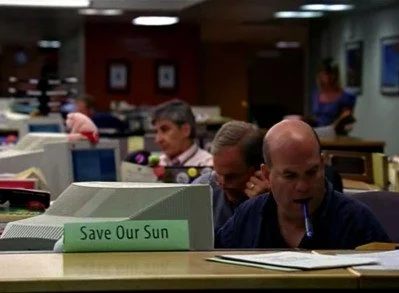
To wrap up the newspaper storyline: David Simon’s Hitchcockian cameo was brilliant. There he sat, pen in mouth, typing away furiously, with a “Save Our Sun” sign on top of his cubicle wall. Lest we forget the mastermind behind this massive ensemble of writing, directing, and acting talent, it was nice to get a glimpse of the man in the last episode of the finest work he’ll ever create. (He may find this to be a depressing thought, the suggestion that he’ll never top “The Wire,” but I really don’t see how it can be surpassed.)
“The Wake” (as it will likely be known forever in the lore of this series) is one of the best in a long line of memorable scenes in “The Wire.” Held at Kavanagh’s, where I believe Bob Colesberry’s wake was also held in season three, it encapsulates the camaraderie, the loyalty, and the profanity that made the show so outstanding. I’ll quote liberally from Landsman’s tremendous speech with McNulty laid out “on the felt” (on the pool table). “What do you say about this piece of work? Fuck if I don’t feel myself without the right words. … He was the black sheep, a permanent pariah; he asked no quarter of the bosses, and none was given. He learned no lessons, he acknowledged no mistakes; he was as stubborn a Mick who ever stumbled out of the Northeast parishes to take a patrolman’s shield. … He brooked no authority, he did what he wanted to do, and he said what he wanted to say. And in the end, he gave the clearances. He was natural po-lice.”
As the camera pans to McNulty’s face, Landsman cries, “But Christ, what an asshole!” and the “deceased’s” eyes fling open in a guffaw. “I’m not talking about the ordinary, gaping orifice that all of us possess,” Landsman goes on. “I mean an all-encompassing, all-consuming, out-of-proportion-to-every-other-facet-of-his-humanity chasm, from whose bourn, to quote Shakespeare, no traveler has ever returned.” It’s a fascinating allusion, since it’s from Hamlet’s famed “To be or not to be” soliloquy; in it, Hamlet considers death at some length and wonders at its inscrutable mysteries: “The undiscover’d country from whose bourn / No traveler returns, puzzles the will / And makes us rather bear those ills we have / Than fly to others we know not of.” What mysterious country is being explored by the likes of Omar, Wallace, D’Angelo, Snoop, Stringer, and all the rest—if any? And for that matter, what uncertainties await McNulty in his new life as he flees the ills he has, perhaps for those he knows not of?
Lester comes in with Shardene, and it’s nice to see them still together (and making each other deliriously happy, based on what the closing montage suggests); soon Landsman is wrapping it up by getting rather somber in observing that McNulty gave thirteen good years, was “a true murder police,” and that when he was good, there was no one better. Amen.
The “street” plots are given relatively little attention in this 93-minute finale, but the previous several episodes has made up for that. The arrogant Cheese (played very well by Method Man) pulls a gun in a petty dispute with a fellow “co-op” member as they discuss raising the funds to purchase the “connect” as offered by Marlo at a cool $10 million. “Ain’t no nostalgia to this shit here,” he says, but Slim Charles drops him with the shot to the head as Cheese is in the middle of a sentence. “That was for Joe,” he says. “This sentimental motherfucker just cost us money,” another man laments.
It occurs to me watching Marlo—out of prison with no charges, but having to avoid the “game”—that he is living out Stringer Bell’s fantasy. Stringer always aspired to shun the drug trade and become a legitimate businessman (or as legitimate a businessman as one could be associating with the likes of Maury Levy), but could never break out of the “game.” Marlo finds himself at a swanky party being introduced to major real-estate players, and he bolts back to streets, where he seems almost pleased to get into a violent confrontation with two corner boys. He’s stuck between worlds, now, and though it seems he’s borne no responsibility, he is truly in a hell of his own creation.
And finally, Michael seems to have developed into a vigilante of sorts, and though he’s quite naturally an outcast, I don’t know if having him slip into the “Omar” role is entirely realistic. He does deliver one of the funniest lines of the episode, though, as he robs Vinson. When he bursts in with a shotgun and a sidekick, Marlo’s former money man protests, “But you’re just a boy!” Michael blasts him in the patella and, as Vinson collapses in pain on the floor, says calmly, “That’s just a knee.”
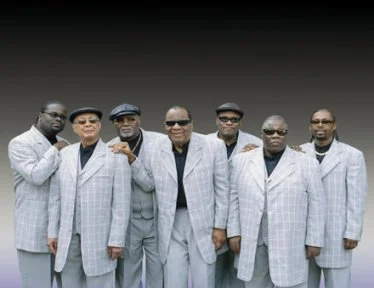
McNulty goes to pick up Larry, the poor schmuck who he stashed in Richmond, and bring him back to Baltimore. Suddenly he stops on the bridge and gets out of the car, looking wistfully across the Potomac, and the closing montage begins. Many of its details have been mentioned earlier, but I have to say that the Blind Boys’ “original” rendition of “Way Down in the Hole” was a perfect fit here. His final words—and the last in the series—are, “Larry, let’s go home.”
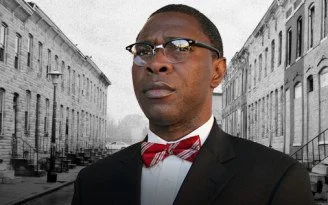
Daniels was always, for me, another of the moral centers or main characters of this show, and I was happy to see him resign rather than bend to Steintorf’s demands, even in light of Daniels’ shady past. The scene in the courtroom during the montage was interesting for its contrasts: Pearlman was given a judgeship riding on the influence of Carcetti, given that Steintorf promised her she would benefit if she made the dirty case on Marlo go away; Daniels is a practicing attorney after refusing to play the game. (Incidentally, it seems to me that he’s a defense attorney, since he’s standing to the right and he’s right next to the accused; this is somewhat surprising to me, as I thought he’d be more interested in prosecution.)
Recurring themes: repetition for effect has always been one of the touchstones of “The Wire,” and this episode was no different. The line “keep my name out of it” is spoken both by Ruby when presenting the evidence of Scott’s dirty reporting and Sydnor near the end when asking Judge Phelan to authorize further investigation of the wiretap case.
Finally: I literally cheered during the closing montage when Kennard was seen being led away in bracelets, presumably for the murder of Omar. That little shit, I thought. Serves him right.
Before I wrap up my favorite moments in the show, I do have to air some grievances about scenes or moments in the finale that didn’t ring true, or loose ends that I feel should have been more completely wrapped up:
There was never any reconciliation or apology between Bunk and Jimmy, though Bunk was an enthusiastic participant in Jimmy’s “wake.” Given all that they’d been through, I was disappointed to see them keep their distance straight through to the end.
On a related note, I’m not sure it was entirely realistic that Jimmy would have forgiven Kima when she reveals her role in their downfall outside the bar. Though he’s clearly relieved to have this whole nightmare concluded, his statement to her seemed too flip, too easy: “Detective, if you think it needed doin’, I guess it did.”
Around the hour mark, there were some shots that seemed gratuitous: daytime shots of the neighborhoods, a nighttime shot of the harbor; dusk in the business district, etc.—it seemed disjointed and unnecessary.
What kind of work will McNulty do? Will he stay in Baltimore? It would seem that he and Beadie will be OK now, and the tender little scene in which she leans on his shoulder conveys that. But what kind of job will be fulfilling to an iconoclastic genius who is obsessive about finding meaning in his work and must utilize his analytical skills? Private detective? (SPINOFF!!) I’m at a loss here.
The closing scene when McNulty stops on the bridge seems contrived. Why did he stop there? Is he leaving Baltimore? Was he going to drop Larry off there, but changed his mind?
And just what in the hell ever happened to Brother Mouzone?
But these are mere nitpicks in a finale that was very satisfying, intense, and engrossing. We’re left to ponder the big questions (Did everyone get what they deserved? Did anyone?) and small (Will Fletcher face the same frustrations as Gus in the position of city editor?); the philosophical (Who is the most virtuous character here? Does anyone emerge unsullied?) and the mundane (What happened to Valchek’s van?). It was a television series that allowed no easy answers, and asked questions many people were not ready to address. It was exquisite, and its equal will not likely be seen anytime soon.
In 40 years, dreck like “According to Jim” and “Two and a Half Men” will be utterly forgotten; shows like “Desperate Housewives” and “CSI” will be recalled only as kitsch pieces by nostalgia buffs. The disposable contrivances of “reality” TV will doubtlessly fade into pop culture oblivion. But “The Wire” is among the very few television shows that will endure on its own merits as an artistic achievement—it will be studied, deconstructed, celebrated, and perhaps even emulated. And most of all, especially to us Wireheads, it will be missed.
Goodbye.
END OF EPISODE 60 NOTES
Monsoon's Afternoon Weather Update for Thursday, 6 March 2008
Thursday night: partly cloudy with a low around 30.
Friday: overcast with rain showers developing by noon and continuing into the night. High 46, low 35.
Saturday: rain will continue in the morning, tapering into the afternoon. Though the bulk of the heaviest rain associated with this system will fall to the south and east of the forecast area (central and southern Berks; northern Lancaster County), there could be up to an inch of rainfall all told. As such, flood watches and warnings are likely, especially given the already swollen waterways from the storm Tuesday and Wednesday. Skies begin to clear late and winds will kick up considerably, with gusts reaching perhaps above 40mph. (There’s a small chance of some flurries or brief passing snow showers in the late evening, but it doesn’t appear to be anything to worry about at this time.) High 48, low 31.
Sunday: partly cloudy with strong winds and noticeably colder. High 34, low 20.
Monday: clear with slightly more seasonable temperatures. High 39, low 26.
Tuesday: partly cloudy with temperatures around normal for this time of year. High 46, low 28.
Wednesday: partly cloudy and breezy. High 51, low 34.
Thursday: becoming mostly cloudy with a high near 50 and a low around 40.
Friday: rainy and cool with some snow mixed in late in the day. High 44, low 31.
Next weekend: quite windy and cold with plenty of sunshine both days. Highs in the upper 30s and lows in the mid to upper 20s.
The following week: seasonable conditions will prevail; highs will be in the 40s and lows in the 20s. I don’t see any real dramatic warm-ups that will have you tom-cattin’ around town in your shirt sleeves or the like.
Have a great, great weekend.
Monsoon
Monsoon Martin's Ba-rack, rockin' it! Forecast for Monday, 3 March 2008
“Well, I blew that one.” These were my words to no one in particular on Saturday morning when I awoke to discover that the expected snowfall had amounted to a few, non-accumulating flurries and squalls, and was currently tapering to drizzle. “A good, old-fashioned blown forecast.” I have no defense; I could explain what happened, but since it would sound like justification, I will refrain.
I would like to make a bold prediction (as if my prognosticating skills amount to jack squat about now) about the upcoming Democratic presidential primaries tomorrow. Many of you recall that recently in this space I endorsed Illinois senator Barack Obama for the nomination; see my post from 2/8/08 for details.
One additional key factor that supports my feeling that Barack’s a good guy and deserves our support is this: back in January, responding to a reporter’s question, Obama declared his favorite TV show to be “The Wire” (my fave) and his favorite character to be Omar (also my fave, though it may be a tie with Bubs): “He’s this gay gangster who only robs drug dealers, and then gives back. You know, he’s sort of a Robin Hood. And he’s the toughest, baddest guy on this show, but he’s gay, you know. And it’s really interesting. It’s a fascinating character.”
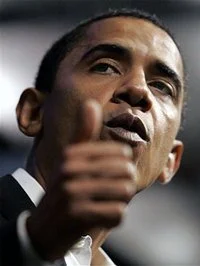
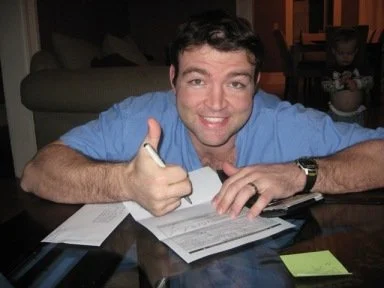
Another indication that Obamamania is unstoppably sweeping the nation is that lovably gruff orthopedic resident Bob Greenleaf, former old-school Lancaster County Republican, has been corrupted by city life (and his awesomely liberal wife Steph) and switched party affiliations! He is now a registered, Obama-supportin’ Democrat. (See actual photo of him completing the actual paperwork below.)
Anyway, the predictions for the March 4th primaries:
Texas: Obama 48%; Clinton 44%
Ohio: Clinton 49%; Obama 47%
Vermont: Obama 63%; Clinton 34%
Rhode Island: Clinton 51%; Obama 44%
Furthermore, I think Hillary Clinton, who needs not only victories but decisive ones to reinforce the viability of continuing her campaign, will nonetheless prolong the race—thus making the April 22nd Pennsylvania primary key and bringing about at least one PA debate and lots of appearances by both candidates.
Moving forward with the weather, we’re looking at unseasonable warmth (though today’s temperature will not quite approach the record high for this date of 70 in Reading). I don’t see any winter weather (snow, sleet, freezing rain) but I’m not ready to declare a definitive end to winter weather yet; given the below-normal temperatures that have predominated lately, I think we could have a winter event anytime through the first week of April.
The forecast…
Today will be partly cloudy and mild with light breezes; increasing clouds late. A bit of drizzle can’t be ruled out overnight. High 59, low 41.
Tomorrow will be mostly cloudy with a shower or two and some scattered fog throughout the early part of the day, followed by steadier rain in the evening and overnight, when rain may be heavy at times and localized flooding is possible. A thunderstorm may even move through late at night, and winds will kick up behind the system. High 51, low 42.
Wednesday could see some early showers, but otherwise it’ll turn out partly cloudy, windy, and cooler. High 46, low 25.
On Thursday we’ll see increasing cloudiness with showers late in the evening and into the night. High 46, low 34.
Friday will be partly to mostly cloudy with breezy and seasonably cool conditions. High 44, low 29.
The weekend looks even cooler with brisk winds both days; highs will be in the upper 30s and lows in the mid to upper 20s.
Next week is looking far better than the winter weather “mess” I hinted at in my last forecast. We’ll see warmer temperatures over all, with highs in the upper 40s (perhaps even reaching into the 50s again) and lows only in the mid to upper 40s. Next chance for rain—and only rain—is Wednesday the 12th and Thursday the 13th as a warm front moves through, sending temperatures to near 60.
Beyond will be seasonably cooler with highs in the mid to upper 40s and lows in the upper 20s (about normal for this time of the year).
We are the UL-ti-mate! (Ba-rack, rockin’ it!)
Monsoon
Monsoon Martin's Happy Leap Day! Forecast Update for 29 February 2008
Hey Friends,
The clipper system has come into clearer focus, and I need to adjust the timing and amounts, as well as driving hazards. Good news about next week, though: the Nor’easter I was discussing yesterday is a bust. Bad news about the following week: it looks like a winter weather mess.
A reminder about the Roadcon hazard classification system:
Roadcon 1 : smooth sailing with no weather-related impediments to travel
Roadcon 2 : wet roadways with the possibility of hydroplaning, but no icy spots; use some caution but not necessary to avoid travel
Roadcon 3 : light snow pack or visibility problems impair driving moderately; use a great deal of caution when driving, especially on untreated or back roads
Roadcon 4 : moderate to heavy snow and/or ice make driving hazardous; expect travel difficulties on untreated or back roads, and limit travel as much as possible
Roadcon 5 : heavy snow or icing and/or very low visibility make driving nearly impossible or extremely hazardous; stay inside!
The storm will unfold in this way…
3pm to 7pm today: flurries and light snow showers arrive. Accumulations will be minimal during this period, and driving should not be compromised. Roadcon 1-2
7pm to midnight: snow intensifies and the bulk of the accumulation will fall. It appears now that the snow will “lay” on untreated roads and sidewalks. There is a great deal more moisture associated with this system than a typical “clipper.” Driving becomes hazardous. Roadcon 3-4
Midnight to 5am tomorrow: snow continues to fall steadily with temperatures holding steady just below freezing (it does not appear that rain or sleet will mix in a whole lot, if at all). Driving remains “dicey.” Roadcon 3
5am to 10am: temperatures slowly rise above freezing and snow tapers. Clearing throughout the day thereafter with a high around 40. Roadcon 2-3
Accumulation: 2-4 inches in most of Berks County and northern Lancaster County, as well as Lebanon County; perhaps as much as 5 inches in northern Berks and the Poconos. Only and inch or two (with more rain mixed in) in Philadelphia, Chester County; points south and east get a mere coating before changing over.
Early dismissal: even if the snow begins a bit early, there is absolutely no chance of an early dismissal today. Any child who asks if there’s going to be an early dismissal, or who says “I heard we’re getting out early,” shall be fed to a pack of starving wolverines.
Drive safely…
Monsoon