
Monsoon's Weather Update for Wednesday, 7 May 2008
A quick weather update from Monsoon…
But first: congratulations to Senator Barack Obama for his double-digit win in the North Carolina primary and his two-point loss in Indiana; the overall gains he posted in the popular vote and delegate count; and moving us closer to ending this contentious primary battle, knocking Hillary Clinton out of the race once and for all, and allowing the party to focus on defeating McCain in November. (For my previous election coverage, type "Obama" in the weblog's search field on the upper right of the screen.)
Wednesday 5/7: unseasonably warm and mostly sunny with increasing cloud late; a shower or thunderstorm could move through late. High 82, low 56.
Thursday 5/8: partly to mostly cloudy with a shower or two in the afternoon; more frequent showers are likely in the evening. High 77, low 53.
Friday 5/9: overcast, breezy and rather cool with scattered showers throughout the morning and afternoon; tapering to showers in the evening. High 63, low 48.
Saturday 5/10: mostly sunny, breezy and gorgeous. High 69, low 44.
Sunday 5/11: mostly cloudy with evening showers likely. High 64, low 49.
Monday 5/12: chilly with rain and strong winds. High 58, low 43.
Tuesday 5/13: mostly cloudy but clearing late. High 64, low 45.
Wednesday 5/14: clear to partly cloudy and pleasant. High 70, low 48.
Thursday 5/15: overcast with perhaps a shower. High 66, low 46.
Friday 5/16: sunny to partly cloudy, cool and breezy. High 62, low 45.
Next weekend: rainy with highs in the low to mid 60s and lows in the upper 40s.
Beyond: warmer and generally pleasant with highs ascending into the 70s.
Ba-rack, rockin’ it!
Monsoon's Brief "Your Mama Don't Dance" Update
Friends,
Some of you have asked about the fate of Gilbertsville’s Noelle and Doug Croner, the daughter-father duo competing on the creepily vapid (or vapidly creepy?) Lifetime series “Your Mama Don’t Dance.” The season finale aired on 4/18, the day of my original post on the matter.
Well: they won.
The Reading Eagle, of course, was all over the story with a piece appearing nearly a week later, buried on B10. (I guess profiles of old white women and their gardens, pecan pie recipes, and Eagle Scout notices really jam up the news hole.)
Noelle and Doug’s triumph even earned a disapproving nod from the E! series “The Soup” as its Clip of the Week.
The prize for winning “Your Mama Don’t Dance” was a trip for six to Aruba (with a luggage set) and a $100,000 prize. Now living the high life, a triumphant Doug promptly resigned his post as a floating substitute at Mifflin…
Monsoon Goes To Prison - Part Five
“Good writer. Bring him over and I’ll show him the other side of corrections.”
So read the cryptic entirety of Larry Chandler’s reply to Curt, who had sent him my "Monsoon Goes To Prison – Part One" posting and mentioned my impending visit.

Larry Chandler, now warden of the Kentucky State Reformatory (KSR), was warden at Luther Luckett Correctional Complex (LLCC) in the documentary film and a loyal friend to the program. He is known to be a progressive but firm warden; in the film he questions the efficacy of the prison system in and of itself (“Do you feel safer?” he asks) and expresses unwavering support for the Shakespeare Behind Bars (SBB) program.
KSR, built in 1936, now overflows with nearly 2,000 prisoners and is part of the same sprawling corrections network in La Grange, Kentucky as LLCC; like LLCC, it is a medium-security prison. And we had a one o’clock Tuesday appointment there with Chandler.
On Monday as we made our way into and through LLCC, Curt gleefully recited the contents of Chandler’s ominous email to the SBB guys, to the chaplain, to Matt Wallace, to his wife—and each time he did so, I got another little butterfly in my stomach about just what “other side of corrections” meant.
We arrived at the prison and as we ascended the steps to enter the ground floor of the “tower” (which houses the administrative offices), the atmosphere immediately felt different. Do you remember when I said I almost felt as though I was in an “office park” rather than a prison when I was visiting LLCC? Well, son of a bitch if this didn’t feel exactly like a goddamned prison: a large, wrought-iron gate had to be unlocked for us to enter, and clanged shut loudly behind us. There were similar metal detectors, but this time we were in a vast atrium with a three-story-high ceiling above us. This is some Shawshank Redemption-type shit right here, I thought, well and truly intimidated by my surroundings.
Making our way through a network of gates and then upstairs on the elevator, we arrived finally at the warden’s office and waited for him in the hall. Curt—who seems to know everyone who works in these prisons—was warmly greeted by a staff member, who sat down and had a friendly chat with us while we waited. In a few short minutes, Chandler came out to greet us—another “character” from the documentary come to life.
Curt and Chandler spent some time in the warden’s office discussing a former LLCC inmate (and longtime SBB participant) who had been transferred to KSR and was now in the “hole” and potentially in a world of trouble. There was even the suggestion that the investigation into this inmate’s wrongdoing may cast an unflattering light on the SBB program due to his prior involvement with it. Though Curt was clearly saddened by this, he expressed his support for the inmate, saying this did not seem like something the man would do; Chandler insisted that if nothing is proven, the inmate will be in the clear and still on track for his parole hearing in 14 months. (Curt asked if we could meet with this inmate, but prisoners in the “hole” may not receive any visitors.)
After this rather sobering conversation, Chandler led us on a thorough, informative, hour-plus-long tour of the entire prison facility. We began in the hospital wing, where Chandler explained that the state government is increasingly phasing out state hospitals for the criminally insane, and that these individuals are now being housed, evaluated and treated at KSR.
We arrived in a heavily-gated, two-story area where the most dangerous psychologically disturbed inmates are kept in solitary confinement behind large doors, each with only a small window into the cell. On each door, signs are posted with such alarming descriptions as “15-minute watch,” “5-minute watch,” and “violent.” As we talked to the staff psychologist and a case worker, inmates—some of whom peered out the small windows in their cell doors, some of whom could not be seen—could be heard banging on the doors and crying out periodically. Inmate volunteers kept watch through the windows in some of the cells, and the staff members carried on about their business calmly. I found the whole scene unsettling—the fact that these individuals are so disturbed, and the fact that the prisons are being so overburdened in this way. My sister-in-law is studying to be an art therapist and has had several internships in mental hospitals with sometimes-dangerously disturbed patients; this experience gave me a small glimpse (and a deeper appreciation) of the challenges she faces in that capacity.
Warden Chandler said that the inmate in the first cell to the left had recently been let out of cell momentarily when he broke free, climbed up a large, chain-link gate reaching to the second-story ceiling, hung upside down, grinned at the onlookers, and dropped headfirst onto the concrete below. Anticipating my question, Chandler said, “and he’s alright.”
So this was the “other side of corrections.” Lest I think that all of prison life consists of agreeable, seemingly well-adjusted men performing Shakespeare, the warden seemed to be saying by bringing me here, take a look at this.
From there we toured the hospital wing, which was dominated by amputees and prisoners who seemed to be near the end of their lives, shuffling through the hallways and lying frailly in darkened rooms. “You ever hear of people dying in prison?” Chandler drawled. “Well, here it is.” An old man in a hospital gown used a walker to move with painstaking deliberation down the hallway with the help of a physical therapist. We visited a man who seemed little more than a skeletal figure in a room crowded with three beds, into which two inch-wide slivers of brilliant sunshine penetrated.
“It’s a gorgeous day out there,” Curt said. “Is it?” the patient asked, absently.
Chandler had told us outside the room that he’d finally relented and recommended the terminally ill inmate be released, as sometimes is done in such cases, but the parole board denied the request.
When we had left the man’s bedside, Chandler told us that they had lost two men over the weekend, who had died of terminal illnesses. “In those cases, do you make considerations for these terminally ill patients, in terms of family visitations?” I asked. He said that he often clashes with other staff and officials in the prison due to his liberal policy of allowing extended visitations to the hospice ward, located in the center of the prison complex. “One of the guys I just told you about, his family was pretty much camped here all weekend with him,” he said. Such acts of mercy are rare, and help to distinguish Chandler as a progressive warden.
After this sobering tour through the hospice and psych wards, we made our way around the rest of the prison complex, thankfully taking in some uplifting sights along the way. We saw three SBB alumni—including Richard, who is featured briefly in the film—now incarcerated at KSR, whom Curt embraced and introduced to me. I was struck by how pleased they all were to see Curt, and he them—and how desperately each one of them wanted to begin a Shakespeare program at KSR. After catching up and advising each inmate on how to proceed, we moved on.
Warden Chandler, who is retiring next year, shared with us some of his proudest accomplishments since coming to a chaotic KSR several years ago. First, the facility is now 100% non-smoking, which is no small feat in a culture where cigarettes have traditionally been used as currency. He showed us the television studio, which has roughly $250,000 worth of equipment and a full studio. I asked how he was able to find room in the prison’s tight budget for such expenditures, especially given the relative closed-mindedness with which taxpayers tend to view prison programs. He explained that all of the funds for the studio come from moneys made on the commissary, from which the prison takes a percentage of the annual profit.
But perhaps his most fulfilling accomplishment will be the Distance Learning Center (DLC), which has survived two years of planning and red tape and is slated to open later this year. This center—the first in any prison in the United States—will enable inmates to take classes at their own pace and ensure that they will avoid lapses in their education when they move from prison to prison. Educational opportunities are embraced by many prisoners at KSR, and the director of the DLC told us that one of his goals was to make these opportunities meaningful and impactful. “Some prisons throw G.E.D.s at their inmates for the sake of statistics,” he said. What he’s interested in doing is something more.
After touring the educational wing—with law library, traditional library, and several classrooms—we were out on the yard.
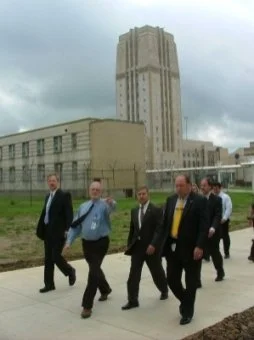
[In the above photograph, Warden Chandler (in blue shirt, pointing) leads some Kentucky government bigwigs, including the Lieutenant Governor, on a tour of KSR. Here they’re in the yard; in the distance behind them is the rear of the tower, where the administrative offices are housed.]
The “yard,” for the uninitiated, is a common area that allows for inmate recreation and socialization at certain times of the day; our visit coincided with the time of day during which all prisoners not confined to “the hole” or otherwise engaged in studies or work details were allowed to mill about in the yard. To envision the yard, picture a large municipal park (complete with benches, athletic fields and courts, and small pavilions) where everyone is dressed the same, and (at this prison, at least) everyone is male. Oh, and there is a double perimeter of razor wire-topped fences encircling the park.
Some of the men sat on benches and chatted quietly; another played his guitar softly and sang; a group of men played handball on a regulation court; a significant number lifted weights over at the Iron-Pumping Pavilion; still others seemed to be making their way from building to building (i.e., from their jobs to the library) as college students might make their way across a small campus.
There were no guards to be seen, and even the guards present inside the prison did not carry guns or weapons of any kind. (The warden explained that in an “unrestricted movement” prison like KSR or LLCC, it would be dangerous for guards on the ground to be armed, since an inmate could take such a weapon and cause some serious problems.) But one could see armed sharpshooters at the ready in any number of towers, constantly surveying the activity below them. Somehow, even with hundreds of eyes following us across the yard, I felt relatively safe. I was with the warden, after all.
Seeing a long line snaking into a pavilion attached to a small building in the yard, the warden called out to us, identifying what was happening: “Pill call.” According to Chandler, more than 85% of the inmates are on medication of some sort. When I asked him how many are on anti-depressants or the like, he answered, “800 of our inmates are taking psychotropic drugs.” Out of a population around 2,000, that’s 40%. He added, “is it any surprise that 74% of mentally ill prisoners self-medicate?” hinting at a persistent illegal narcotics problem that is all too prevalent at many prisons.
As we walked across the yard, many of the men greeted the warden as he walked past; well aware that some of these cordial greetings were disingenuous, Chandler would mutter a comment to that effect for our benefit now and again. At least ten different prisoners, when they spotted Chandler, called after him plaintively to speak with him about some urgent piece of business—a problem with a job assignment, a requested transfer, a letter that was never answered. Chandler would shout “Well, catch up!” without slowing down even a half-step, patiently listen to the inmate’s request, offer a solution, and continue his conversation with Curt and me.

Having barely caught our breath from the comprehensive tour with Larry Chandler, Curt and I dashed over to LLCC for the rehearsal. As we were making our way to our seats, Ron said, “Wassup, big man?” while he made his way past me and shook my hand firmly. It was great to once again be recognized, to again be welcomed into this tight-knit family.
Curt began today’s meeting by discussing the case of the SBB alum in the hole at KSR, about which he had just learned from Chandler. Curt could not share all the details of the case, which is still under investigation, but the men—especially the veterans of the group—were clearly disappointed and concerned to hear this, since the inmate in question had gotten married last summer to his high-school sweetheart and was looking forward to potential parole in 14 months.
Since we arrived late, SBB dispensed with the warm-ups and dove right into the final scene of Julius Caesar. Twenty men were present in the chapel today—four African American and 16 white. (This was three fewer than yesterday, and I was surprised that at least some of these no-shows may simply have “blown off” today’s rehearsal.) Nonetheless, I was impressed again by the fact that men who would otherwise seldom associate on the yard regard one another as family here.
As the players geared up to stage the scene, it was taking a while to focus some of the group members on the task at hand. The assistant director smiled exasperatedly and called out to me, as if in apology, “it takes us a minute to burn off the excess energy of the day.”
Finally, the troupe was ready to tackle Act 5, scene 5—the last in the play. In it, Brutus and his soldiers enter the stage, stopping to rest in their desperate retreat. Brutus realizes his life will soon come to an end, and that he would prefer to end it himself, so he asks three of the soldiers—Clitus, Dardanius, and Volumnius—to hold his sword while he runs on it. All three refuse, but finally Strato agrees to help Brutus commit suicide. Antony arrives on the scene to discover Brutus dead and proclaims him “the noblest Roman of them all.”
As was the case yesterday, there are heated discussions about the choreography and staging of this scene, particularly the three refusals to Brutus’ request. Stephen, who plays Clitus, is a smallish man with thick glasses whose thick drawl and lack of self-assurance as an actor make it difficult for him to infuse his lines with the emotion they require. Several inmates offer tips to Stephen, as does Curt, explaining the passion and outrage he must convey. When he runs onstage and tells Brutus (Big G) that Statilius “is or ta’en or slain” (has either been captured or killed), he needs to do so with the utmost alarm. When he refuses Brutus’ request by saying, “What I, my lord? No, not for all the world. … I’d rather kill myself,” he needs to communicate his character’s indignation, his sadness, and his overriding respect for Brutus.
Looking around at the men engaged in the vociferous exchange of ideas, perfecting their performances, it is almost possible to forget one is inside a prison—that is, until one looks out the window at the razor wire-topped fences gleaming in the bright sun, standing quietly against the bright blue sky.

The rehearsal continues with constant conversation about how to carry out a scene. Here and there, inmates will come over and chat with me: one recounts the time he visited Altoona, Pennsylvania with his friend who did the lighting for the Shrine Circus, then went to Hershey and the toured the chocolate factory, then saw Disney On Ice at Hersheypark Arena; Vaughn comes over and runs some ideas by me for the closing sequence; Stephen asks about my classes and laments the trouble he’s having with the lines. They want to hear about my job, where I live—anything or anywhere else than here, and I realize how suffocating it must be to have such a limited geographic sphere of experience.
During all this, Curt plays his carefully cultivated role: at times he refuses to intervene, making brief comments only to gently facilitate, insisting that the inmates figure out the scene for themselves; other times he takes complete control, offering notes, blocking, and elaborating on stage directions.
Ron, who is playing Messala, again takes a leadership role in the production because of his longtime involvement in SBB. He addresses the group and every eye and ear is focused on his words: “Anybody who’s in any scene, you have a purpose—even if you’re not sayin’ nothin’.” During the performances—particularly those for which the actors’ family and friends may be in the audience—it is vital to resist the urge to wave hello. “You are in character the moment you are seen.” The end of the play, Ron explained, is the “culmination of the long, extended intensity of the whole play. Don’t fuck around and ruin it.”
A brief aside here: those of you who know me well understand that I am a connoisseur of profanity—I believe it enriches our communication (rather than debasing it, as some would suggest), and I believe that there are certain sentiments that cannot but be expressed with oaths and swearing. In SBB rehearsals, “dirty” words are tossed around the room with glorious abandon by Curt and the inmates alike. Shakespeare, of course, was a virtuoso of the blasphemous—God’s bodkins, ‘Sblood, Zwounds, I could go on. Since one of the touchstones of the SBB program (and of my own humble existence) is the power of words—to transform, to heal, to reveal, to astound—allow me to share some of my favorite instances of profanity during my visit:
“He’s safe, motherfucker.” – Curt’s acting note to Lucilius in Act 5, scene 4
“Don’t be fuckin’ around with it.” – admonition against using the “swords” for excessive tomfoolery
“…or some shit like ‘at.” – regional tic of Kentucky dialect, used often in place of “or whatever,” “and so forth,” etc.
“A whole shitload of guys just waitin’ to kill ‘em…” – explanation of the final scene’s urgency by Curt
“Son of a bitch, the torch is out!” – Curt’s acting note to Clitus, on his Act 5, scene 5 motivations
“I have a mouthful of fuckin’ Novocain, did you forget that?” – Big G to another troupe member who had questioned why Brutus’ delivery was muffled, reminding the gentleman that G had undergone oral surgery earlier in the day. (Vaughn’s comment, following G’s outburst: “And still he showed up.”)
The rehearsal wrapped up around 5:15 as some of the troupe members began to drift away to dinner again. As we made our way out of the chapel and into one of the open walkways in the prison complex, I chatted with Stephen Marshall, the inmate portraying Antony, for a while. He asked about the classes I teach and confessed that unlike many of the other participants in the program, he is not a voracious reader: “I can’t stand reading. But performing it is a whole nother thing.” In this final comment, the inmate provided another potent reason why Shakespeare is perfect for a program like this: not only do his plays connect with the heights and depths of the human condition, but they also allow an additional avenue of access—performance.

As we parted company, the troupe members were disappointed to learn that I would not be able to attend any of their performances this year, but I promised to return next year—when they will be performing “that Scottish play” (as Hal noted that superstitious actors often refer to Macbeth).
On the long drive back to Pennsylvania, I thought about what charges could be leveled against this program by its critics. Some might argue that tax funds should not be dedicated to such an activity, and must only be spent on increased security. I’m reminded of Warden Norton’s response when Andy Dufresne asks permission to petition the state legislature for more library funds: “ Far as they’re concerned, there’s only three ways to spend the taxpayers’ hard-earned money when it come to prisons: More walls. More bars. More guards.” And yet it is only this year and next that taxpayer money will be used to fund the aforementioned tangential outgrowths of SBB; still, none of the NEA grant has been or will be used for SBB.
Maybe it’s a question of what we want our correctional facilities to accomplish. Do they exist simply to segregate that portion of our population adjudged violent or criminal, without any privileges or opportunities? In that case, I suppose I can understand the impulse to “let ‘em rot” behind bars for the crimes they’ve committed, the lives they’ve ruined, the victims they’ve left behind.
But what sort of human beings will emerge when their sentences are up and the corrections system heaves them back into our midst? It would seem to me that we’ll get the same ill-adjusted, volatile individuals—only angrier and more desperate because of the idle, festering time they have served.
And finally, it comes down to a choice I have discussed with Curt and with my students about justice: should it be restorative or retributive? That is, should we focus on punishment or on rehabilitation when designing and populating our ever-expanding corrections system?
Programs like the ones I saw in La Grange, Kentucky—Shakespeare Behind Bars, college courses, Distance Learning, and the like, as well as counseling services—are concerned with the restoration of humanity, the cultivation of the individual. These are the transition services Ron was talking about on the first day, and they are creating better-adjusted, healthier human beings who can handle their everyday problems when they are released. The long-term success of Curt’s program—35 SBB participants released from prison and not a single instance of recidivism—bears this argument out.
It is in our best interest as a society to ensure that those incarcerated are offered the benefits of education, treatment, and opportunity, so that they may ultimately be well, and do well.
END.
A Monsoon Weather Alert for Sunday, 27 April 2008
A strong cold front is moving through, bringing with it moderate to strong winds and some potentially significant precipitation. Rain will begin overnight Sunday and intensify Monday morning and afternoon. Total rainfall amounts could reach an inch or an inch and a quarter. Precipitation may include strong to severe thunderstorms—which would include hail and damaging winds—anytime from late morning through the late afternoon. It all tapers off by the early evening, but clouds will persist into early Tuesday. Monday’s high will reach only the low 60s; overnight low will be in the mid to upper 40s. Tuesday will be markedly cooler with the high reaching only 56; the low Tuesday night will plummet all the way down near freezing.
(Happy Birthday Monday to Harper Lee; Tuesday to Duke Ellington and Eve Plumb!)
The last day of April will be sunny and cool with the slight possibility of showers late. High 58, low 38. (Happy Birthday to Willie Nelson and Kirsten Dunst!)
Thursday and Friday, the first two days of May, look partly to mostly cloudy and a bit warmer with highs in the mid to upper 60s and lows in the mid to upper 40s. (Happy Birthday Thursday to Chuck Bednarik and Joseph Heller; Friday to Christine Baranski and The Rock!)
Next weekend will be warmer still with highs reaching into the low 70s, but there is the potential for some showers and thunderstorms on Sunday.
Next week cools off a bit and will hover around seasonal averages, with highs mainly in the mid 60s and lows in the mid to upper 40s.
MonsoonMonsoon Goes To Prison - Part Four
After the warm-up exercises on the first day of my visit to the Shakespeare Behind Bars (SBB) rehearsals, Ron came over to chat and share some of his experiences. He wasn’t the only inmate who did this, but his story affected me deeply, and so I’ll begin with it here.
Ron elaborated on the story about Curt’s actor and his post-traumatic stress disorder (PTSD) by relating it to his own experience in the armed forces. “The military is designed to strip individuality” away from soldiers, he said; the first phase of basic training is called “socialization,” during which an individual is broken down, then built back up into someone who will follow orders unquestioningly.
The problem Ron sees is that there is no “phase-out” program for the military—or for those being released from prison, really. Whatever programs exist are inadequate, he said. Having served in several operations including Desert Shield in Saudi Arabia, Ron noted that a soldier seeks to solve his problems by following orders. When he gets out into the “real world, it’s like, ‘Now what?’” Coping with the everyday choices we must make throughout our daily lives can be intimidating or downright crippling; the crime rate among veterans suffering from PTSD a far higher than those in the general population.
[Later, Curt shared with me the story of one of the inmates, now at another prison, who was a sniper in the army and had more than 50 kills. When he rejoined civilian life, his mechanism for problem-solving was still rooted in his military experience; as a result he shot and killed two men who had attempted to rape his girlfriend. While discussing his role in a SBB play and the temperate actions his character took when confronted with violence, this man had an epiphany: I did not have to kill those guys.]
After being discharged from the service for rules violations, Ron told me, “I tried to take myself out” and spent nine days in a coma following this suicide attempt. A few months later, still having failed to deal with his psychological problems, Ron took someone else’s life.
What Ron has learned through his participation in the SBB program and the time he has been incarcerated is the importance of the “safety net”—not just that such a system be provided, but that those in similar situations to his recognize that support is there. “Being aware of the people around you” and the help they can offer is paramount.
Despite having grown up in the Victory Park projects in Louisville, Ron told me he attended Trinity High School, an exclusive, all-male prep school. In 11th grade, Ron created a computer program to make fake report cards; when the school uncovered the scheme and contacted home, “my mom came to school with a belt.”
In Act I, scene 2 of Julius Caesar, Cassius delivers the line, “The fault, dear Brutus, lies not in our stars, / But in ourselves, that we are underlings.” Surely the SBB group explicated this line for its meaning in the context of the play—it’s Cassius’ aggressive plea to Brutus that they transcend their fates and topple imperious Caesar—but also in terms of its meaning for their lives. Where does the fault lie in the inmates’ lives? With their “stars” (destinies) or with themselves? Finding the truth in this passage, and their own interpretations of it, is the central pursuit of the SBB program.
“I’d be a doctor right now,” Ron said wistfully, “if I hadn’t gotten in trouble.”

Today’s agenda is to rehearse Act 5, scene 4 of the play. When each year’s play is selected, Curt gives copies of the work to the SBB participants, who study a monologue and read the play carefully over the summer. In the fall, Curt asks for “epiphanies” and observations, the group discusses the play at length, and the men choose their roles (they’re never cast by Curt). By the end of the year, they’re running through the play at three-day-per-week rehearsals, scene by scene, perfecting the delivery of each line. My visit coincided with the end of this process: the last two scenes of the play. This week and next, the troupe is running through the play, one act at a time; this is followed by dress rehearsals in the beginning of May; performances on the yard and at other local prisons will follow.
Curt explained to me that the group works from the First Folio, or first collection of Shakespeare’s works collected in 1623.
As such, the explanatory notes that are found invariably in modern editions of Shakespeare’s plays (and in the editions used by my students) are absent. The inmates themselves must analyze, explicate, deconstruct, and investigate each line to find its essence before the play can be enacted.
The scene opens with Brutus (played boomingly by Big G) crying, “Yet countrymen, O yet hold up your heads!” and consists of plenty of battlefield fighting. Curt has brought in “swords” made of bamboo. After running through the first 10 lines or so of the scene, Larry DeClue, one of the cast members who also functions as an assistant director, strides to the center of the circle to give notes. It seems the soldiers’ fighting techniques were sloppy, and their entrance left a great deal to be desired.
Most impressive here is the fact that anyone could give “notes” or tips to the actors involved in the scene, and the rest of the troupe listened intently no matter who was speaking. Curt pointed out that during the fight scenes, it is vital to pay attention to one’s partner and maintain concentration and dedication to the scene. “It’s about the intensity,” he said. Every man onstage needs to “stay in the game” and “don’t half-ass it” in performing their roles, however fleeting or minor they may be in this scene. “Remember,” he said, repeating a mantra, “nobility lies in the attempt.” The men are both tough and tender in dealing with each other—one moment offering this kind of stern advice, the next offering gentle encouragement to a struggling actor.

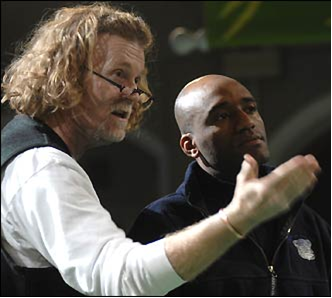
[In the above photo, Curt Tofteland appears with an actor from the 2007 Actors’ Shakespeare Project production of A Winter’s Tale.]
Getting back to the constructive criticism, Ron jumped in. “Remember that you’re going into battle,” Ron offered. “You need to show that on your face.”
The individual pairs of soldiers who will be fighting are encouraged by the assistant director to choreograph their scenes carefully, and no small energy is expended on creating symmetry and authenticity for the performance. (There is even a tumble and some artful dying added to the mix, making this all seem rather balletic.)
During the choreography, it becomes obvious to me that the inmates take the material and their performance of it very seriously, yet there is no shortage of clowning and ribbing.
Looking around the room, I am struck by the broad variety of activities in which the inmates have become involved: one man who was “killed” in the fighting falls asleep for a good thirty minutes; others work on the blocking of their scene; several others not directly involved in the scene chat quietly in a corner. Periodically, the men will run out to the chapel’s lobby to have some coffee or outside the chapel for a smoke break.
I asked Curt about the sometimes free-form mood of the rehearsal time and he explained that it’s done very deliberately. The coffee is donated by the owner of a local coffee shop who was moved by the film Shakespeare Behind Bars and wanted to support the program. The men are allowed to drink coffee, but only in the lobby of the chapel (one man spilled some on the carpet in the chapel space). Curt acknowledged that having men running out for coffee and cigarette breaks “has become a distraction” but insisted that “the guys are given so little free choice, I wanted to see how they’d handle it” when offered that freedom. Another problem he noted is that the men sometimes sneak out early—rehearsal is scheduled to run from 3 to 5:30—so they’ll have more time to spend at dinner. He said he was planning on addressing these issues with the men, not in a scolding way, but by presenting the problems and posing the question of how they might best be solved.
Back to Act 5, scene 4, and Louis is working through the lines of Lucilius as he discovers the body of his friend Cato. Louis is African American and sports cornrows and a Luther Luckett Basketball t-shirt underneath his khaki overshirt. He’s clearly a talented actor and has very obviously worked on his lines outside of rehearsal. He runs through the scene when he discovers Cato’s body and says, “O young and noble Cato, art thou down?” at least fifteen times, varying his delivery, emphasis, and movements based on the feedback of Curt and the other men. One time he muddles past the words “young” and “noble” and Curt snaps, “What is he?” When Louis reruns the line with the words enunciated, Curt offers an approving “Yes!”
Lucilius is captured by Antony’s men and pretends to be Brutus; the men excitedly announce to their captain this prestigious collar. When Antony arrives and asks where Brutus is, Lucilius turns around and says, “Safe, Antony. Brutus is safe enough.” In this scene, Lucilius is reveling in the fact that he has just duped Antony, who has badly miscalculated, and Louis is struggling to match his delivery to this emotion. Curt cuts to the heart of the matter and delivers the spirit of the line: “He’s safe, motherfucker!” In the next run-through, Louis delivers the line brilliantly, with perfect swagger, expression, and weight.
At the end of the scene the SBB production has added an elaborate and effective stage direction: Caesar’s ghost appears (played by Vaughn) and summons the dead strewn around the battlefield; they notice Caesar, crawl toward him, and “exeunt” (plural of exit) the stage, bound for eternity.
At around ten minutes after five, Curt cuts the rehearsal short for a question-and-answer session and says I may grill them as I see fit. By this point, friends, I am feeling overwhelmed by what I’ve seen, I’m still processing it, and I have no real blockbuster questions to ask. But I manage to ask one question, the responses to which sustain us through the rest of the time: “Can you talk a little bit about what this program has meant to you, the impact it’s had on you?”
Curt broke in to explain that of the 23 men assembled there, their experiences both in prison and with the program are widely divergent. The longest-serving inmate in the program has been incarcerated for 27 years; some are recently incarcerated; others expect to be released within the year. They ranged in age from their mid twenties to late fifties. Five or six men indicated that this was their first year with the program—one said he’s been in SBB for only three weeks—while Hal (featured in the documentary film as Prospero) has been with the group since its inception in 1995.
Among the several men who responded to my question, the camaraderie and support they receive from the other members of SBB was cited again and again. Through the program, they interact with men whom they would typically ignore on the “yard” (the communal area where inmates can recreate or socialize during certain times of the day) and learn how to deal with different personalities. Some men, after all, are better at delivering and accepting constructive criticism than others.
Louis said the most powerful aspect of SBB is “discovering things about ourselves through the material.” This is seen again and again in the documentary—inmates come to realizations and have breakthroughs as they study the play and find the truth within their characters.
The program also provides a “foundation for growth,” Louis explained, ensuring that the men will have help in dealing with their problems.
Another participant named Eric, a young white man with a full beard, spoke up and echoed much of what Louis and the other men had said. Many of the men are not adept at dealing with their problems, he noted, and participating in SBB provides a forum for the safe and thorough consideration of these problems. He also thanked Curt directly for his continuing efforts in starting the program and supporting all of its participants.
[Curt told me later that this contribution was nothing short of a breakthrough for Eric, a first-year SBB participant. Eric had been frustrated during much of his time in the program, clashing with other inmates and leaving the group twice—only to return later, but refusing to discuss what had happened. Eric’s acknowledgement of the program’s usefulness in forcing the men to deal with their problems—and his direct recognition of Curt—suggested that SBB had been influencing and helping him in ways few of the men understood until today.]
As the rehearsal broke up, each man said goodbye to Curt, many of them hugging him, underscoring the warm and comfortable rapport he has developed with the inmates over years. The men also shook my hands and Matt’s hands before making their way out of the rehearsal space. Some inmates struck up or continued other conversations with me about Pennsylvania, about my students, and what I thought of the program.
On the way back to Louisville, Curt elaborated on what he saw happening in the rehearsal, and in the program as a whole. The real strength of what happens there is the problem-solving ability the men gain, he said. “Shakespeare is smarter than all of us,” Curt said, and he can serve as a conduit to greater understanding in ways no one could have anticipated. “Shakespeare Behind Bars,” he explained, “is really a course in remedial living” that will prepare them for life both behind and beyond bars.
[Curt’s statement about Shakespeare’s intelligence reminded me of the time I spent in college studying Shakespeare with Dr. Al Cacicedo. A militant multiculturalist, I eschewed the Dead White Men of literature in favor of Richard Wright, Toni Morrison, Amiri Baraka, and other African American authors. The real value lay in politically charged literature, the voice of the oppressed, I was sure. And I still feel these perspectives are among the most moving and important works I have ever read. But Al encouraged me to look inside Shakespeare’s works for their universal truths, for their unforeseen insights, for their lyrical beauty.]
Later that evening, Curt treated me to a lovely dinner at a local Italian restaurant. We discussed the reactions I’d had to what I’d seen, and my students’ reactions to the film. I explained that my students in the class that studied The Tempest and watched Shakespeare Behind Bars tended to be rather sheltered, and that through the film they’d been forced to expand their worldviews somewhat. I also noted that the analysis of both The Tempest (in the film) and Julius Caesar (today) by the inmates was more insightful, more active and robust, than what I typically encounter among my high-achieving, gifted students. We discussed the fact that though my students’ experiences are no less valid, there is no real substitute for life experience. The men in the program have loved, have made horrific mistakes, have lived with crushing regret—and they bring these understandings to their study of the play.
Curt elaborated on a wide range of topics, touching on the making of the film, detailed updates on inmates, and navigating the corrections system to keep his program afloat. I came to understand that introducing and directing a program like this requires an ongoing and delicate interaction with the Department of Corrections to build trust and good will toward the program. Curt told of guards who disliked the program when it began, but who now drive more than a hundred miles to attend performances with their families each May.
He praised the filmmakers for their deftness in telling a complex story. “There are so many different experiences and backgrounds in this program,” he said, “that it’s impossible to look at only one man’s story and get the full picture of Shakespeare Behind Bars.”
A statistic he mentioned several times during my visit—and one that would seem to inoculate the program against those who would criticize it—is this: 35 SBB participants have been released from prison since the program was established, and none of those men has committed a single crime. Thirty-five men and no recidivism. It speaks to the power of the lessons learned in that circle, the cooperation and problem-solving techniques that are cultivated and practiced each time they meet. “‘Teachable moments’ are happening all the time,” Curt said.
It was that statement that stayed with me as I returned to my hotel room and ruminated on all I had seen and heard in that first day. While I was focusing on what these men learned through their participation in the program, what had I learned in my observation of it?
The Shakespeare Behind Bars program, it seems to me, is a validation of what we as teachers do—the very best the learning process has to offer. Our fondest wishes as educators are that the students will develop their critical thinking skills, deepen their understanding of the world around them, learn to communicate effectively with others, cultivate an empathy in considering others’ perspectives and lives, and ultimately uncover their own aptitudes, truths, and paths.
Curt has worked hard to create a program that does all these things for his guys, and for the world.
TO BE CONCLUDED IN PART FIVE.
Monsoon's Weather Update for Thursday, 24 April 2008
The weather :

Weather narrative: Unseasonably warm and dry weather will continue the next couple of days as high pressure stalls over the region. Things will get a bit more turbulent as a slow-moving cold front works through southeastern Pennsylvania over the weekend. There is a small chance of showers or thunderstorms Saturday night and Sunday, but the better chance for rainfall of any note is Monday into Tuesday.
This second cold front will usher in cooler temperatures, with highs staying in the 50s, for the middle of next week. Things get seasonably milder by the end of the week with temperatures rebounding into the upper 60s. Next weekend looks sensational, and beyond that we’re looking into the upper 70s and perhaps 80s the following week.
Good news for Mifflin teachers, though: the newly-installed air conditioning is working reasonably well for most of us, or so it seems. So the days of dreading high temperatures during the school year may be behind us!
Beyond the forecast table: Warmer still with highs in the 80s; rain is possible the 7th or 8th.
Monsoon
Monsoon Goes To Prison - Part Three
“So what kinds of reactions did your students have to the film?”
This was the first question from Curt L. Tofteland, director of Kentucky Shakespeare Festival and Shakespeare Behind Bars, after he picked me up from my hotel to head to the Monday, April 14th rehearsal.
They had reacted in myriad ways, and with broadly divergent thoughts, but what stood foremost in my mind was their initial reaction, which is said to be the most honest.
About 40 minutes into the film, Leonard, one of the troupe members, is suddenly sent to the “hole” (solitary confinement), allegedly for a violation of the computer policy. In a brief interview segment, the filmmaker is heard asking Leonard, “So why are you here?” There is a pause of some 20 seconds, during which landscapes of emotion cross Leonard’s face. He finally answers, “I sexually molested seven girls.” Choking with emotion, he continues, “It’s the worst thing I’ve ever done,” and says that he hopes to be able to conduct a meaningful life, somehow balancing the scales, “so that I’m not remembered for the very worst thing I’ve ever done.”
Immediately following this confession, the bell ending the class period was about to ring and I asked my students what they thought of the film so far. Some of them stared forward, some of them looked at me, some shifted uncomfortably in their seats—but none answered. And this wasn’t adolescent indifference; what they had seen had impacted them, maybe even changed them, and they were still processing it. It was a powerful moment for me to witness, and I told Curt about it.
Curt then gave me some background about this scene, which led to a lengthy dialogue about both the documentary film and the program. The filmmakers had been instructed not to ask the troupe members about their crimes. “Nobody talks about their crimes in prison,” Curt explained, and yet the confessions of Hal, Sammie, and Big G had come tumbling out spontaneously on camera.
When Leonard was sent to the hole, disrupting the play’s rehearsals and necessitating that his role be recast, the film crew received special permission to talk with Leonard despite the fact that prisoners in solitary confinement are typically allowed no visitors. (Curt also explained that sex offenders occupy the lowest rung in the inmate hierarchy; cop killers, the highest: indeed, one can hear the other prisoners in “the hole” heckling Leonard in strong terms about pedophilia.)
When the filmmaker asks Leonard in the course of their interview, “So why are you here,” he is actually asking what Leonard has done to be placed in solitary confinement. “Leonard had never talked about his crime, never taken responsibility for what he had done,” Curt told me, “but he was just ready.” He answered the question in its larger sense—why is he in prison—and the results are spellbinding.
Having completed the sex offender program, Leonard had high hopes that his parole would be granted and his 50-year sentence reduced at his recent hearing. Instead, according to Curt, he got a 10-year “flop” (deferment, or extended sentence), which means that he will not be released until he is at least in his late 50s. As a result, Leonard withdrew from prison life, leaving the Shakespeare Behind Bars program (Curt insists on referring to it as a “vacation” when an inmate leaves the program, always leaving the door open for his eventual return). Since then he’s become involved with Luckett’s TV studio and has shown signs of reengaging with constructive programs, so there’s hope he’ll come back to Shakespeare.
Curt then talked a bit about how Shakespeare Behind Bars (SBB) is funded: it has been a condition of his involvement since he founded the program in 1995 that it should never be dependent on tax dollars. He said he periodically receives phone calls from citizens who are angry that their tax money is going to such a program for prisoners. His first response is that the program is free; his second is that he doesn’t really approve of the fact that his tax dollars are being used to fight a war, but he has little say in the matter. This usually ends the conversation rather quickly.
Recently, though, he couldn’t pass up an opportunity to expand upon some of the program’s goals through the facilitation of a $25,000 National Endowment for the Arts (NEA) grant. With the funds, he’s continues to be part of the SBB program and restaging the play Julius Caesar at the Luther Luckett Correctional Complex (LLCC); the festival’s education director, Pamela DiPasquale is directing an abridged version of Caesar with professional actors that will tour schools in the area. In addition, an actor/director who works often with Kentucky Shakespeare Festival, Matt Wallace, is conducting a Shakespeare’s Studio Artist Residency with troubled youths ages 15-17 at the Audubon Youth Development Center; they’re also studying and staging sections of Caesar. The teens visited LLCC in March to witness the inmates running scenes and ask questions of them; this week, the students in the Audubon program will return to LLCC to perform a few scenes and share what the program has meant to them.
As we reached the end of our 20-minute drive northeast from Louisville to La Grange and turned in to the prison’s long driveway, Curt told me about some of the rhythms and procedures of entering the prison and what to expect when entering the site of the rehearsal. (When speaking of SBB’s participants, Curt consistently refers to them as “my guys,” which serves to underscore his devotion to these men and his unwavering belief in the value of the program.)
Luther Luckett was built fairly recently (about 25 years ago), so it’s set up more like an office park than a prison: no clanging gates, no towering walls, no imposing architecture. Still, I was reminded I was entering a prison when Curt told me to bring only a photo identification and my notebook, leaving my phone, wallet, keys, and all other personal effects in the car. When we entered, we had to remove our jackets and place them on a conveyor which led them through an x-ray machine, then each sidle through a free-standing metal detector. There’s something eerie and rather sobering about watching your jacket and notebook and they are dragged through the unit—and seeing only the zipper and buttons along with the metal parts of my fancy pen. I surrendered my driver’s license and was handed a badge I was to wear at all times inside the prison, showing it to guards at various stations along our way. As Curt pointed out, my official identity was now “Visitor 3” for the duration of my visit. Matt Wallace, the artist-in-residence mentioned above and presumably the man who will take over SBB (at least on an interim basis) when Curt retires next year, joined us as well to observe the rehearsal.

Curt introduced me to the guards and staff members he knows well, so I didn’t feel out of place for long. The chaplain, Marc Wessels, went to Lancaster Theological Seminary and is familiar with this area, so we exchanged a bit of small talk about this coincidence. We entered the chapel, where the rehearsal would be taking place during both days of my visit (in the film, rehearsals seem to be held in multiple locations, including a portion of the athletic facilities and the canteen).
Inside we found some 23 men, all clad head-to-toe in khaki (the prison uniform; I had been cautioned not to wear any khaki-colored clothing during my visit), milling about, waiting for rehearsal to begin.
The sight took my breath away: I was finally here.
Scanning the faces of the inmates, my eyes rested on those I recognized from the film: there was Floyd Vaughn; there was Howard, who was denied parole during the filming and in a heartbreaking scene said he was most upset about having to call his family and break the news to them; there was a bespectacled, larger-than-life Jerry “Big G” Guenthner; there was Hal, who played Prospero in The Tempest as shown in the documentary and offered meaningful reflections on his crime; there was Ron, who memorably clashed with Hal during a rehearsal scene in the film. Mostly, though, there were new faces, and each seemed genuinely pleased that I was there. Within ten minutes of my arrival, Vaughn, Ron, Mike, Hal, and a few others had all introduced themselves, asked where I was from, and thanked me for coming to visit.
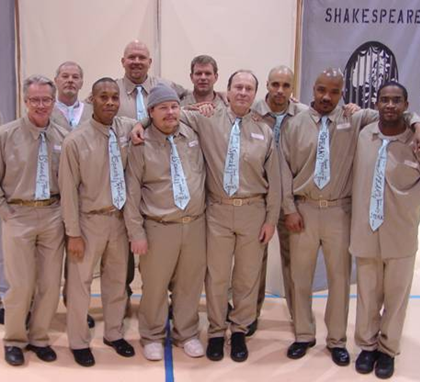
[The above picture was taken by Curt Tofteland and is from a previous year's performance. Front row, far left: Hal; fourth, fifth, and sixth from left are Leonard, Ron, and Louis. Back row, far left: Vaughn; second from left: Big G.]
I think the troupe member who made the profoundest impact on me was Ron, though I had memorable exchanges with others as well. When Curt introduced us and said I was from Pennsylvania, without missing a beat Ron asked, “Clinton or Obama?” My response (the latter) elicited a strong handshake and approving slap on the back—though Ron was quick to add that Obama had not gotten his support simply because they share the same skin color: “I listened to what Obama had to say, studied Hillary,” but he said he ultimately was turned off by her campaign tactics. When I agreed that this troubled me as well, he offered an appreciative, “That what I’m talkin’ about.”
As Curt entered the rehearsal space (and I positioned myself on the relative periphery of the circle), the men gradually left their private conversations and took their seats. Curt began by asking me to introduce myself and talk about why I was there; I did so and noted that I was excited about learning from them, keeping my comments (unlike my writing) brief. Curt opened the meeting by telling them that over the past weekend, one of the actors he’d hired to take part in the above-mentioned Caesar program was arrested for his second DUI. Curt told of how, prior to offering him the job, he’d asked the actor, an Iraq war veteran, if he was dealing well with his experiences in combat. The actor had answered that he was fine, but clearly he was seeking to dull the pain of his post-traumatic stress disorder with alcohol. The results of his actions: if convicted, he might serve some jail time; he has disappointed those who were there to help him (including Curt) but whose help he refused; and he has grossly inconvenienced the members of Curt’s troupe—and most specifically Curt, who now must find a new actor to step into the role with less than two weeks to go.
The undercurrent of Curt’s comments was unmistakable—that the mistakes we make have consequences that reach far beyond our own individual regrets, and that it is essential to ask for help when we think we may need it—but it was a message delivered smoothly, without heavy-handedness or pedantry.
Ron, who is one of the long-time members of SBB, spoke up and disagreed with some of what Curt said. “People in those situations think they have certain things under control,” he said, but in reality they continue to struggle to maintain that control. There are grey areas that we must respect, Ron insisted, because “some people are quick to make black-and-white determinations about right and wrong.” We must acknowledge the power of a disease like alcoholism, for example, rather than placing the blame on the actor for having failed to ask for help when he felt he was doing well.
Curt countered by saying that “change and responsibility begins in one place—and that is with the individual.” Change must be profound and resolute. To further illustrate his point, Curt brought up the case of Ricky, a participant in SBB who appears in the film; in figuring out how to endure a sentence of “two lifes without” (a double life sentence without possibility of parole), Rick decides to join SBB. “I’ve never finished anything in my life,” he says, so he’s determined to do this, and do it well.
Rick has been mentored into the program by Big G; new participants must be recommended by an existing member, have one year clear conduct, and must stay out of trouble or they will be unable to continue. Rick makes the unfortunate choice to get a tattoo in prison in violation of the rules, and landed in the hole, disqualifying him from being in SBB. Following the filming, Rick was transferred to another prison, the Kentucky State Reformatory, and after several months hanged himself with his shoelaces.
“Ricky slipped through the net,” Curt said, emphasizing the fact that he had a support network in SBB but declined to ask for help when he needed it, “but it was his choice.”
It was a fascinating conversation about whether we (as individuals, as a society) can focus on the need to ascribe and accept personal responsibility for our actions without sitting in condescending judgment of one another’s flaws and foibles. I had been there for ten minutes, and already I was in the midst of one of the most compelling philosophical exchanges of my life.
“What does Brutus say before he leaves the stage?” Curt asked Big G, who is playing the role.
“O that a man might know / The end of this day’s business ere it come,” G flawlessly recited from Act 5, scene 1. How will we handle the problems with which we will invariably be faced each day? Will be make it through unscathed? I am struck here with empathy, but it’s almost deeper than that: I can see myself in these men. This is not to say that I expect to commit murder or armed robbery or felony assault; it’s simply to suggest that these men are not substantively different from me, from any of us. They made mistakes, miscalculations; they lost control; they made poor choices. Their crimes don’t make them monsters, as the simplest among us might dismissively conclude. Their crimes make them human.
The discussion wraps up with a consideration of the ways in which men’s egos tend to prevent them from asking for—or accepting—the help we need. “People go out of their way to help, but we say, ‘Oh, I know what I’m doing,’” one inmate said. “Well, I didn’t know frickin’ squat, ‘cause now I’m sittin’ in this fuckin’ place.”
Curt seamlessly transitions from this discussion into the material, encouraging the men to find themselves in their roles. It’s time for the warm-up exercises, and I notice immediately the warmth that dominates Curt’s interactions with the men, and their interactions with one another. He’s also very physical with “his guys,” slapping them on the back in encouragement and greeting. It is unusual (and refreshing) to see men so comfortable with one another physically.
The warm-up scene in the film was one of my students’ favorite, partially because a few of them are actors, but mostly because it made them marvel at how a group of inmates threw themselves body and soul into the craft of acting.
First up is “Zip Zap Zop” (though I think they were saying “Zip Zap Zoh” here), a traditional acting exercise in which the men stand in a circle and “send” the energy across and around to the other men. One man claps crisply, makes eye contact with someone else in the circle, and “passes” the sound to him by directing his hand toward the receiver. It’s a drill that emphasizes clear expression, swift reaction, full engagement, careful listening and communication, and impeccable timing.
Then the men go around the circle reciting a monologue from Julius Caesar they had been given by Curt to memorize over the summer. It’s Antony’s soliloquy from the end of Act 3, scene 1, after he discovers his friend Caesar’s body and then shakes the bloody hands of the conspirators:
O, pardon me, thou bleeding piece of earth,
That I am meek and gentle with these butchers!
Thou art the ruins of the noblest man
That ever lived in the tide of times.
Woe to the hand that shed this costly blood!
Over thy wounds now do I prophesy,--
Which, like dumb mouths, do ope their ruby lips,
To beg the voice and utterance of my tongue--
A curse shall light upon the limbs of men;
Domestic fury and fierce civil strife
Shall cumber all the parts of Italy;
Blood and destruction shall be so in use
And dreadful objects so familiar
That mothers shall but smile when they behold
Their infants quarter’d with the hands of war;
All pity choked with custom of fell deeds:
And Caesar’s spirit, ranging for revenge,
With Ate by his side come hot from hell,
Shall in these confines with a monarch's voice
Cry ‘Havoc,’ and let slip the dogs of war;
That this foul deed shall smell above the earth
With carrion men, groaning for burial.
Here again, it’s the importance of eye contact, of communal pursuit—the circle breaks down, after all, if someone forgets the next word and must repeat the previous one—being emphasized with this exercise.
As the warm-up exercises die down and the men gear up for the rehearsal of a portion of the play, Ron came over and chats with me for a bit; this would be the first of several conversations over the course of my two-day visit, and I found him to be a most fascinating individual.
TO BE CONTINUED IN PART FOUR.
Monsoon Martin's Pennsylvania Primary Primer - 22 April 2008
My friends,
The day has come to get out and vote in the Democratic primary for the United States presidency. Our state is center stage—Chris Matthews and Keith Olbermann are on MSNBC talking about what may happen in Lancaster County, the Lehigh Valley, the Reading area, and how it would affect the chances of either candidate—in a primary for the first time in my memory.
 I’ve written about this election before several times in this space, but let me reiterate here and now that I wholeheartedly endorse Barack Obama for President of the United States.
Below are two lists: the first, a list of reasons to vote for Barack Obama; the second, a list of reasons not to vote for Hillary Clinton. I have tried to be as succinct and straightforward as possible, and have based my comments on things I have heard and read from reliable sources.
Fifteen Reasons to Vote for Barack Obama
1. He was against the criminal, disastrous Iraq war from the start.
2. He wants to overhaul NAFTA and punish companies that outsource, both of which have damaged the base of manufacturing jobs in the U.S.
3. He takes no lobbyist or PAC money; he would be at least less beholden to special interests. I believe he would stand up to corporate bullying and obscene profits in American life.
4. He is not a divisive politician who engages in bickering and backbiting, but a visionary leader who will bring people together.
5. His experience as a community organizer and activist bespeak his connection with the problems of ordinary people and his ability to negotiate in good faith. His election as President, given his diverse background and broad worldview, would immediately raise the dismal status of the U.S. in the eyes of many around the world.
6. His March 18th speech on race and American life at the National Constitution Center is the most searingly honest and significant discourse on the topic in my lifetime.
7. His favorite TV show was “The Wire” and he would be the first president versed in hip-hop culture; he made a Jay-Z reference in a speech the other day, for god’s sake!
8. He has clear, substantive plans to tackle the problem of global climate change; as today is Earth Day, this should be in the forefront of voters’ minds.
9. He has stated he would create a prison-to-work incentive for former inmates transitioning back into society.
10. His views on education are progressive; he wants to abolish “teach-to-the-test” curricula and opposes vouchers.
11. He opposes death penalty in all but the rarest cases and is a proponent of legislation that makes it easier for innocent death-row inmates to win new trials.
12. He seems to genuinely have a sense of humor; that may seem like an insignificant trait, but I think it’d be pretty damned important if he wins the presidency.
13. He likes (and plays) the sport of basketball instead of being obsessed with tired, wanky pastimes of the rich and powerful like golf.
14. He voted against the use of cluster bombs in civilian areas.
15. As a colleague and I were discussing yesterday, he has the courage to disagree with his constituents on some issues rather than simply telling them what he thinks they want to hear. He will not insult the intelligence of the American people by pandering to the lowest common denominator. This is true leadership.
There are plenty of other compelling reasons to vote for Barack Obama, but these stand out for me as I sit here late on Monday night and contemplate the long-awaited primary battle.
If you’re still thinking of voting for Hillary Clinton—after all, you might say, some of the above are also true of her to some extent, notably numbers 8 and 10—I have compiled a list to try and sway your allegiance a bit. Again, all of these are based upon what I have seen or heard from reliable sources about Hillary Clinton.
Fifteen Reasons Not to Vote for Hillary Clinton
1. She voted for President Bush’s ill-conceived, ill-fated Iraq War, and has compounded the error by repeatedly reauthorizing funds to fight the war and refusing to acknowledge her error in failing to read the National Intelligence Estimate before her initial vote.
2. She voted for the USA PATRIOT Act of 2001 in the hysteria following the 9/11 attacks.
3. She supported Israel’s brutal military assault on civilian targets in Lebanon and Gaza; she has said she would support large-scale U.S. “retaliation” against Iran if it or any of its proxies attacked Israel. And finally, she was the only Democrat to vote for the aggressive Kyl-Lieberman Amendment to authorize unilateral U.S. force against Iran.
4. She opposes the full repeal of the conservative, anti-gay Defense of Marriage Act (DOMA).
5. She co-sponsored legislation that would have made it illegal to burn the flag of the United States, wasting precious congressional time on a symbolic issue around which she was pandering to conservatives.
6. She doesn’t seem to have any core convictions; she seemingly believes she is entitled to the presidency and will do anything to get elected. (Sure, this is an opinion. But it’s based upon what I’ve seen and heard, and it’s my weblog.)
7. She has engaged in unrelentingly dirty campaign tactics, seizing on minor gaffes and unrelated issues to obfuscate her own policy and leadership shortcomings; the day before the Pennsylvania primaries, her campaign released a fearmongering attack ad subtly linking Barack Obama with Osama bin Laden.
8. In an interview on “60 Minutes,” when asked whether Obama is a Muslim, she said he was not, then quickly added, “as far as I know.”
9. She lied shamelessly about the “harrowing” Bosnia plane landing in 1996, then lied to cover it up by claiming that her misstatements were out of fatigue rather than admitting they had been orchestrated to inflate the magnitude of her foreign policy experience while First Lady.
10. She served on the Wal-Mart board of directors and there is no evidence she challenged Wal-Mart’s fierce anti-union tactics; she served as a ruthless corporate attorney at the notorious union-busting Rose Law Firm. As a result of this history (and other factors), her populist rhetoric in the current campaign rings rather hollow.
11. She has been a cheerleader for the Democratic Leadership Council (DLC), which has moved the party away from its progressive roots and toward a more centrist, pro-business platform.
12. She was a member of the College Republicans and in some substantive ways, has never left the party.
13. She supports the death penalty, almost without exception.
14. She unconscionably voted against a resolution against using cluster bombs in civilian areas.
15. She is a war hawk, a polarizing figure here and abroad, and has demonstrated a disturbing tendency to respond with indignation and rage when her motives or policies are questioned.
Thanks for listening…now get out and vote!
Monsoon